P51675
Gene name |
Ccr1 (Cmkbr1) |
Protein name |
C-C chemokine receptor type 1 |
Names |
|
Species |
Mus musculus (Mouse) |
KEGG Pathway |
mmu:12768 |
EC number |
|
Protein Class |
|
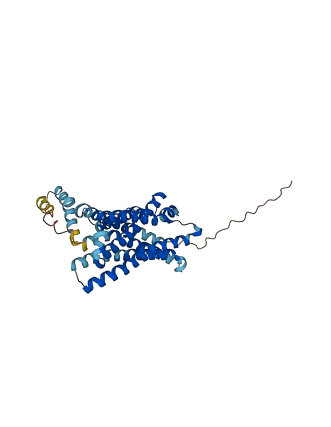
Descriptions
The autoinhibited protein was predicted that may have potential autoinhibitory elements via cis-regPred.
Autoinhibitory domains (AIDs)
Target domain |
|
Relief mechanism |
|
Assay |
cis-regPred |
Accessory elements
No accessory elements
Autoinhibited structure

Activated structure
1 structures for P51675
| Entry ID | Method | Resolution | Chain | Position | Source |
|---|---|---|---|---|---|
| AF-P51675-F1 | Predicted | AlphaFoldDB |
8 variants for P51675
| Variant ID(s) | Position | Change | Description | Diseaes Association | Provenance |
|---|---|---|---|---|---|
| rs264276408 | 6 | F>I | No | EVA | |
| rs259592341 | 50 | V>L | No | EVA | |
| rs8236822 | 104 | A>S | No | EVA | |
| rs8236821 | 104 | A>V | No | EVA | |
| rs8254392 | 149 | F>L | No | EVA | |
| rs8254387 | 181 | R>H | No | EVA | |
| rs8254390 | 278 | Q>H | No | EVA | |
| rs260902849 | 309 | W>R | No | EVA |
No associated diseases with P51675
1 regional properties for P51675
| Type | Name | Position | InterPro Accession |
|---|---|---|---|
| domain | GPCR, rhodopsin-like, 7TM | 55 - 302 | IPR017452 |
5 GO annotations of cellular component
| Name | Definition |
|---|---|
| cytoplasm | The contents of a cell excluding the plasma membrane and nucleus, but including other subcellular structures. |
| external side of plasma membrane | The leaflet of the plasma membrane that faces away from the cytoplasm and any proteins embedded or anchored in it or attached to its surface. |
| integral component of membrane | The component of a membrane consisting of the gene products and protein complexes having at least some part of their peptide sequence embedded in the hydrophobic region of the membrane. |
| neuronal cell body | The portion of a neuron that includes the nucleus, but excludes cell projections such as axons and dendrites. |
| plasma membrane | The membrane surrounding a cell that separates the cell from its external environment. It consists of a phospholipid bilayer and associated proteins. |
6 GO annotations of molecular function
| Name | Definition |
|---|---|
| C-C chemokine binding | Binding to a C-C chemokine; C-C chemokines do not have an amino acid between the first two cysteines of the characteristic four-cysteine motif. |
| C-C chemokine receptor activity | Combining with a C-C chemokine and transmitting the signal from one side of the membrane to the other to initiate a change in cell activity. C-C chemokines do not have an amino acid between the first two cysteines of the characteristic four-cysteine motif. |
| chemokine (C-C motif) ligand 5 binding | Binding to chemokine (C-C motif) ligand 5. |
| chemokine (C-C motif) ligand 7 binding | Binding to chemokine (C-C motif) ligand 7. |
| chemokine receptor activity | Combining with a chemokine, and transmitting the signal from one side of the membrane to the other to initiate a change in cell activity. Chemokines are a family of small chemotactic cytokines; their name is derived from their ability to induce directed chemotaxis in nearby responsive cells. All chemokines possess a number of conserved cysteine residues involved in intramolecular disulfide bond formation. Some chemokines are considered pro-inflammatory and can be induced during an immune response to recruit cells of the immune system to a site of infection, while others are considered homeostatic and are involved in controlling the migration of cells during normal processes of tissue maintenance or development. Chemokines are found in all vertebrates, some viruses and some bacteria. |
| phosphatidylinositol phospholipase C activity | Catalysis of the reaction: 1-phosphatidyl-1D-myo-inositol 4,5-bisphosphate + H(2)O = 1,2-diacylglycerol + 1D-myo-inositol 1,4,5-trisphosphate + H(+). |
20 GO annotations of biological process
| Name | Definition |
|---|---|
| calcium ion transport | The directed movement of calcium (Ca) ions into, out of or within a cell, or between cells, by means of some agent such as a transporter or pore. |
| calcium-mediated signaling | Any intracellular signal transduction in which the signal is passed on within the cell via calcium ions. |
| cell chemotaxis | The directed movement of a motile cell guided by a specific chemical concentration gradient. Movement may be towards a higher concentration (positive chemotaxis) or towards a lower concentration (negative chemotaxis). |
| cell-cell signaling | Any process that mediates the transfer of information from one cell to another. This process includes signal transduction in the receiving cell and, where applicable, release of a ligand and any processes that actively facilitate its transport and presentation to the receiving cell. Examples include signaling via soluble ligands, via cell adhesion molecules and via gap junctions. |
| cellular calcium ion homeostasis | Any process involved in the maintenance of an internal steady state of calcium ions at the level of a cell. |
| chemokine-mediated signaling pathway | The series of molecular signals initiated by a chemokine binding to its receptor on the surface of a target cell, and ending with the regulation of a downstream cellular process, e.g. transcription. |
| exocytosis | A process of secretion by a cell that results in the release of intracellular molecules (e.g. hormones, matrix proteins) contained within a membrane-bounded vesicle. Exocytosis can occur either by full fusion, when the vesicle collapses into the plasma membrane, or by a kiss-and-run mechanism that involves the formation of a transient contact, a pore, between a granule (for exemple of chromaffin cells) and the plasma membrane. The latter process most of the time leads to only partial secretion of the granule content. Exocytosis begins with steps that prepare vesicles for fusion with the membrane (tethering and docking) and ends when molecules are secreted from the cell. |
| immune response | Any immune system process that functions in the calibrated response of an organism to a potential internal or invasive threat. |
| inflammatory response | The immediate defensive reaction (by vertebrate tissue) to infection or injury caused by chemical or physical agents. The process is characterized by local vasodilation, extravasation of plasma into intercellular spaces and accumulation of white blood cells and macrophages. |
| leukocyte chemotaxis | The movement of a leukocyte in response to an external stimulus. |
| myeloid cell differentiation | The process in which a relatively unspecialized myeloid precursor cell acquires the specialized features of any cell of the myeloid leukocyte, megakaryocyte, thrombocyte, or erythrocyte lineages. |
| negative regulation of bone mineralization | Any process that stops, prevents, or reduces the frequency, rate or extent of bone mineralization. |
| negative regulation of gene expression | Any process that decreases the frequency, rate or extent of gene expression. Gene expression is the process in which a gene's coding sequence is converted into a mature gene product (protein or RNA). |
| negative regulation of innate immune response | Any process that stops, prevents, or reduces the frequency, rate or extent of the innate immune response. |
| positive regulation of calcium ion transport | Any process that activates or increases the frequency, rate or extent of the directed movement of calcium ions into, out of or within a cell, or between cells, by means of some agent such as a transporter or pore. |
| positive regulation of cell migration | Any process that activates or increases the frequency, rate or extent of cell migration. |
| positive regulation of cytosolic calcium ion concentration | Any process that increases the concentration of calcium ions in the cytosol. |
| positive regulation of ERK1 and ERK2 cascade | Any process that activates or increases the frequency, rate or extent of signal transduction mediated by the ERK1 and ERK2 cascade. |
| positive regulation of monocyte chemotaxis | Any process that increases the frequency, rate, or extent of monocyte chemotaxis. |
| positive regulation of osteoclast differentiation | Any process that activates or increases the frequency, rate or extent of osteoclast differentiation. |
120 homologous proteins in AiPD
| UniProt AC | Gene Name | Protein Name | Species | Evidence Code |
|---|---|---|---|---|
| Q2YDN1 | GPR161 | G protein-coupled receptor 161 | Bos taurus (Bovine) | PR |
| Q0GBZ5 | HCRTR1 | Orexin/Hypocretin receptor type 1 | Bos taurus (Bovine) | PR |
| Q17QD8 | GPR37L1 | G-protein coupled receptor 37-like 1 | Bos taurus (Bovine) | PR |
| Q8SPN1 | PROKR2 | Prokineticin receptor 2 | Bos taurus (Bovine) | PR |
| P46626 | ADRB3 | Beta-3 adrenergic receptor | Bos taurus (Bovine) | PR |
| O46639 | TRHR | Thyrotropin-releasing hormone receptor | Bos taurus (Bovine) | PR |
| Q8SPN2 | PROKR1 | Prokineticin receptor 1 | Bos taurus (Bovine) | PR |
| B9VR26 | CMLKR1 | Chemerin-like receptor 1 | Bos taurus (Bovine) | PR |
| P18130 | ADRA1A | Alpha-1A adrenergic receptor | Bos taurus (Bovine) | PR |
| B4XF06 | GPR39 | G-protein coupled receptor 39 | Bos taurus (Bovine) | PR |
| O18913 | OPN1LW | Long-wave-sensitive opsin 1 | Felis catus (Cat) (Felis silvestris catus) | PR |
| P28683 | PRA1 | Green-sensitive opsin | Gallus gallus (Chicken) | PR |
| Q9N298 | HTR1A | 5-hydroxytryptamine receptor 1A | Pan troglodytes (Chimpanzee) | PR |
| P08099 | Rh2 | Opsin Rh2 | Drosophila melanogaster (Fruit fly) | PR |
| P06002 | ninaE | Opsin Rh1 | Drosophila melanogaster (Fruit fly) | PR |
| Q4LBB9 | Octbeta2R | Octopamine receptor beta-2R | Drosophila melanogaster (Fruit fly) | PR |
| Q8NFJ6 | PROKR2 | Prokineticin receptor 2 | Homo sapiens (Human) | PR |
| Q13585 | GPR50 | Melatonin-related receptor | Homo sapiens (Human) | PR |
| Q9BZJ6 | GPR63 | Probable G-protein coupled receptor 63 | Homo sapiens (Human) | PR |
| Q9H3N8 | HRH4 | Histamine H4 receptor | Homo sapiens (Human) | PR |
| P28336 | NMBR | Neuromedin-B receptor | Homo sapiens (Human) | PR |
| Q9Y5Y3 | GPR45 | Probable G-protein coupled receptor 45 | Homo sapiens (Human) | PR |
| P08913 | ADRA2A | Alpha-2A adrenergic receptor | Homo sapiens (Human) | PR |
| P41597 | CCR2 | C-C chemokine receptor type 2 | Homo sapiens (Human) | PR |
| P51681 | CCR5 | C-C chemokine receptor type 5 | Homo sapiens (Human) | PR |
| Q8TCW9 | PROKR1 | Prokineticin receptor 1 | Homo sapiens (Human) | PR |
| Q99788 | CMKLR1 | Chemerin-like receptor 1 | Homo sapiens (Human) | PR |
| P08908 | HTR1A | 5-hydroxytryptamine receptor 1A | Homo sapiens (Human) | PR |
| P30559 | OXTR | Oxytocin receptor | Homo sapiens (Human) | PR |
| P32239 | CCKBR | Gastrin/cholecystokinin type B receptor | Homo sapiens (Human) | PR |
| O60883 | GPR37L1 | G-protein coupled receptor 37-like 1 | Homo sapiens (Human) | PR |
| Q8TDU9 | RXFP4 | Relaxin-3 receptor 2 | Homo sapiens (Human) | PR |
| P04000 | OPN1LW | Long-wave-sensitive opsin 1 | Homo sapiens (Human) | PR |
| Q6U736 | OPN5 | Opsin-5 | Homo sapiens (Human) | PR |
| P34972 | CNR2 | Cannabinoid receptor 2 | Homo sapiens (Human) | PR |
| P24530 | EDNRB | Endothelin receptor type B | Homo sapiens (Human) | PR |
| P35348 | ADRA1A | Alpha-1A adrenergic receptor | Homo sapiens (Human) | PR |
| Q6W5P4 | NPSR1 | Neuropeptide S receptor | Homo sapiens (Human) | PR |
| O43613 | HCRTR1 | Orexin/Hypocretin receptor type 1 | Homo sapiens (Human) | PR |
| P61073 | CXCR4 | C-X-C chemokine receptor type 4 | Homo sapiens (Human) | PR |
| Q9BXC0 | HCAR1 | Hydroxycarboxylic acid receptor 1 | Homo sapiens (Human) | PR |
| P30556 | AGTR1 | Type-1 angiotensin II receptor | Homo sapiens (Human) | PR |
| Q15761 | NPY5R | Neuropeptide Y receptor type 5 | Homo sapiens (Human) | PR |
| Q8N6U8 | GPR161 | G-protein coupled receptor 161 | Homo sapiens (Human) | PR |
| Q6DWJ6 | GPR139 | Probable G-protein coupled receptor 139 | Homo sapiens (Human) | PR |
| P21462 | FPR1 | fMet-Leu-Phe receptor | Homo sapiens (Human) | PR |
| P35414 | APLNR | Apelin receptor | Homo sapiens (Human) | PR |
| P46091 | CMKLR2 | Chemerin-like receptor 2 | Homo sapiens (Human) | PR |
| P32745 | SSTR3 | Somatostatin receptor type 3 | Homo sapiens (Human) | PR |
| P41439 | FOLR3 | Folate receptor gamma | Homo sapiens (Human) | PR |
| P19973 | Lsp1 | Lymphocyte-specific protein 1 | Mus musculus (Mouse) | PR |
| O54799 | Nmbr | Neuromedin-B receptor | Mus musculus (Mouse) | PR |
| Q64264 | Htr1a | 5-hydroxytryptamine receptor 1A | Mus musculus (Mouse) | PR |
| Q5U431 | Gpr39 | G-protein coupled receptor 39 | Mus musculus (Mouse) | PR |
| Q99JG2 | Gpr37l1 | G-protein coupled receptor 37-like 1 | Mus musculus (Mouse) | PR |
| P97295 | Npy2r | Neuropeptide Y receptor type 2 | Mus musculus (Mouse) | PR |
| O08786 | Cckar | Cholecystokinin receptor type A | Mus musculus (Mouse) | PR |
| P56481 | Cckbr | Gastrin/cholecystokinin type B receptor | Mus musculus (Mouse) | PR |
| P30731 | Gpr83 | G-protein coupled receptor 83 | Mus musculus (Mouse) | PR |
| P97468 | Cmklr1 | Chemerin-like receptor 1 | Mus musculus (Mouse) | PR |
| P21761 | Trhr | Thyrotropin-releasing hormone receptor | Mus musculus (Mouse) | PR |
| Q5QD16 | Taar3 | Trace amine-associated receptor 3 | Mus musculus (Mouse) | PR |
| P97292 | Hrh2 | Histamine H2 receptor | Mus musculus (Mouse) | PR |
| Q9EQQ3 | Gpr63 | Probable G-protein coupled receptor 63 | Mus musculus (Mouse) | PR |
| Q924H0 | Npffr2 | Neuropeptide FF receptor 2 | Mus musculus (Mouse) | PR |
| P34971 | Adrb1 | Beta-1 adrenergic receptor | Mus musculus (Mouse) | PR |
| Q91ZY2 | Hrh4 | Histamine H4 receptor | Mus musculus (Mouse) | PR |
| O88416 | Gpr33 | Probable G-protein coupled receptor 33 | Mus musculus (Mouse) | PR |
| Q8K087 | Cmklr2 | Chemerin-like receptor 2 | Mus musculus (Mouse) | PR |
| Q9WV08 | Aplnr | Apelin receptor | Mus musculus (Mouse) | PR |
| P97718 | Adra1a | Alpha-1A adrenergic receptor | Mus musculus (Mouse) | PR |
| Q8BZP8 | Npsr1 | Neuropeptide S receptor | Mus musculus (Mouse) | PR |
| Q8K458 | Prokr2 | Prokineticin receptor 2 | Mus musculus (Mouse) | PR |
| P58308 | Hcrtr2 | Orexin receptor type 2 | Mus musculus (Mouse) | PR |
| Q7TQP3 | Gpr119 | Glucose-dependent insulinotropic receptor | Mus musculus (Mouse) | PR |
| Q8BGE9 | Rxfp3 | Relaxin-3 receptor 1 | Mus musculus (Mouse) | PR |
| Q6VZZ7 | Opn5 | Opsin-5 | Mus musculus (Mouse) | PR |
| Q8CIM5 | Gpr84 | G-protein coupled receptor 84 | Mus musculus (Mouse) | PR |
| P25962 | Adrb3 | Beta-3 adrenergic receptor | Mus musculus (Mouse) | PR |
| Q80UC8 | Gpr139 | Probable G-protein coupled receptor 139 | Mus musculus (Mouse) | PR |
| P0C5I1 | Gpr25 | Probable G-protein coupled receptor 25 | Mus musculus (Mouse) | PR |
| P47936 | Cnr2 | Cannabinoid receptor 2 | Mus musculus (Mouse) | PR |
| Q5QD13 | Taar6 | Trace amine-associated receptor 6 | Mus musculus (Mouse) | PR |
| P35846 | Folr1 | Folate receptor alpha | Mus musculus (Mouse) | PR |
| P58307 | Hcrtr1 | Orexin/Hypocretin receptor type 1 | Mus musculus (Mouse) | PR |
| Q8C131 | Hcar1 | Hydroxycarboxylic acid receptor 1 | Mus musculus (Mouse) | PR |
| Q9EQQ4 | Gpr45 | Probable G-protein coupled receptor 45 | Mus musculus (Mouse) | PR |
| B2RPY5 | Gpr161 | G-protein coupled receptor 161 | Mus musculus (Mouse) | PR |
| P70658 | Cxcr4 | C-X-C chemokine receptor type 4 | Mus musculus (Mouse) | PR |
| Q9Z0D9 | Cx3cr1 | CX3C chemokine receptor 1 | Mus musculus (Mouse) | PR |
| Q764M9 | CXCR4 | C-X-C chemokine receptor type 4 | Sus scrofa (Pig) | PR |
| Q9EQD2 | Npffr2 | Neuropeptide FF receptor 2 | Rattus norvegicus (Rat) | PR |
| O08565 | Cxcr4 | C-X-C chemokine receptor type 4 | Rattus norvegicus (Rat) | PR |
| Q01717 | Trhr | Thyrotropin-releasing hormone receptor | Rattus norvegicus (Rat) | PR |
| P30936 | Sstr3 | Somatostatin receptor type 3 | Rattus norvegicus (Rat) | PR |
| Q9JHG3 | Aplnr | Apelin receptor | Rattus norvegicus (Rat) | PR |
| P43140 | Adra1a | Alpha-1A adrenergic receptor | Rattus norvegicus (Rat) | PR |
| P19327 | Htr1a | 5-hydroxytryptamine receptor 1A | Rattus norvegicus (Rat) | PR |
| P56719 | Hcrtr2 | Orexin receptor type 2 | Rattus norvegicus (Rat) | PR |
| P28564 | Htr1b | 5-hydroxytryptamine receptor 1B | Rattus norvegicus (Rat) | PR |
| P56718 | Hcrtr1 | Orexin/Hypocretin receptor type 1 | Rattus norvegicus (Rat) | PR |
| P25102 | Hrh2 | Histamine H2 receptor | Rattus norvegicus (Rat) | PR |
| P23944 | Adra1d | Alpha-1D adrenergic receptor | Rattus norvegicus (Rat) | PR |
| Q8R415 | Prokr2 | Prokineticin receptor 2 | Rattus norvegicus (Rat) | PR |
| Q5QD24 | Taar3 | Trace amine-associated receptor 3 | Rattus norvegicus (Rat) | PR |
| P0C0W8 | Gpr139 | Probable G-protein coupled receptor 139 | Rattus norvegicus (Rat) | PR |
| P28647 | Adora3 | Adenosine receptor A3 | Rattus norvegicus (Rat) | PR |
| P35370 | Oprl1 | Nociceptin receptor | Rattus norvegicus (Rat) | PR |
| P46090 | Cmklr2 | Chemerin-like receptor 2 | Rattus norvegicus (Rat) | PR |
| O97664 | CMKLR2 | Chemerin-like receptor 2 | Macaca mulatta (Rhesus macaque) | PR |
| O97666 | APLNR | Apelin receptor | Macaca mulatta (Rhesus macaque) | PR |
| Q56H79 | NPSR1 | Neuropeptide S receptor | Macaca mulatta (Rhesus macaque) | PR |
| Q18904 | npr-8 | Probable G-protein coupled receptor npr-8 | Caenorhabditis elegans | PR |
| Q09388 | gar-2 | Muscarinic acetylcholine receptor gar-2 | Caenorhabditis elegans | PR |
| B3DM66 | gpr161 | G-protein coupled receptor 161 | Xenopus tropicalis (Western clawed frog) (Silurana tropicalis) | PR |
| Q9W6A6 | opn1mw4 | Green-sensitive opsin-4 | Danio rerio (Zebrafish) (Brachydanio rerio) | PR |
| Q9W6A5 | opn1mw1 | Green-sensitive opsin-1 | Danio rerio (Zebrafish) (Brachydanio rerio) | PR |
| Q8AYM7 | opn1mw3 | Green-sensitive opsin-3 | Danio rerio (Zebrafish) (Brachydanio rerio) | PR |
| Q8AYN0 | opn1lw2 | Red-sensitive opsin-2 | Danio rerio (Zebrafish) (Brachydanio rerio) | PR |
| Q90X46 | gpr161 | G-protein coupled receptor 161 | Danio rerio (Zebrafish) (Brachydanio rerio) | PR |
| 10 | 20 | 30 | 40 | 50 | 60 |
| MEISDFTEAY | PTTTEFDYGD | STPCQKTAVR | AFGAGLLPPL | YSLVFIIGVV | GNVLVILVLM |
| 70 | 80 | 90 | 100 | 110 | 120 |
| QHRRLQSMTS | IYLFNLAVSD | LVFLFTLPFW | IDYKLKDDWI | FGDAMCKLLS | GFYYLGLYSE |
| 130 | 140 | 150 | 160 | 170 | 180 |
| IFFIILLTID | RYLAIVHAVF | ALRARTVTFG | IITSIITWAL | AILASMPALY | FFKAQWEFTH |
| 190 | 200 | 210 | 220 | 230 | 240 |
| RTCSPHFPYK | SLKQWKRFQA | LKLNLLGLIL | PLLVMIICYA | GIIRILLRRP | SEKKVKAVRL |
| 250 | 260 | 270 | 280 | 290 | 300 |
| IFAITLLFFL | LWTPYNLSVF | VSAFQDVLFT | NQCEQSKQLD | LAMQVTEVIA | YTHCCVNPII |
| 310 | 320 | 330 | 340 | 350 | |
| YVFVGERFWK | YLRQLFQRHV | AIPLAKWLPF | LSVDQLERTS | SISPSTGEHE | LSAGF |