O08786
Gene name |
Cckar |
Protein name |
Cholecystokinin receptor type A |
Names |
CCK-A receptor, CCK-AR, Cholecystokinin-1 receptor, CCK1-R |
Species |
Mus musculus (Mouse) |
KEGG Pathway |
mmu:12425 |
EC number |
|
Protein Class |
|
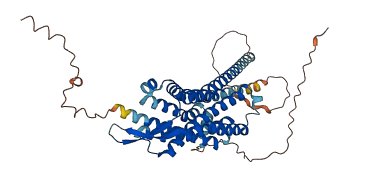
Descriptions
The autoinhibited protein was predicted that may have potential autoinhibitory elements via cis-regPred.
Autoinhibitory domains (AIDs)
Target domain |
|
Relief mechanism |
|
Assay |
cis-regPred |
Accessory elements
No accessory elements
Autoinhibited structure

Activated structure
1 structures for O08786
| Entry ID | Method | Resolution | Chain | Position | Source |
|---|---|---|---|---|---|
| AF-O08786-F1 | Predicted | AlphaFoldDB |
25 variants for O08786
| Variant ID(s) | Position | Change | Description | Diseaes Association | Provenance |
|---|---|---|---|---|---|
| rs3388750185 | 19 | E>* | No | EVA | |
| rs3388764503 | 20 | L>V | No | EVA | |
| rs3388762201 | 39 | W>R | No | EVA | |
| rs3395677352 | 43 | V>L | No | EVA | |
| rs3388762208 | 72 | M>L | No | EVA | |
| rs3388754692 | 116 | T>N | No | EVA | |
| rs3388747655 | 142 | A>V | No | EVA | |
| rs3388759460 | 165 | T>I | No | EVA | |
| rs3388755019 | 166 | W>L | No | EVA | |
| rs3388732454 | 172 | I>F | No | EVA | |
| rs3388761788 | 185 | F>S | No | EVA | |
| rs3388761346 | 187 | K>* | No | EVA | |
| rs3388759813 | 228 | A>T | No | EVA | |
| rs3388750261 | 249 | S>Y | No | EVA | |
| rs217659485 | 258 | G>S | No | EVA | |
| rs250303490 | 264 | G>S | No | EVA | |
| rs236694052 | 265 | S>I | No | EVA | |
| rs3388732464 | 279 | Q>H | No | EVA | |
| rs3388768279 | 360 | I>T | No | EVA | |
| rs3388750240 | 378 | Y>H | No | EVA | |
| rs3388761598 | 392 | T>I | No | EVA | |
| rs3388732486 | 404 | V>L | No | EVA | |
| rs3388764569 | 407 | E>D | No | EVA | |
| rs3388732449 | 433 | A>V | No | EVA | |
| rs13459172 | 436 | H>P | No | EVA |
No associated diseases with O08786
1 regional properties for O08786
| Type | Name | Position | InterPro Accession |
|---|---|---|---|
| domain | GPCR, rhodopsin-like, 7TM | 22 - 605 | IPR017452 |
10 GO annotations of cellular component
| Name | Definition |
|---|---|
| cytoplasm | The contents of a cell excluding the plasma membrane and nucleus, but including other subcellular structures. |
| cytosol | The part of the cytoplasm that does not contain organelles but which does contain other particulate matter, such as protein complexes. |
| endoplasmic reticulum | The irregular network of unit membranes, visible only by electron microscopy, that occurs in the cytoplasm of many eukaryotic cells. The membranes form a complex meshwork of tubular channels, which are often expanded into slitlike cavities called cisternae. The ER takes two forms, rough (or granular), with ribosomes adhering to the outer surface, and smooth (with no ribosomes attached). |
| endosome | A vacuole to which materials ingested by endocytosis are delivered. |
| integral component of plasma membrane | The component of the plasma membrane consisting of the gene products and protein complexes having at least some part of their peptide sequence embedded in the hydrophobic region of the membrane. |
| lysosome | A small lytic vacuole that has cell cycle-independent morphology found in most animal cells and that contains a variety of hydrolases, most of which have their maximal activities in the pH range 5-6. The contained enzymes display latency if properly isolated. About 40 different lysosomal hydrolases are known and lysosomes have a great variety of morphologies and functions. |
| membrane | A lipid bilayer along with all the proteins and protein complexes embedded in it an attached to it. |
| nucleoplasm | That part of the nuclear content other than the chromosomes or the nucleolus. |
| plasma membrane | The membrane surrounding a cell that separates the cell from its external environment. It consists of a phospholipid bilayer and associated proteins. |
| terminal bouton | Terminal inflated portion of the axon, containing the specialized apparatus necessary to release neurotransmitters. The axon terminus is considered to be the whole region of thickening and the terminal bouton is a specialized region of it. |
3 GO annotations of molecular function
| Name | Definition |
|---|---|
| cholecystokinin receptor activity | Combining with cholecystokinin and transmitting the signal across the membrane by activating an associated G-protein to initiate a change in cell activity. Cholecystokinin can act as a neuropeptide or as a gastrointestinal hormone. |
| G protein-coupled receptor activity | Combining with an extracellular signal and transmitting the signal across the membrane by activating an associated G-protein; promotes the exchange of GDP for GTP on the alpha subunit of a heterotrimeric G-protein complex. |
| peptide hormone binding | Binding to a peptide with hormonal activity in animals. |
20 GO annotations of biological process
| Name | Definition |
|---|---|
| actin cytoskeleton reorganization | A process that is carried out at the cellular level which results in dynamic structural changes to the arrangement of constituent parts of cytoskeletal structures comprising actin filaments and their associated proteins. |
| axonogenesis | De novo generation of a long process of a neuron, including the terminal branched region. Refers to the morphogenesis or creation of shape or form of the developing axon, which carries efferent (outgoing) action potentials from the cell body towards target cells. |
| cholecystokinin signaling pathway | A G protein-coupled receptor signaling pathway initiated by cholecystokinin binding to its receptor on the surface of a target cell, and ending with the regulation of a downstream cellular process, e.g. transcription. |
| eating behavior | The specific behavior of an organism relating to the intake of food, any substance (usually solid) that can be metabolized by an organism to give energy and build tissue. |
| feeding behavior | Behavior associated with the intake of food. |
| forebrain development | The process whose specific outcome is the progression of the forebrain over time, from its formation to the mature structure. The forebrain is the anterior of the three primary divisions of the developing chordate brain or the corresponding part of the adult brain (in vertebrates, includes especially the cerebral hemispheres, the thalamus, and the hypothalamus and especially in higher vertebrates is the main control center for sensory and associative information processing, visceral functions, and voluntary motor functions). |
| G protein-coupled receptor signaling pathway | The series of molecular signals initiated by a ligand binding to its receptor, in which the activated receptor promotes the exchange of GDP for GTP on the alpha-subunit of an associated heterotrimeric G-protein complex. The GTP-bound activated alpha-G-protein then dissociates from the beta- and gamma-subunits to further transmit the signal within the cell. The pathway begins with receptor-ligand interaction, and ends with regulation of a downstream cellular process. The pathway can start from the plasma membrane, Golgi or nuclear membrane. |
| gastric acid secretion | The regulated release of gastric acid (hydrochloric acid) by parietal or oxyntic cells during digestion. |
| insulin secretion | The regulated release of proinsulin from secretory granules accompanied by cleavage of proinsulin to form mature insulin. In vertebrates, insulin is secreted from B granules in the B cells of the vertebrate pancreas and from insulin-producing cells in insects. |
| neuron migration | The characteristic movement of an immature neuron from germinal zones to specific positions where they will reside as they mature. |
| pancreatic juice secretion | The regulated release of pancreatic juice by the exocrine pancreas into the upper part of the intestine. Pancreatic juice is slightly alkaline and contains numerous enzymes and inactive enzyme precursors including alpha-amylase, chymotrypsinogen, lipase, procarboxypeptidase, proelastase, prophospholipase A2, ribonuclease, and trypsinogen. Its high concentration of bicarbonate ions helps to neutralize the acid from the stomach. |
| positive regulation of cytosolic calcium ion concentration | Any process that increases the concentration of calcium ions in the cytosol. |
| positive regulation of somatostatin secretion | Any process that increases the rate, frequency, extent of the regulated release of somatostatin from secretory granules in the D cells of the pancreas. |
| reduction of food intake in response to dietary excess | An eating behavior process whereby detection of a dietary excess results in a decrease in intake of nutrients. |
| regulation of calcium ion transport | Any process that modulates the frequency, rate or extent of the directed movement of calcium ions into, out of or within a cell, or between cells, by means of some agent such as a transporter or pore. |
| regulation of hormone secretion | Any process that modulates the frequency, rate or extent of the regulated release of a hormone from a cell. |
| regulation of potassium ion transport | Any process that modulates the frequency, rate or extent of the directed movement of potassium ions (K+) into, out of or within a cell, or between cells, by means of some agent such as a transporter or pore. |
| response to heat | Any process that results in a change in state or activity of a cell or an organism (in terms of movement, secretion, enzyme production, gene expression, etc.) as a result of a heat stimulus, a temperature stimulus above the optimal temperature for that organism. |
| response to starvation | Any process that results in a change in state or activity of a cell or an organism (in terms of movement, secretion, enzyme production, gene expression, etc.) as a result of a starvation stimulus, deprivation of nourishment. |
| temperature homeostasis | A homeostatic process in which an organism modulates its internal body temperature. |
119 homologous proteins in AiPD
| UniProt AC | Gene Name | Protein Name | Species | Evidence Code |
|---|---|---|---|---|
| Q2YDN1 | GPR161 | G protein-coupled receptor 161 | Bos taurus (Bovine) | PR |
| Q0GBZ5 | HCRTR1 | Orexin/Hypocretin receptor type 1 | Bos taurus (Bovine) | PR |
| Q17QD8 | GPR37L1 | G-protein coupled receptor 37-like 1 | Bos taurus (Bovine) | PR |
| Q8SPN1 | PROKR2 | Prokineticin receptor 2 | Bos taurus (Bovine) | PR |
| P46626 | ADRB3 | Beta-3 adrenergic receptor | Bos taurus (Bovine) | PR |
| O46639 | TRHR | Thyrotropin-releasing hormone receptor | Bos taurus (Bovine) | PR |
| Q8SPN2 | PROKR1 | Prokineticin receptor 1 | Bos taurus (Bovine) | PR |
| B9VR26 | CMLKR1 | Chemerin-like receptor 1 | Bos taurus (Bovine) | PR |
| P18130 | ADRA1A | Alpha-1A adrenergic receptor | Bos taurus (Bovine) | PR |
| B4XF06 | GPR39 | G-protein coupled receptor 39 | Bos taurus (Bovine) | PR |
| O18913 | OPN1LW | Long-wave-sensitive opsin 1 | Felis catus (Cat) (Felis silvestris catus) | PR |
| P28683 | PRA1 | Green-sensitive opsin | Gallus gallus (Chicken) | PR |
| Q9N298 | HTR1A | 5-hydroxytryptamine receptor 1A | Pan troglodytes (Chimpanzee) | PR |
| P08099 | Rh2 | Opsin Rh2 | Drosophila melanogaster (Fruit fly) | PR |
| P06002 | ninaE | Opsin Rh1 | Drosophila melanogaster (Fruit fly) | PR |
| Q4LBB9 | Octbeta2R | Octopamine receptor beta-2R | Drosophila melanogaster (Fruit fly) | PR |
| Q8NFJ6 | PROKR2 | Prokineticin receptor 2 | Homo sapiens (Human) | PR |
| Q13585 | GPR50 | Melatonin-related receptor | Homo sapiens (Human) | PR |
| Q9BZJ6 | GPR63 | Probable G-protein coupled receptor 63 | Homo sapiens (Human) | PR |
| Q9H3N8 | HRH4 | Histamine H4 receptor | Homo sapiens (Human) | PR |
| P28336 | NMBR | Neuromedin-B receptor | Homo sapiens (Human) | PR |
| Q9Y5Y3 | GPR45 | Probable G-protein coupled receptor 45 | Homo sapiens (Human) | PR |
| P08913 | ADRA2A | Alpha-2A adrenergic receptor | Homo sapiens (Human) | PR |
| P41597 | CCR2 | C-C chemokine receptor type 2 | Homo sapiens (Human) | PR |
| P51681 | CCR5 | C-C chemokine receptor type 5 | Homo sapiens (Human) | PR |
| Q8TCW9 | PROKR1 | Prokineticin receptor 1 | Homo sapiens (Human) | PR |
| Q99788 | CMKLR1 | Chemerin-like receptor 1 | Homo sapiens (Human) | PR |
| P08908 | HTR1A | 5-hydroxytryptamine receptor 1A | Homo sapiens (Human) | PR |
| P30559 | OXTR | Oxytocin receptor | Homo sapiens (Human) | PR |
| P32239 | CCKBR | Gastrin/cholecystokinin type B receptor | Homo sapiens (Human) | PR |
| O60883 | GPR37L1 | G-protein coupled receptor 37-like 1 | Homo sapiens (Human) | PR |
| Q8TDU9 | RXFP4 | Relaxin-3 receptor 2 | Homo sapiens (Human) | PR |
| P04000 | OPN1LW | Long-wave-sensitive opsin 1 | Homo sapiens (Human) | PR |
| Q6U736 | OPN5 | Opsin-5 | Homo sapiens (Human) | PR |
| P34972 | CNR2 | Cannabinoid receptor 2 | Homo sapiens (Human) | PR |
| P24530 | EDNRB | Endothelin receptor type B | Homo sapiens (Human) | PR |
| P35348 | ADRA1A | Alpha-1A adrenergic receptor | Homo sapiens (Human) | PR |
| Q6W5P4 | NPSR1 | Neuropeptide S receptor | Homo sapiens (Human) | PR |
| O43613 | HCRTR1 | Orexin/Hypocretin receptor type 1 | Homo sapiens (Human) | PR |
| P61073 | CXCR4 | C-X-C chemokine receptor type 4 | Homo sapiens (Human) | PR |
| Q9BXC0 | HCAR1 | Hydroxycarboxylic acid receptor 1 | Homo sapiens (Human) | PR |
| P30556 | AGTR1 | Type-1 angiotensin II receptor | Homo sapiens (Human) | PR |
| Q15761 | NPY5R | Neuropeptide Y receptor type 5 | Homo sapiens (Human) | PR |
| Q8N6U8 | GPR161 | G-protein coupled receptor 161 | Homo sapiens (Human) | PR |
| Q6DWJ6 | GPR139 | Probable G-protein coupled receptor 139 | Homo sapiens (Human) | PR |
| P21462 | FPR1 | fMet-Leu-Phe receptor | Homo sapiens (Human) | PR |
| P35414 | APLNR | Apelin receptor | Homo sapiens (Human) | PR |
| P46091 | CMKLR2 | Chemerin-like receptor 2 | Homo sapiens (Human) | PR |
| P32745 | SSTR3 | Somatostatin receptor type 3 | Homo sapiens (Human) | PR |
| P41439 | FOLR3 | Folate receptor gamma | Homo sapiens (Human) | PR |
| P19973 | Lsp1 | Lymphocyte-specific protein 1 | Mus musculus (Mouse) | PR |
| O54799 | Nmbr | Neuromedin-B receptor | Mus musculus (Mouse) | PR |
| Q64264 | Htr1a | 5-hydroxytryptamine receptor 1A | Mus musculus (Mouse) | PR |
| P51675 | Ccr1 | C-C chemokine receptor type 1 | Mus musculus (Mouse) | PR |
| Q5U431 | Gpr39 | G-protein coupled receptor 39 | Mus musculus (Mouse) | PR |
| Q99JG2 | Gpr37l1 | G-protein coupled receptor 37-like 1 | Mus musculus (Mouse) | PR |
| P97295 | Npy2r | Neuropeptide Y receptor type 2 | Mus musculus (Mouse) | PR |
| P56481 | Cckbr | Gastrin/cholecystokinin type B receptor | Mus musculus (Mouse) | PR |
| P30731 | Gpr83 | G-protein coupled receptor 83 | Mus musculus (Mouse) | PR |
| P97468 | Cmklr1 | Chemerin-like receptor 1 | Mus musculus (Mouse) | PR |
| P21761 | Trhr | Thyrotropin-releasing hormone receptor | Mus musculus (Mouse) | PR |
| Q5QD16 | Taar3 | Trace amine-associated receptor 3 | Mus musculus (Mouse) | PR |
| P97292 | Hrh2 | Histamine H2 receptor | Mus musculus (Mouse) | PR |
| Q9EQQ3 | Gpr63 | Probable G-protein coupled receptor 63 | Mus musculus (Mouse) | PR |
| P34971 | Adrb1 | Beta-1 adrenergic receptor | Mus musculus (Mouse) | PR |
| Q91ZY2 | Hrh4 | Histamine H4 receptor | Mus musculus (Mouse) | PR |
| O88416 | Gpr33 | Probable G-protein coupled receptor 33 | Mus musculus (Mouse) | PR |
| Q8K087 | Cmklr2 | Chemerin-like receptor 2 | Mus musculus (Mouse) | PR |
| P70658 | Cxcr4 | C-X-C chemokine receptor type 4 | Mus musculus (Mouse) | PR |
| Q9WV08 | Aplnr | Apelin receptor | Mus musculus (Mouse) | PR |
| P97718 | Adra1a | Alpha-1A adrenergic receptor | Mus musculus (Mouse) | PR |
| Q8BZP8 | Npsr1 | Neuropeptide S receptor | Mus musculus (Mouse) | PR |
| Q7TQP3 | Gpr119 | Glucose-dependent insulinotropic receptor | Mus musculus (Mouse) | PR |
| Q8BGE9 | Rxfp3 | Relaxin-3 receptor 1 | Mus musculus (Mouse) | PR |
| Q6VZZ7 | Opn5 | Opsin-5 | Mus musculus (Mouse) | PR |
| Q8CIM5 | Gpr84 | G-protein coupled receptor 84 | Mus musculus (Mouse) | PR |
| P25962 | Adrb3 | Beta-3 adrenergic receptor | Mus musculus (Mouse) | PR |
| Q80UC8 | Gpr139 | Probable G-protein coupled receptor 139 | Mus musculus (Mouse) | PR |
| P0C5I1 | Gpr25 | Probable G-protein coupled receptor 25 | Mus musculus (Mouse) | PR |
| P47936 | Cnr2 | Cannabinoid receptor 2 | Mus musculus (Mouse) | PR |
| Q5QD13 | Taar6 | Trace amine-associated receptor 6 | Mus musculus (Mouse) | PR |
| P35846 | Folr1 | Folate receptor alpha | Mus musculus (Mouse) | PR |
| Q8C131 | Hcar1 | Hydroxycarboxylic acid receptor 1 | Mus musculus (Mouse) | PR |
| Q9EQQ4 | Gpr45 | Probable G-protein coupled receptor 45 | Mus musculus (Mouse) | PR |
| B2RPY5 | Gpr161 | G-protein coupled receptor 161 | Mus musculus (Mouse) | PR |
| P58307 | Hcrtr1 | Orexin/Hypocretin receptor type 1 | Mus musculus (Mouse) | PR |
| Q8K458 | Prokr2 | Prokineticin receptor 2 | Mus musculus (Mouse) | PR |
| Q924H0 | Npffr2 | Neuropeptide FF receptor 2 | Mus musculus (Mouse) | PR |
| P58308 | Hcrtr2 | Orexin receptor type 2 | Mus musculus (Mouse) | PR |
| Q764M9 | CXCR4 | C-X-C chemokine receptor type 4 | Sus scrofa (Pig) | PR |
| Q9EQD2 | Npffr2 | Neuropeptide FF receptor 2 | Rattus norvegicus (Rat) | PR |
| O08565 | Cxcr4 | C-X-C chemokine receptor type 4 | Rattus norvegicus (Rat) | PR |
| Q01717 | Trhr | Thyrotropin-releasing hormone receptor | Rattus norvegicus (Rat) | PR |
| P30936 | Sstr3 | Somatostatin receptor type 3 | Rattus norvegicus (Rat) | PR |
| Q9JHG3 | Aplnr | Apelin receptor | Rattus norvegicus (Rat) | PR |
| P43140 | Adra1a | Alpha-1A adrenergic receptor | Rattus norvegicus (Rat) | PR |
| P19327 | Htr1a | 5-hydroxytryptamine receptor 1A | Rattus norvegicus (Rat) | PR |
| P56719 | Hcrtr2 | Orexin receptor type 2 | Rattus norvegicus (Rat) | PR |
| P28564 | Htr1b | 5-hydroxytryptamine receptor 1B | Rattus norvegicus (Rat) | PR |
| P56718 | Hcrtr1 | Orexin/Hypocretin receptor type 1 | Rattus norvegicus (Rat) | PR |
| P25102 | Hrh2 | Histamine H2 receptor | Rattus norvegicus (Rat) | PR |
| P23944 | Adra1d | Alpha-1D adrenergic receptor | Rattus norvegicus (Rat) | PR |
| Q8R415 | Prokr2 | Prokineticin receptor 2 | Rattus norvegicus (Rat) | PR |
| Q5QD24 | Taar3 | Trace amine-associated receptor 3 | Rattus norvegicus (Rat) | PR |
| P0C0W8 | Gpr139 | Probable G-protein coupled receptor 139 | Rattus norvegicus (Rat) | PR |
| P28647 | Adora3 | Adenosine receptor A3 | Rattus norvegicus (Rat) | PR |
| P35370 | Oprl1 | Nociceptin receptor | Rattus norvegicus (Rat) | PR |
| P46090 | Cmklr2 | Chemerin-like receptor 2 | Rattus norvegicus (Rat) | PR |
| O97664 | CMKLR2 | Chemerin-like receptor 2 | Macaca mulatta (Rhesus macaque) | PR |
| O97666 | APLNR | Apelin receptor | Macaca mulatta (Rhesus macaque) | PR |
| Q56H79 | NPSR1 | Neuropeptide S receptor | Macaca mulatta (Rhesus macaque) | PR |
| Q18904 | npr-8 | Probable G-protein coupled receptor npr-8 | Caenorhabditis elegans | PR |
| Q09388 | gar-2 | Muscarinic acetylcholine receptor gar-2 | Caenorhabditis elegans | PR |
| B3DM66 | gpr161 | G-protein coupled receptor 161 | Xenopus tropicalis (Western clawed frog) (Silurana tropicalis) | PR |
| Q9W6A6 | opn1mw4 | Green-sensitive opsin-4 | Danio rerio (Zebrafish) (Brachydanio rerio) | PR |
| Q9W6A5 | opn1mw1 | Green-sensitive opsin-1 | Danio rerio (Zebrafish) (Brachydanio rerio) | PR |
| Q8AYM7 | opn1mw3 | Green-sensitive opsin-3 | Danio rerio (Zebrafish) (Brachydanio rerio) | PR |
| Q8AYN0 | opn1lw2 | Red-sensitive opsin-2 | Danio rerio (Zebrafish) (Brachydanio rerio) | PR |
| Q90X46 | gpr161 | G-protein coupled receptor 161 | Danio rerio (Zebrafish) (Brachydanio rerio) | PR |
| 10 | 20 | 30 | 40 | 50 | 60 |
| MDVVDSLLMN | GSNITPPCEL | GLENETLFCL | DQPQPSKEWQ | SAVQILLYSF | IFLLSVLGNT |
| 70 | 80 | 90 | 100 | 110 | 120 |
| LVITVLIRNK | RMRTVTNIFL | LSLAVSDLML | CLFCMPFNLI | PNLLKDFIFG | SAVCKTTTYF |
| 130 | 140 | 150 | 160 | 170 | 180 |
| MGTSVSVSTF | NLVAISLERY | GAICRPLQSR | VWQTKSHALK | VIAATWCLSF | TIMTPYPIYS |
| 190 | 200 | 210 | 220 | 230 | 240 |
| NLVPFTKNNN | QTANMCRFLL | PSDAMQQSWQ | TFLLLILFLI | PGVVMVVAYG | LISLELYQGI |
| 250 | 260 | 270 | 280 | 290 | 300 |
| KFDASQKKSA | KEKRLSSGGG | GGGGSSSSRY | EDSDGCYLQK | SRPPRKLELQ | QLSTSSSGGR |
| 310 | 320 | 330 | 340 | 350 | 360 |
| INRIRSSGSA | ANLIAKKRVI | RMLIVIVVLF | FLCWMPIFSA | NAWRAYDTVS | AEKHLSGTPI |
| 370 | 380 | 390 | 400 | 410 | 420 |
| SFILLLSYTS | SCVNPIIYCF | MNKRFRLGFM | ATFPCCPNPG | PTGVRGEVGE | EEDGRTIRAS |
| 430 | |||||
| LSRYSYSHMS | TSAPPH |