P06002
Gene name |
ninaE (Rh1, CG4550) |
Protein name |
Opsin Rh1 |
Names |
Neither inactivation nor afterpotential E protein, Outer R1-R6 photoreceptor cells opsin |
Species |
Drosophila melanogaster (Fruit fly) |
KEGG Pathway |
dme:Dmel_CG4550 |
EC number |
|
Protein Class |
|
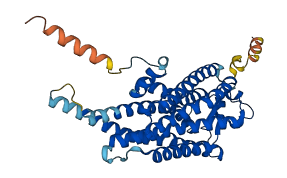
Descriptions
The autoinhibited protein was predicted that may have potential autoinhibitory elements via cis-regPred.
Autoinhibitory domains (AIDs)
Target domain |
|
Relief mechanism |
|
Assay |
cis-regPred |
Accessory elements
No accessory elements
Autoinhibited structure

Activated structure
1 structures for P06002
| Entry ID | Method | Resolution | Chain | Position | Source |
|---|---|---|---|---|---|
| AF-P06002-F1 | Predicted | AlphaFoldDB |
No variants for P06002
| Variant ID(s) | Position | Change | Description | Diseaes Association | Provenance |
|---|---|---|---|---|---|
| No variants for P06002 | |||||
No associated diseases with P06002
Functions
7 GO annotations of cellular component
| Name | Definition |
|---|---|
| cytoplasmic vesicle | A vesicle found in the cytoplasm of a cell. |
| early endosome | A membrane-bounded organelle that receives incoming material from primary endocytic vesicles that have been generated by clathrin-dependent and clathrin-independent endocytosis; vesicles fuse with the early endosome to deliver cargo for sorting into recycling or degradation pathways. |
| inaD signaling complex | A complex of proteins that are involved in phototransduction and attached to the transient receptor potential (TRP) channel. The protein connections are mediated through inaD. |
| integral component of plasma membrane | The component of the plasma membrane consisting of the gene products and protein complexes having at least some part of their peptide sequence embedded in the hydrophobic region of the membrane. |
| photoreceptor outer segment | The outer segment of a vertebrate photoreceptor that contains a stack of membrane discs embedded with photoreceptor proteins. |
| rhabdomere | The specialized microvilli-containing organelle on the apical surfaces of a photoreceptor cell containing the visual pigment rhodopsin and most of the proteins involved in phototransduction. |
| subrhabdomeral cisterna | A membrane-bounded compartment that is found at the base of the rhabdomere and contains stored calcium, InsP3 receptors and smooth endoplasmic reticulum Ca2+-ATPase. |
1 GO annotations of molecular function
| Name | Definition |
|---|---|
| G protein-coupled photoreceptor activity | Combining with incidental electromagnetic radiation, particularly visible light, and transmitting the signal across the membrane by activating an associated G-protein; promotes the exchange of GDP for GTP on the alpha subunit of a heterotrimeric G-protein complex. |
15 GO annotations of biological process
| Name | Definition |
|---|---|
| adult locomotory behavior | Locomotory behavior in a fully developed and mature organism. |
| cellular response to light stimulus | Any process that results in a change in state or activity of a cell (in terms of movement, secretion, enzyme production, gene expression, etc.) as a result of a light stimulus, electromagnetic radiation of wavelengths classified as infrared, visible or ultraviolet light. |
| detection of UV | The series of events in which an ultraviolet radiation (UV light) stimulus is received and converted into a molecular signal. Ultraviolet radiation is electromagnetic radiation with a wavelength in the range of 10 to 380 nanometers. |
| detection of visible light | The series of events in which a visible light stimulus is received by a cell and converted into a molecular signal. A visible light stimulus is electromagnetic radiation that can be perceived visually by an organism; for organisms lacking a visual system, this can be defined as light with a wavelength within the range 380 to 780 nm. |
| G protein-coupled receptor signaling pathway | The series of molecular signals initiated by a ligand binding to its receptor, in which the activated receptor promotes the exchange of GDP for GTP on the alpha-subunit of an associated heterotrimeric G-protein complex. The GTP-bound activated alpha-G-protein then dissociates from the beta- and gamma-subunits to further transmit the signal within the cell. The pathway begins with receptor-ligand interaction, and ends with regulation of a downstream cellular process. The pathway can start from the plasma membrane, Golgi or nuclear membrane. |
| negative regulation of compound eye retinal cell programmed cell death | Any process that stops, prevents, or reduces the frequency, rate or extent of programmed cell death that occurs in the compound eye retina. |
| optomotor response | Eye, head or whole body movements that help to compensate movements of the environment in order to stabilize its image on the retina. In the case of whole body movements, these motor actions may also stabilize a locomotor course in response to some disturbance. Examples include: the optokinetic reflex, which allows human eyes to follow objects in motion while the head remains stationary reflex; the optomotor responses of flying insects and swimming fish. |
| phospholipase C-activating rhodopsin mediated signaling pathway | A phospholipase C-activating receptor G protein-coupled receptor signaling pathway initiated by a rhodopsin molecule being activated by a photon, and ending with the regulation of a downstream cellular process, e.g. transcription. |
| photoreceptor cell morphogenesis | The process in which the structures of a photoreceptor cell are generated and organized. This process occurs while the initially relatively unspecialized cell is acquiring the specialized features of a photoreceptor cell, a sensory cell that reacts to the presence of light. An example of this is found in Drosophila melanogaster. |
| phototaxis | The directed movement of a motile cell or organism in response to light. |
| phototransduction | The sequence of reactions within a cell required to convert absorbed photons into a molecular signal. |
| response to light intensity | Any process that results in a change in state or activity of a cell or an organism (in terms of movement, secretion, enzyme production, gene expression, etc.) as a result of a light intensity stimulus. |
| rhabdomere development | The assembly and arrangement of a rhabdomere within a cell. The rhabdomere is the organelle on the apical surface of a photoreceptor cell that contains the visual pigments. |
| thermotaxis | The directed movement of a motile cell or organism in response to a temperature gradient. Movement may be towards either a higher or lower temperature. |
| visual perception | The series of events required for an organism to receive a visual stimulus, convert it to a molecular signal, and recognize and characterize the signal. Visual stimuli are detected in the form of photons and are processed to form an image. |
119 homologous proteins in AiPD
| UniProt AC | Gene Name | Protein Name | Species | Evidence Code |
|---|---|---|---|---|
| Q2YDN1 | GPR161 | G protein-coupled receptor 161 | Bos taurus (Bovine) | PR |
| Q0GBZ5 | HCRTR1 | Orexin/Hypocretin receptor type 1 | Bos taurus (Bovine) | PR |
| Q17QD8 | GPR37L1 | G-protein coupled receptor 37-like 1 | Bos taurus (Bovine) | PR |
| Q8SPN1 | PROKR2 | Prokineticin receptor 2 | Bos taurus (Bovine) | PR |
| P46626 | ADRB3 | Beta-3 adrenergic receptor | Bos taurus (Bovine) | PR |
| O46639 | TRHR | Thyrotropin-releasing hormone receptor | Bos taurus (Bovine) | PR |
| Q8SPN2 | PROKR1 | Prokineticin receptor 1 | Bos taurus (Bovine) | PR |
| B9VR26 | CMLKR1 | Chemerin-like receptor 1 | Bos taurus (Bovine) | PR |
| P18130 | ADRA1A | Alpha-1A adrenergic receptor | Bos taurus (Bovine) | PR |
| B4XF06 | GPR39 | G-protein coupled receptor 39 | Bos taurus (Bovine) | PR |
| O18913 | OPN1LW | Long-wave-sensitive opsin 1 | Felis catus (Cat) (Felis silvestris catus) | PR |
| P28683 | PRA1 | Green-sensitive opsin | Gallus gallus (Chicken) | PR |
| Q9N298 | HTR1A | 5-hydroxytryptamine receptor 1A | Pan troglodytes (Chimpanzee) | PR |
| P08099 | Rh2 | Opsin Rh2 | Drosophila melanogaster (Fruit fly) | PR |
| Q4LBB9 | Octbeta2R | Octopamine receptor beta-2R | Drosophila melanogaster (Fruit fly) | PR |
| Q8NFJ6 | PROKR2 | Prokineticin receptor 2 | Homo sapiens (Human) | PR |
| Q13585 | GPR50 | Melatonin-related receptor | Homo sapiens (Human) | PR |
| Q9BZJ6 | GPR63 | Probable G-protein coupled receptor 63 | Homo sapiens (Human) | PR |
| Q9H3N8 | HRH4 | Histamine H4 receptor | Homo sapiens (Human) | PR |
| P28336 | NMBR | Neuromedin-B receptor | Homo sapiens (Human) | PR |
| Q9Y5Y3 | GPR45 | Probable G-protein coupled receptor 45 | Homo sapiens (Human) | PR |
| P08913 | ADRA2A | Alpha-2A adrenergic receptor | Homo sapiens (Human) | PR |
| P41597 | CCR2 | C-C chemokine receptor type 2 | Homo sapiens (Human) | PR |
| P51681 | CCR5 | C-C chemokine receptor type 5 | Homo sapiens (Human) | PR |
| Q8TCW9 | PROKR1 | Prokineticin receptor 1 | Homo sapiens (Human) | PR |
| Q99788 | CMKLR1 | Chemerin-like receptor 1 | Homo sapiens (Human) | PR |
| P08908 | HTR1A | 5-hydroxytryptamine receptor 1A | Homo sapiens (Human) | PR |
| P30559 | OXTR | Oxytocin receptor | Homo sapiens (Human) | PR |
| P32239 | CCKBR | Gastrin/cholecystokinin type B receptor | Homo sapiens (Human) | PR |
| O60883 | GPR37L1 | G-protein coupled receptor 37-like 1 | Homo sapiens (Human) | PR |
| Q8TDU9 | RXFP4 | Relaxin-3 receptor 2 | Homo sapiens (Human) | PR |
| P04000 | OPN1LW | Long-wave-sensitive opsin 1 | Homo sapiens (Human) | PR |
| Q6U736 | OPN5 | Opsin-5 | Homo sapiens (Human) | PR |
| P34972 | CNR2 | Cannabinoid receptor 2 | Homo sapiens (Human) | PR |
| P24530 | EDNRB | Endothelin receptor type B | Homo sapiens (Human) | PR |
| P35348 | ADRA1A | Alpha-1A adrenergic receptor | Homo sapiens (Human) | PR |
| Q6W5P4 | NPSR1 | Neuropeptide S receptor | Homo sapiens (Human) | PR |
| O43613 | HCRTR1 | Orexin/Hypocretin receptor type 1 | Homo sapiens (Human) | PR |
| P61073 | CXCR4 | C-X-C chemokine receptor type 4 | Homo sapiens (Human) | PR |
| Q9BXC0 | HCAR1 | Hydroxycarboxylic acid receptor 1 | Homo sapiens (Human) | PR |
| P30556 | AGTR1 | Type-1 angiotensin II receptor | Homo sapiens (Human) | PR |
| Q15761 | NPY5R | Neuropeptide Y receptor type 5 | Homo sapiens (Human) | PR |
| Q8N6U8 | GPR161 | G-protein coupled receptor 161 | Homo sapiens (Human) | PR |
| Q6DWJ6 | GPR139 | Probable G-protein coupled receptor 139 | Homo sapiens (Human) | PR |
| P21462 | FPR1 | fMet-Leu-Phe receptor | Homo sapiens (Human) | PR |
| P35414 | APLNR | Apelin receptor | Homo sapiens (Human) | PR |
| P46091 | CMKLR2 | Chemerin-like receptor 2 | Homo sapiens (Human) | PR |
| P32745 | SSTR3 | Somatostatin receptor type 3 | Homo sapiens (Human) | PR |
| P41439 | FOLR3 | Folate receptor gamma | Homo sapiens (Human) | PR |
| P19973 | Lsp1 | Lymphocyte-specific protein 1 | Mus musculus (Mouse) | PR |
| O54799 | Nmbr | Neuromedin-B receptor | Mus musculus (Mouse) | PR |
| Q64264 | Htr1a | 5-hydroxytryptamine receptor 1A | Mus musculus (Mouse) | PR |
| P51675 | Ccr1 | C-C chemokine receptor type 1 | Mus musculus (Mouse) | PR |
| Q5U431 | Gpr39 | G-protein coupled receptor 39 | Mus musculus (Mouse) | PR |
| Q99JG2 | Gpr37l1 | G-protein coupled receptor 37-like 1 | Mus musculus (Mouse) | PR |
| P97295 | Npy2r | Neuropeptide Y receptor type 2 | Mus musculus (Mouse) | PR |
| O08786 | Cckar | Cholecystokinin receptor type A | Mus musculus (Mouse) | PR |
| P56481 | Cckbr | Gastrin/cholecystokinin type B receptor | Mus musculus (Mouse) | PR |
| P30731 | Gpr83 | G-protein coupled receptor 83 | Mus musculus (Mouse) | PR |
| P97468 | Cmklr1 | Chemerin-like receptor 1 | Mus musculus (Mouse) | PR |
| P21761 | Trhr | Thyrotropin-releasing hormone receptor | Mus musculus (Mouse) | PR |
| Q5QD16 | Taar3 | Trace amine-associated receptor 3 | Mus musculus (Mouse) | PR |
| P97292 | Hrh2 | Histamine H2 receptor | Mus musculus (Mouse) | PR |
| Q9EQQ3 | Gpr63 | Probable G-protein coupled receptor 63 | Mus musculus (Mouse) | PR |
| Q924H0 | Npffr2 | Neuropeptide FF receptor 2 | Mus musculus (Mouse) | PR |
| P34971 | Adrb1 | Beta-1 adrenergic receptor | Mus musculus (Mouse) | PR |
| Q91ZY2 | Hrh4 | Histamine H4 receptor | Mus musculus (Mouse) | PR |
| O88416 | Gpr33 | Probable G-protein coupled receptor 33 | Mus musculus (Mouse) | PR |
| Q8K087 | Cmklr2 | Chemerin-like receptor 2 | Mus musculus (Mouse) | PR |
| P70658 | Cxcr4 | C-X-C chemokine receptor type 4 | Mus musculus (Mouse) | PR |
| Q9WV08 | Aplnr | Apelin receptor | Mus musculus (Mouse) | PR |
| P97718 | Adra1a | Alpha-1A adrenergic receptor | Mus musculus (Mouse) | PR |
| Q8BZP8 | Npsr1 | Neuropeptide S receptor | Mus musculus (Mouse) | PR |
| Q8K458 | Prokr2 | Prokineticin receptor 2 | Mus musculus (Mouse) | PR |
| P58308 | Hcrtr2 | Orexin receptor type 2 | Mus musculus (Mouse) | PR |
| Q7TQP3 | Gpr119 | Glucose-dependent insulinotropic receptor | Mus musculus (Mouse) | PR |
| Q8BGE9 | Rxfp3 | Relaxin-3 receptor 1 | Mus musculus (Mouse) | PR |
| Q6VZZ7 | Opn5 | Opsin-5 | Mus musculus (Mouse) | PR |
| Q8CIM5 | Gpr84 | G-protein coupled receptor 84 | Mus musculus (Mouse) | PR |
| P25962 | Adrb3 | Beta-3 adrenergic receptor | Mus musculus (Mouse) | PR |
| Q80UC8 | Gpr139 | Probable G-protein coupled receptor 139 | Mus musculus (Mouse) | PR |
| P0C5I1 | Gpr25 | Probable G-protein coupled receptor 25 | Mus musculus (Mouse) | PR |
| P47936 | Cnr2 | Cannabinoid receptor 2 | Mus musculus (Mouse) | PR |
| Q5QD13 | Taar6 | Trace amine-associated receptor 6 | Mus musculus (Mouse) | PR |
| P35846 | Folr1 | Folate receptor alpha | Mus musculus (Mouse) | PR |
| P58307 | Hcrtr1 | Orexin/Hypocretin receptor type 1 | Mus musculus (Mouse) | PR |
| Q8C131 | Hcar1 | Hydroxycarboxylic acid receptor 1 | Mus musculus (Mouse) | PR |
| Q9EQQ4 | Gpr45 | Probable G-protein coupled receptor 45 | Mus musculus (Mouse) | PR |
| B2RPY5 | Gpr161 | G-protein coupled receptor 161 | Mus musculus (Mouse) | PR |
| Q764M9 | CXCR4 | C-X-C chemokine receptor type 4 | Sus scrofa (Pig) | PR |
| Q9EQD2 | Npffr2 | Neuropeptide FF receptor 2 | Rattus norvegicus (Rat) | PR |
| O08565 | Cxcr4 | C-X-C chemokine receptor type 4 | Rattus norvegicus (Rat) | PR |
| Q01717 | Trhr | Thyrotropin-releasing hormone receptor | Rattus norvegicus (Rat) | PR |
| P30936 | Sstr3 | Somatostatin receptor type 3 | Rattus norvegicus (Rat) | PR |
| Q9JHG3 | Aplnr | Apelin receptor | Rattus norvegicus (Rat) | PR |
| P43140 | Adra1a | Alpha-1A adrenergic receptor | Rattus norvegicus (Rat) | PR |
| P19327 | Htr1a | 5-hydroxytryptamine receptor 1A | Rattus norvegicus (Rat) | PR |
| P56719 | Hcrtr2 | Orexin receptor type 2 | Rattus norvegicus (Rat) | PR |
| P28564 | Htr1b | 5-hydroxytryptamine receptor 1B | Rattus norvegicus (Rat) | PR |
| P56718 | Hcrtr1 | Orexin/Hypocretin receptor type 1 | Rattus norvegicus (Rat) | PR |
| P28647 | Adora3 | Adenosine receptor A3 | Rattus norvegicus (Rat) | PR |
| P25102 | Hrh2 | Histamine H2 receptor | Rattus norvegicus (Rat) | PR |
| P23944 | Adra1d | Alpha-1D adrenergic receptor | Rattus norvegicus (Rat) | PR |
| Q8R415 | Prokr2 | Prokineticin receptor 2 | Rattus norvegicus (Rat) | PR |
| Q5QD24 | Taar3 | Trace amine-associated receptor 3 | Rattus norvegicus (Rat) | PR |
| P0C0W8 | Gpr139 | Probable G-protein coupled receptor 139 | Rattus norvegicus (Rat) | PR |
| P35370 | Oprl1 | Nociceptin receptor | Rattus norvegicus (Rat) | PR |
| P46090 | Cmklr2 | Chemerin-like receptor 2 | Rattus norvegicus (Rat) | PR |
| O97664 | CMKLR2 | Chemerin-like receptor 2 | Macaca mulatta (Rhesus macaque) | PR |
| O97666 | APLNR | Apelin receptor | Macaca mulatta (Rhesus macaque) | PR |
| Q56H79 | NPSR1 | Neuropeptide S receptor | Macaca mulatta (Rhesus macaque) | PR |
| Q18904 | npr-8 | Probable G-protein coupled receptor npr-8 | Caenorhabditis elegans | PR |
| Q09388 | gar-2 | Muscarinic acetylcholine receptor gar-2 | Caenorhabditis elegans | PR |
| B3DM66 | gpr161 | G-protein coupled receptor 161 | Xenopus tropicalis (Western clawed frog) (Silurana tropicalis) | PR |
| Q9W6A6 | opn1mw4 | Green-sensitive opsin-4 | Danio rerio (Zebrafish) (Brachydanio rerio) | PR |
| Q9W6A5 | opn1mw1 | Green-sensitive opsin-1 | Danio rerio (Zebrafish) (Brachydanio rerio) | PR |
| Q8AYM7 | opn1mw3 | Green-sensitive opsin-3 | Danio rerio (Zebrafish) (Brachydanio rerio) | PR |
| Q8AYN0 | opn1lw2 | Red-sensitive opsin-2 | Danio rerio (Zebrafish) (Brachydanio rerio) | PR |
| Q90X46 | gpr161 | G-protein coupled receptor 161 | Danio rerio (Zebrafish) (Brachydanio rerio) | PR |
| 10 | 20 | 30 | 40 | 50 | 60 |
| MESFAVAAAQ | LGPHFAPLSN | GSVVDKVTPD | MAHLISPYWN | QFPAMDPIWA | KILTAYMIMI |
| 70 | 80 | 90 | 100 | 110 | 120 |
| GMISWCGNGV | VIYIFATTKS | LRTPANLLVI | NLAISDFGIM | ITNTPMMGIN | LYFETWVLGP |
| 130 | 140 | 150 | 160 | 170 | 180 |
| MMCDIYAGLG | SAFGCSSIWS | MCMISLDRYQ | VIVKGMAGRP | MTIPLALGKI | AYIWFMSSIW |
| 190 | 200 | 210 | 220 | 230 | 240 |
| CLAPAFGWSR | YVPEGNLTSC | GIDYLERDWN | PRSYLIFYSI | FVYYIPLFLI | CYSYWFIIAA |
| 250 | 260 | 270 | 280 | 290 | 300 |
| VSAHEKAMRE | QAKKMNVKSL | RSSEDAEKSA | EGKLAKVALV | TITLWFMAWT | PYLVINCMGL |
| 310 | 320 | 330 | 340 | 350 | 360 |
| FKFEGLTPLN | TIWGACFAKS | AACYNPIVYG | ISHPKYRLAL | KEKCPCCVFG | KVDDGKSSDA |
| 370 | |||||
| QSQATASEAE | SKA |