O08565
Gene name |
Cxcr4 (Cmkar4) |
Protein name |
C-X-C chemokine receptor type 4 |
Names |
|
Species |
Rattus norvegicus (Rat) |
KEGG Pathway |
rno:60628 |
EC number |
|
Protein Class |
|
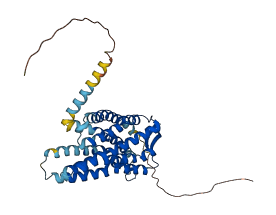
Descriptions
The autoinhibited protein was predicted that may have potential autoinhibitory elements via cis-regPred.
Autoinhibitory domains (AIDs)
Target domain |
|
Relief mechanism |
|
Assay |
cis-regPred |
Accessory elements
No accessory elements
Autoinhibited structure

Activated structure
1 structures for O08565
| Entry ID | Method | Resolution | Chain | Position | Source |
|---|---|---|---|---|---|
| AF-O08565-F1 | Predicted | AlphaFoldDB |
No variants for O08565
| Variant ID(s) | Position | Change | Description | Diseaes Association | Provenance |
|---|---|---|---|---|---|
| No variants for O08565 | |||||
No associated diseases with O08565
1 regional properties for O08565
| Type | Name | Position | InterPro Accession |
|---|---|---|---|
| domain | GPCR, rhodopsin-like, 7TM | 63 - 358 | IPR017452 |
Functions
17 GO annotations of cellular component
| Name | Definition |
|---|---|
| cell leading edge | The area of a motile cell closest to the direction of movement. |
| cell surface | The external part of the cell wall and/or plasma membrane. |
| cell-cell junction | A cell junction that forms a connection between two or more cells of an organism; excludes direct cytoplasmic intercellular bridges, such as ring canals in insects. |
| cytoplasm | The contents of a cell excluding the plasma membrane and nucleus, but including other subcellular structures. |
| cytoplasmic vesicle | A vesicle found in the cytoplasm of a cell. |
| cytosol | The part of the cytoplasm that does not contain organelles but which does contain other particulate matter, such as protein complexes. |
| early endosome | A membrane-bounded organelle that receives incoming material from primary endocytic vesicles that have been generated by clathrin-dependent and clathrin-independent endocytosis; vesicles fuse with the early endosome to deliver cargo for sorting into recycling or degradation pathways. |
| endosome | A vacuole to which materials ingested by endocytosis are delivered. |
| external side of plasma membrane | The leaflet of the plasma membrane that faces away from the cytoplasm and any proteins embedded or anchored in it or attached to its surface. |
| extracellular matrix | A structure lying external to one or more cells, which provides structural support, biochemical or biomechanical cues for cells or tissues. |
| growth cone | The migrating motile tip of a growing neuron projection, where actin accumulates, and the actin cytoskeleton is the most dynamic. |
| integral component of membrane | The component of a membrane consisting of the gene products and protein complexes having at least some part of their peptide sequence embedded in the hydrophobic region of the membrane. |
| late endosome | A prelysosomal endocytic organelle differentiated from early endosomes by lower lumenal pH and different protein composition. Late endosomes are more spherical than early endosomes and are mostly juxtanuclear, being concentrated near the microtubule organizing center. |
| lysosome | A small lytic vacuole that has cell cycle-independent morphology found in most animal cells and that contains a variety of hydrolases, most of which have their maximal activities in the pH range 5-6. The contained enzymes display latency if properly isolated. About 40 different lysosomal hydrolases are known and lysosomes have a great variety of morphologies and functions. |
| nucleus | A membrane-bounded organelle of eukaryotic cells in which chromosomes are housed and replicated. In most cells, the nucleus contains all of the cell's chromosomes except the organellar chromosomes, and is the site of RNA synthesis and processing. In some species, or in specialized cell types, RNA metabolism or DNA replication may be absent. |
| plasma membrane | The membrane surrounding a cell that separates the cell from its external environment. It consists of a phospholipid bilayer and associated proteins. |
| protein-containing complex | A stable assembly of two or more macromolecules, i.e. proteins, nucleic acids, carbohydrates or lipids, in which at least one component is a protein and the constituent parts function together. |
9 GO annotations of molecular function
| Name | Definition |
|---|---|
| actin binding | Binding to monomeric or multimeric forms of actin, including actin filaments. |
| C-C chemokine binding | Binding to a C-C chemokine; C-C chemokines do not have an amino acid between the first two cysteines of the characteristic four-cysteine motif. |
| C-C chemokine receptor activity | Combining with a C-C chemokine and transmitting the signal from one side of the membrane to the other to initiate a change in cell activity. C-C chemokines do not have an amino acid between the first two cysteines of the characteristic four-cysteine motif. |
| C-X-C chemokine receptor activity | Combining with a C-X-C chemokine and transmitting the signal from one side of the membrane to the other to initiate a change in cell activity. A C-X-C chemokine has a single amino acid between the first two cysteines of the characteristic four cysteine motif. |
| C-X-C motif chemokine 12 receptor activity | Combining with the C-X-C motif chemokine 12 (CXCL12) and transmitting the signal from one side of the membrane to the other to initiate a change in cell activity. |
| myosin light chain binding | Binding to a light chain of a myosin complex. |
| small molecule binding | Binding to a small molecule, any low molecular weight, monomeric, non-encoded molecule. |
| ubiquitin binding | Binding to ubiquitin, a protein that when covalently bound to other cellular proteins marks them for proteolytic degradation. |
| ubiquitin protein ligase binding | Binding to a ubiquitin protein ligase enzyme, any of the E3 proteins. |
61 GO annotations of biological process
| Name | Definition |
|---|---|
| ameboidal-type cell migration | Cell migration that is accomplished by extension and retraction of a pseudopodium. |
| aorta development | The progression of the aorta over time, from its initial formation to the mature structure. An aorta is an artery that carries blood from the heart to other parts of the body. |
| blood vessel endothelial cell migration | The orderly movement of an endothelial cell into the extracellular matrix in order to form new blood vessels during angiogenesis. |
| brain development | The process whose specific outcome is the progression of the brain over time, from its formation to the mature structure. Brain development begins with patterning events in the neural tube and ends with the mature structure that is the center of thought and emotion. The brain is responsible for the coordination and control of bodily activities and the interpretation of information from the senses (sight, hearing, smell, etc.). |
| branching involved in blood vessel morphogenesis | The process of coordinated growth and sprouting of blood vessels giving rise to the organized vascular system. |
| calcium-mediated signaling | Any intracellular signal transduction in which the signal is passed on within the cell via calcium ions. |
| cardiac muscle contraction | Muscle contraction of cardiac muscle tissue. |
| cell chemotaxis | The directed movement of a motile cell guided by a specific chemical concentration gradient. Movement may be towards a higher concentration (positive chemotaxis) or towards a lower concentration (negative chemotaxis). |
| cell migration | The controlled self-propelled movement of a cell from one site to a destination guided by molecular cues. Cell migration is a central process in the development and maintenance of multicellular organisms. |
| cellular response to cytokine stimulus | Any process that results in a change in state or activity of a cell (in terms of movement, secretion, enzyme production, gene expression, etc.) as a result of a cytokine stimulus. |
| cellular response to organonitrogen compound | Any process that results in a change in state or activity of a cell (in terms of movement, secretion, enzyme production, gene expression, etc.) as a result of an organonitrogen stimulus. An organonitrogen compound is formally a compound containing at least one carbon-nitrogen bond. |
| cellular response to xenobiotic stimulus | Any process that results in a change in state or activity of a cell (in terms of movement, secretion, enzyme production, gene expression, etc.) as a result of a stimulus from a xenobiotic, a compound foreign to the organism exposed to it. It may be synthesized by another organism (like ampicilin) or it can be a synthetic chemical. |
| CXCL12-activated CXCR4 signaling pathway | The series of molecular signals initiated by the binding of the C-X-C chemokine CXCL12 to a C-X-C chemokine type 4 receptor (CXCR4) on the surface of a target cell, and ending with the regulation of a downstream cellular process, e.g. transcription. |
| detection of mechanical stimulus involved in sensory perception of pain | The series of events involved in the perception of pain in which a mechanical stimulus is received and converted into a molecular signal. |
| detection of temperature stimulus involved in sensory perception of pain | The series of events involved in the perception of pain in which a temperature stimulus is received and converted into a molecular signal. |
| endothelial cell differentiation | The process in which a mesodermal, bone marrow or neural crest cell acquires specialized features of an endothelial cell, a thin flattened cell. A layer of such cells lines the inside surfaces of body cavities, blood vessels, and lymph vessels, making up the endothelium. |
| endothelial tube morphogenesis | The process in which the anatomical structures of a tube are generated and organized from an endothelium. Endothelium refers to the layer of cells lining blood vessels, lymphatics, the heart, and serous cavities, and is derived from bone marrow or mesoderm. Corneal endothelium is a special case, derived from neural crest cells. |
| epithelial cell development | The process whose specific outcome is the progression of an epithelial cell over time, from its formation to the mature structure. An epithelial cell is a cell usually found in a two-dimensional sheet with a free surface. |
| G protein-coupled receptor signaling pathway | The series of molecular signals initiated by a ligand binding to its receptor, in which the activated receptor promotes the exchange of GDP for GTP on the alpha-subunit of an associated heterotrimeric G-protein complex. The GTP-bound activated alpha-G-protein then dissociates from the beta- and gamma-subunits to further transmit the signal within the cell. The pathway begins with receptor-ligand interaction, and ends with regulation of a downstream cellular process. The pathway can start from the plasma membrane, Golgi or nuclear membrane. |
| generation of neurons | The process in which nerve cells are generated. This includes the production of neuroblasts and their differentiation into neurons. |
| germ cell development | The process whose specific outcome is the progression of an immature germ cell over time, from its formation to the mature structure (gamete). A germ cell is any reproductive cell in a multicellular organism. |
| germ cell migration | The orderly movement of a cell specialized to produce haploid gametes through the embryo from its site of production to the place where the gonads will form. |
| hematopoietic stem cell migration | The orderly movement of a hematopoietic stem cell from one site to another. A hematopoietic stem cell is a cell from which all cells of the lymphoid and myeloid lineages develop, including blood cells and cells of the immune system. |
| immune response | Any immune system process that functions in the calibrated response of an organism to a potential internal or invasive threat. |
| kidney development | The process whose specific outcome is the progression of the kidney over time, from its formation to the mature structure. The kidney is an organ that filters the blood and/or excretes the end products of body metabolism in the form of urine. |
| motor neuron axon guidance | The process in which the migration of an axon growth cone of a motor neuron is directed to a specific target site in response to a combination of attractive and repulsive cues. |
| myelin maintenance | The process of preserving the structure and function of mature myelin. This includes maintaining the compact structure of myelin necessary for its electrical insulating characteristics as well as the structure of non-compact regions such as Schmidt-Lantermann clefts and paranodal loops. This does not include processes responsible for maintaining the nodes of Ranvier, which are not part of the myelin sheath. |
| neural precursor cell proliferation | The multiplication or reproduction of neural precursor cells, resulting in the expansion of a cell population. A neural precursor cell is either a nervous system stem cell or a nervous system progenitor cell. |
| neurogenesis | Generation of cells within the nervous system. |
| neuron migration | The characteristic movement of an immature neuron from germinal zones to specific positions where they will reside as they mature. |
| neuron recognition | The process in which a neuronal cell in a multicellular organism interprets its surroundings. |
| osteoclast differentiation | The process in which a relatively unspecialized monocyte acquires the specialized features of an osteoclast. An osteoclast is a specialized phagocytic cell associated with the absorption and removal of the mineralized matrix of bone tissue. |
| positive regulation of calcium ion import | Any process that increases the rate, frequency, or extent of the directed movement of calcium ions into a cell or organelle. |
| positive regulation of cell migration | Any process that activates or increases the frequency, rate or extent of cell migration. |
| positive regulation of chemotaxis | Any process that activates or increases the frequency, rate or extent of the directed movement of a motile cell or organism in response to a specific chemical concentration gradient. |
| positive regulation of cold-induced thermogenesis | Any process that activates or increases the frequency, rate or extent of cold-induced thermogenesis. |
| positive regulation of cytosolic calcium ion concentration | Any process that increases the concentration of calcium ions in the cytosol. |
| positive regulation of dendrite extension | Any process that activates or increases the frequency, rate or extent of dendrite extension. |
| positive regulation of ERK1 and ERK2 cascade | Any process that activates or increases the frequency, rate or extent of signal transduction mediated by the ERK1 and ERK2 cascade. |
| positive regulation of macrophage migration inhibitory factor signaling pathway | Any process that activates or increases the frequency, rate or extent of macrophage migration inhibitory factor signaling pathway. |
| positive regulation of mesenchymal stem cell migration | Any process that activates or increases the frequency, rate or extent of mesenchymal stem cell migration. |
| positive regulation of neurogenesis | Any process that activates or increases the frequency, rate or extent of neurogenesis, the generation of cells within the nervous system. |
| positive regulation of oligodendrocyte differentiation | Any process that activates or increases the frequency, rate or extent of oligodendrocyte differentiation. |
| positive regulation of protein phosphorylation | Any process that activates or increases the frequency, rate or extent of addition of phosphate groups to amino acids within a protein. |
| positive regulation of vascular wound healing | Any process that increases the rate, frequency, or extent of blood vessel formation when new vessels emerge from the proliferation of pre-existing blood vessels and contribute to the series of events that restore integrity to damaged vasculature. |
| regulation of calcium ion transport | Any process that modulates the frequency, rate or extent of the directed movement of calcium ions into, out of or within a cell, or between cells, by means of some agent such as a transporter or pore. |
| regulation of cell adhesion | Any process that modulates the frequency, rate or extent of attachment of a cell to another cell or to the extracellular matrix. |
| regulation of cell migration | Any process that modulates the frequency, rate or extent of cell migration. |
| regulation of chemotaxis | Any process that modulates the frequency, rate or extent of the directed movement of a motile cell or organism in response to a specific chemical concentration gradient. |
| regulation of neuron migration | Any process that modulates the frequency, rate or extent of neuron migration. |
| regulation of programmed cell death | Any process that modulates the frequency, rate or extent of programmed cell death, cell death resulting from activation of endogenous cellular processes. |
| regulation of viral process | Any process that modulates the rate or extent of the viral life cycle, the set of processes by which a virus reproduces and spreads among hosts. |
| response to activity | Any process that results in a change in state or activity of a cell or an organism (in terms of movement, secretion, enzyme production, gene expression, etc.) as a result of an activity stimulus. |
| response to hypoxia | Any process that results in a change in state or activity of a cell or an organism (in terms of movement, secretion, enzyme production, gene expression, etc.) as a result of a stimulus indicating lowered oxygen tension. Hypoxia, defined as a decline in O2 levels below normoxic levels of 20.8 - 20.95%, results in metabolic adaptation at both the cellular and organismal level. |
| response to morphine | Any process that results in a change in state or activity of a cell or an organism (in terms of movement, secretion, enzyme production, gene expression, etc.) as a result of a morphine stimulus. Morphine is an opioid alkaloid, isolated from opium, with a complex ring structure. |
| response to organic cyclic compound | Any process that results in a change in state or activity of a cell or an organism (in terms of movement, secretion, enzyme production, gene expression, etc.) as a result of an organic cyclic compound stimulus. |
| response to tacrolimus | Any process that results in a change in state or activity of a cell or an organism (in terms of movement, secretion, enzyme production, gene expression, etc.) as a result of a tacrolimus stimulus. |
| response to ultrasound | Any process that results in a change in state or activity of a cell or an organism (in terms of movement, secretion, enzyme production, gene expression, etc.) as a result of an ultrasonic stimulus. |
| T cell proliferation | The expansion of a T cell population by cell division. Follows T cell activation. |
| telencephalon cell migration | The orderly movement of a cell from one site to another at least one of which is located in the telencephalon. |
| ventricular septum development | The progression of the ventricular septum over time from its formation to the mature structure. |
119 homologous proteins in AiPD
| UniProt AC | Gene Name | Protein Name | Species | Evidence Code |
|---|---|---|---|---|
| Q2YDN1 | GPR161 | G protein-coupled receptor 161 | Bos taurus (Bovine) | PR |
| Q0GBZ5 | HCRTR1 | Orexin/Hypocretin receptor type 1 | Bos taurus (Bovine) | PR |
| Q17QD8 | GPR37L1 | G-protein coupled receptor 37-like 1 | Bos taurus (Bovine) | PR |
| Q8SPN1 | PROKR2 | Prokineticin receptor 2 | Bos taurus (Bovine) | PR |
| P46626 | ADRB3 | Beta-3 adrenergic receptor | Bos taurus (Bovine) | PR |
| O46639 | TRHR | Thyrotropin-releasing hormone receptor | Bos taurus (Bovine) | PR |
| Q8SPN2 | PROKR1 | Prokineticin receptor 1 | Bos taurus (Bovine) | PR |
| B9VR26 | CMLKR1 | Chemerin-like receptor 1 | Bos taurus (Bovine) | PR |
| P18130 | ADRA1A | Alpha-1A adrenergic receptor | Bos taurus (Bovine) | PR |
| B4XF06 | GPR39 | G-protein coupled receptor 39 | Bos taurus (Bovine) | PR |
| O18913 | OPN1LW | Long-wave-sensitive opsin 1 | Felis catus (Cat) (Felis silvestris catus) | PR |
| P28683 | PRA1 | Green-sensitive opsin | Gallus gallus (Chicken) | PR |
| Q9N298 | HTR1A | 5-hydroxytryptamine receptor 1A | Pan troglodytes (Chimpanzee) | PR |
| P08099 | Rh2 | Opsin Rh2 | Drosophila melanogaster (Fruit fly) | PR |
| P06002 | ninaE | Opsin Rh1 | Drosophila melanogaster (Fruit fly) | PR |
| Q4LBB9 | Octbeta2R | Octopamine receptor beta-2R | Drosophila melanogaster (Fruit fly) | PR |
| Q8NFJ6 | PROKR2 | Prokineticin receptor 2 | Homo sapiens (Human) | PR |
| Q13585 | GPR50 | Melatonin-related receptor | Homo sapiens (Human) | PR |
| Q9BZJ6 | GPR63 | Probable G-protein coupled receptor 63 | Homo sapiens (Human) | PR |
| Q9H3N8 | HRH4 | Histamine H4 receptor | Homo sapiens (Human) | PR |
| P28336 | NMBR | Neuromedin-B receptor | Homo sapiens (Human) | PR |
| Q9Y5Y3 | GPR45 | Probable G-protein coupled receptor 45 | Homo sapiens (Human) | PR |
| P08913 | ADRA2A | Alpha-2A adrenergic receptor | Homo sapiens (Human) | PR |
| P41597 | CCR2 | C-C chemokine receptor type 2 | Homo sapiens (Human) | PR |
| P51681 | CCR5 | C-C chemokine receptor type 5 | Homo sapiens (Human) | PR |
| Q8TCW9 | PROKR1 | Prokineticin receptor 1 | Homo sapiens (Human) | PR |
| Q99788 | CMKLR1 | Chemerin-like receptor 1 | Homo sapiens (Human) | PR |
| P08908 | HTR1A | 5-hydroxytryptamine receptor 1A | Homo sapiens (Human) | PR |
| P30559 | OXTR | Oxytocin receptor | Homo sapiens (Human) | PR |
| P32239 | CCKBR | Gastrin/cholecystokinin type B receptor | Homo sapiens (Human) | PR |
| O60883 | GPR37L1 | G-protein coupled receptor 37-like 1 | Homo sapiens (Human) | PR |
| Q8TDU9 | RXFP4 | Relaxin-3 receptor 2 | Homo sapiens (Human) | PR |
| P04000 | OPN1LW | Long-wave-sensitive opsin 1 | Homo sapiens (Human) | PR |
| Q6U736 | OPN5 | Opsin-5 | Homo sapiens (Human) | PR |
| P34972 | CNR2 | Cannabinoid receptor 2 | Homo sapiens (Human) | PR |
| P24530 | EDNRB | Endothelin receptor type B | Homo sapiens (Human) | PR |
| P35348 | ADRA1A | Alpha-1A adrenergic receptor | Homo sapiens (Human) | PR |
| Q6W5P4 | NPSR1 | Neuropeptide S receptor | Homo sapiens (Human) | PR |
| O43613 | HCRTR1 | Orexin/Hypocretin receptor type 1 | Homo sapiens (Human) | PR |
| Q9BXC0 | HCAR1 | Hydroxycarboxylic acid receptor 1 | Homo sapiens (Human) | PR |
| P30556 | AGTR1 | Type-1 angiotensin II receptor | Homo sapiens (Human) | PR |
| Q15761 | NPY5R | Neuropeptide Y receptor type 5 | Homo sapiens (Human) | PR |
| Q8N6U8 | GPR161 | G-protein coupled receptor 161 | Homo sapiens (Human) | PR |
| Q6DWJ6 | GPR139 | Probable G-protein coupled receptor 139 | Homo sapiens (Human) | PR |
| P21462 | FPR1 | fMet-Leu-Phe receptor | Homo sapiens (Human) | PR |
| P35414 | APLNR | Apelin receptor | Homo sapiens (Human) | PR |
| P46091 | CMKLR2 | Chemerin-like receptor 2 | Homo sapiens (Human) | PR |
| P32745 | SSTR3 | Somatostatin receptor type 3 | Homo sapiens (Human) | PR |
| P41439 | FOLR3 | Folate receptor gamma | Homo sapiens (Human) | PR |
| P61073 | CXCR4 | C-X-C chemokine receptor type 4 | Homo sapiens (Human) | PR |
| P19973 | Lsp1 | Lymphocyte-specific protein 1 | Mus musculus (Mouse) | PR |
| O54799 | Nmbr | Neuromedin-B receptor | Mus musculus (Mouse) | PR |
| Q64264 | Htr1a | 5-hydroxytryptamine receptor 1A | Mus musculus (Mouse) | PR |
| P51675 | Ccr1 | C-C chemokine receptor type 1 | Mus musculus (Mouse) | PR |
| Q5U431 | Gpr39 | G-protein coupled receptor 39 | Mus musculus (Mouse) | PR |
| Q99JG2 | Gpr37l1 | G-protein coupled receptor 37-like 1 | Mus musculus (Mouse) | PR |
| P97295 | Npy2r | Neuropeptide Y receptor type 2 | Mus musculus (Mouse) | PR |
| O08786 | Cckar | Cholecystokinin receptor type A | Mus musculus (Mouse) | PR |
| P56481 | Cckbr | Gastrin/cholecystokinin type B receptor | Mus musculus (Mouse) | PR |
| P30731 | Gpr83 | G-protein coupled receptor 83 | Mus musculus (Mouse) | PR |
| P97468 | Cmklr1 | Chemerin-like receptor 1 | Mus musculus (Mouse) | PR |
| P21761 | Trhr | Thyrotropin-releasing hormone receptor | Mus musculus (Mouse) | PR |
| Q5QD16 | Taar3 | Trace amine-associated receptor 3 | Mus musculus (Mouse) | PR |
| P97292 | Hrh2 | Histamine H2 receptor | Mus musculus (Mouse) | PR |
| Q9EQQ3 | Gpr63 | Probable G-protein coupled receptor 63 | Mus musculus (Mouse) | PR |
| Q924H0 | Npffr2 | Neuropeptide FF receptor 2 | Mus musculus (Mouse) | PR |
| P34971 | Adrb1 | Beta-1 adrenergic receptor | Mus musculus (Mouse) | PR |
| Q91ZY2 | Hrh4 | Histamine H4 receptor | Mus musculus (Mouse) | PR |
| O88416 | Gpr33 | Probable G-protein coupled receptor 33 | Mus musculus (Mouse) | PR |
| Q8K087 | Cmklr2 | Chemerin-like receptor 2 | Mus musculus (Mouse) | PR |
| Q9WV08 | Aplnr | Apelin receptor | Mus musculus (Mouse) | PR |
| P97718 | Adra1a | Alpha-1A adrenergic receptor | Mus musculus (Mouse) | PR |
| Q8BZP8 | Npsr1 | Neuropeptide S receptor | Mus musculus (Mouse) | PR |
| Q8K458 | Prokr2 | Prokineticin receptor 2 | Mus musculus (Mouse) | PR |
| P58308 | Hcrtr2 | Orexin receptor type 2 | Mus musculus (Mouse) | PR |
| Q7TQP3 | Gpr119 | Glucose-dependent insulinotropic receptor | Mus musculus (Mouse) | PR |
| Q8BGE9 | Rxfp3 | Relaxin-3 receptor 1 | Mus musculus (Mouse) | PR |
| Q6VZZ7 | Opn5 | Opsin-5 | Mus musculus (Mouse) | PR |
| Q8CIM5 | Gpr84 | G-protein coupled receptor 84 | Mus musculus (Mouse) | PR |
| P25962 | Adrb3 | Beta-3 adrenergic receptor | Mus musculus (Mouse) | PR |
| Q80UC8 | Gpr139 | Probable G-protein coupled receptor 139 | Mus musculus (Mouse) | PR |
| P0C5I1 | Gpr25 | Probable G-protein coupled receptor 25 | Mus musculus (Mouse) | PR |
| P47936 | Cnr2 | Cannabinoid receptor 2 | Mus musculus (Mouse) | PR |
| Q5QD13 | Taar6 | Trace amine-associated receptor 6 | Mus musculus (Mouse) | PR |
| P35846 | Folr1 | Folate receptor alpha | Mus musculus (Mouse) | PR |
| P58307 | Hcrtr1 | Orexin/Hypocretin receptor type 1 | Mus musculus (Mouse) | PR |
| Q8C131 | Hcar1 | Hydroxycarboxylic acid receptor 1 | Mus musculus (Mouse) | PR |
| Q9EQQ4 | Gpr45 | Probable G-protein coupled receptor 45 | Mus musculus (Mouse) | PR |
| B2RPY5 | Gpr161 | G-protein coupled receptor 161 | Mus musculus (Mouse) | PR |
| P70658 | Cxcr4 | C-X-C chemokine receptor type 4 | Mus musculus (Mouse) | PR |
| Q764M9 | CXCR4 | C-X-C chemokine receptor type 4 | Sus scrofa (Pig) | PR |
| Q9EQD2 | Npffr2 | Neuropeptide FF receptor 2 | Rattus norvegicus (Rat) | PR |
| Q01717 | Trhr | Thyrotropin-releasing hormone receptor | Rattus norvegicus (Rat) | PR |
| P30936 | Sstr3 | Somatostatin receptor type 3 | Rattus norvegicus (Rat) | PR |
| Q9JHG3 | Aplnr | Apelin receptor | Rattus norvegicus (Rat) | PR |
| P43140 | Adra1a | Alpha-1A adrenergic receptor | Rattus norvegicus (Rat) | PR |
| P19327 | Htr1a | 5-hydroxytryptamine receptor 1A | Rattus norvegicus (Rat) | PR |
| P56719 | Hcrtr2 | Orexin receptor type 2 | Rattus norvegicus (Rat) | PR |
| P28564 | Htr1b | 5-hydroxytryptamine receptor 1B | Rattus norvegicus (Rat) | PR |
| P56718 | Hcrtr1 | Orexin/Hypocretin receptor type 1 | Rattus norvegicus (Rat) | PR |
| P25102 | Hrh2 | Histamine H2 receptor | Rattus norvegicus (Rat) | PR |
| P23944 | Adra1d | Alpha-1D adrenergic receptor | Rattus norvegicus (Rat) | PR |
| Q8R415 | Prokr2 | Prokineticin receptor 2 | Rattus norvegicus (Rat) | PR |
| Q5QD24 | Taar3 | Trace amine-associated receptor 3 | Rattus norvegicus (Rat) | PR |
| P0C0W8 | Gpr139 | Probable G-protein coupled receptor 139 | Rattus norvegicus (Rat) | PR |
| P28647 | Adora3 | Adenosine receptor A3 | Rattus norvegicus (Rat) | PR |
| P35370 | Oprl1 | Nociceptin receptor | Rattus norvegicus (Rat) | PR |
| P46090 | Cmklr2 | Chemerin-like receptor 2 | Rattus norvegicus (Rat) | PR |
| O97664 | CMKLR2 | Chemerin-like receptor 2 | Macaca mulatta (Rhesus macaque) | PR |
| O97666 | APLNR | Apelin receptor | Macaca mulatta (Rhesus macaque) | PR |
| Q56H79 | NPSR1 | Neuropeptide S receptor | Macaca mulatta (Rhesus macaque) | PR |
| Q18904 | npr-8 | Probable G-protein coupled receptor npr-8 | Caenorhabditis elegans | PR |
| Q09388 | gar-2 | Muscarinic acetylcholine receptor gar-2 | Caenorhabditis elegans | PR |
| B3DM66 | gpr161 | G-protein coupled receptor 161 | Xenopus tropicalis (Western clawed frog) (Silurana tropicalis) | PR |
| Q9W6A6 | opn1mw4 | Green-sensitive opsin-4 | Danio rerio (Zebrafish) (Brachydanio rerio) | PR |
| Q9W6A5 | opn1mw1 | Green-sensitive opsin-1 | Danio rerio (Zebrafish) (Brachydanio rerio) | PR |
| Q8AYM7 | opn1mw3 | Green-sensitive opsin-3 | Danio rerio (Zebrafish) (Brachydanio rerio) | PR |
| Q8AYN0 | opn1lw2 | Red-sensitive opsin-2 | Danio rerio (Zebrafish) (Brachydanio rerio) | PR |
| Q90X46 | gpr161 | G-protein coupled receptor 161 | Danio rerio (Zebrafish) (Brachydanio rerio) | PR |
| 10 | 20 | 30 | 40 | 50 | 60 |
| MEIYTSDNYS | EEVGSGDYDS | NKEPCFRDEN | ENFNRIFLPT | IYFIIFLTGI | VGNGLVILVM |
| 70 | 80 | 90 | 100 | 110 | 120 |
| GYQKKLRSMT | DKYRLHLSVA | DLLFVITLPF | WAVDAMADWY | FGKFLCKAVH | IIYTVNLYSS |
| 130 | 140 | 150 | 160 | 170 | 180 |
| VLILAFISLD | RYLAIVHATN | SQRPRKLLAE | KAVYVGVWIP | ALLLTIPDII | FADVSQGDGR |
| 190 | 200 | 210 | 220 | 230 | 240 |
| YICDRLYPDS | LWMVVFQFQH | IMVGLILPGI | VILSCYCIII | SKLSHSKGHQ | KRKALKTTVI |
| 250 | 260 | 270 | 280 | 290 | 300 |
| LILAFFACWL | PYYVGISIDS | FILLEVIKQG | CEFESVVHKW | ISITEALAFF | HCCLNPILYA |
| 310 | 320 | 330 | 340 | ||
| FLGAKFKSSA | QHALNSMSRG | SSLKILSKGK | RGGHSSVSTE | SESSSFHSS |