Q9Z1Y3
Gene name |
Cdh2 |
Protein name |
Cadherin-2 |
Names |
|
Species |
Rattus norvegicus (Rat) |
KEGG Pathway |
rno:83501 |
EC number |
|
Protein Class |
|
Descriptions
The autoinhibited protein was predicted that may have potential autoinhibitory elements via cis-regPred.
Autoinhibitory domains (AIDs)
Target domain |
|
Relief mechanism |
|
Assay |
cis-regPred |
Accessory elements
No accessory elements
Autoinhibited structure

Activated structure
1 structures for Q9Z1Y3
| Entry ID | Method | Resolution | Chain | Position | Source |
|---|---|---|---|---|---|
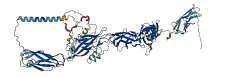
| AF-Q9Z1Y3-F1 | Predicted | AlphaFoldDB |
No variants for Q9Z1Y3
| Variant ID(s) | Position | Change | Description | Diseaes Association | Provenance |
|---|---|---|---|---|---|
| No variants for Q9Z1Y3 | |||||
No associated diseases with Q9Z1Y3
3 regional properties for Q9Z1Y3
| Type | Name | Position | InterPro Accession |
|---|---|---|---|
| domain | tRNA(Ile)-lysidine/2-thiocytidine synthase, N-terminal | 21 - 145 | IPR011063-1 |
| domain | tRNA(Ile)-lysidine/2-thiocytidine synthase, N-terminal | 198 - 256 | IPR011063-2 |
| domain | tRNA(Ile)-lysidine synthase, N-terminal | 20 - 258 | IPR012795 |
Functions
26 GO annotations of cellular component
| Name | Definition |
|---|---|
| adherens junction | A cell-cell junction composed of the epithelial cadherin-catenin complex. The epithelial cadherins, or E-cadherins, of each interacting cell extend through the plasma membrane into the extracellular space and bind to each other. The E-cadherins bind to catenins on the cytoplasmic side of the membrane, where the E-cadherin-catenin complex binds to cytoskeletal components and regulatory and signaling molecules. |
| apical part of cell | The region of a polarized cell that forms a tip or is distal to a base. For example, in a polarized epithelial cell, the apical region has an exposed surface and lies opposite to the basal lamina that separates the epithelium from other tissue. |
| apical plasma membrane | The region of the plasma membrane located at the apical end of the cell. |
| apicolateral plasma membrane | The apical end of the lateral plasma membrane of epithelial cells. |
| basolateral plasma membrane | The region of the plasma membrane that includes the basal end and sides of the cell. Often used in reference to animal polarized epithelial membranes, where the basal membrane is the part attached to the extracellular matrix, or in plant cells, where the basal membrane is defined with respect to the zygotic axis. |
| catenin complex | Complex of peripheral cytoplasmic proteins (alpha-, beta- and gamma-catenin) that interact with the cytoplasmic region of uvomorulin/E-cadherin to connect it to the actin cytoskeleton. |
| cell junction | A cellular component that forms a specialized region of connection between two or more cells, or between a cell and the extracellular matrix, or between two membrane-bound components of a cell, such as flagella. |
| cell surface | The external part of the cell wall and/or plasma membrane. |
| cell-cell junction | A cell junction that forms a connection between two or more cells of an organism; excludes direct cytoplasmic intercellular bridges, such as ring canals in insects. |
| cytoplasm | The contents of a cell excluding the plasma membrane and nucleus, but including other subcellular structures. |
| fascia adherens | A cell-cell junction that contains the transmembrane protein N-cadherin, which interacts with identical molecules from neighbouring cells to form a tight mechanical intercellular link; forms a large portion of the intercalated disc, the structure at which myofibrils terminate in cardiomyocytes. |
| glutamatergic synapse | A synapse that uses glutamate as a neurotransmitter. |
| integral component of plasma membrane | The component of the plasma membrane consisting of the gene products and protein complexes having at least some part of their peptide sequence embedded in the hydrophobic region of the membrane. |
| integral component of postsynaptic specialization membrane | The component of the postsynaptic specialization membrane consisting of the gene products and protein complexes having at least some part of their peptide sequence embedded in the hydrophobic region of the membrane. |
| integral component of presynaptic active zone membrane | The component of the presynaptic active zone membrane consisting of the gene products and protein complexes having at least some part of their peptide sequence embedded in the hydrophobic region of the membrane. |
| intercalated disc | A complex cell-cell junction at which myofibrils terminate in cardiomyocytes; mediates mechanical and electrochemical integration between individual cardiomyocytes. The intercalated disc contains regions of tight mechanical attachment (fasciae adherentes and desmosomes) and electrical coupling (gap junctions) between adjacent cells. |
| lamellipodium | A thin sheetlike process extended by the leading edge of a migrating cell or extending cell process; contains a dense meshwork of actin filaments. |
| membrane | A lipid bilayer along with all the proteins and protein complexes embedded in it an attached to it. |
| neuron projection | A prolongation or process extending from a nerve cell, e.g. an axon or dendrite. |
| plasma membrane | The membrane surrounding a cell that separates the cell from its external environment. It consists of a phospholipid bilayer and associated proteins. |
| plasma membrane raft | A membrane raft that is part of the plasma membrane. |
| postsynaptic density | An electron dense network of proteins within and adjacent to the postsynaptic membrane of an asymmetric, neuron-neuron synapse. Its major components include neurotransmitter receptors and the proteins that spatially and functionally organize them such as anchoring and scaffolding molecules, signaling enzymes and cytoskeletal components. |
| protein-containing complex | A stable assembly of two or more macromolecules, i.e. proteins, nucleic acids, carbohydrates or lipids, in which at least one component is a protein and the constituent parts function together. |
| sarcolemma | The outer membrane of a muscle cell, consisting of the plasma membrane, a covering basement membrane (about 100 nm thick and sometimes common to more than one fiber), and the associated loose network of collagen fibers. |
| synapse | The junction between an axon of one neuron and a dendrite of another neuron, a muscle fiber or a glial cell. As the axon approaches the synapse it enlarges into a specialized structure, the presynaptic terminal bouton, which contains mitochondria and synaptic vesicles. At the tip of the terminal bouton is the presynaptic membrane; facing it, and separated from it by a minute cleft (the synaptic cleft) is a specialized area of membrane on the receiving cell, known as the postsynaptic membrane. In response to the arrival of nerve impulses, the presynaptic terminal bouton secretes molecules of neurotransmitters into the synaptic cleft. These diffuse across the cleft and transmit the signal to the postsynaptic membrane. |
| T-tubule | Invagination of the plasma membrane of a muscle cell that extends inward from the cell surface around each myofibril. The ends of T-tubules make contact with the sarcoplasmic reticulum membrane. |
13 GO annotations of molecular function
| Name | Definition |
|---|---|
| alpha-catenin binding | Binding to catenin complex alpha subunit. |
| beta-catenin binding | Binding to a catenin beta subunit. |
| cadherin binding | Binding to cadherin, a type I membrane protein involved in cell adhesion. |
| calcium ion binding | Binding to a calcium ion (Ca2+). |
| enzyme binding | Binding to an enzyme, a protein with catalytic activity. |
| gamma-catenin binding | Binding to catenin complex gamma subunit. |
| identical protein binding | Binding to an identical protein or proteins. |
| nitric-oxide synthase binding | Binding to nitric-oxide synthase. |
| protein kinase binding | Binding to a protein kinase, any enzyme that catalyzes the transfer of a phosphate group, usually from ATP, to a protein substrate. |
| protein phosphatase binding | Binding to a protein phosphatase. |
| protein tyrosine kinase binding | Binding to protein tyrosine kinase. |
| protein-containing complex binding | Binding to a macromolecular complex. |
| RNA binding | Binding to an RNA molecule or a portion thereof. |
38 GO annotations of biological process
| Name | Definition |
|---|---|
| blood vessel morphogenesis | The process in which the anatomical structures of blood vessels are generated and organized. The blood vessel is the vasculature carrying blood. |
| brain development | The process whose specific outcome is the progression of the brain over time, from its formation to the mature structure. Brain development begins with patterning events in the neural tube and ends with the mature structure that is the center of thought and emotion. The brain is responsible for the coordination and control of bodily activities and the interpretation of information from the senses (sight, hearing, smell, etc.). |
| brain morphogenesis | The process in which the anatomical structures of the brain are generated and organized. The brain is one of the two components of the central nervous system and is the center of thought and emotion. It is responsible for the coordination and control of bodily activities and the interpretation of information from the senses (sight, hearing, smell, etc.). |
| calcium-dependent cell-cell adhesion via plasma membrane cell adhesion molecules | The attachment of one cell to another cell via adhesion molecules that require the presence of calcium for the interaction. |
| cell adhesion | The attachment of a cell, either to another cell or to an underlying substrate such as the extracellular matrix, via cell adhesion molecules. |
| cell migration | The controlled self-propelled movement of a cell from one site to a destination guided by molecular cues. Cell migration is a central process in the development and maintenance of multicellular organisms. |
| cell-cell adhesion | The attachment of one cell to another cell via adhesion molecules. |
| cell-cell adhesion mediated by cadherin | The attachment of one cell to another cell via a cadherin, transmembrane proteins having repeating extracellular calcium ion binding domains. |
| cell-cell adhesion via plasma-membrane adhesion molecules | The attachment of one cell to another cell via adhesion molecules that are at least partially embedded in the plasma membrane. |
| cell-cell junction assembly | The aggregation, arrangement and bonding together of a set of components to form a junction between cells. |
| cerebral cortex development | The progression of the cerebral cortex over time from its initial formation until its mature state. The cerebral cortex is the outer layered region of the telencephalon. |
| glial cell differentiation | The process in which a relatively unspecialized cell acquires the specialized features of a glial cell. |
| heterophilic cell-cell adhesion via plasma membrane cell adhesion molecules | The attachment of an adhesion molecule in one cell to a nonidentical adhesion molecule in an adjacent cell. |
| homeostasis of number of cells | Any biological process involved in the maintenance of the steady-state number of cells within a population of cells. |
| homophilic cell adhesion via plasma membrane adhesion molecules | The attachment of a plasma membrane adhesion molecule in one cell to an identical molecule in an adjacent cell. |
| mesenchymal cell migration | The orderly movement of a mesenchymal cell from one site to another, often during the development of a multicellular organism. |
| modulation of chemical synaptic transmission | Any process that modulates the frequency or amplitude of synaptic transmission, the process of communication from a neuron to a target (neuron, muscle, or secretory cell) across a synapse. Amplitude, in this case, refers to the change in postsynaptic membrane potential due to a single instance of synaptic transmission. |
| negative regulation of canonical Wnt signaling pathway | Any process that decreases the rate, frequency, or extent of the Wnt signaling pathway through beta-catenin, the series of molecular signals initiated by binding of a Wnt protein to a frizzled family receptor on the surface of the target cell, followed by propagation of the signal via beta-catenin, and ending with a change in transcription of target genes. |
| neural crest cell development | The process aimed at the progression of a neural crest cell over time, from initial commitment of the cell to its specific fate, to the fully functional differentiated cell. |
| neuroepithelial cell differentiation | The process in which epiblast cells acquire specialized features of neuroepithelial cells. |
| neuroligin clustering involved in postsynaptic membrane assembly | The receptor clustering process involved in assembly of the postsynaptic membrane in which neuroligins are localized to distinct domains in the cell membrane. Neuroligins are neuronal cell surface proteins on the postsynaptic membrane that mediate synapse formation between neurons. |
| neuronal stem cell population maintenance | Any process in by an organism or tissue maintains a population of neuronal stem cells. |
| positive regulation of MAPK cascade | Any process that activates or increases the frequency, rate or extent of signal transduction mediated by the MAPK cascade. |
| positive regulation of synaptic vesicle clustering | Any process that activates or increases the frequency, rate or extent of synaptic vesicle clustering. |
| protein localization to plasma membrane | A process in which a protein is transported to, or maintained in, a specific location in the plasma membrane. |
| radial glial cell differentiation | The process in which neuroepithelial cells of the neural tube give rise to radial glial cells, specialized bipotential progenitors cells of the brain. Differentiation includes the processes involved in commitment of a cell to a specific fate. |
| regulation of axonogenesis | Any process that modulates the frequency, rate or extent of axonogenesis, the generation of an axon, the long process of a neuron. |
| regulation of myelination | Any process that modulates the frequency, rate or extent of the formation of a myelin sheath around nerve axons. |
| regulation of oligodendrocyte progenitor proliferation | Any process that modulates the frequency, rate or extent of oligodendrocyte progenitor proliferation. |
| regulation of postsynaptic density protein 95 clustering | Any process that modulates the frequency, rate or extent of postsynaptic density protein 95 clustering. |
| regulation of protein localization | Any process that modulates the frequency, rate or extent of any process in which a protein is transported to, or maintained in, a specific location. |
| regulation of Rho protein signal transduction | Any process that modulates the frequency, rate or extent of Rho protein signal transduction. |
| regulation of synaptic transmission, glutamatergic | Any process that modulates the frequency, rate or extent of glutamatergic synaptic transmission, the process of communication from a neuron to another neuron across a synapse using the neurotransmitter glutamate. |
| striated muscle cell differentiation | The process in which a relatively unspecialized cell acquires specialized features of a striated muscle cell; striated muscle fibers are divided by transverse bands into striations, and cardiac and voluntary muscle are types of striated muscle. |
| synapse assembly | The aggregation, arrangement and bonding together of a set of components to form a synapse. This process ends when the synapse is mature (functional). |
| synaptic membrane adhesion | The attachment of presynaptic membrane to postsynaptic membrane via adhesion molecules that are at least partially embedded in the plasma membrane. |
| telencephalon development | The process whose specific outcome is the progression of the telencephalon over time, from its formation to the mature structure. The telencephalon is the paired anteriolateral division of the prosencephalon plus the lamina terminalis from which the olfactory lobes, cerebral cortex, and subcortical nuclei are derived. |
| type B pancreatic cell development | The process whose specific outcome is the progression of a type B pancreatic cell over time, from its formation to the mature structure. A type B pancreatic cell is a cell located towards center of the islets of Langerhans that secretes insulin. |
41 homologous proteins in AiPD
| UniProt AC | Gene Name | Protein Name | Species | Evidence Code |
|---|---|---|---|---|
| Q3SWX5 | CDH6 | Cadherin-6 | Bos taurus (Bovine) | PR |
| P79995 | CDH10 | Cadherin-10 | Gallus gallus (Chicken) | PR |
| Q8UVJ7 | CDHR1 | Cadherin-related family member 1 | Gallus gallus (Chicken) | PR |
| Q5DRC8 | PCDHB6 | Protocadherin beta-6 | Pan troglodytes (Chimpanzee) | PR |
| Q5DRE4 | PCDHA8 | Protocadherin alpha-8 | Pan troglodytes (Chimpanzee) | PR |
| Q5DRE6 | PCDHA6 | Protocadherin alpha-6 | Pan troglodytes (Chimpanzee) | PR |
| Q5DRF0 | PCDHA2 | Protocadherin alpha-2 | Pan troglodytes (Chimpanzee) | PR |
| Q5DRE7 | PCDHA5 | Protocadherin alpha-5 | Pan troglodytes (Chimpanzee) | PR |
| Q9VJB6 | CadN2 | Putative neural-cadherin 2 | Drosophila melanogaster (Fruit fly) | PR |
| Q9ULB4 | CDH9 | Cadherin-9 | Homo sapiens (Human) | PR |
| Q9Y5E3 | PCDHB6 | Protocadherin beta-6 | Homo sapiens (Human) | PR |
| Q9Y5F1 | PCDHB12 | Protocadherin beta-12 | Homo sapiens (Human) | PR |
| O60330 | PCDHGA12 | Protocadherin gamma-A12 | Homo sapiens (Human) | PR |
| P12830 | CDH1 | Cadherin-1 | Homo sapiens (Human) | PR |
| Q9H159 | CDH19 | Cadherin-19 | Homo sapiens (Human) | PR |
| Q9P2E7 | PCDH10 | Protocadherin-10 | Homo sapiens (Human) | PR |
| Q9Y6N8 | CDH10 | Cadherin-10 | Homo sapiens (Human) | PR |
| P55285 | CDH6 | Cadherin-6 | Homo sapiens (Human) | PR |
| Q9Y5I2 | PCDHA10 | Protocadherin alpha-10 | Homo sapiens (Human) | PR |
| Q6ZTQ4 | CDHR3 | Cadherin-related family member 3 | Homo sapiens (Human) | PR |
| Q9Y5H3 | PCDHGA10 | Protocadherin gamma-A10 | Homo sapiens (Human) | PR |
| Q9UN75 | PCDHA12 | Protocadherin alpha-12 | Homo sapiens (Human) | PR |
| Q9Y5I1 | PCDHA11 | Protocadherin alpha-11 | Homo sapiens (Human) | PR |
| Q9Y5H8 | PCDHA3 | Protocadherin alpha-3 | Homo sapiens (Human) | PR |
| Q9Y5H9 | PCDHA2 | Protocadherin alpha-2 | Homo sapiens (Human) | PR |
| Q9UN73 | PCDHA6 | Protocadherin alpha-6 | Homo sapiens (Human) | PR |
| Q9Y5H6 | PCDHA8 | Protocadherin alpha-8 | Homo sapiens (Human) | PR |
| Q9UN74 | PCDHA4 | Protocadherin alpha-4 | Homo sapiens (Human) | PR |
| Q9UN72 | PCDHA7 | Protocadherin alpha-7 | Homo sapiens (Human) | PR |
| Q9Y5H7 | PCDHA5 | Protocadherin alpha-5 | Homo sapiens (Human) | PR |
| Q9Y5G4 | PCDHGA9 | Protocadherin gamma-A9 | Homo sapiens (Human) | PR |
| Q9Y5G0 | PCDHGB5 | Protocadherin gamma-B5 | Homo sapiens (Human) | PR |
| P19022 | CDH2 | Cadherin-2 | Homo sapiens (Human) | PR |
| P09803 | Cdh1 | Cadherin-1 | Mus musculus (Mouse) | PR |
| P70407 | Cdh9 | Cadherin-9 | Mus musculus (Mouse) | PR |
| P97326 | Cdh6 | Cadherin-6 | Mus musculus (Mouse) | PR |
| P70408 | Cdh10 | Cadherin-10 | Mus musculus (Mouse) | PR |
| Q8VHF2 | Cdhr5 | Cadherin-related family member 5 | Mus musculus (Mouse) | PR |
| P15116 | Cdh2 | Cadherin-2 | Mus musculus (Mouse) | PR |
| Q767I8 | Pcdha4 | Protocadherin alpha-4 | Rattus norvegicus (Rat) | PR |
| P55280 | Cdh6 | Cadherin-6 | Rattus norvegicus (Rat) | PR |
| 10 | 20 | 30 | 40 | 50 | 60 |
| MCRIAGGPRT | LLPLLAALLQ | ASLEASGELA | LCKTGFPEDV | YSAVLPKTVH | EGQPLLNVKF |
| 70 | 80 | 90 | 100 | 110 | 120 |
| SNCNRKRKVQ | YESSEPADFK | VDEDGTVYAV | RSFPLSAEQA | KFLIYAQDKE | TQEKWQVAVN |
| 130 | 140 | 150 | 160 | 170 | 180 |
| LSLEPSLTEE | PMKEPHEIEE | IVFPRQLAKH | SGALQRQKRD | WVIPPINLPE | NSRGPFPQEL |
| 190 | 200 | 210 | 220 | 230 | 240 |
| VRIRSDRDKN | LSLRYSVTGP | GADQPPTGIF | IINPISGQLS | VTKPLDRELI | ARFHLRAHAV |
| 250 | 260 | 270 | 280 | 290 | 300 |
| DINGNQVENP | IDIVINVIDM | NDNRPEFLHQ | VWNGSVPEGS | KPGTYVMTVT | AIDADDPNAL |
| 310 | 320 | 330 | 340 | 350 | 360 |
| NGMLRYRILS | QAPSTPSPNM | FTINNETGDI | ITVAAGLDRE | KVQQYTLIIQ | ATDMEGNPTY |
| 370 | 380 | 390 | 400 | 410 | 420 |
| GLSNTATAVI | TVTDVNDNPP | EFTAMTFYGE | VPENRVDVIV | ANLTVTDKDQ | PHTPAWNAAY |
| 430 | 440 | 450 | 460 | 470 | 480 |
| RISGGDPTGR | FAILTDPNSN | DGLVTVVKPI | DFETNRMFVL | TVAAENQVPL | AKGIQHPPQS |
| 490 | 500 | 510 | 520 | 530 | 540 |
| TATVSVTVID | VNENPYFAPN | PKIIRQEEGL | HAGTMLTTLT | AQDPDRYMQQ | NIRYTKLSDP |
| 550 | 560 | 570 | 580 | 590 | 600 |
| ANWLKIDPVN | GQITTIAVLD | RESPNVKNNI | YNATFLASDN | GIPPMSGTGT | LQIYLLDIND |
| 610 | 620 | 630 | 640 | 650 | 660 |
| NAPQVLPQEA | ETCETPEPNS | INITALDYDI | DPNAGPFAFD | LPLSPATIKR | NWTITRLNGD |
| 670 | 680 | 690 | 700 | 710 | 720 |
| FAQLNLKIKF | LEAGIYEVPI | VITDSGNPPK | SNISILRVKV | CQCDSNGDCT | DVDRIVGAGL |
| 730 | 740 | 750 | 760 | 770 | 780 |
| GTGTIIAILL | CIIILLILVL | MFVVWMKRRD | KERQAKQLLI | DPEDDVRDNI | LKYDEEGGGE |
| 790 | 800 | 810 | 820 | 830 | 840 |
| EDQDYDLSQL | QQPDTVEPDA | IKPVGIRRLD | ERPIHAEPQY | PVRSAAPHPG | DIGDFINEGL |
| 850 | 860 | 870 | 880 | 890 | 900 |
| KAADNDPTAP | PYDSLLVFDY | EGSGSTAGSL | SSLNSSSSGG | DQDYDYLNDW | GPRFKKLADM |
| YGGGDD |