P12938
Gene name |
Cyp2d3 (Cyp2d-3) |
Protein name |
Cytochrome P450 2D3 |
Names |
CYPIID3, Cytochrome P450-DB3, Debrisoquine 4-hydroxylase |
Species |
Rattus norvegicus (Rat) |
KEGG Pathway |
rno:24303 |
EC number |
1.14.14.1: With reduced flavin or flavoprotein as one donor, and incorporation of one atom of oxygen |
Protein Class |
|
Descriptions
The autoinhibited protein was predicted that may have potential autoinhibitory elements via cis-regPred.
Autoinhibitory domains (AIDs)
Target domain |
|
Relief mechanism |
|
Assay |
cis-regPred |
Accessory elements
No accessory elements
Autoinhibited structure

Activated structure
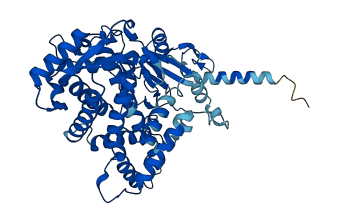
1 structures for P12938
| Entry ID | Method | Resolution | Chain | Position | Source |
|---|---|---|---|---|---|
| AF-P12938-F1 | Predicted | AlphaFoldDB |
No variants for P12938
| Variant ID(s) | Position | Change | Description | Diseaes Association | Provenance |
|---|---|---|---|---|---|
| No variants for P12938 | |||||
No associated diseases with P12938
1 regional properties for P12938
| Type | Name | Position | InterPro Accession |
|---|---|---|---|
| conserved_site | Cytochrome P450, conserved site | 439 - 448 | IPR017972 |
Functions
| Description | ||
|---|---|---|
| EC Number | 1.14.14.1 | With reduced flavin or flavoprotein as one donor, and incorporation of one atom of oxygen |
| Subcellular Localization |
|
|
| PANTHER Family | ||
| PANTHER Subfamily | ||
| PANTHER Protein Class | ||
| PANTHER Pathway Category | No pathway information available | |
3 GO annotations of cellular component
| Name | Definition |
|---|---|
| cytoplasm | The contents of a cell excluding the plasma membrane and nucleus, but including other subcellular structures. |
| endoplasmic reticulum membrane | The lipid bilayer surrounding the endoplasmic reticulum. |
| intracellular membrane-bounded organelle | Organized structure of distinctive morphology and function, bounded by a single or double lipid bilayer membrane and occurring within the cell. Includes the nucleus, mitochondria, plastids, vacuoles, and vesicles. Excludes the plasma membrane. |
6 GO annotations of molecular function
| Name | Definition |
|---|---|
| aromatase activity | Catalysis of the reduction of an aliphatic ring to yield an aromatic ring. |
| heme binding | Binding to a heme, a compound composed of iron complexed in a porphyrin (tetrapyrrole) ring. |
| iron ion binding | Binding to an iron (Fe) ion. |
| monooxygenase activity | Catalysis of the incorporation of one atom from molecular oxygen into a compound and the reduction of the other atom of oxygen to water. |
| oxidoreductase activity, acting on paired donors, with incorporation or reduction of molecular oxygen, reduced flavin or flavoprotein as one donor, and incorporation of one atom of oxygen | Catalysis of an oxidation-reduction (redox) reaction in which hydrogen or electrons are transferred from reduced flavin or flavoprotein and one other donor, and one atom of oxygen is incorporated into one donor. |
| steroid hydroxylase activity | Catalysis of the formation of a hydroxyl group on a steroid by incorporation of oxygen from O2. |
4 GO annotations of biological process
| Name | Definition |
|---|---|
| arachidonic acid metabolic process | The chemical reactions and pathways involving arachidonic acid, a straight chain fatty acid with 20 carbon atoms and four double bonds per molecule. Arachidonic acid is the all-Z-(5,8,11,14)-isomer. |
| liver development | The process whose specific outcome is the progression of the liver over time, from its formation to the mature structure. The liver is an exocrine gland which secretes bile and functions in metabolism of protein and carbohydrate and fat, synthesizes substances involved in the clotting of the blood, synthesizes vitamin A, detoxifies poisonous substances, stores glycogen, and breaks down worn-out erythrocytes. |
| organic acid metabolic process | The chemical reactions and pathways involving organic acids, any acidic compound containing carbon in covalent linkage. |
| xenobiotic metabolic process | The chemical reactions and pathways involving a xenobiotic compound, a compound foreign to the organim exposed to it. It may be synthesized by another organism (like ampicilin) or it can be a synthetic chemical. |
52 homologous proteins in AiPD
| UniProt AC | Gene Name | Protein Name | Species | Evidence Code |
|---|---|---|---|---|
| Q0IIF9 | CYP2U1 | Cytochrome P450 2U1 | Bos taurus (Bovine) | PR |
| O18963 | CYP2E1 | Cytochrome P450 2E1 | Bos taurus (Bovine) | PR |
| P12394 | CYP17A1 | Steroid 17-alpha-hydroxylase/17,20 lyase | Gallus gallus (Chicken) | PR |
| Q95078 | Cyp18a1 | Cytochrome P450 18a1 | Drosophila melanogaster (Fruit fly) | PR |
| P33260 | CYP2C18 | Cytochrome P450 2C18 | Homo sapiens (Human) | PR |
| Q7Z449 | CYP2U1 | Cytochrome P450 2U1 | Homo sapiens (Human) | PR |
| P05177 | CYP1A2 | Cytochrome P450 1A2 | Homo sapiens (Human) | PR |
| P05093 | CYP17A1 | Steroid 17-alpha-hydroxylase/17,20 lyase | Homo sapiens (Human) | PR |
| P51589 | CYP2J2 | Cytochrome P450 2J2 | Homo sapiens (Human) | PR |
| P10632 | CYP2C8 | Cytochrome P450 2C8 | Homo sapiens (Human) | PR |
| P05181 | CYP2E1 | Cytochrome P450 2E1 | Homo sapiens (Human) | PR |
| Q9D816 | Cyp2c55 | Cytochrome P450 2C55 | Mus musculus (Mouse) | PR |
| P27786 | Cyp17a1 | Steroid 17-alpha-hydroxylase/17,20 lyase | Mus musculus (Mouse) | PR |
| O54749 | Cyp2j5 | Cytochrome P450 2J5 | Mus musculus (Mouse) | PR |
| O54750 | Cyp2j6 | Cytochrome P450 2J6 | Mus musculus (Mouse) | PR |
| P24456 | Cyp2d10 | Cytochrome P450 2D10 | Mus musculus (Mouse) | PR |
| Q9CX98 | Cyp2u1 | Cytochrome P450 2U1 | Mus musculus (Mouse) | PR |
| P24457 | Cyp2d11 | Cytochrome P450 2D11 | Mus musculus (Mouse) | PR |
| P79383 | CYP2E1 | Cytochrome P450 2E1 | Sus scrofa (Pig) | PR |
| P11715 | Cyp17a1 | Steroid 17-alpha-hydroxylase/17,20 lyase | Rattus norvegicus (Rat) | PR |
| O35293 | Cyp2f2 | Cytochrome P450 2F2 | Rattus norvegicus (Rat) | PR |
| P05182 | Cyp2e1 | Cytochrome P450 2E1 | Rattus norvegicus (Rat) | PR |
| P20814 | Cyp2c13 | Cytochrome P450 2C13, male-specific | Rattus norvegicus (Rat) | PR |
| P10633 | Cyp2d1 | Cytochrome P450 2D1 | Rattus norvegicus (Rat) | PR |
| P12939 | Cyp2d10 | Cytochrome P450 2D10 | Rattus norvegicus (Rat) | PR |
| P24470 | Cyp2c23 | Cytochrome P450 2C23 | Rattus norvegicus (Rat) | PR |
| P33273 | Cyp2c55 | Cytochrome P450 2C55 | Rattus norvegicus (Rat) | PR |
| P05179 | Cyp2c7 | Cytochrome P450 2C7 | Rattus norvegicus (Rat) | PR |
| Q8HYM9 | CYP17A1 | Steroid 17-alpha-hydroxylase/17,20 lyase | Macaca mulatta (Rhesus macaque) | PR |
| Q6YV88 | CYP71Z7 | Ent-cassadiene hydroxylase | Oryza sativa subsp japonica (Rice) | PR |
| A3A871 | CYP71Z6 | Ent-isokaurene C2/C3-hydroxylase | Oryza sativa subsp japonica (Rice) | PR |
| Q7X7X4 | CYP99A2 | Cytochrome P450 99A2 | Oryza sativa subsp japonica (Rice) | PR |
| O48957 | CYP99A1 | Cytochrome P450 CYP99A1 | Sorghum bicolor (Sorghum) (Sorghum vulgare) | PR |
| O48922 | CYP98A2 | Cytochrome P450 98A2 | Glycine max (Soybean) (Glycine hispida) | PR |
| Q42797 | CYP73A11 | Trans-cinnamate 4-monooxygenase | Glycine max (Soybean) (Glycine hispida) | PR |
| Q9XHC6 | CYP93E1 | Beta-amyrin 24-hydroxylase | Glycine max (Soybean) (Glycine hispida) | PR |
| O81971 | CYP71D9 | Cytochrome P450 71D9 | Glycine max (Soybean) (Glycine hispida) | PR |
| O49340 | CYP71A12 | Cytochrome P450 71A12 | Arabidopsis thaliana (Mouse-ear cress) | PR |
| O64638 | CYP76C3 | Cytochrome P450 76C3 | Arabidopsis thaliana (Mouse-ear cress) | PR |
| P58049 | CYP71B11 | Cytochrome P450 71B11 | Arabidopsis thaliana (Mouse-ear cress) | PR |
| P58050 | CYP71B13 | Cytochrome P450 71B13 | Arabidopsis thaliana (Mouse-ear cress) | PR |
| Q96514 | CYP71B7 | Cytochrome P450 71B7 | Arabidopsis thaliana (Mouse-ear cress) | PR |
| Q9CA61 | CYP98A8 | Cytochrome P450 98A8 | Arabidopsis thaliana (Mouse-ear cress) | PR |
| Q9LTM0 | CYP71B23 | Cytochrome P450 71B23 | Arabidopsis thaliana (Mouse-ear cress) | PR |
| Q9LTM6 | CYP71B17 | Cytochrome P450 71B17 | Arabidopsis thaliana (Mouse-ear cress) | PR |
| Q9LTM7 | CYP71B16 | Cytochrome P450 71B16 | Arabidopsis thaliana (Mouse-ear cress) | PR |
| Q9LVD2 | CYP71B10 | Cytochrome P450 71B10 | Arabidopsis thaliana (Mouse-ear cress) | PR |
| Q9SAE4 | CYP71B29 | Cytochrome P450 71B29 | Arabidopsis thaliana (Mouse-ear cress) | PR |
| Q9SRQ1 | CYP89A9 | Cytochrome P450 89A9 | Arabidopsis thaliana (Mouse-ear cress) | PR |
| Q9ZU07 | CYP71B12 | Cytochrome P450 71B12 | Arabidopsis thaliana (Mouse-ear cress) | PR |
| O64636 | CYP76C1 | Cytochrome P450 76C1 | Arabidopsis thaliana (Mouse-ear cress) | PR |
| Q949U1 | CYP79F1 | Dihomomethionine N-hydroxylase | Arabidopsis thaliana (Mouse-ear cress) | PR |
| 10 | 20 | 30 | 40 | 50 | 60 |
| MELLAGTGLW | PMAIFTVIFI | LLVDLMHRRQ | RWTSRYPPGP | VPWPVLGNLL | QVDLCNMPYS |
| 70 | 80 | 90 | 100 | 110 | 120 |
| MYKLQNRYGD | VFSLQMGWKP | VVVINGLKAV | QELLVTCGED | TADRPEMPIF | QHIGYGHKAK |
| 130 | 140 | 150 | 160 | 170 | 180 |
| GVVLAPYGPE | WREQRRFSVS | TLRNFGVGKK | SLEQWVTDEA | SHLCDALTAE | AGRPLDPYTL |
| 190 | 200 | 210 | 220 | 230 | 240 |
| LNKAVCNVIA | SLIYARRFDY | GDPDFIKVLK | ILKESMGEQT | GLFPEVLNMF | PVLLRIPGLA |
| 250 | 260 | 270 | 280 | 290 | 300 |
| DKVFPGQKTF | LTMVDNLVTE | HKKTWDPDQP | PRDLTDAFLA | EIEKAKGNPE | SSFNDANLRL |
| 310 | 320 | 330 | 340 | 350 | 360 |
| VVNDLFGAGM | VTTSITLTWA | LLLMILHPDV | QCRVQQEIDE | VIGQVRHPEM | ADQAHMPFTN |
| 370 | 380 | 390 | 400 | 410 | 420 |
| AVIHEVQRFA | DIVPMNLPHK | TSRDIEVQGF | LIPKGTTLIP | NLSSVLKDET | VWEKPLRFHP |
| 430 | 440 | 450 | 460 | 470 | 480 |
| EHFLDAQGNF | VKHEAFMPFS | AGRRACLGEP | LARMELFLFF | TCLLQRFSFS | VPTGQPRPSD |
| 490 | |||||
| YGVFAFLLSP | SPYQLCAFKR |