P05182
Gene name |
Cyp2e1 |
Protein name |
Cytochrome P450 2E1 |
Names |
4-nitrophenol 2-hydroxylase, CYPIIE1, Cytochrome P450-J, Cytochrome P450RLM6 |
Species |
Rattus norvegicus (Rat) |
KEGG Pathway |
rno:25086 |
EC number |
1.14.13.n7: With NADH or NADPH as one donor, and incorporation of one atom of oxygen |
Protein Class |
|
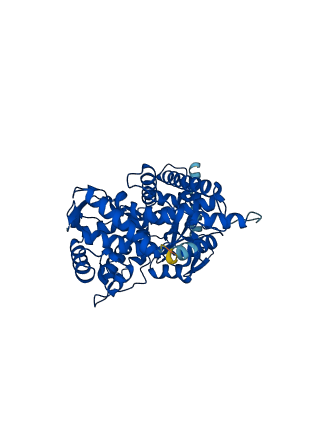
Descriptions
The autoinhibited protein was predicted that may have potential autoinhibitory elements via cis-regPred.
Autoinhibitory domains (AIDs)
Target domain |
|
Relief mechanism |
|
Assay |
cis-regPred |
Accessory elements
No accessory elements
Autoinhibited structure

Activated structure
1 structures for P05182
| Entry ID | Method | Resolution | Chain | Position | Source |
|---|---|---|---|---|---|
| AF-P05182-F1 | Predicted | AlphaFoldDB |
No variants for P05182
| Variant ID(s) | Position | Change | Description | Diseaes Association | Provenance |
|---|---|---|---|---|---|
| No variants for P05182 | |||||
No associated diseases with P05182
1 regional properties for P05182
| Type | Name | Position | InterPro Accession |
|---|---|---|---|
| conserved_site | Cytochrome P450, conserved site | 430 - 439 | IPR017972 |
Functions
| Description | ||
|---|---|---|
| EC Number | 1.14.13.n7 | With NADH or NADPH as one donor, and incorporation of one atom of oxygen |
| Subcellular Localization |
|
|
| PANTHER Family | ||
| PANTHER Subfamily | ||
| PANTHER Protein Class | ||
| PANTHER Pathway Category | No pathway information available | |
8 GO annotations of cellular component
| Name | Definition |
|---|---|
| cytoplasm | The contents of a cell excluding the plasma membrane and nucleus, but including other subcellular structures. |
| endoplasmic reticulum | The irregular network of unit membranes, visible only by electron microscopy, that occurs in the cytoplasm of many eukaryotic cells. The membranes form a complex meshwork of tubular channels, which are often expanded into slitlike cavities called cisternae. The ER takes two forms, rough (or granular), with ribosomes adhering to the outer surface, and smooth (with no ribosomes attached). |
| endoplasmic reticulum membrane | The lipid bilayer surrounding the endoplasmic reticulum. |
| Golgi membrane | The lipid bilayer surrounding any of the compartments of the Golgi apparatus. |
| intracellular membrane-bounded organelle | Organized structure of distinctive morphology and function, bounded by a single or double lipid bilayer membrane and occurring within the cell. Includes the nucleus, mitochondria, plastids, vacuoles, and vesicles. Excludes the plasma membrane. |
| intrinsic component of endoplasmic reticulum membrane | The component of the endoplasmic reticulum membrane consisting of the gene products and protein complexes having either part of their peptide sequence embedded in the hydrophobic region of the membrane or some other covalently attached group such as a GPI anchor that is similarly embedded in the membrane. |
| mitochondrial inner membrane | The inner, i.e. lumen-facing, lipid bilayer of the mitochondrial envelope. It is highly folded to form cristae. |
| mitochondrion | A semiautonomous, self replicating organelle that occurs in varying numbers, shapes, and sizes in the cytoplasm of virtually all eukaryotic cells. It is notably the site of tissue respiration. |
13 GO annotations of molecular function
| Name | Definition |
|---|---|
| 4-nitrophenol 2-monooxygenase activity | Catalysis of the reaction: 4-nitrophenol + H(+) + NADH + O(2) = 4-nitrocatechol + H(2)O + NAD(+). |
| arachidonic acid epoxygenase activity | Catalysis of an NADPH- and oxygen-dependent reaction that converts arachidonic acid to a cis-epoxyeicosatrienoic acid. |
| aromatase activity | Catalysis of the reduction of an aliphatic ring to yield an aromatic ring. |
| enzyme binding | Binding to an enzyme, a protein with catalytic activity. |
| heme binding | Binding to a heme, a compound composed of iron complexed in a porphyrin (tetrapyrrole) ring. |
| Hsp70 protein binding | Binding to a Hsp70 protein, heat shock proteins around 70kDa in size. |
| Hsp90 protein binding | Binding to Hsp90 proteins, any of a group of heat shock proteins around 90kDa in size. |
| iron ion binding | Binding to an iron (Fe) ion. |
| long-chain fatty acid omega-1 hydroxylase activity | Catalysis of the reaction: an (omega-1)-ethyl long-chain fatty acid + O2 + reduced = an (omega-1)-hydroxy-long-chain fatty acid + H+ + H2O + oxidized |
| monooxygenase activity | Catalysis of the incorporation of one atom from molecular oxygen into a compound and the reduction of the other atom of oxygen to water. |
| oxidoreductase activity | Catalysis of an oxidation-reduction (redox) reaction, a reversible chemical reaction in which the oxidation state of an atom or atoms within a molecule is altered. One substrate acts as a hydrogen or electron donor and becomes oxidized, while the other acts as hydrogen or electron acceptor and becomes reduced. |
| oxidoreductase activity, acting on paired donors, with incorporation or reduction of molecular oxygen, reduced flavin or flavoprotein as one donor, and incorporation of one atom of oxygen | Catalysis of an oxidation-reduction (redox) reaction in which hydrogen or electrons are transferred from reduced flavin or flavoprotein and one other donor, and one atom of oxygen is incorporated into one donor. |
| steroid hydroxylase activity | Catalysis of the formation of a hydroxyl group on a steroid by incorporation of oxygen from O2. |
15 GO annotations of biological process
| Name | Definition |
|---|---|
| 4-nitrophenol metabolic process | The chemical reactions and pathways involving 4-nitrophenol, a nitroaromatic compound which is used in the production of dyes, leather treatment agents, fungicides and as an intermediate in the production of the insecticide parathion. |
| epoxygenase P450 pathway | The chemical reactions and pathways by which arachidonic acid is converted to other compounds including epoxyeicosatrienoic acids and dihydroxyeicosatrienoic acids. |
| heterocycle metabolic process | The chemical reactions and pathways involving heterocyclic compounds, those with a cyclic molecular structure and at least two different atoms in the ring (or rings). |
| lipid hydroxylation | The covalent attachment of a hydroxyl group to one or more fatty acids in a lipid. |
| long-chain fatty acid metabolic process | The chemical reactions and pathways involving long-chain fatty acids, A long-chain fatty acid is a fatty acid with a chain length between C13 and C22. |
| monoterpenoid metabolic process | The chemical reactions and pathways involving monoterpenoid compounds, terpenoids having a C10 skeleton. |
| organic acid metabolic process | The chemical reactions and pathways involving organic acids, any acidic compound containing carbon in covalent linkage. |
| response to bacterium | Any process that results in a change in state or activity of a cell or an organism (in terms of movement, secretion, enzyme production, gene expression, etc.) as a result of a stimulus from a bacterium. |
| response to ethanol | Any process that results in a change in state or activity of a cell or an organism (in terms of movement, secretion, enzyme production, gene expression, etc.) as a result of an ethanol stimulus. |
| response to organonitrogen compound | Any process that results in a change in state or activity of a cell or an organism (in terms of movement, secretion, enzyme production, gene expression, etc.) as a result of an organonitrogen stimulus. An organonitrogen compound is formally a compound containing at least one carbon-nitrogen bond. |
| response to ozone | Any process that results in a change in state or activity of a cell or an organism (in terms of movement, secretion, enzyme production, gene expression, etc.) as a result of a ozone stimulus. |
| response to xenobiotic stimulus | Any process that results in a change in state or activity of a cell or an organism (in terms of movement, secretion, enzyme production, gene expression, etc.) as a result of a stimulus from a xenobiotic, a compound foreign to the organim exposed to it. It may be synthesized by another organism (like ampicilin) or it can be a synthetic chemical. |
| steroid metabolic process | The chemical reactions and pathways involving steroids, compounds with a 1,2,cyclopentanoperhydrophenanthrene nucleus. |
| triglyceride metabolic process | The chemical reactions and pathways involving triglyceride, any triester of glycerol. The three fatty acid residues may all be the same or differ in any permutation. Triglycerides are important components of plant oils, animal fats and animal plasma lipoproteins. |
| xenobiotic metabolic process | The chemical reactions and pathways involving a xenobiotic compound, a compound foreign to the organim exposed to it. It may be synthesized by another organism (like ampicilin) or it can be a synthetic chemical. |
52 homologous proteins in AiPD
| UniProt AC | Gene Name | Protein Name | Species | Evidence Code |
|---|---|---|---|---|
| Q0IIF9 | CYP2U1 | Cytochrome P450 2U1 | Bos taurus (Bovine) | PR |
| O18963 | CYP2E1 | Cytochrome P450 2E1 | Bos taurus (Bovine) | PR |
| P12394 | CYP17A1 | Steroid 17-alpha-hydroxylase/17,20 lyase | Gallus gallus (Chicken) | PR |
| Q95078 | Cyp18a1 | Cytochrome P450 18a1 | Drosophila melanogaster (Fruit fly) | PR |
| P33260 | CYP2C18 | Cytochrome P450 2C18 | Homo sapiens (Human) | PR |
| Q7Z449 | CYP2U1 | Cytochrome P450 2U1 | Homo sapiens (Human) | PR |
| P05177 | CYP1A2 | Cytochrome P450 1A2 | Homo sapiens (Human) | PR |
| P05093 | CYP17A1 | Steroid 17-alpha-hydroxylase/17,20 lyase | Homo sapiens (Human) | PR |
| P51589 | CYP2J2 | Cytochrome P450 2J2 | Homo sapiens (Human) | PR |
| P10632 | CYP2C8 | Cytochrome P450 2C8 | Homo sapiens (Human) | PR |
| P05181 | CYP2E1 | Cytochrome P450 2E1 | Homo sapiens (Human) | PR |
| Q9D816 | Cyp2c55 | Cytochrome P450 2C55 | Mus musculus (Mouse) | PR |
| P27786 | Cyp17a1 | Steroid 17-alpha-hydroxylase/17,20 lyase | Mus musculus (Mouse) | PR |
| O54749 | Cyp2j5 | Cytochrome P450 2J5 | Mus musculus (Mouse) | PR |
| O54750 | Cyp2j6 | Cytochrome P450 2J6 | Mus musculus (Mouse) | PR |
| P24456 | Cyp2d10 | Cytochrome P450 2D10 | Mus musculus (Mouse) | PR |
| Q9CX98 | Cyp2u1 | Cytochrome P450 2U1 | Mus musculus (Mouse) | PR |
| P24457 | Cyp2d11 | Cytochrome P450 2D11 | Mus musculus (Mouse) | PR |
| P79383 | CYP2E1 | Cytochrome P450 2E1 | Sus scrofa (Pig) | PR |
| P11715 | Cyp17a1 | Steroid 17-alpha-hydroxylase/17,20 lyase | Rattus norvegicus (Rat) | PR |
| O35293 | Cyp2f2 | Cytochrome P450 2F2 | Rattus norvegicus (Rat) | PR |
| P12938 | Cyp2d3 | Cytochrome P450 2D3 | Rattus norvegicus (Rat) | PR |
| P20814 | Cyp2c13 | Cytochrome P450 2C13, male-specific | Rattus norvegicus (Rat) | PR |
| P10633 | Cyp2d1 | Cytochrome P450 2D1 | Rattus norvegicus (Rat) | PR |
| P12939 | Cyp2d10 | Cytochrome P450 2D10 | Rattus norvegicus (Rat) | PR |
| P24470 | Cyp2c23 | Cytochrome P450 2C23 | Rattus norvegicus (Rat) | PR |
| P33273 | Cyp2c55 | Cytochrome P450 2C55 | Rattus norvegicus (Rat) | PR |
| P05179 | Cyp2c7 | Cytochrome P450 2C7 | Rattus norvegicus (Rat) | PR |
| Q8HYM9 | CYP17A1 | Steroid 17-alpha-hydroxylase/17,20 lyase | Macaca mulatta (Rhesus macaque) | PR |
| Q6YV88 | CYP71Z7 | Ent-cassadiene hydroxylase | Oryza sativa subsp japonica (Rice) | PR |
| A3A871 | CYP71Z6 | Ent-isokaurene C2/C3-hydroxylase | Oryza sativa subsp japonica (Rice) | PR |
| Q7X7X4 | CYP99A2 | Cytochrome P450 99A2 | Oryza sativa subsp japonica (Rice) | PR |
| O48957 | CYP99A1 | Cytochrome P450 CYP99A1 | Sorghum bicolor (Sorghum) (Sorghum vulgare) | PR |
| O48922 | CYP98A2 | Cytochrome P450 98A2 | Glycine max (Soybean) (Glycine hispida) | PR |
| Q42797 | CYP73A11 | Trans-cinnamate 4-monooxygenase | Glycine max (Soybean) (Glycine hispida) | PR |
| Q9XHC6 | CYP93E1 | Beta-amyrin 24-hydroxylase | Glycine max (Soybean) (Glycine hispida) | PR |
| O81971 | CYP71D9 | Cytochrome P450 71D9 | Glycine max (Soybean) (Glycine hispida) | PR |
| O49340 | CYP71A12 | Cytochrome P450 71A12 | Arabidopsis thaliana (Mouse-ear cress) | PR |
| O64638 | CYP76C3 | Cytochrome P450 76C3 | Arabidopsis thaliana (Mouse-ear cress) | PR |
| P58049 | CYP71B11 | Cytochrome P450 71B11 | Arabidopsis thaliana (Mouse-ear cress) | PR |
| P58050 | CYP71B13 | Cytochrome P450 71B13 | Arabidopsis thaliana (Mouse-ear cress) | PR |
| Q96514 | CYP71B7 | Cytochrome P450 71B7 | Arabidopsis thaliana (Mouse-ear cress) | PR |
| Q9CA61 | CYP98A8 | Cytochrome P450 98A8 | Arabidopsis thaliana (Mouse-ear cress) | PR |
| Q9LTM0 | CYP71B23 | Cytochrome P450 71B23 | Arabidopsis thaliana (Mouse-ear cress) | PR |
| Q9LTM6 | CYP71B17 | Cytochrome P450 71B17 | Arabidopsis thaliana (Mouse-ear cress) | PR |
| Q9LTM7 | CYP71B16 | Cytochrome P450 71B16 | Arabidopsis thaliana (Mouse-ear cress) | PR |
| Q9LVD2 | CYP71B10 | Cytochrome P450 71B10 | Arabidopsis thaliana (Mouse-ear cress) | PR |
| Q9SAE4 | CYP71B29 | Cytochrome P450 71B29 | Arabidopsis thaliana (Mouse-ear cress) | PR |
| Q9SRQ1 | CYP89A9 | Cytochrome P450 89A9 | Arabidopsis thaliana (Mouse-ear cress) | PR |
| Q9ZU07 | CYP71B12 | Cytochrome P450 71B12 | Arabidopsis thaliana (Mouse-ear cress) | PR |
| O64636 | CYP76C1 | Cytochrome P450 76C1 | Arabidopsis thaliana (Mouse-ear cress) | PR |
| Q949U1 | CYP79F1 | Dihomomethionine N-hydroxylase | Arabidopsis thaliana (Mouse-ear cress) | PR |
| 10 | 20 | 30 | 40 | 50 | 60 |
| MAVLGITIAL | LVWVATLLVI | SIWKQIYNSW | NLPPGPFPLP | ILGNIFQLDL | KDIPKSFTKL |
| 70 | 80 | 90 | 100 | 110 | 120 |
| AKRFGPVFTL | HLGSRRIVVL | HGYKAVKEVL | LNHKNEFSGR | GDIPVFQEYK | NKGIIFNNGP |
| 130 | 140 | 150 | 160 | 170 | 180 |
| TWKDVRRFSL | SILRDWGMGK | QGNEARIQRE | AQFLVEELKK | TKGQPFDPTF | LIGCAPCNVI |
| 190 | 200 | 210 | 220 | 230 | 240 |
| ADILFNKRFD | YNDKKCLRLM | SLFNENFYLL | STPWIQLYNN | FADYLRYLPG | SHRKIMKNVS |
| 250 | 260 | 270 | 280 | 290 | 300 |
| EIKQYTLEKA | KEHLQSLDIN | CARDVTDCLL | IEMEKEKHSQ | EPMYTMENVS | VTLADLFFAG |
| 310 | 320 | 330 | 340 | 350 | 360 |
| TETTSTTLRY | GLLILMKYPE | IEEKLHEEID | RVIGPSRVPA | VRDRLDMPYM | DAVVHEIQRF |
| 370 | 380 | 390 | 400 | 410 | 420 |
| INLVPSNLPH | EATRDTVFQG | YVIPKGTVVI | PTLDSLLYDS | HEFPDPEKFK | PEHFLNENGK |
| 430 | 440 | 450 | 460 | 470 | 480 |
| FKYSDYFKAF | SAGKRVCVGE | GLARMELFLL | LSAILQHFNL | KSLVDPKDID | LSPVTVGFGS |
| 490 | |||||
| IPPQFKLCVI | PRS |