P05179
Gene name |
Cyp2c7 (Cyp2c-7) |
Protein name |
Cytochrome P450 2C7 |
Names |
CYPIIC7, Cytochrome P450F, PTF1 |
Species |
Rattus norvegicus (Rat) |
KEGG Pathway |
rno:29298 |
EC number |
1.14.14.1: With reduced flavin or flavoprotein as one donor, and incorporation of one atom of oxygen |
Protein Class |
|
Descriptions
The autoinhibited protein was predicted that may have potential autoinhibitory elements via cis-regPred.
Autoinhibitory domains (AIDs)
Target domain |
|
Relief mechanism |
|
Assay |
cis-regPred |
Accessory elements
No accessory elements
Autoinhibited structure

Activated structure
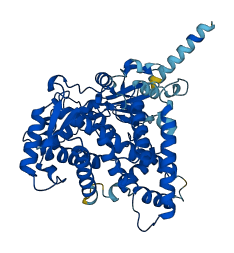
1 structures for P05179
| Entry ID | Method | Resolution | Chain | Position | Source |
|---|---|---|---|---|---|
| AF-P05179-F1 | Predicted | AlphaFoldDB |
No variants for P05179
| Variant ID(s) | Position | Change | Description | Diseaes Association | Provenance |
|---|---|---|---|---|---|
| No variants for P05179 | |||||
No associated diseases with P05179
1 regional properties for P05179
| Type | Name | Position | InterPro Accession |
|---|---|---|---|
| conserved_site | Cytochrome P450, conserved site | 428 - 437 | IPR017972 |
Functions
| Description | ||
|---|---|---|
| EC Number | 1.14.14.1 | With reduced flavin or flavoprotein as one donor, and incorporation of one atom of oxygen |
| Subcellular Localization |
|
|
| PANTHER Family | ||
| PANTHER Subfamily | ||
| PANTHER Protein Class | ||
| PANTHER Pathway Category | No pathway information available | |
3 GO annotations of cellular component
| Name | Definition |
|---|---|
| cytoplasm | The contents of a cell excluding the plasma membrane and nucleus, but including other subcellular structures. |
| endoplasmic reticulum membrane | The lipid bilayer surrounding the endoplasmic reticulum. |
| intracellular membrane-bounded organelle | Organized structure of distinctive morphology and function, bounded by a single or double lipid bilayer membrane and occurring within the cell. Includes the nucleus, mitochondria, plastids, vacuoles, and vesicles. Excludes the plasma membrane. |
6 GO annotations of molecular function
| Name | Definition |
|---|---|
| arachidonic acid epoxygenase activity | Catalysis of an NADPH- and oxygen-dependent reaction that converts arachidonic acid to a cis-epoxyeicosatrienoic acid. |
| aromatase activity | Catalysis of the reduction of an aliphatic ring to yield an aromatic ring. |
| heme binding | Binding to a heme, a compound composed of iron complexed in a porphyrin (tetrapyrrole) ring. |
| iron ion binding | Binding to an iron (Fe) ion. |
| oxidoreductase activity, acting on paired donors, with incorporation or reduction of molecular oxygen, reduced flavin or flavoprotein as one donor, and incorporation of one atom of oxygen | Catalysis of an oxidation-reduction (redox) reaction in which hydrogen or electrons are transferred from reduced flavin or flavoprotein and one other donor, and one atom of oxygen is incorporated into one donor. |
| steroid hydroxylase activity | Catalysis of the formation of a hydroxyl group on a steroid by incorporation of oxygen from O2. |
11 GO annotations of biological process
| Name | Definition |
|---|---|
| epoxygenase P450 pathway | The chemical reactions and pathways by which arachidonic acid is converted to other compounds including epoxyeicosatrienoic acids and dihydroxyeicosatrienoic acids. |
| organic acid metabolic process | The chemical reactions and pathways involving organic acids, any acidic compound containing carbon in covalent linkage. |
| response to ethanol | Any process that results in a change in state or activity of a cell or an organism (in terms of movement, secretion, enzyme production, gene expression, etc.) as a result of an ethanol stimulus. |
| response to lipopolysaccharide | Any process that results in a change in state or activity of an organism (in terms of movement, secretion, enzyme production, gene expression, etc.) as a result of a lipopolysaccharide stimulus; lipopolysaccharide is a major component of the cell wall of gram-negative bacteria. |
| response to nutrient | Any process that results in a change in state or activity of a cell or an organism (in terms of movement, secretion, enzyme production, gene expression, etc.) as a result of a nutrient stimulus. |
| response to organic cyclic compound | Any process that results in a change in state or activity of a cell or an organism (in terms of movement, secretion, enzyme production, gene expression, etc.) as a result of an organic cyclic compound stimulus. |
| response to organonitrogen compound | Any process that results in a change in state or activity of a cell or an organism (in terms of movement, secretion, enzyme production, gene expression, etc.) as a result of an organonitrogen stimulus. An organonitrogen compound is formally a compound containing at least one carbon-nitrogen bond. |
| response to peptide hormone | Any process that results in a change in state or activity of a cell or an organism (in terms of movement, secretion, enzyme production, gene expression, etc.) as a result of a peptide hormone stimulus. A peptide hormone is any of a class of peptides that are secreted into the blood stream and have endocrine functions in living animals. |
| response to retinoic acid | Any process that results in a change in state or activity of a cell or an organism (in terms of movement, secretion, enzyme production, gene expression, etc.) as a result of a retinoic acid stimulus. |
| response to xenobiotic stimulus | Any process that results in a change in state or activity of a cell or an organism (in terms of movement, secretion, enzyme production, gene expression, etc.) as a result of a stimulus from a xenobiotic, a compound foreign to the organim exposed to it. It may be synthesized by another organism (like ampicilin) or it can be a synthetic chemical. |
| xenobiotic metabolic process | The chemical reactions and pathways involving a xenobiotic compound, a compound foreign to the organim exposed to it. It may be synthesized by another organism (like ampicilin) or it can be a synthetic chemical. |
52 homologous proteins in AiPD
| UniProt AC | Gene Name | Protein Name | Species | Evidence Code |
|---|---|---|---|---|
| Q0IIF9 | CYP2U1 | Cytochrome P450 2U1 | Bos taurus (Bovine) | PR |
| O18963 | CYP2E1 | Cytochrome P450 2E1 | Bos taurus (Bovine) | PR |
| P12394 | CYP17A1 | Steroid 17-alpha-hydroxylase/17,20 lyase | Gallus gallus (Chicken) | PR |
| Q95078 | Cyp18a1 | Cytochrome P450 18a1 | Drosophila melanogaster (Fruit fly) | PR |
| Q7Z449 | CYP2U1 | Cytochrome P450 2U1 | Homo sapiens (Human) | PR |
| P05177 | CYP1A2 | Cytochrome P450 1A2 | Homo sapiens (Human) | PR |
| P05093 | CYP17A1 | Steroid 17-alpha-hydroxylase/17,20 lyase | Homo sapiens (Human) | PR |
| P51589 | CYP2J2 | Cytochrome P450 2J2 | Homo sapiens (Human) | PR |
| P10632 | CYP2C8 | Cytochrome P450 2C8 | Homo sapiens (Human) | PR |
| P05181 | CYP2E1 | Cytochrome P450 2E1 | Homo sapiens (Human) | PR |
| P33260 | CYP2C18 | Cytochrome P450 2C18 | Homo sapiens (Human) | PR |
| Q9D816 | Cyp2c55 | Cytochrome P450 2C55 | Mus musculus (Mouse) | PR |
| P27786 | Cyp17a1 | Steroid 17-alpha-hydroxylase/17,20 lyase | Mus musculus (Mouse) | PR |
| O54749 | Cyp2j5 | Cytochrome P450 2J5 | Mus musculus (Mouse) | PR |
| O54750 | Cyp2j6 | Cytochrome P450 2J6 | Mus musculus (Mouse) | PR |
| P24456 | Cyp2d10 | Cytochrome P450 2D10 | Mus musculus (Mouse) | PR |
| Q9CX98 | Cyp2u1 | Cytochrome P450 2U1 | Mus musculus (Mouse) | PR |
| P24457 | Cyp2d11 | Cytochrome P450 2D11 | Mus musculus (Mouse) | PR |
| P79383 | CYP2E1 | Cytochrome P450 2E1 | Sus scrofa (Pig) | PR |
| P11715 | Cyp17a1 | Steroid 17-alpha-hydroxylase/17,20 lyase | Rattus norvegicus (Rat) | PR |
| O35293 | Cyp2f2 | Cytochrome P450 2F2 | Rattus norvegicus (Rat) | PR |
| P05182 | Cyp2e1 | Cytochrome P450 2E1 | Rattus norvegicus (Rat) | PR |
| P10633 | Cyp2d1 | Cytochrome P450 2D1 | Rattus norvegicus (Rat) | PR |
| P12938 | Cyp2d3 | Cytochrome P450 2D3 | Rattus norvegicus (Rat) | PR |
| P12939 | Cyp2d10 | Cytochrome P450 2D10 | Rattus norvegicus (Rat) | PR |
| P20814 | Cyp2c13 | Cytochrome P450 2C13, male-specific | Rattus norvegicus (Rat) | PR |
| P24470 | Cyp2c23 | Cytochrome P450 2C23 | Rattus norvegicus (Rat) | PR |
| P33273 | Cyp2c55 | Cytochrome P450 2C55 | Rattus norvegicus (Rat) | PR |
| Q8HYM9 | CYP17A1 | Steroid 17-alpha-hydroxylase/17,20 lyase | Macaca mulatta (Rhesus macaque) | PR |
| A3A871 | CYP71Z6 | Ent-isokaurene C2/C3-hydroxylase | Oryza sativa subsp japonica (Rice) | PR |
| Q6YV88 | CYP71Z7 | Ent-cassadiene hydroxylase | Oryza sativa subsp japonica (Rice) | PR |
| Q7X7X4 | CYP99A2 | Cytochrome P450 99A2 | Oryza sativa subsp japonica (Rice) | PR |
| O48957 | CYP99A1 | Cytochrome P450 CYP99A1 | Sorghum bicolor (Sorghum) (Sorghum vulgare) | PR |
| O48922 | CYP98A2 | Cytochrome P450 98A2 | Glycine max (Soybean) (Glycine hispida) | PR |
| O81971 | CYP71D9 | Cytochrome P450 71D9 | Glycine max (Soybean) (Glycine hispida) | PR |
| Q42797 | CYP73A11 | Trans-cinnamate 4-monooxygenase | Glycine max (Soybean) (Glycine hispida) | PR |
| Q9XHC6 | CYP93E1 | Beta-amyrin 24-hydroxylase | Glycine max (Soybean) (Glycine hispida) | PR |
| O49340 | CYP71A12 | Cytochrome P450 71A12 | Arabidopsis thaliana (Mouse-ear cress) | PR |
| O64636 | CYP76C1 | Cytochrome P450 76C1 | Arabidopsis thaliana (Mouse-ear cress) | PR |
| O64638 | CYP76C3 | Cytochrome P450 76C3 | Arabidopsis thaliana (Mouse-ear cress) | PR |
| P58049 | CYP71B11 | Cytochrome P450 71B11 | Arabidopsis thaliana (Mouse-ear cress) | PR |
| P58050 | CYP71B13 | Cytochrome P450 71B13 | Arabidopsis thaliana (Mouse-ear cress) | PR |
| Q949U1 | CYP79F1 | Dihomomethionine N-hydroxylase | Arabidopsis thaliana (Mouse-ear cress) | PR |
| Q96514 | CYP71B7 | Cytochrome P450 71B7 | Arabidopsis thaliana (Mouse-ear cress) | PR |
| Q9CA61 | CYP98A8 | Cytochrome P450 98A8 | Arabidopsis thaliana (Mouse-ear cress) | PR |
| Q9LTM0 | CYP71B23 | Cytochrome P450 71B23 | Arabidopsis thaliana (Mouse-ear cress) | PR |
| Q9LTM6 | CYP71B17 | Cytochrome P450 71B17 | Arabidopsis thaliana (Mouse-ear cress) | PR |
| Q9LTM7 | CYP71B16 | Cytochrome P450 71B16 | Arabidopsis thaliana (Mouse-ear cress) | PR |
| Q9LVD2 | CYP71B10 | Cytochrome P450 71B10 | Arabidopsis thaliana (Mouse-ear cress) | PR |
| Q9SAE4 | CYP71B29 | Cytochrome P450 71B29 | Arabidopsis thaliana (Mouse-ear cress) | PR |
| Q9SRQ1 | CYP89A9 | Cytochrome P450 89A9 | Arabidopsis thaliana (Mouse-ear cress) | PR |
| Q9ZU07 | CYP71B12 | Cytochrome P450 71B12 | Arabidopsis thaliana (Mouse-ear cress) | PR |
| 10 | 20 | 30 | 40 | 50 | 60 |
| MDLVTFLVLT | LSSLILLSLW | RQSSRRRKLP | PGPTPLPIIG | NFLQIDVKNI | SQSLTKFSKT |
| 70 | 80 | 90 | 100 | 110 | 120 |
| YGPVFTLYLG | SQPTVILHGY | EAIKEALIDN | GEKFSGRGSY | PMNENVTKGF | GIVFSNGNRW |
| 130 | 140 | 150 | 160 | 170 | 180 |
| KEMRRFTIMN | FRNLGIGKRN | IEDRVQEEAQ | CLVEELRKTK | GSPCDPSLIL | NCAPCNVICS |
| 190 | 200 | 210 | 220 | 230 | 240 |
| ITFQNHFDYK | DKEMLTFMEK | VNENLKIMSS | PWMQVCNSFP | SLIDYFPGTH | HKIAKNINYM |
| 250 | 260 | 270 | 280 | 290 | 300 |
| KSYLLKKIEE | HQESLDVTNP | RDFVDYYLIK | QKQANNIEQS | EYSHENLTCS | IMDLIGAGTE |
| 310 | 320 | 330 | 340 | 350 | 360 |
| TMSTTLRYAL | LLLMKYPHVT | AKVQEEIDRV | IGRHRSPCMQ | DRKHMPYTDA | MIHEVQRFIN |
| 370 | 380 | 390 | 400 | 410 | 420 |
| FVPTNLPHAV | TCDIKFRNYL | IPKGTKVLTS | LTSVLHDSKE | FPNPEMFDPG | HFLDENGNFK |
| 430 | 440 | 450 | 460 | 470 | 480 |
| KSDYFLPFSA | GKRACVGEGL | ARMQLFLFLT | TILQNFNLKS | LVHPKDIDTM | PVLNGFASLP |
| PTYQLCFIPS |