Q9N2I2
Gene name |
SERPINA5 |
Protein name |
Plasma serine protease inhibitor |
Names |
Protein C inhibitor, PCI, Serpin A5 |
Species |
Bos taurus (Bovine) |
KEGG Pathway |
bta:338050 |
EC number |
|
Protein Class |
|
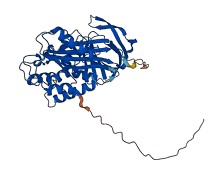
Descriptions
The autoinhibited protein was predicted that may have potential autoinhibitory elements via cis-regPred.
Autoinhibitory domains (AIDs)
Target domain |
|
Relief mechanism |
|
Assay |
cis-regPred |
Accessory elements
No accessory elements
Autoinhibited structure

Activated structure
2 structures for Q9N2I2
| Entry ID | Method | Resolution | Chain | Position | Source |
|---|---|---|---|---|---|
| 3B9F | X-ray | 160 A | I | 42-404 | PDB |
| AF-Q9N2I2-F1 | Predicted | AlphaFoldDB |
No variants for Q9N2I2
| Variant ID(s) | Position | Change | Description | Diseaes Association | Provenance |
|---|---|---|---|---|---|
| No variants for Q9N2I2 | |||||
No associated diseases with Q9N2I2
Functions
14 GO annotations of cellular component
| Name | Definition |
|---|---|
| acrosomal membrane | The membrane that surrounds the acrosomal lumen. The acrosome is a special type of lysosome in the head of a spermatozoon that contains acid hydrolases and is concerned with the breakdown of the outer membrane of the ovum during fertilization. |
| extracellular space | That part of a multicellular organism outside the cells proper, usually taken to be outside the plasma membranes, and occupied by fluid. |
| platelet alpha granule | A secretory organelle found in blood platelets, which is unique in that it exhibits further compartmentalization and acquires its protein content via two distinct mechanisms: (1) biosynthesis predominantly at the megakaryocyte (MK) level (with some vestigial platelet synthesis) (e.g. platelet factor 4) and (2) endocytosis and pinocytosis at both the MK and circulating platelet levels (e.g. fibrinogen (Fg) and IgG). |
| platelet dense tubular network | A network of membrane-bounded compartments found in blood platelets, where they regulate platelet activation by sequestering or releasing calcium. The dense tubular network exists as thin elongated membranes in resting platelets, and undergoes a major ultrastructural change, to a rounded vesicular form, upon addition of thrombin. |
| protein C inhibitor-coagulation factor V complex | A heterodimeric protein complex that contains protein C inhibitor (SERPINA5) and coagulation factor V (F5); formation of the complex inhibits the serine protease activity of coagulation factor V. |
| protein C inhibitor-coagulation factor Xa complex | A heterodimeric protein complex that contains protein C inhibitor (SERPINA5) and coagulation factor Xa (F10); formation of the complex inhibits the serine protease activity of coagulation factor Xa. |
| protein C inhibitor-coagulation factor XI complex | A heterodimeric protein complex that contains protein C inhibitor (SERPINA5) and coagulation factor XI (F11); formation of the complex inhibits the serine protease activity of coagulation factor XI. |
| protein C inhibitor-KLK3 complex | A heterodimeric protein complex that contains protein C inhibitor (SERPINA5) and prostate-specific antigen (KLK3); formation of the complex inhibits the serine protease activity of prostate-specific antigen. |
| protein C inhibitor-plasma kallikrein complex | A heterodimeric protein complex that contains protein C inhibitor (SERPINA5) and plasma kallikrein (KLK1B); formation of the complex inhibits the serine protease activity of plasma kallikrein. |
| protein C inhibitor-PLAT complex | A heterodimeric protein complex that contains protein C inhibitor (SERPINA5) and tissue-type plasminogen activator (PLAT); formation of the complex inhibits the serine protease activity of tissue-type plasminogen activator. |
| protein C inhibitor-PLAU complex | A heterodimeric protein complex that contains protein C inhibitor (SERPINA5) and urokinase-type plasminogen activator (PLAU); formation of the complex inhibits the serine protease activity of urokinase-type plasminogen activator. |
| protein C inhibitor-thrombin complex | A heterodimeric protein complex that contains protein C inhibitor (SERPINA5) and thrombin (F2); formation of the complex inhibits the serine protease activity of thrombin. |
| protein C inhibitor-TMPRSS11E complex | A heterodimeric protein complex that contains protein C inhibitor (SERPINA5) and transmembrane protease serine 11E (TMPRSS11E); formation of the complex inhibits the serine protease activity of transmembrane protease serine 11E. |
| protein C inhibitor-TMPRSS7 complex | A heterodimeric protein complex that contains protein C inhibitor (SERPINA5) and transmembrane protease serine 7 (TMPRSS7); formation of the complex inhibits the serine protease activity of transmembrane protease serine 7. |
4 GO annotations of molecular function
| Name | Definition |
|---|---|
| heparin binding | Binding to heparin, a member of a group of glycosaminoglycans found mainly as an intracellular component of mast cells and which consist predominantly of alternating alpha-(1->4)-linked D-galactose and N-acetyl-D-glucosamine-6-sulfate residues. |
| phosphatidylcholine binding | Binding to a phosphatidylcholine, a glycophospholipid in which a phosphatidyl group is esterified to the hydroxyl group of choline. |
| retinoic acid binding | Binding to retinoic acid, 3,7-dimethyl-9-(2,6,-trimethyl-1-cyclohexen-1-yl)-2,4,6,8-nonatetraenoic acid. |
| serine-type endopeptidase inhibitor activity | Binds to and stops, prevents or reduces the activity of serine-type endopeptidases, enzymes that catalyze the hydrolysis of nonterminal peptide bonds in a polypeptide chain; a serine residue (and a histidine residue) are at the active center of the enzyme. |
3 GO annotations of biological process
| Name | Definition |
|---|---|
| lipid transport | The directed movement of lipids into, out of or within a cell, or between cells, by means of some agent such as a transporter or pore. Lipids are compounds soluble in an organic solvent but not, or sparingly, in an aqueous solvent. |
| negative regulation of endopeptidase activity | Any process that decreases the frequency, rate or extent of endopeptidase activity, the endohydrolysis of peptide bonds within proteins. |
| single fertilization | The union of male and female gametes to form a zygote. |
37 homologous proteins in AiPD
| UniProt AC | Gene Name | Protein Name | Species | Evidence Code |
|---|---|---|---|---|
| P41361 | SERPINC1 | Antithrombin-III | Bos taurus (Bovine) | PR |
| Q9TTE1 | SERPINA3-1 | Serpin A3-1 | Bos taurus (Bovine) | PR |
| Q1JPB0 | SERPINB1 | Leukocyte elastase inhibitor | Bos taurus (Bovine) | PR |
| P13909 | SERPINE1 | Plasminogen activator inhibitor 1 | Bos taurus (Bovine) | PR |
| A2I7N1 | SERPINA3-5 | Serpin A3-5 | Bos taurus (Bovine) | PR |
| A6QPQ2 | SERPINA3-8 | Serpin A3-8 | Bos taurus (Bovine) | PR |
| A2I7N2 | SERPINA3-6 | Serpin A3-6 | Bos taurus (Bovine) | PR |
| A2I7M9 | SERPINA3-2 | Serpin A3-2 | Bos taurus (Bovine) | PR |
| O73790 | SERPINB10 | Heterochromatin-associated protein MENT | Gallus gallus (Chicken) | PR |
| P05121 | SERPINE1 | Plasminogen activator inhibitor 1 | Homo sapiens (Human) | PR |
| Q9UK55 | SERPINA10 | Protein Z-dependent protease inhibitor | Homo sapiens (Human) | PR |
| P05155 | SERPING1 | Plasma protease C1 inhibitor | Homo sapiens (Human) | PR |
| P08697 | SERPINF2 | Alpha-2-antiplasmin | Homo sapiens (Human) | PR |
| Q86WD7 | SERPINA9 | Serpin A9 | Homo sapiens (Human) | PR |
| P01008 | SERPINC1 | Antithrombin-III | Homo sapiens (Human) | PR |
| P01011 | SERPINA3 | Alpha-1-antichymotrypsin | Homo sapiens (Human) | PR |
| P07093 | SERPINE2 | Glia-derived nexin | Homo sapiens (Human) | PR |
| Q96P15 | SERPINB11 | Serpin B11 | Homo sapiens (Human) | PR |
| Q5SV42 | Serpinb1c | Leukocyte elastase inhibitor C | Mus musculus (Mouse) | PR |
| Q07235 | Serpine2 | Glia-derived nexin | Mus musculus (Mouse) | PR |
| Q8CDC0 | Serpinb13 | Serpin B13 | Mus musculus (Mouse) | PR |
| P22777 | Serpine1 | Plasminogen activator inhibitor 1 | Mus musculus (Mouse) | PR |
| Q5I2A0 | Serpina3g | Serine protease inhibitor A3G | Mus musculus (Mouse) | PR |
| Q9JK88 | Serpini2 | Serpin I2 | Mus musculus (Mouse) | PR |
| P12388 | Serpinb2 | Plasminogen activator inhibitor 2, macrophage | Mus musculus (Mouse) | PR |
| P32261 | Serpinc1 | Antithrombin-III | Mus musculus (Mouse) | PR |
| Q9D154 | Serpinb1a | Leukocyte elastase inhibitor A | Mus musculus (Mouse) | PR |
| Q8BYY9 | Serpina3b | Serine protease inhibitor A3B | Mus musculus (Mouse) | PR |
| Q80X76 | Serpina3f | Serine protease inhibitor A3F | Mus musculus (Mouse) | PR |
| P29524 | Serpinb2 | Plasminogen activator inhibitor 2 type A | Rattus norvegicus (Rat) | PR |
| Q6P734 | Serping1 | Plasma protease C1 inhibitor | Rattus norvegicus (Rat) | PR |
| P05545 | Serpina3k | Serine protease inhibitor A3K | Rattus norvegicus (Rat) | PR |
| P07092 | Serpine2 | Glia-derived nexin | Rattus norvegicus (Rat) | PR |
| Q62975 | Serpina10 | Protein Z-dependent protease inhibitor | Rattus norvegicus (Rat) | PR |
| Q9ZQR6 | At2g14540 | Serpin-Z2 | Arabidopsis thaliana (Mouse-ear cress) | PR |
| Q9M1T7 | At3g45220 | Serpin-Z4 | Arabidopsis thaliana (Mouse-ear cress) | PR |
| O48706 | At2g26390 | Serpin-Z3 | Arabidopsis thaliana (Mouse-ear cress) | PR |
| 10 | 20 | 30 | 40 | 50 | 60 |
| MRLCLFLCLV | LLGPRMATLR | RSQKKKIQEV | PPAVTTAPPG | SRDFVFDLYR | ALAAAAPAQN |
| 70 | 80 | 90 | 100 | 110 | 120 |
| IFFSPLSITV | SLAMLSLGAQ | SNTKAQILEG | LGIGPGEGSE | EELHSASQRL | LRELQQPQDS |
| 130 | 140 | 150 | 160 | 170 | 180 |
| LQLSLGNALF | TKPRLPIQEA | FLGAMRTLYL | ADTFPTNFED | PEGAKKKIND | YVAKQTKGKI |
| 190 | 200 | 210 | 220 | 230 | 240 |
| VDLIKSLDGT | QVMVMVNYIF | FKAKWETSFN | LKSTHEQDFY | VTPETVVRVP | MMKQQDQFYY |
| 250 | 260 | 270 | 280 | 290 | 300 |
| LLDRNLSCKV | VGVPYQGNAT | AFFILPREGE | MEQVENGLKE | KTLKKWLRMP | MKRRLELYLP |
| 310 | 320 | 330 | 340 | 350 | 360 |
| KFSIEGSYQL | EEVLPKLGIR | DIFTSDADLT | GISNHSSIRV | SEMVHKAVVE | VDESGTQAAA |
| 370 | 380 | 390 | 400 | ||
| ATGMVITFKS | ARLGSQRIVF | NRPFLVLIVK | NSKHILFLGK | VTRP |