Q07235
Gene name |
Serpine2 (Pi7, Pn1, Spi4) |
Protein name |
Glia-derived nexin |
Names |
GDN, Peptidase inhibitor 7, PI-7, Protease nexin 1, PN-1, Protease nexin I, Serine protease-inhibitor 4, Serpin E2 |
Species |
Mus musculus (Mouse) |
KEGG Pathway |
mmu:20720 |
EC number |
|
Protein Class |
|
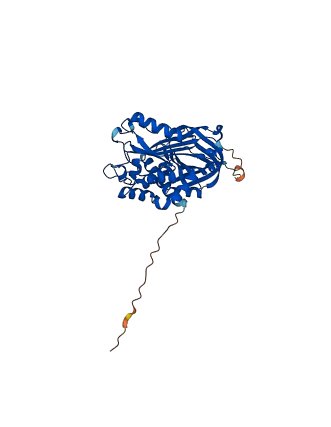
Descriptions
The autoinhibited protein was predicted that may have potential autoinhibitory elements via cis-regPred.
Autoinhibitory domains (AIDs)
Target domain |
|
Relief mechanism |
|
Assay |
cis-regPred |
Accessory elements
No accessory elements
Autoinhibited structure

Activated structure
1 structures for Q07235
| Entry ID | Method | Resolution | Chain | Position | Source |
|---|---|---|---|---|---|
| AF-Q07235-F1 | Predicted | AlphaFoldDB |
17 variants for Q07235
| Variant ID(s) | Position | Change | Description | Diseaes Association | Provenance |
|---|---|---|---|---|---|
| rs3388482736 | 59 | A>T | No | EVA | |
| rs3388483204 | 90 | K>R | No | EVA | |
| rs3388481342 | 95 | I>F | No | EVA | |
| rs3388483181 | 156 | W>G | No | EVA | |
| rs3388481408 | 209 | A>G | No | EVA | |
| rs3388483285 | 209 | A>S | No | EVA | |
| rs3388482464 | 258 | P>S | No | EVA | |
| rs3390230998 | 303 | D>S | No | EVA | |
| rs221984653 | 313 | I>V | No | EVA | |
| rs1134564187 | 325 | T>K | No | EVA | |
| rs3388482732 | 331 | E>Q | No | EVA | |
| rs3388482446 | 332 | S>I | No | EVA | |
| rs3388481292 | 351 | T>S | No | EVA | |
| rs3388480979 | 354 | S>P | No | EVA | |
| rs3388482351 | 362 | I>T | No | EVA | |
| rs3388482358 | 369 | W>* | No | EVA | |
| rs3388482358 | 369 | W>C | No | EVA |
No associated diseases with Q07235
1 regional properties for Q07235
| Type | Name | Position | InterPro Accession |
|---|---|---|---|
| domain | Histone H2A/H2B/H3 | 1 - 132 | IPR007125 |
9 GO annotations of cellular component
| Name | Definition |
|---|---|
| collagen-containing extracellular matrix | An extracellular matrix consisting mainly of proteins (especially collagen) and glycosaminoglycans (mostly as proteoglycans) that provides not only essential physical scaffolding for the cellular constituents but can also initiate crucial biochemical and biomechanical cues required for tissue morphogenesis, differentiation and homeostasis. The components are secreted by cells in the vicinity and form a sheet underlying or overlying cells such as endothelial and epithelial cells. |
| cytosol | The part of the cytoplasm that does not contain organelles but which does contain other particulate matter, such as protein complexes. |
| extracellular region | The space external to the outermost structure of a cell. For cells without external protective or external encapsulating structures this refers to space outside of the plasma membrane. This term covers the host cell environment outside an intracellular parasite. |
| extracellular space | That part of a multicellular organism outside the cells proper, usually taken to be outside the plasma membranes, and occupied by fluid. |
| extrinsic component of external side of plasma membrane | The component of a plasma membrane consisting of gene products and protein complexes that are loosely bound to its external surface, but not integrated into the hydrophobic region. |
| membrane | A lipid bilayer along with all the proteins and protein complexes embedded in it an attached to it. |
| neuromuscular junction | The junction between the axon of a motor neuron and a muscle fiber. In response to the arrival of action potentials, the presynaptic button releases molecules of neurotransmitters into the synaptic cleft. These diffuse across the cleft and transmit the signal to the postsynaptic membrane of the muscle fiber, leading to a change in post-synaptic potential. |
| neuronal cell body | The portion of a neuron that includes the nucleus, but excludes cell projections such as axons and dendrites. |
| platelet alpha granule | A secretory organelle found in blood platelets, which is unique in that it exhibits further compartmentalization and acquires its protein content via two distinct mechanisms: (1) biosynthesis predominantly at the megakaryocyte (MK) level (with some vestigial platelet synthesis) (e.g. platelet factor 4) and (2) endocytosis and pinocytosis at both the MK and circulating platelet levels (e.g. fibrinogen (Fg) and IgG). |
4 GO annotations of molecular function
| Name | Definition |
|---|---|
| glycosaminoglycan binding | Binding to a glycan (polysaccharide) containing a substantial proportion of aminomonosaccharide residues. |
| heparin binding | Binding to heparin, a member of a group of glycosaminoglycans found mainly as an intracellular component of mast cells and which consist predominantly of alternating alpha-(1->4)-linked D-galactose and N-acetyl-D-glucosamine-6-sulfate residues. |
| serine-type endopeptidase inhibitor activity | Binds to and stops, prevents or reduces the activity of serine-type endopeptidases, enzymes that catalyze the hydrolysis of nonterminal peptide bonds in a polypeptide chain; a serine residue (and a histidine residue) are at the active center of the enzyme. |
| signaling receptor binding | Binding to one or more specific sites on a receptor molecule, a macromolecule that undergoes combination with a hormone, neurotransmitter, drug or intracellular messenger to initiate a change in cell function. |
32 GO annotations of biological process
| Name | Definition |
|---|---|
| blood coagulation | The sequential process in which the multiple coagulation factors of the blood interact, ultimately resulting in the formation of an insoluble fibrin clot; it may be divided into three stages: stage 1, the formation of intrinsic and extrinsic prothrombin converting principle; stage 2, the formation of thrombin; stage 3, the formation of stable fibrin polymers. |
| cell differentiation | The process in which relatively unspecialized cells, e.g. embryonic or regenerative cells, acquire specialized structural and/or functional features that characterize the cells, tissues, or organs of the mature organism or some other relatively stable phase of the organism's life history. Differentiation includes the processes involved in commitment of a cell to a specific fate and its subsequent development to the mature state. |
| cerebellar granular layer morphogenesis | The process in which the anatomical structure of the cerebellar granular layer is generated and organized. The granular layer is the innermost layer of the cerebellar cortex. This layer contains densely packed small neurons, mostly granule cells. Some Golgi cells are found at the outer border. Granule neurons send parallel fibers to the upper molecular layer, where they synapse with Purkinje cell dendrites. Mossy fibers from the pontine nuclei in the white matter synapse with granule cell axons, Golgi cell axons and unipolar brush interneuron axons at cerebellar glomeruli in the granule cell layer. |
| dense core granule biogenesis | A cellular process that results in the biosynthesis of constituent macromolecules, assembly, and arrangement of constituent parts of a dense core granule. Includes biosynthesis of constituent macromolecules, and those macromolecular modifications that are involved in synthesis or assembly of the dense core granule. |
| detection of mechanical stimulus involved in sensory perception | The series of events in which a mechanical stimulus is received and converted into a molecular signal as part of sensory perception. |
| innervation | The process in which a nerve invades a tissue and makes functional synaptic connection within the tissue. |
| long-term synaptic potentiation | A process that modulates synaptic plasticity such that synapses are changed resulting in the increase in the rate, or frequency of synaptic transmission at the synapse. |
| mating plug formation | The deposition of a plug of sperm or other gelatinous material into the opening of the vulva by a male at the termination of copulation. Probably acts to prevent subsequent matings by other males. |
| negative regulation of blood coagulation | Any process that stops, prevents, or reduces the frequency, rate or extent of blood coagulation. |
| negative regulation of cell growth | Any process that stops, prevents, or reduces the frequency, rate, extent or direction of cell growth. |
| negative regulation of cell population proliferation | Any process that stops, prevents or reduces the rate or extent of cell proliferation. |
| negative regulation of endopeptidase activity | Any process that decreases the frequency, rate or extent of endopeptidase activity, the endohydrolysis of peptide bonds within proteins. |
| negative regulation of peptidase activity | Any process that stops or reduces the rate of peptidase activity, the hydrolysis of peptide bonds within proteins. |
| negative regulation of phosphatidylinositol 3-kinase signaling | Any process that stops, prevents, or reduces the frequency, rate or extent of signal transduction mediated by the phosphatidylinositol 3-kinase cascade. |
| negative regulation of plasminogen activation | Any process that decreases the rate, frequency or extent of plasminogen activation. Plasminogen activation is the process in which plasminogen is processed to plasmin. |
| negative regulation of platelet activation | Any process that decreases the rate or frequency of platelet activation. Platelet activation is a series of progressive, overlapping events triggered by exposure of the platelets to subendothelial tissue. |
| negative regulation of platelet aggregation | Any process that decreases the rate, frequency or extent of platelet aggregation. Platelet aggregation is the adhesion of one platelet to one or more other platelets via adhesion molecules. |
| negative regulation of protein catabolic process | Any process that stops, prevents or reduces the frequency, rate or extent of protein catabolic process. |
| negative regulation of protein processing | Any process that decreases the rate, frequency or extent of protein maturation by peptide bond cleavage. |
| negative regulation of proteolysis | Any process that stops, prevents, or reduces the frequency, rate or extent of the hydrolysis of a peptide bond or bonds within a protein. |
| negative regulation of smoothened signaling pathway | Any process that stops, prevents, or reduces the frequency, rate or extent of smoothened signaling. |
| negative regulation of sodium ion transport | Any process that decreases the frequency, rate or extent of the directed movement of sodium ions (Na+) into, out of or within a cell, or between cells, by means of some agent such as a transporter or pore. |
| platelet activation | A series of progressive, overlapping events triggered by exposure of the platelets to subendothelial tissue. These events include shape change, adhesiveness, aggregation, and release reactions. When carried through to completion, these events lead to the formation of a stable hemostatic plug. |
| positive regulation of astrocyte differentiation | Any process that activates or increases the frequency, rate or extent of astrocyte differentiation. |
| positive regulation of neuron projection development | Any process that increases the rate, frequency or extent of neuron projection development. Neuron projection development is the process whose specific outcome is the progression of a neuron projection over time, from its formation to the mature structure. A neuron projection is any process extending from a neural cell, such as axons or dendrites (collectively called neurites). |
| protein catabolic process | The chemical reactions and pathways resulting in the breakdown of a protein by the destruction of the native, active configuration, with or without the hydrolysis of peptide bonds. |
| regulation of synaptic transmission, glutamatergic | Any process that modulates the frequency, rate or extent of glutamatergic synaptic transmission, the process of communication from a neuron to another neuron across a synapse using the neurotransmitter glutamate. |
| regulation of timing of cell differentiation | The process controlling the activation and/or rate at which relatively unspecialized cells acquire specialized features. Any process that modulates the rate, frequency or extent of the XXX at a consistent predetermined time point during its development. |
| response to wounding | Any process that results in a change in state or activity of a cell or an organism (in terms of movement, secretion, enzyme production, gene expression, etc.) as a result of a stimulus indicating damage to the organism. |
| secretion by cell | The controlled release of a substance by a cell. |
| secretory granule organization | A process that is carried out at the cellular level which results in the assembly, arrangement of constituent parts, or disassembly of a secretory granule. A secretory granule is a small subcellular vesicle, surrounded by a membrane, that is formed from the Golgi apparatus and contains a highly concentrated protein destined for secretion. |
| seminal vesicle epithelium development | The progression of the seminal vesicle epithelium over time, from its formation to the mature structure. |
35 homologous proteins in AiPD
| UniProt AC | Gene Name | Protein Name | Species | Evidence Code |
|---|---|---|---|---|
| Q9N2I2 | SERPINA5 | Plasma serine protease inhibitor | Bos taurus (Bovine) | PR |
| P41361 | SERPINC1 | Antithrombin-III | Bos taurus (Bovine) | PR |
| A6QPQ2 | SERPINA3-8 | Serpin A3-8 | Bos taurus (Bovine) | PR |
| A2I7N1 | SERPINA3-5 | Serpin A3-5 | Bos taurus (Bovine) | PR |
| Q1JPB0 | SERPINB1 | Leukocyte elastase inhibitor | Bos taurus (Bovine) | PR |
| P13909 | SERPINE1 | Plasminogen activator inhibitor 1 | Bos taurus (Bovine) | PR |
| Q9TTE1 | SERPINA3-1 | Serpin A3-1 | Bos taurus (Bovine) | PR |
| O73790 | SERPINB10 | Heterochromatin-associated protein MENT | Gallus gallus (Chicken) | PR |
| Q9UK55 | SERPINA10 | Protein Z-dependent protease inhibitor | Homo sapiens (Human) | PR |
| P05155 | SERPING1 | Plasma protease C1 inhibitor | Homo sapiens (Human) | PR |
| P08697 | SERPINF2 | Alpha-2-antiplasmin | Homo sapiens (Human) | PR |
| Q86WD7 | SERPINA9 | Serpin A9 | Homo sapiens (Human) | PR |
| P01008 | SERPINC1 | Antithrombin-III | Homo sapiens (Human) | PR |
| Q96P15 | SERPINB11 | Serpin B11 | Homo sapiens (Human) | PR |
| P01011 | SERPINA3 | Alpha-1-antichymotrypsin | Homo sapiens (Human) | PR |
| P05121 | SERPINE1 | Plasminogen activator inhibitor 1 | Homo sapiens (Human) | PR |
| P07093 | SERPINE2 | Glia-derived nexin | Homo sapiens (Human) | PR |
| P12388 | Serpinb2 | Plasminogen activator inhibitor 2, macrophage | Mus musculus (Mouse) | PR |
| P32261 | Serpinc1 | Antithrombin-III | Mus musculus (Mouse) | PR |
| Q5SV42 | Serpinb1c | Leukocyte elastase inhibitor C | Mus musculus (Mouse) | PR |
| Q80X76 | Serpina3f | Serine protease inhibitor A3F | Mus musculus (Mouse) | PR |
| Q8BYY9 | Serpina3b | Serine protease inhibitor A3B | Mus musculus (Mouse) | PR |
| Q9D154 | Serpinb1a | Leukocyte elastase inhibitor A | Mus musculus (Mouse) | PR |
| Q9JK88 | Serpini2 | Serpin I2 | Mus musculus (Mouse) | PR |
| Q8CDC0 | Serpinb13 | Serpin B13 | Mus musculus (Mouse) | PR |
| P22777 | Serpine1 | Plasminogen activator inhibitor 1 | Mus musculus (Mouse) | PR |
| Q5I2A0 | Serpina3g | Serine protease inhibitor A3G | Mus musculus (Mouse) | PR |
| P29524 | Serpinb2 | Plasminogen activator inhibitor 2 type A | Rattus norvegicus (Rat) | PR |
| Q6P734 | Serping1 | Plasma protease C1 inhibitor | Rattus norvegicus (Rat) | PR |
| P05545 | Serpina3k | Serine protease inhibitor A3K | Rattus norvegicus (Rat) | PR |
| Q62975 | Serpina10 | Protein Z-dependent protease inhibitor | Rattus norvegicus (Rat) | PR |
| P07092 | Serpine2 | Glia-derived nexin | Rattus norvegicus (Rat) | PR |
| O48706 | At2g26390 | Serpin-Z3 | Arabidopsis thaliana (Mouse-ear cress) | PR |
| Q9M1T7 | At3g45220 | Serpin-Z4 | Arabidopsis thaliana (Mouse-ear cress) | PR |
| Q9ZQR6 | At2g14540 | Serpin-Z2 | Arabidopsis thaliana (Mouse-ear cress) | PR |
| 10 | 20 | 30 | 40 | 50 | 60 |
| MNWHFPFFIL | TTVTLYSVHS | QFNSLSLEEL | GSNTGIQVFN | QIIKSRPHEN | VVVSPHGIAS |
| 70 | 80 | 90 | 100 | 110 | 120 |
| ILGMLQLGAD | GKTKKQLSTV | MRYNVNGVGK | VLKKINKAIV | SKKNKDIVTV | ANAVFLRNGF |
| 130 | 140 | 150 | 160 | 170 | 180 |
| KMEVPFAVRN | KDVFQCEVQN | VNFQDPASAS | ESINFWVKNE | TRGMIDNLLS | PNLIDGALTR |
| 190 | 200 | 210 | 220 | 230 | 240 |
| LVLVNAVYFK | GLWKSRFQPE | STKKRTFVAG | DGKSYQVPML | AQLSVFRSGS | TRTPNGLWYN |
| 250 | 260 | 270 | 280 | 290 | 300 |
| FIELPYHGES | ISMLIALPTE | SSTPLSAIIP | HITTKTIDSW | MNTMVPKRMQ | LVLPKFTAVA |
| 310 | 320 | 330 | 340 | 350 | 360 |
| QTDLKEPLKA | LGITEMFEPS | KANFTKITRS | ESLHVSHILQ | KAKIEVSEDG | TKASAATTAI |
| 370 | 380 | 390 | |||
| LIARSSPPWF | IVDRPFLFSI | RHNPTGAILF | LGQVNKP |