Q9IA96
Gene name |
SFRP2 |
Protein name |
Secreted frizzled-related protein 2 |
Names |
sFRP-2 |
Species |
Gallus gallus (Chicken) |
KEGG Pathway |
gga:395546 |
EC number |
|
Protein Class |
|
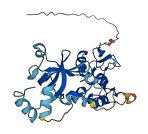
Descriptions
The autoinhibited protein was predicted that may have potential autoinhibitory elements via cis-regPred.
Autoinhibitory domains (AIDs)
Target domain |
|
Relief mechanism |
|
Assay |
cis-regPred |
Accessory elements
No accessory elements
Autoinhibited structure

Activated structure
1 structures for Q9IA96
| Entry ID | Method | Resolution | Chain | Position | Source |
|---|---|---|---|---|---|
| AF-Q9IA96-F1 | Predicted | AlphaFoldDB |
No variants for Q9IA96
| Variant ID(s) | Position | Change | Description | Diseaes Association | Provenance |
|---|---|---|---|---|---|
| No variants for Q9IA96 | |||||
No associated diseases with Q9IA96
1 GO annotations of cellular component
| Name | Definition |
|---|---|
| extracellular space | That part of a multicellular organism outside the cells proper, usually taken to be outside the plasma membranes, and occupied by fluid. |
1 GO annotations of molecular function
| Name | Definition |
|---|---|
| Wnt-protein binding | Binding to a Wnt-protein, a secreted growth factor involved in signaling. |
4 GO annotations of biological process
| Name | Definition |
|---|---|
| apoptotic process | A programmed cell death process which begins when a cell receives an internal (e.g. DNA damage) or external signal (e.g. an extracellular death ligand), and proceeds through a series of biochemical events (signaling pathway phase) which trigger an execution phase. The execution phase is the last step of an apoptotic process, and is typically characterized by rounding-up of the cell, retraction of pseudopodes, reduction of cellular volume (pyknosis), chromatin condensation, nuclear fragmentation (karyorrhexis), plasma membrane blebbing and fragmentation of the cell into apoptotic bodies. When the execution phase is completed, the cell has died. |
| canonical Wnt signaling pathway | The series of molecular signals initiated by binding of a Wnt protein to a frizzled family receptor on the surface of the target cell, followed by propagation of the signal via beta-catenin, and ending with a change in transcription of target genes. In this pathway, the activated receptor signals via downstream effectors that result in the inhibition of beta-catenin phosphorylation, thereby preventing degradation of beta-catenin. Stabilized beta-catenin can then accumulate and travel to the nucleus to trigger changes in transcription of target genes. |
| cell differentiation | The process in which relatively unspecialized cells, e.g. embryonic or regenerative cells, acquire specialized structural and/or functional features that characterize the cells, tissues, or organs of the mature organism or some other relatively stable phase of the organism's life history. Differentiation includes the processes involved in commitment of a cell to a specific fate and its subsequent development to the mature state. |
| negative regulation of canonical Wnt signaling pathway | Any process that decreases the rate, frequency, or extent of the Wnt signaling pathway through beta-catenin, the series of molecular signals initiated by binding of a Wnt protein to a frizzled family receptor on the surface of the target cell, followed by propagation of the signal via beta-catenin, and ending with a change in transcription of target genes. |
24 homologous proteins in AiPD
| UniProt AC | Gene Name | Protein Name | Species | Evidence Code |
|---|---|---|---|---|
| O19116 | SFRP1 | Secreted frizzled-related protein 1 | Bos taurus (Bovine) | PR |
| O57328 | FZD1 | Frizzled-1 | Gallus gallus (Chicken) | PR |
| Q9DEQ4 | SFRP1 | Secreted frizzled-related protein 1 | Gallus gallus (Chicken) | PR |
| Q863H1 | SFRP2 | Secreted frizzled-related protein 2 | Canis lupus familiaris (Dog) (Canis familiaris) | PR |
| Q8N474 | SFRP1 | Secreted frizzled-related protein 1 | Homo sapiens (Human) | PR |
| Q9ULW2 | FZD10 | Frizzled-10 | Homo sapiens (Human) | PR |
| O75084 | FZD7 | Frizzled-7 | Homo sapiens (Human) | PR |
| Q9UP38 | FZD1 | Frizzled-1 | Homo sapiens (Human) | PR |
| Q14332 | FZD2 | Frizzled-2 | Homo sapiens (Human) | PR |
| O00144 | FZD9 | Frizzled-9 | Homo sapiens (Human) | PR |
| O60353 | FZD6 | Frizzled-6 | Homo sapiens (Human) | PR |
| Q6FHJ7 | SFRP4 | Secreted frizzled-related protein 4 | Homo sapiens (Human) | PR |
| Q96HF1 | SFRP2 | Secreted frizzled-related protein 2 | Homo sapiens (Human) | PR |
| Q9Z1N6 | Sfrp4 | Secreted frizzled-related sequence protein 4 | Mus musculus (Mouse) | PR |
| Q8C4U3 | Sfrp1 | Secreted frizzled-related protein 1 | Mus musculus (Mouse) | PR |
| O70421 | Fzd1 | Frizzled-1 | Mus musculus (Mouse) | PR |
| Q9JIP6 | Fzd2 | Frizzled-2 | Mus musculus (Mouse) | PR |
| Q61090 | Fzd7 | Frizzled-7 | Mus musculus (Mouse) | PR |
| P97299 | Sfrp2 | Secreted frizzled-related protein 2 | Mus musculus (Mouse) | PR |
| Q08463 | Fzd1 | Frizzled-1 | Rattus norvegicus (Rat) | PR |
| Q9JLS4 | Sfrp4 | Secreted frizzled-related protein 4 | Rattus norvegicus (Rat) | PR |
| Q08464 | Fzd2 | Frizzled-2 | Rattus norvegicus (Rat) | PR |
| Q7YRN1 | SFRP4 | Secreted frizzled-related protein 4 | Macaca mulatta (Rhesus macaque) | PR |
| Q5BL72 | fzd7 | Frizzled-7 | Xenopus tropicalis (Western clawed frog) (Silurana tropicalis) | PR |
| 10 | 20 | 30 | 40 | 50 | 60 |
| MPRRLCALLL | LASQCLGSTA | GLFPFGEPDF | SYKRSNCKPI | PAPMLLCRGI | EYQSMRLPNL |
| 70 | 80 | 90 | 100 | 110 | 120 |
| LGHETVQEVL | EQATTWIPLV | QKQCHPDTRK | FLCSLFAPVC | IDDLDEIIQP | CHSLCEEVKE |
| 130 | 140 | 150 | 160 | 170 | 180 |
| SCAPVMSAFG | FPWPDMLDCS | RFPKDNDLCI | PLASSDHILP | VTREAPKVCD | ACKNKNEDDN |
| 190 | 200 | 210 | 220 | 230 | 240 |
| DIMENLCKND | FALKIKVKEI | AYINGDTKIT | PETKSKTIYK | LNGLTERDLR | KIVLWLKGGL |
| 250 | 260 | 270 | 280 | 290 | |
| QCTCDEMNDI | NVPYLVMGQK | QAGELVITSL | KRWQKGQRAF | KRFSRSIRKL | QC |