Q61090
Gene name |
Fzd7 |
Protein name |
Frizzled-7 |
Names |
Fz-7, mFz7 |
Species |
Mus musculus (Mouse) |
KEGG Pathway |
mmu:14369 |
EC number |
|
Protein Class |
|
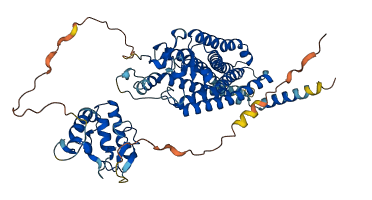
Descriptions
The autoinhibited protein was predicted that may have potential autoinhibitory elements via cis-regPred.
Autoinhibitory domains (AIDs)
Target domain |
|
Relief mechanism |
|
Assay |
cis-regPred |
Accessory elements
No accessory elements
Autoinhibited structure

Activated structure
1 structures for Q61090
| Entry ID | Method | Resolution | Chain | Position | Source |
|---|---|---|---|---|---|
| AF-Q61090-F1 | Predicted | AlphaFoldDB |
14 variants for Q61090
| Variant ID(s) | Position | Change | Description | Diseaes Association | Provenance |
|---|---|---|---|---|---|
| rs3389958822 | 236 | R>* | No | EVA | |
| rs3388472879 | 352 | W>* | No | EVA | |
| rs3390039766 | 383 | A>V | No | EVA | |
| rs3388474529 | 410 | Y>* | No | EVA | |
| rs3388473645 | 460 | E>V | No | EVA | |
| rs3390049727 | 487 | Y>S | No | EVA | |
| rs3388474210 | 489 | Y>* | No | EVA | |
| rs3390027822 | 493 | F>I | No | EVA | |
| rs3389958809 | 493 | F>Y | No | EVA | |
| rs3389984097 | 535 | T>P | No | EVA | |
| rs3413026028 | 536 | M>T | No | EVA | |
| rs3390040870 | 538 | V>M | No | EVA | |
| rs3390040943 | 539 | G>V | No | EVA | |
| rs1134687216 | 556 | R>C | No | EVA |
No associated diseases with Q61090
1 regional properties for Q61090
| Type | Name | Position | InterPro Accession |
|---|---|---|---|
| domain | Pleckstrin homology domain | 5 - 119 | IPR001849 |
Functions
4 GO annotations of cellular component
| Name | Definition |
|---|---|
| integral component of membrane | The component of a membrane consisting of the gene products and protein complexes having at least some part of their peptide sequence embedded in the hydrophobic region of the membrane. |
| intracellular membrane-bounded organelle | Organized structure of distinctive morphology and function, bounded by a single or double lipid bilayer membrane and occurring within the cell. Includes the nucleus, mitochondria, plastids, vacuoles, and vesicles. Excludes the plasma membrane. |
| plasma membrane | The membrane surrounding a cell that separates the cell from its external environment. It consists of a phospholipid bilayer and associated proteins. |
| recycling endosome membrane | The lipid bilayer surrounding a recycling endosome. |
6 GO annotations of molecular function
| Name | Definition |
|---|---|
| frizzled binding | Binding to a frizzled (fz) receptor. |
| G protein-coupled receptor activity | Combining with an extracellular signal and transmitting the signal across the membrane by activating an associated G-protein; promotes the exchange of GDP for GTP on the alpha subunit of a heterotrimeric G-protein complex. |
| PDZ domain binding | Binding to a PDZ domain of a protein, a domain found in diverse signaling proteins. |
| phosphatidylinositol-4,5-bisphosphate binding | Binding to phosphatidylinositol-4,5-bisphosphate, a derivative of phosphatidylinositol in which the inositol ring is phosphorylated at the 4' and 5' positions. |
| Wnt receptor activity | Combining with a Wnt protein and transmitting the signal across the plasma membrane to initiate a change in cell activity. |
| Wnt-protein binding | Binding to a Wnt-protein, a secreted growth factor involved in signaling. |
17 GO annotations of biological process
| Name | Definition |
|---|---|
| canonical Wnt signaling pathway | The series of molecular signals initiated by binding of a Wnt protein to a frizzled family receptor on the surface of the target cell, followed by propagation of the signal via beta-catenin, and ending with a change in transcription of target genes. In this pathway, the activated receptor signals via downstream effectors that result in the inhibition of beta-catenin phosphorylation, thereby preventing degradation of beta-catenin. Stabilized beta-catenin can then accumulate and travel to the nucleus to trigger changes in transcription of target genes. |
| mesenchymal to epithelial transition | A transition where a mesenchymal cell establishes apical/basolateral polarity, forms intercellular adhesive junctions, synthesizes basement membrane components and becomes an epithelial cell. |
| negative regulation of cardiac muscle cell differentiation | Any process that stops, prevents or reduces the frequency, rate or extent of cardiac muscle cell differentiation. |
| negative regulation of cell-substrate adhesion | Any process that decreases the frequency, rate or extent of cell-substrate adhesion. Cell-substrate adhesion is the attachment of a cell to the underlying substrate via adhesion molecules. |
| negative regulation of ectodermal cell fate specification | Any process that restricts, stops or prevents a cell from specifying into an ectoderm cell. |
| non-canonical Wnt signaling pathway | The series of molecular signals initiated by binding of a Wnt protein to a frizzled family receptor on the surface of the target cell, followed by propagation of the signal via effectors other than beta-catenin. |
| non-canonical Wnt signaling pathway via JNK cascade | The series of molecular signals initiated by binding of a Wnt protein to a frizzled family receptor on the surface of the target cell, where the signal is passed on via the JNK cascade. |
| positive regulation of DNA-templated transcription | Any process that activates or increases the frequency, rate or extent of cellular DNA-templated transcription. |
| positive regulation of epithelial cell proliferation involved in wound healing | Any process that activates or increases the rate or extent of epithelial cell proliferation, contributing to the restoration of integrity to a damaged tissue following an injury. |
| positive regulation of phosphorylation | Any process that activates or increases the frequency, rate or extent of addition of phosphate groups to a molecule. |
| regulation of canonical Wnt signaling pathway | Any process that modulates the rate, frequency, or extent of the Wnt signaling pathway through beta-catenin, the series of molecular signals initiated by binding of a Wnt protein to a frizzled family receptor on the surface of the target cell, followed by propagation of the signal via beta-catenin, and ending with a change in transcription of target genes. |
| regulation of DNA-templated transcription | Any process that modulates the frequency, rate or extent of cellular DNA-templated transcription. |
| skeletal muscle satellite cell maintenance involved in skeletal muscle regeneration | Any process by which the number of skeletal muscle satellite cells in a skeletal muscle is maintained during muscle regeneration. There are at least three mechanisms by which this is achieved. Skeletal muscle satellite stem cell asymmetric division ensures satellite stem cell numbers are kept constant. Symmetric division of these cells amplifies the number of skeletal muscle satellite stem cells. Some adult skeletal muscle myoblasts (descendants of activated satellite cells) can develop back into quiescent satellite cells, replenishing the overall pool of satellite cells. |
| somatic stem cell division | The self-renewing division of a somatic stem cell, a stem cell that can give rise to cell types of the body other than those of the germ-line. |
| stem cell population maintenance | The process by which an organism or tissue maintains a population of stem cells of a single type. This can be achieved by a number of mechanisms: stem cell asymmetric division maintains stem cell numbers; stem cell symmetric division increases them; maintenance of a stem cell niche maintains the conditions for commitment to the stem cell fate for some types of stem cell; stem cells may arise de novo from other cell types. |
| substrate adhesion-dependent cell spreading | The morphogenetic process that results in flattening of a cell as a consequence of its adhesion to a substrate. |
| T cell differentiation in thymus | The process in which a precursor cell type acquires the specialized features of a T cell via a differentiation pathway dependent upon transit through the thymus. |
23 homologous proteins in AiPD
| UniProt AC | Gene Name | Protein Name | Species | Evidence Code |
|---|---|---|---|---|
| O19116 | SFRP1 | Secreted frizzled-related protein 1 | Bos taurus (Bovine) | PR |
| Q9DEQ4 | SFRP1 | Secreted frizzled-related protein 1 | Gallus gallus (Chicken) | PR |
| O57328 | FZD1 | Frizzled-1 | Gallus gallus (Chicken) | PR |
| Q9IA96 | SFRP2 | Secreted frizzled-related protein 2 | Gallus gallus (Chicken) | PR |
| Q8N474 | SFRP1 | Secreted frizzled-related protein 1 | Homo sapiens (Human) | PR |
| Q9ULW2 | FZD10 | Frizzled-10 | Homo sapiens (Human) | PR |
| Q96HF1 | SFRP2 | Secreted frizzled-related protein 2 | Homo sapiens (Human) | PR |
| Q9UP38 | FZD1 | Frizzled-1 | Homo sapiens (Human) | PR |
| Q14332 | FZD2 | Frizzled-2 | Homo sapiens (Human) | PR |
| O00144 | FZD9 | Frizzled-9 | Homo sapiens (Human) | PR |
| O60353 | FZD6 | Frizzled-6 | Homo sapiens (Human) | PR |
| Q6FHJ7 | SFRP4 | Secreted frizzled-related protein 4 | Homo sapiens (Human) | PR |
| O75084 | FZD7 | Frizzled-7 | Homo sapiens (Human) | PR |
| O70421 | Fzd1 | Frizzled-1 | Mus musculus (Mouse) | PR |
| P97299 | Sfrp2 | Secreted frizzled-related protein 2 | Mus musculus (Mouse) | PR |
| Q8C4U3 | Sfrp1 | Secreted frizzled-related protein 1 | Mus musculus (Mouse) | PR |
| Q9JIP6 | Fzd2 | Frizzled-2 | Mus musculus (Mouse) | PR |
| Q9Z1N6 | Sfrp4 | Secreted frizzled-related sequence protein 4 | Mus musculus (Mouse) | PR |
| Q08463 | Fzd1 | Frizzled-1 | Rattus norvegicus (Rat) | PR |
| Q9JLS4 | Sfrp4 | Secreted frizzled-related protein 4 | Rattus norvegicus (Rat) | PR |
| Q08464 | Fzd2 | Frizzled-2 | Rattus norvegicus (Rat) | PR |
| Q7YRN1 | SFRP4 | Secreted frizzled-related protein 4 | Macaca mulatta (Rhesus macaque) | PR |
| Q5BL72 | fzd7 | Frizzled-7 | Xenopus tropicalis (Western clawed frog) (Silurana tropicalis) | PR |
| 10 | 20 | 30 | 40 | 50 | 60 |
| MRGPGTAASH | SPLGLCALVL | ALLGALPTDT | RAQPYHGEKG | ISVPDHGFCQ | PISIPLCTDI |
| 70 | 80 | 90 | 100 | 110 | 120 |
| AYNQTILPNL | LGHTNQEDAG | LEVHQFYPLV | KVQCSPELRF | FLCSMYAPVC | TVLDQAIPPC |
| 130 | 140 | 150 | 160 | 170 | 180 |
| RSLCERARQG | CEALMNKFGF | QWPERLRCEN | FPVHGAGEIC | VGQNTSDGSG | GAGGSPTAYP |
| 190 | 200 | 210 | 220 | 230 | 240 |
| TAPYLPDPPF | TAMSPSDGRG | RLSFPFSCPR | QLKVPPYLGY | RFLGERDCGA | PCEPGRANGL |
| 250 | 260 | 270 | 280 | 290 | 300 |
| MYFKEEERRF | ARLWVGVWSV | LCCASTLFTV | LTYLVDMRRF | SYPERPIIFL | SGCYFMVAVA |
| 310 | 320 | 330 | 340 | 350 | 360 |
| HVAGFLLEDR | AVCVERFSDD | GYRTVAQGTK | KEGCTILFMV | LYFFGMASSI | WWVILSLTWF |
| 370 | 380 | 390 | 400 | 410 | 420 |
| LAAGMKWGHE | AIEANSQYFH | LAAWAVPAVK | TITILAMGQV | DGDLLSGVCY | VGLSSVDALR |
| 430 | 440 | 450 | 460 | 470 | 480 |
| GFVLAPLFVY | LFIGTSFLLA | GFVSLFRIRT | IMKHDGTKTE | KLEKLMVRIG | VFSVLYTVPA |
| 490 | 500 | 510 | 520 | 530 | 540 |
| TIVLACYFYE | QAFREHWERT | WLLQTCKSYA | VPCPPGHFSP | MSPDFTVFMI | KYLMTMIVGI |
| 550 | 560 | 570 | |||
| TTGFWIWSGK | TLQSWRRFYH | RLSHSSKGET | AV |