Descriptions
The autoinhibited protein was predicted that may have potential autoinhibitory elements via cis-regPred.
Autoinhibitory domains (AIDs)
Target domain |
|
Relief mechanism |
|
Assay |
cis-regPred |
Accessory elements
No accessory elements
Autoinhibited structure

Activated structure
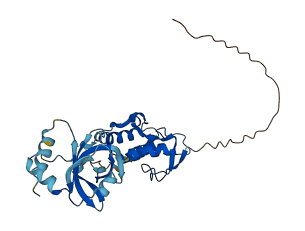
1 structures for Q863H1
| Entry ID | Method | Resolution | Chain | Position | Source |
|---|---|---|---|---|---|
| AF-Q863H1-F1 | Predicted | AlphaFoldDB |
1 variants for Q863H1
| Variant ID(s) | Position | Change | Description | Diseaes Association | Provenance |
|---|---|---|---|---|---|
| rs850633484 | 60 | P>L | No | EVA |
No associated diseases with Q863H1
2 GO annotations of cellular component
| Name | Definition |
|---|---|
| collagen-containing extracellular matrix | An extracellular matrix consisting mainly of proteins (especially collagen) and glycosaminoglycans (mostly as proteoglycans) that provides not only essential physical scaffolding for the cellular constituents but can also initiate crucial biochemical and biomechanical cues required for tissue morphogenesis, differentiation and homeostasis. The components are secreted by cells in the vicinity and form a sheet underlying or overlying cells such as endothelial and epithelial cells. |
| extracellular space | That part of a multicellular organism outside the cells proper, usually taken to be outside the plasma membranes, and occupied by fluid. |
5 GO annotations of molecular function
| Name | Definition |
|---|---|
| endopeptidase activator activity | Binds to and increases the activity of an endopeptidase, any enzyme that hydrolyzes nonterminal peptide bonds in polypeptides. |
| fibronectin binding | Binding to a fibronectin, a group of related adhesive glycoproteins of high molecular weight found on the surface of animal cells, connective tissue matrices, and in extracellular fluids. |
| integrin binding | Binding to an integrin. |
| receptor ligand activity | The activity of a gene product that interacts with a receptor to effect a change in the activity of the receptor. Ligands may be produced by the same, or different, cell that expresses the receptor. Ligands may diffuse extracellularly from their point of origin to the receiving cell, or remain attached to an adjacent cell surface (e.g. Notch ligands). |
| Wnt-protein binding | Binding to a Wnt-protein, a secreted growth factor involved in signaling. |
54 GO annotations of biological process
| Name | Definition |
|---|---|
| BMP signaling pathway | The series of molecular signals initiated by the binding of a member of the BMP (bone morphogenetic protein) family to a receptor on the surface of a target cell, and ending with the regulation of a downstream cellular process, e.g. transcription. |
| branching involved in blood vessel morphogenesis | The process of coordinated growth and sprouting of blood vessels giving rise to the organized vascular system. |
| canonical Wnt signaling pathway | The series of molecular signals initiated by binding of a Wnt protein to a frizzled family receptor on the surface of the target cell, followed by propagation of the signal via beta-catenin, and ending with a change in transcription of target genes. In this pathway, the activated receptor signals via downstream effectors that result in the inhibition of beta-catenin phosphorylation, thereby preventing degradation of beta-catenin. Stabilized beta-catenin can then accumulate and travel to the nucleus to trigger changes in transcription of target genes. |
| cardiac left ventricle morphogenesis | The process in which the left cardiac ventricle is generated and organized. |
| cardiac muscle cell apoptotic process | A form of programmed cell death induced by external or internal signals that trigger the activity of proteolytic caspases, whose actions dismantle a cardiac muscle cell and result in its death. Cardiac muscle cells are striated muscle cells that are responsible for heart contraction. |
| cell-cell signaling | Any process that mediates the transfer of information from one cell to another. This process includes signal transduction in the receiving cell and, where applicable, release of a ligand and any processes that actively facilitate its transport and presentation to the receiving cell. Examples include signaling via soluble ligands, via cell adhesion molecules and via gap junctions. |
| cellular response to extracellular stimulus | Any process that results in a change in state or activity of a cell (in terms of movement, secretion, enzyme production, gene expression, etc.) as a result of an extracellular stimulus. |
| cellular response to X-ray | Any process that results in a change in state or activity of a cell (in terms of movement, secretion, enzyme production, gene expression, etc.) as a result of X-ray radiation. An X-ray is a form of electromagnetic radiation with a wavelength in the range of 10 nanometers to 100 picometers (corresponding to frequencies in the range 30 PHz to 3 EHz). |
| chondrocyte development | The process whose specific outcome is the progression of a chondrocyte over time, from its commitment to its mature state. Chondrocyte development does not include the steps involved in committing a chondroblast to a chondrocyte fate. |
| collagen fibril organization | Any process that determines the size and arrangement of collagen fibrils within an extracellular matrix. |
| convergent extension involved in axis elongation | The morphogenetic process in which an epithelium narrows along one axis and lengthens in a perpendicular axis contributing to the lengthening of the axis of an organism. |
| digestive tract morphogenesis | The process in which the anatomical structures of the digestive tract are generated and organized. The digestive tract is the anatomical structure through which food passes and is processed. |
| embryonic digit morphogenesis | The process, occurring in the embryo, by which the anatomical structures of the digit are generated and organized. A digit is one of the terminal divisions of an appendage, such as a finger or toe. |
| hematopoietic stem cell proliferation | The expansion of a hematopoietic stem cell population by cell division. A hematopoietic stem cell is a stem cell from which all cells of the lymphoid and myeloid lineages develop. |
| male gonad development | The process whose specific outcome is the progression of the male gonad over time, from its formation to the mature structure. |
| mesodermal cell fate specification | The cell fate determination process in which a cell becomes capable of differentiating autonomously into a mesoderm cell in an environment that is neutral with respect to the developmental pathway; upon specification, the cell fate can be reversed. |
| negative regulation of BMP signaling pathway | Any process that stops, prevents, or reduces the frequency, rate or extent of the BMP signaling pathway. |
| negative regulation of canonical Wnt signaling pathway | Any process that decreases the rate, frequency, or extent of the Wnt signaling pathway through beta-catenin, the series of molecular signals initiated by binding of a Wnt protein to a frizzled family receptor on the surface of the target cell, followed by propagation of the signal via beta-catenin, and ending with a change in transcription of target genes. |
| negative regulation of cardiac muscle cell apoptotic process | Any process that decreases the rate or extent of cardiac cell apoptotic process, a form of programmed cell death induced by external or internal signals that trigger the activity of proteolytic caspases whose actions dismantle a cardiac muscle cell and result in its death. |
| negative regulation of cell growth | Any process that stops, prevents, or reduces the frequency, rate, extent or direction of cell growth. |
| negative regulation of cell migration | Any process that stops, prevents, or reduces the frequency, rate or extent of cell migration. |
| negative regulation of cysteine-type endopeptidase activity involved in apoptotic process | Any process that stops, prevents, or reduces the frequency, rate or extent of a cysteine-type endopeptidase activity involved in the apoptotic process. |
| negative regulation of dermatome development | Any process that decreases the rate, frequency, or extent of the progression of the dermatome over time, from its initial formation to the mature structure. The dermatome is the portion of a somite that will form skin. |
| negative regulation of DNA-templated transcription | Any process that stops, prevents, or reduces the frequency, rate or extent of cellular DNA-templated transcription. |
| negative regulation of epithelial cell proliferation | Any process that stops, prevents or reduces the rate or extent of epithelial cell proliferation. |
| negative regulation of epithelial to mesenchymal transition | Any process that decreases the rate, frequency, or extent of epithelial to mesenchymal transition. Epithelial to mesenchymal transition where an epithelial cell loses apical/basolateral polarity, severs intercellular adhesive junctions, degrades basement membrane components and becomes a migratory mesenchymal cell. |
| negative regulation of extrinsic apoptotic signaling pathway via death domain receptors | Any process that stops, prevents or reduces the frequency, rate or extent of extrinsic apoptotic signaling pathway via death domain receptors. |
| negative regulation of gene expression | Any process that decreases the frequency, rate or extent of gene expression. Gene expression is the process in which a gene's coding sequence is converted into a mature gene product (protein or RNA). |
| negative regulation of intrinsic apoptotic signaling pathway in response to DNA damage | Any process that stops, prevents or reduces the frequency, rate or extent of intrinsic apoptotic signaling pathway in response to DNA damage. |
| negative regulation of JUN kinase activity | Any process that stops, prevents, or reduces the frequency, rate or extent of JUN kinase activity. |
| negative regulation of mesodermal cell fate specification | Any process that stops, prevents, or reduces the frequency, rate or extent of mesoderm cell fate specification. |
| negative regulation of peptidyl-tyrosine phosphorylation | Any process that stops, prevents, or reduces the frequency, rate or extent of the phosphorylation of peptidyl-tyrosine. |
| negative regulation of planar cell polarity pathway involved in axis elongation | Any process that stops, prevents, or reduces the frequency, rate or extent of planar cell polarity pathway involved in axis elongation. |
| outflow tract morphogenesis | The process in which the anatomical structures of the outflow tract are generated and organized. The outflow tract is the portion of the heart through which blood flows into the arteries. |
| planar cell polarity pathway involved in axis elongation | The series of molecular signals initiated by binding of a Wnt protein to a receptor on the surface of the target cell where activated receptors signal to modulate cytoskeletal elements and control cell polarity that contributes to axis elongation. |
| planar cell polarity pathway involved in neural tube closure | The series of molecular signals initiated by binding of a Wnt protein to a receptor on the surface of the target cell where activated receptors signal via downstream effectors that modulates the establishment of planar polarity contributing to neural tube closure. |
| positive regulation of angiogenesis | Any process that activates or increases angiogenesis. |
| positive regulation of apoptotic process | Any process that activates or increases the frequency, rate or extent of cell death by apoptotic process. |
| positive regulation of canonical Wnt signaling pathway | Any process that increases the rate, frequency, or extent of the Wnt signaling pathway through beta-catenin, the series of molecular signals initiated by binding of a Wnt protein to a frizzled family receptor on the surface of the target cell, followed by propagation of the signal via beta-catenin, and ending with a change in transcription of target genes. |
| positive regulation of cell adhesion mediated by integrin | Any process that activates or increases the frequency, rate, or extent of cell adhesion mediated by integrin. |
| positive regulation of cell growth | Any process that activates or increases the frequency, rate, extent or direction of cell growth. |
| positive regulation of cell population proliferation | Any process that activates or increases the rate or extent of cell proliferation. |
| positive regulation of fat cell differentiation | Any process that activates or increases the frequency, rate or extent of adipocyte differentiation. |
| positive regulation of osteoblast differentiation | Any process that activates or increases the frequency, rate or extent of osteoblast differentiation. |
| positive regulation of peptidyl-serine phosphorylation | Any process that activates or increases the frequency, rate or extent of the phosphorylation of peptidyl-serine. |
| positive regulation of transcription by RNA polymerase II | Any process that activates or increases the frequency, rate or extent of transcription from an RNA polymerase II promoter. |
| post-anal tail morphogenesis | The process in which a post-anal tail is generated and organized. A post-anal tail is a muscular region of the body that extends posterior to the anus. The post-anal tail may aid locomotion and balance. |
| regulation of midbrain dopaminergic neuron differentiation | Any process that modulates the frequency, rate or extent of midbrain dopaminergic neuron differentiation. |
| regulation of neuron projection development | Any process that modulates the rate, frequency or extent of neuron projection development. Neuron projection development is the process whose specific outcome is the progression of a neuron projection over time, from its formation to the mature structure. A neuron projection is any process extending from a neural cell, such as axons or dendrites (collectively called neurites). |
| regulation of stem cell division | Any process that modulates the frequency, rate or extent of stem cell division. |
| response to xenobiotic stimulus | Any process that results in a change in state or activity of a cell or an organism (in terms of movement, secretion, enzyme production, gene expression, etc.) as a result of a stimulus from a xenobiotic, a compound foreign to the organim exposed to it. It may be synthesized by another organism (like ampicilin) or it can be a synthetic chemical. |
| sclerotome development | The progression of the sclerotome over time, from its initial formation to the mature structure. The sclerotome is the portion of the somite that will give rise to a vertebra. |
| stem cell fate specification | The process in which a cell becomes capable of differentiating autonomously into a stem cell in an environment that is neutral with respect to the developmental pathway. Upon specification, the cell fate can be reversed. |
| Wnt signaling pathway involved in somitogenesis | The series of molecular signals initiated by binding of Wnt protein to a frizzled family receptor on the surface of the target cell and ending with a change in cell state that contributes to somitogenesis. |
3 homologous proteins in AiPD
| 10 | 20 | 30 | 40 | 50 | 60 |
| MPRGPGSLLL | LVLASHCCLG | SARGLFFGQP | DFSYKRSNCK | PIPANLQLCH | GIEYQNMRLP |
| 70 | 80 | 90 | 100 | 110 | 120 |
| NLLGHETMKE | VLEQAGAWIP | LVMKQCHPDT | KKFLCSLFAP | VCLDDLDETI | QPCHSLCVQV |
| 130 | 140 | 150 | 160 | 170 | 180 |
| KDRCAPVMSA | FGFPWPDMLE | CDRFPQDNDL | CIPLASSDHL | LPATEEAPKV | CEACKNKNED |
| 190 | 200 | 210 | 220 | 230 | 240 |
| DNDIMETLCK | NDFALKIKVK | EITYINRDTK | IILETKSKTI | YKLNGVSERD | LKKSVLWLKD |
| 250 | 260 | 270 | 280 | 290 | |
| SLQCTCEEMN | DINAPYLVMG | QKLGGELVIT | SVKRWQKGQR | EFKRISRSIR | KLQC |