G3V7X8
Gene name |
Cyp26b1 |
Protein name |
Cytochrome P450 26B1 |
Names |
|
Species |
Rattus norvegicus (Rat) |
KEGG Pathway |
rno:312495 |
EC number |
|
Protein Class |
|
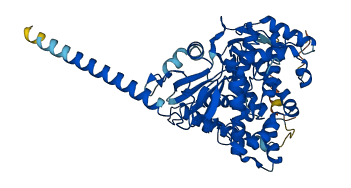
Descriptions
The autoinhibited protein was predicted that may have potential autoinhibitory elements via cis-regPred.
Autoinhibitory domains (AIDs)
Target domain |
|
Relief mechanism |
|
Assay |
cis-regPred |
Accessory elements
No accessory elements
Autoinhibited structure

Activated structure
1 structures for G3V7X8
| Entry ID | Method | Resolution | Chain | Position | Source |
|---|---|---|---|---|---|
| AF-G3V7X8-F1 | Predicted | AlphaFoldDB |
1 variants for G3V7X8
| Variant ID(s) | Position | Change | Description | Diseaes Association | Provenance |
|---|---|---|---|---|---|
| rs3320299392 | 145 | F>L | No | EVA |
No associated diseases with G3V7X8
1 regional properties for G3V7X8
| Type | Name | Position | InterPro Accession |
|---|---|---|---|
| conserved_site | Cytochrome P450, conserved site | 434 - 443 | IPR017972 |
2 GO annotations of cellular component
| Name | Definition |
|---|---|
| cytoplasm | The contents of a cell excluding the plasma membrane and nucleus, but including other subcellular structures. |
| endoplasmic reticulum membrane | The lipid bilayer surrounding the endoplasmic reticulum. |
7 GO annotations of molecular function
| Name | Definition |
|---|---|
| heme binding | Binding to a heme, a compound composed of iron complexed in a porphyrin (tetrapyrrole) ring. |
| iron ion binding | Binding to an iron (Fe) ion. |
| monooxygenase activity | Catalysis of the incorporation of one atom from molecular oxygen into a compound and the reduction of the other atom of oxygen to water. |
| oxidoreductase activity | Catalysis of an oxidation-reduction (redox) reaction, a reversible chemical reaction in which the oxidation state of an atom or atoms within a molecule is altered. One substrate acts as a hydrogen or electron donor and becomes oxidized, while the other acts as hydrogen or electron acceptor and becomes reduced. |
| oxidoreductase activity, acting on paired donors, with incorporation or reduction of molecular oxygen, NAD(P)H as one donor, and incorporation of one atom of oxygen | Catalysis of an oxidation-reduction (redox) reaction in which hydrogen or electrons are transferred from NADH or NADPH and one other donor, and one atom of oxygen is incorporated into one donor. |
| retinoic acid 4-hydroxylase activity | Catalysis of the conversion of retinoic acid to 4-hydroxy-retinoic acid. |
| retinoic acid binding | Binding to retinoic acid, 3,7-dimethyl-9-(2,6,-trimethyl-1-cyclohexen-1-yl)-2,4,6,8-nonatetraenoic acid. |
25 GO annotations of biological process
| Name | Definition |
|---|---|
| bone morphogenesis | The process in which bones are generated and organized. |
| cell fate determination | A process involved in cell fate commitment. Once determination has taken place, a cell becomes committed to differentiate down a particular pathway regardless of its environment. |
| cellular response to retinoic acid | Any process that results in a change in state or activity of a cell (in terms of movement, secretion, enzyme production, gene expression, etc.) as a result of a retinoic acid stimulus. |
| cornification | A type of programmed cell death that occurs in the epidermis, morphologically and biochemically distinct from apoptosis. It leads to the formation of corneocytes, i.e. dead keratinocytes containing an amalgam of specific proteins (e.g., keratin, loricrin, SPR and involucrin) and lipids (e.g., fatty acids and ceramides), which are necessary for the function of the cornified skin layer (mechanical resistance, elasticity, water repellence and structural stability). |
| embryonic limb morphogenesis | The process, occurring in the embryo, by which the anatomical structures of the limb are generated and organized. A limb is an appendage of an animal used for locomotion or grasping. |
| establishment of skin barrier | Establishment of the epithelial barrier, the functional barrier in the skin that limits its permeability. |
| establishment of T cell polarity | The directed orientation of T cell signaling molecules and associated membrane rafts towards a chemokine gradient or a contact point with antigen presenting cell. |
| inflammatory response | The immediate defensive reaction (by vertebrate tissue) to infection or injury caused by chemical or physical agents. The process is characterized by local vasodilation, extravasation of plasma into intercellular spaces and accumulation of white blood cells and macrophages. |
| kidney development | The process whose specific outcome is the progression of the kidney over time, from its formation to the mature structure. The kidney is an organ that filters the blood and/or excretes the end products of body metabolism in the form of urine. |
| male meiotic nuclear division | A cell cycle process by which the cell nucleus divides as part of a meiotic cell cycle in the male germline. |
| negative regulation of retinoic acid receptor signaling pathway | Any process that stops, prevents, or reduces the frequency, rate or extent of retinoic acid receptor signaling pathway activity. |
| positive regulation of gene expression | Any process that increases the frequency, rate or extent of gene expression. Gene expression is the process in which a gene's coding sequence is converted into a mature gene product (protein or RNA). |
| positive regulation of tongue muscle cell differentiation | Any process that activates or increases the frequency, rate or extent of tongue muscle cell differentiation. |
| proximal/distal pattern formation | The regionalization process in which specific areas of cell differentiation are determined along a proximal/distal axis. The proximal/distal axis is defined by a line that runs from main body (proximal end) of an organism outward (distal end). |
| regulation of retinoic acid receptor signaling pathway | Any process that modulates the frequency, rate or extent of retinoic acid receptor signaling pathway activity. |
| regulation of T cell differentiation | Any process that modulates the frequency, rate or extent of T cell differentiation. |
| response to retinoic acid | Any process that results in a change in state or activity of a cell or an organism (in terms of movement, secretion, enzyme production, gene expression, etc.) as a result of a retinoic acid stimulus. |
| response to vitamin A | Any process that results in a change in state or activity of a cell or an organism (in terms of movement, secretion, enzyme production, gene expression, etc.) as a result of a vitamin A stimulus. |
| retinoic acid catabolic process | The chemical reactions and pathways resulting in the breakdown of retinoic acid, one of the three components that makes up vitamin A. |
| retinoic acid metabolic process | The chemical reactions and pathways involving retinoic acid, one of the three components that makes up vitamin A. |
| retinoic acid receptor signaling pathway | The series of molecular signals generated as a consequence of a retinoic acid receptor binding to one of its physiological ligands. |
| spermatogenesis | The developmental process by which male germ line stem cells self renew or give rise to successive cell types resulting in the development of a spermatozoa. |
| sterol metabolic process | The chemical reactions and pathways involving sterols, steroids with one or more hydroxyl groups and a hydrocarbon side-chain in the molecule. |
| tongue morphogenesis | The process in which the anatomical structures of the tongue are generated and organized. The tongue is the movable, muscular organ on the floor of the mouth of most vertebrates, in man other mammals is the principal organ of taste, aids in the prehension of food, in swallowing, and in modifying the voice as in speech. |
| xenobiotic metabolic process | The chemical reactions and pathways involving a xenobiotic compound, a compound foreign to the organim exposed to it. It may be synthesized by another organism (like ampicilin) or it can be a synthetic chemical. |
36 homologous proteins in AiPD
| UniProt AC | Gene Name | Protein Name | Species | Evidence Code |
|---|---|---|---|---|
| Q9VYQ5 | Cyp318a1 | Probable cytochrome P450 318a1 | Drosophila melanogaster (Fruit fly) | PR |
| Q9VXY0 | Cyp4s3 | Probable cytochrome P450 4s3 | Drosophila melanogaster (Fruit fly) | PR |
| Q9VMS7 | Cyp4ac3 | Probable cytochrome P450 4ac3 | Drosophila melanogaster (Fruit fly) | PR |
| Q9V559 | Cyp4p3 | Probable cytochrome P450 4p3 | Drosophila melanogaster (Fruit fly) | PR |
| Q9V7G5 | Cyp4aa1 | Probable cytochrome P450 4aa1 | Drosophila melanogaster (Fruit fly) | PR |
| Q9VMS8 | Cyp4ac2 | Probable cytochrome P450 4ac2 | Drosophila melanogaster (Fruit fly) | PR |
| Q9VVN6 | Cyp312a1 | Probable cytochrome P450 312a1 | Drosophila melanogaster (Fruit fly) | PR |
| Q02928 | CYP4A11 | Cytochrome P450 4A11 | Homo sapiens (Human) | PR |
| Q86W10 | CYP4Z1 | Cytochrome P450 4Z1 | Homo sapiens (Human) | PR |
| Q5TCH4 | CYP4A22 | Cytochrome P450 4A22 | Homo sapiens (Human) | PR |
| P13584 | CYP4B1 | Cytochrome P450 4B1 | Homo sapiens (Human) | PR |
| Q6ZWL3 | CYP4V2 | Cytochrome P450 4V2 | Homo sapiens (Human) | PR |
| B6SSW8 | CYP714B3 | Cytochrome P450 714B3 | Zea mays (Maize) | PR |
| O35728 | Cyp4a14 | Cytochrome P450 4A14 | Mus musculus (Mouse) | PR |
| Q91WL5 | Cyp4a12a | Cytochrome P450 4A12A | Mus musculus (Mouse) | PR |
| Q9GJX5 | CYP4A21 | Taurochenodeoxycholic 6 alpha-hydroxylase | Sus scrofa (Pig) | PR |
| Q8SPK1 | CYP4A24 | Cytochrome P450 4A24 | Sus scrofa (Pig) | PR |
| P24464 | Cyp4a12 | Cytochrome P450 4A12 | Rattus norvegicus (Rat) | PR |
| P20816 | Cyp4a2 | Cytochrome P450 4A2 | Rattus norvegicus (Rat) | PR |
| Q0DS59 | CYP714B2 | Cytochrome P450 714B2 | Oryza sativa subsp japonica (Rice) | PR |
| Q5KQH7 | CYP714D1 | Cytochrome P450 714D1 | Oryza sativa subsp japonica (Rice) | PR |
| Q6F4F5 | CYP724B1 | Cytochrome P450 724B1 | Oryza sativa subsp japonica (Rice) | PR |
| Q05JG2 | CYP707A5 | Abscisic acid 8'-hydroxylase 1 | Oryza sativa subsp japonica (Rice) | PR |
| Q9SHG5 | CYP72C1 | Cytochrome P450 72C1 | Arabidopsis thaliana (Mouse-ear cress) | PR |
| Q9C788 | CYP704B1 | Cytochrome P450 704B1 | Arabidopsis thaliana (Mouse-ear cress) | PR |
| Q9ZUX1 | CYP94C1 | Cytochrome P450 94C1 | Arabidopsis thaliana (Mouse-ear cress) | PR |
| Q9LUC9 | CYP72A11 | Cytochrome P450 72A11 | Arabidopsis thaliana (Mouse-ear cress) | PR |
| Q9LUC8 | CYP72A13 | Cytochrome P450 72A13 | Arabidopsis thaliana (Mouse-ear cress) | PR |
| Q9LUC6 | CYP72A14 | Cytochrome P450 72A14 | Arabidopsis thaliana (Mouse-ear cress) | PR |
| Q9LUC5 | CYP72A15 | Cytochrome P450 72A15 | Arabidopsis thaliana (Mouse-ear cress) | PR |
| Q6TBX7 | CYP97C1 | Carotene epsilon-monooxygenase, chloroplastic | Arabidopsis thaliana (Mouse-ear cress) | PR |
| O64697 | CYP710A1 | Cytochrome P450 710A1 | Arabidopsis thaliana (Mouse-ear cress) | PR |
| O64698 | CYP710A2 | Cytochrome P450 710A2 | Arabidopsis thaliana (Mouse-ear cress) | PR |
| O81077 | CYP707A2 | Abscisic acid 8'-hydroxylase 2 | Arabidopsis thaliana (Mouse-ear cress) | PR |
| Q94IA6 | CYP90D1 | 3-epi-6-deoxocathasterone 23-monooxygenase CYP90D1 | Arabidopsis thaliana (Mouse-ear cress) | PR |
| Q6EIG3 | cyp26b1 | Cytochrome P450 26B1 | Danio rerio (Zebrafish) (Brachydanio rerio) | PR |
| 10 | 20 | 30 | 40 | 50 | 60 |
| MLFEGLELVS | ALATLAACLV | SVTLLLAVSQ | QLWQLRWAAT | RDKSCKLPIP | KGSMGFPLIG |
| 70 | 80 | 90 | 100 | 110 | 120 |
| ETGHWLLQGS | GFQSSRREKY | GNVFKTHLLG | RPLIRVTGAE | NVRKILLGEH | QLVSTEWPRS |
| 130 | 140 | 150 | 160 | 170 | 180 |
| ARVLLGPNTV | ANSIGDIHRN | KRKVFSKIFS | HEALESYLPK | IQLVIQDTLR | AWSSQPEAIN |
| 190 | 200 | 210 | 220 | 230 | 240 |
| VYQEAQRLTF | RMAVRVLLGF | SIPEEDLGNL | FEVYQQFVEN | VFSLPVDLPF | SGYRRGIQAR |
| 250 | 260 | 270 | 280 | 290 | 300 |
| QILQKGLEKA | IREKLQCTQG | KDYSDALDIL | IESSKEHGKE | MTMQELKDGT | LELIFAAYAT |
| 310 | 320 | 330 | 340 | 350 | 360 |
| TASASTSLIM | QLLKHPAVLE | KLREELRAQG | LLHGGGCPCE | GTLRLDMLSG | LRYLDCVIKE |
| 370 | 380 | 390 | 400 | 410 | 420 |
| VMRLFTPVSG | GYRTVLQTFE | LDGFQIPKGW | SVMYSIRDTH | DTAPVFKDVN | VFDPDRFSQA |
| 430 | 440 | 450 | 460 | 470 | 480 |
| RSEDKDGRFH | YLPFGGGVRT | CLGKHLAKLF | LKVLAVELAS | TSRFELATRT | FPRITLVPVL |
| 490 | 500 | 510 | |||
| HPVDGLSVKF | FGLDSNQNEI | LPETEAMLSA | TV |