Descriptions
The autoinhibited protein was predicted that may have potential autoinhibitory elements via cis-regPred.
Autoinhibitory domains (AIDs)
Target domain |
|
Relief mechanism |
|
Assay |
cis-regPred |
Accessory elements
No accessory elements
Autoinhibited structure

Activated structure
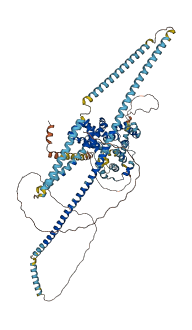
1 structures for P97366
| Entry ID | Method | Resolution | Chain | Position | Source |
|---|---|---|---|---|---|
| AF-P97366-F1 | Predicted | AlphaFoldDB |
No variants for P97366
| Variant ID(s) | Position | Change | Description | Diseaes Association | Provenance |
|---|---|---|---|---|---|
| No variants for P97366 | |||||
No associated diseases with P97366
1 regional properties for P97366
| Type | Name | Position | InterPro Accession |
|---|---|---|---|
| domain | Rab-GAP-TBC domain | 160 - 371 | IPR000195 |
Functions
4 GO annotations of cellular component
| Name | Definition |
|---|---|
| cytosol | The part of the cytoplasm that does not contain organelles but which does contain other particulate matter, such as protein complexes. |
| microtubule organizing center | An intracellular structure that can catalyze gamma-tubulin-dependent microtubule nucleation and that can anchor microtubules by interacting with their minus ends, plus ends or sides. |
| nucleus | A membrane-bounded organelle of eukaryotic cells in which chromosomes are housed and replicated. In most cells, the nucleus contains all of the cell's chromosomes except the organellar chromosomes, and is the site of RNA synthesis and processing. In some species, or in specialized cell types, RNA metabolism or DNA replication may be absent. |
| spindle | The array of microtubules and associated molecules that forms between opposite poles of a eukaryotic cell during mitosis or meiosis and serves to move the duplicated chromosomes apart. |
2 GO annotations of molecular function
| Name | Definition |
|---|---|
| GTPase activator activity | Binds to and increases the activity of a GTPase, an enzyme that catalyzes the hydrolysis of GTP. |
| small GTPase binding | Binding to a small monomeric GTPase. |
5 GO annotations of biological process
| Name | Definition |
|---|---|
| activation of GTPase activity | Any process that initiates the activity of an inactive GTPase through the replacement of GDP by GTP. |
| cell cycle | The progression of biochemical and morphological phases and events that occur in a cell during successive cell replication or nuclear replication events. Canonically, the cell cycle comprises the replication and segregation of genetic material followed by the division of the cell, but in endocycles or syncytial cells nuclear replication or nuclear division may not be followed by cell division. |
| cell division | The process resulting in division and partitioning of components of a cell to form more cells; may or may not be accompanied by the physical separation of a cell into distinct, individually membrane-bounded daughter cells. |
| positive regulation of GTPase activity | Any process that activates or increases the activity of a GTPase. |
| retrograde transport, endosome to Golgi | The directed movement of membrane-bounded vesicles from endosomes back to the trans-Golgi network where they are recycled for further rounds of transport. |
13 homologous proteins in AiPD
| UniProt AC | Gene Name | Protein Name | Species | Evidence Code |
|---|---|---|---|---|
| O60447 | EVI5 | Ecotropic viral integration site 5 protein homolog | Homo sapiens (Human) | PR |
| Q60949 | Tbc1d1 | TBC1 domain family member 1 | Mus musculus (Mouse) | PR |
| Q8BYJ6 | Tbc1d4 | TBC1 domain family member 4 | Mus musculus (Mouse) | PR |
| Q8R5A6 | Tbc1d22a | TBC1 domain family member 22A | Mus musculus (Mouse) | PR |
| Q80XC3 | Usp6nl | USP6 N-terminal-like protein | Mus musculus (Mouse) | PR |
| Q6A039 | Tbc1d12 | TBC1 domain family member 12 | Mus musculus (Mouse) | PR |
| Q8C9V1 | Tbc1d10c | Carabin | Mus musculus (Mouse) | PR |
| Q9D3N8 | Grtp1 | Growth hormone-regulated TBC protein 1 | Mus musculus (Mouse) | PR |
| A1A5B6 | Tbc1d25 | TBC1 domain family member 25 | Mus musculus (Mouse) | PR |
| Q8BYH7 | Tbc1d17 | TBC1 domain family member 17 | Mus musculus (Mouse) | PR |
| Q9Z1A9 | Tbc1d8 | TBC1 domain family member 8 | Mus musculus (Mouse) | PR |
| A3KGB4 | Tbc1d8b | TBC1 domain family member 8B | Mus musculus (Mouse) | PR |
| Q3UYK3 | Tbc1d9 | TBC1 domain family member 9 | Mus musculus (Mouse) | PR |
| 10 | 20 | 30 | 40 | 50 | 60 |
| MVTTKMTAAF | RNPNRRQVAT | DKVAEKLSST | LSWVKNTVSH | TVSQMASQVA | SPSASLHTTS |
| 70 | 80 | 90 | 100 | 110 | 120 |
| SSTTLSTPTQ | SPSSPSKLSP | DDLELLAKLE | EQNRLIETDS | KSLRSVNGSR | RNSGSSLVSS |
| 130 | 140 | 150 | 160 | 170 | 180 |
| SSASSNLSHL | EEDSWILWGR | IVNEWDDVRK | KKEKQVKELV | RKGIPHHFRA | IVWQLLCNAQ |
| 190 | 200 | 210 | 220 | 230 | 240 |
| SMTIKDQYSE | LLKMTSPCEK | LIRRDIARTY | PEHNFFKEKD | SLGQEVLFNV | MKAYSLVDRE |
| 250 | 260 | 270 | 280 | 290 | 300 |
| LVTVRAVLSS | LDCCCMQMPE | EEAFCVFVKL | MQDYRLRELF | KPSMAELGLC | MYQFECMIQE |
| 310 | 320 | 330 | 340 | 350 | 360 |
| YLPELFVHFQ | SQSFHTSMYA | SSWFLTIFLT | TFPLPIATRI | FDIFMSEGLE | IVFRVGLALL |
| 370 | 380 | 390 | 400 | 410 | 420 |
| QMNQAELMQL | DMEGMLQHFQ | KVIPHQFDGG | PEKLIQSAYQ | VKYNSKKMKK | LEKEYTTIKT |
| 430 | 440 | 450 | 460 | 470 | 480 |
| KEMEEQGEIK | RLRTENRLLK | QRIETLEKHK | CSSTYNEDFV | LQLEKELVQA | RLSEAESQCA |
| 490 | 500 | 510 | 520 | 530 | 540 |
| LKEMQDKVLD | IEKKNNSFPD | ENNIARLQEE | LIAVKLREAE | AIMGLKELRQ | QVRTLEEHWQ |
| 550 | 560 | 570 | 580 | 590 | 600 |
| RHLARTSGRW | KDPPKKNAVN | ELQDELMSIR | LREAETQAEI | REMKQRMMEM | ETQNQINSNQ |
| 610 | 620 | 630 | 640 | 650 | 660 |
| LRRAEQEVNS | LQEKVCSLSV | KNKGLLAQLS | EAKRRQAEIE | CKNKEEVMAV | RLREADSIAA |
| 670 | 680 | 690 | 700 | 710 | 720 |
| VAELQQHIAE | LEIQKEEGKL | QGQLNRSDSN | QYIRELKDQI | AELTHELRCL | KGQRDFSSRP |
| 730 | 740 | 750 | 760 | 770 | 780 |
| PFDGIHIVSH | LIGDDELFHS | SDEDFIDSSL | QESAIGFPLH | RKSGPMSLNP | ALADGSESEA |
| 790 | 800 | ||||
| EDGMLGPQES | DPEAPQKQPP | QRESYSTTV |