P31650
Gene name |
Slc6a11 |
Protein name |
Sodium- and chloride-dependent GABA transporter 3 |
Names |
GAT-3, Sodium- and chloride-dependent GABA transporter 4, GAT-4, Solute carrier family 6 member 11 |
Species |
Mus musculus (Mouse) |
KEGG Pathway |
mmu:243616 |
EC number |
|
Protein Class |
|
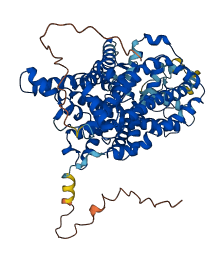
Descriptions
The autoinhibited protein was predicted that may have potential autoinhibitory elements via cis-regPred.
Autoinhibitory domains (AIDs)
Target domain |
|
Relief mechanism |
|
Assay |
cis-regPred |
Accessory elements
No accessory elements
Autoinhibited structure

Activated structure
1 structures for P31650
| Entry ID | Method | Resolution | Chain | Position | Source |
|---|---|---|---|---|---|
| AF-P31650-F1 | Predicted | AlphaFoldDB |
20 variants for P31650
| Variant ID(s) | Position | Change | Description | Diseaes Association | Provenance |
|---|---|---|---|---|---|
| rs218825606 | 32 | A>T | No | EVA | |
| rs48122354 | 59 | A>S | No | EVA | |
| rs3388854492 | 109 | T>M | No | EVA | |
| rs3397228850 | 153 | L>Q | No | EVA | |
| rs3388849331 | 163 | W>* | No | EVA | |
| rs37350347 | 187 | S>T | No | EVA | |
| rs3388856934 | 224 | A>G | No | EVA | |
| rs3388833038 | 233 | I>N | No | EVA | |
| rs3388833025 | 343 | A>T | No | EVA | |
| rs3412101777 | 405 | S>R | No | EVA | |
| rs3388846450 | 418 | V>I | No | EVA | |
| rs3388854510 | 420 | M>K | No | EVA | |
| rs3388851847 | 493 | D>E | No | EVA | |
| rs3388841716 | 547 | G>S | No | EVA | |
| rs3388849318 | 568 | L>M | No | EVA | |
| rs3388850951 | 573 | G>S | No | EVA | |
| rs3388851817 | 581 | K>* | No | EVA | |
| rs220916444 | 598 | S>G | No | EVA | |
| rs3412115829 | 611 | V>I | No | EVA | |
| rs3388845186 | 626 | H>Y | No | EVA |
No associated diseases with P31650
No regional properties for P31650
| Type | Name | Position | InterPro Accession |
|---|---|---|---|
| No domain, repeats, and functional sites for P31650 | |||
10 GO annotations of cellular component
| Name | Definition |
|---|---|
| cell projection | A prolongation or process extending from a cell, e.g. a flagellum or axon. |
| cytoplasm | The contents of a cell excluding the plasma membrane and nucleus, but including other subcellular structures. |
| GABA-ergic synapse | A synapse that uses GABA as a neurotransmitter. These synapses are typically inhibitory. |
| integral component of plasma membrane | The component of the plasma membrane consisting of the gene products and protein complexes having at least some part of their peptide sequence embedded in the hydrophobic region of the membrane. |
| integral component of postsynaptic membrane | The component of the postsynaptic membrane consisting of the gene products and protein complexes having at least some part of their peptide sequence embedded in the hydrophobic region of the membrane. |
| integral component of presynaptic membrane | The component of the presynaptic membrane consisting of the gene products and protein complexes having at least some part of their peptide sequence embedded in the hydrophobic region of the membrane. |
| membrane | A lipid bilayer along with all the proteins and protein complexes embedded in it an attached to it. |
| neuron projection | A prolongation or process extending from a nerve cell, e.g. an axon or dendrite. |
| plasma membrane | The membrane surrounding a cell that separates the cell from its external environment. It consists of a phospholipid bilayer and associated proteins. |
| synapse | The junction between an axon of one neuron and a dendrite of another neuron, a muscle fiber or a glial cell. As the axon approaches the synapse it enlarges into a specialized structure, the presynaptic terminal bouton, which contains mitochondria and synaptic vesicles. At the tip of the terminal bouton is the presynaptic membrane; facing it, and separated from it by a minute cleft (the synaptic cleft) is a specialized area of membrane on the receiving cell, known as the postsynaptic membrane. In response to the arrival of nerve impulses, the presynaptic terminal bouton secretes molecules of neurotransmitters into the synaptic cleft. These diffuse across the cleft and transmit the signal to the postsynaptic membrane. |
5 GO annotations of molecular function
| Name | Definition |
|---|---|
| amino acid:sodium symporter activity | Enables the transfer of a solute or solutes from one side of a membrane to the other according to the reaction: amino acid(out) + Na+(out) = amino acid(in) + Na+(in). |
| gamma-aminobutyric acid:sodium symporter activity | Enables the transfer of a solute or solutes from one side of a membrane to the other according to the reaction: gamma-aminobutyric acid(out) + Na+(out) + Cl-(out) = gamma-aminobutyric acid(in) + Na+(in) + Cl(in). |
| monocarboxylic acid transmembrane transporter activity | Enables the transfer of monocarboxylic acids from one side of a membrane to the other. A monocarboxylic acid is an organic acid with one COOH group. |
| neurotransmitter binding | Binding to a neurotransmitter, any chemical substance that is capable of transmitting (or inhibiting the transmission of) a nerve impulse from a neuron to another cell. |
| taurine:sodium symporter activity | Enables the transfer of a solute or solutes from one side of a membrane to the other according to the reaction: taurine(out) + Na+(out) = taurine(in) + Na+(in). |
7 GO annotations of biological process
| Name | Definition |
|---|---|
| brain development | The process whose specific outcome is the progression of the brain over time, from its formation to the mature structure. Brain development begins with patterning events in the neural tube and ends with the mature structure that is the center of thought and emotion. The brain is responsible for the coordination and control of bodily activities and the interpretation of information from the senses (sight, hearing, smell, etc.). |
| monocarboxylic acid transport | The directed movement of monocarboxylic acids into, out of or within a cell, or between cells, by means of some agent such as a transporter or pore. |
| neurotransmitter reuptake | The directed movement of neurotransmitter molecules from the extrasynaptic space into the presynaptic cytosol. |
| neurotransmitter transport | The directed movement of a neurotransmitter into, out of or within a cell, or between cells, by means of some agent such as a transporter or pore. Neurotransmitters are any chemical substance that is capable of transmitting (or inhibiting the transmission of) a nerve impulse from a neuron to another cell. |
| neurotransmitter uptake | The directed movement of neurotransmitters into neurons or glial cells. This process leads to inactivation and recycling of neurotransmitters. |
| response to xenobiotic stimulus | Any process that results in a change in state or activity of a cell or an organism (in terms of movement, secretion, enzyme production, gene expression, etc.) as a result of a stimulus from a xenobiotic, a compound foreign to the organim exposed to it. It may be synthesized by another organism (like ampicilin) or it can be a synthetic chemical. |
| sodium ion transmembrane transport | A process in which a sodium ion is transported from one side of a membrane to the other by means of some agent such as a transporter or pore. |
26 homologous proteins in AiPD
| UniProt AC | Gene Name | Protein Name | Species | Evidence Code |
|---|---|---|---|---|
| O18875 | SLC6A8 | Sodium- and chloride-dependent creatine transporter 1 | Bos taurus (Bovine) | PR |
| Q9MZ34 | SLC6A6 | Sodium- and chloride-dependent taurine transporter | Bos taurus (Bovine) | PR |
| Q9W4C5 | NAAT1 | Sodium-dependent nutrient amino acid transporter 1 | Drosophila melanogaster (Fruit fly) | PR |
| P48029 | SLC6A8 | Sodium- and chloride-dependent creatine transporter 1 | Homo sapiens (Human) | PR |
| P30531 | SLC6A1 | Sodium- and chloride-dependent GABA transporter 1 | Homo sapiens (Human) | PR |
| Q9NSD5 | SLC6A13 | Sodium- and chloride-dependent GABA transporter 2 | Homo sapiens (Human) | PR |
| Q9Y345 | SLC6A5 | Sodium- and chloride-dependent glycine transporter 2 | Homo sapiens (Human) | PR |
| Q9UN76 | SLC6A14 | Sodium- and chloride-dependent neutral and basic amino acid transporter B(0+) | Homo sapiens (Human) | PR |
| P31641 | SLC6A6 | Sodium- and chloride-dependent taurine transporter | Homo sapiens (Human) | PR |
| P48066 | SLC6A11 | Sodium- and chloride-dependent GABA transporter 3 | Homo sapiens (Human) | PR |
| O35316 | Slc6a6 | Sodium- and chloride-dependent taurine transporter | Mus musculus (Mouse) | PR |
| P31648 | Slc6a1 | Sodium- and chloride-dependent GABA transporter 1 | Mus musculus (Mouse) | PR |
| P31649 | Slc6a13 | Sodium- and chloride-dependent GABA transporter 2 | Mus musculus (Mouse) | PR |
| Q9JMA9 | Slc6a14 | Sodium- and chloride-dependent neutral and basic amino acid transporter B(0+) | Mus musculus (Mouse) | PR |
| Q9D687 | Slc6a19 | Sodium-dependent neutral amino acid transporter B(0)AT1 | Mus musculus (Mouse) | PR |
| O88575 | Slc6a20b | Sodium- and chloride-dependent transporter XTRP3B | Mus musculus (Mouse) | PR |
| Q8BJI1 | Slc6a17 | Sodium-dependent neutral amino acid transporter SLC6A17 | Mus musculus (Mouse) | PR |
| O55192 | Slc6a2 | Sodium-dependent noradrenaline transporter | Mus musculus (Mouse) | PR |
| Q8VBW1 | Slc6a8 | Sodium- and chloride-dependent creatine transporter 1 | Mus musculus (Mouse) | PR |
| O88576 | Slc6a18 | Sodium-dependent neutral amino acid transporter B(0)AT3 | Mus musculus (Mouse) | PR |
| Q761V0 | Slc6a5 | Sodium- and chloride-dependent glycine transporter 2 | Mus musculus (Mouse) | PR |
| P23978 | Slc6a1 | Sodium- and chloride-dependent GABA transporter 1 | Rattus norvegicus (Rat) | PR |
| P28570 | Slc6a8 | Sodium- and chloride-dependent creatine transporter 1 | Rattus norvegicus (Rat) | PR |
| P31647 | Slc6a11 | Sodium- and chloride-dependent GABA transporter 3 | Rattus norvegicus (Rat) | PR |
| O76689 | snf-6 | Sodium-dependent acetylcholine transporter | Caenorhabditis elegans | PR |
| G5EBN9 | snf-3 | Sodium- and chloride-dependent betaine transporter | Caenorhabditis elegans | PR |
| 10 | 20 | 30 | 40 | 50 | 60 |
| MTAEQALPLG | NGKAAEEARG | SETLGGGGGG | AAGTREARDK | AVHERGHWNN | KVEFVLSVAG |
| 70 | 80 | 90 | 100 | 110 | 120 |
| EIIGLGNVWR | FPYLCYKNGG | GAFLIPYVVF | FICCGIPVFF | LETALGQFTS | EGGITCWRRV |
| 130 | 140 | 150 | 160 | 170 | 180 |
| CPLFEGIGYA | TQVIEAHLNV | YYIIILAWAI | FYLSNCFTTE | LPWATCGHEW | NTEKCVEFQK |
| 190 | 200 | 210 | 220 | 230 | 240 |
| LNFSNYSHVS | LQNATSPVME | FWERRVLAIS | DGIEHIGNLR | WELALCLLAA | WTICYFCIWK |
| 250 | 260 | 270 | 280 | 290 | 300 |
| GTKSTGKVVY | VTATFPYIML | LILLIRGVTL | PGASEGIKFY | LYPDLSRLSD | PQVWVDAGTQ |
| 310 | 320 | 330 | 340 | 350 | 360 |
| IFFSYAICLG | CLTALGSYNN | YNNNCYRDCI | MLCCLNSGTS | FVAGFAIFSV | LGFMAYEQGV |
| 370 | 380 | 390 | 400 | 410 | 420 |
| PIAEVAESGP | GLAFIAYPKA | VTMMPLSPLW | ATLFFMMLIF | LGLDSQFVCV | ESLVTAVVDM |
| 430 | 440 | 450 | 460 | 470 | 480 |
| YPKVFRRGYR | RELLILALSI | ISYFLGLVML | TEGGMYIFQL | FDSYAASGMC | LLFVAIFECV |
| 490 | 500 | 510 | 520 | 530 | 540 |
| CIGWVYGSNR | FYDNIEDMIG | YRPLSLIKWC | WKVVTPGICA | GIFIFFLVKY | KPLKYNNVYT |
| 550 | 560 | 570 | 580 | 590 | 600 |
| YPAWGYGIGW | LMALSSMLCI | PLWIFIKLWK | TEGTLPEKLQ | KLTVPSADLK | MRGKLGASPR |
| 610 | 620 | ||||
| TVTVNDCEAK | VKGDGTISAI | TEKETHF |