P23978
Gene name |
Slc6a1 (Gabt1, Gat-1, Gat1) |
Protein name |
Sodium- and chloride-dependent GABA transporter 1 |
Names |
GAT-1, Solute carrier family 6 member 1 |
Species |
Rattus norvegicus (Rat) |
KEGG Pathway |
rno:79212 |
EC number |
|
Protein Class |
|
Descriptions
The autoinhibited protein was predicted that may have potential autoinhibitory elements via cis-regPred.
Autoinhibitory domains (AIDs)
Target domain |
|
Relief mechanism |
|
Assay |
cis-regPred |
Accessory elements
No accessory elements
Autoinhibited structure

Activated structure
2 structures for P23978
| Entry ID | Method | Resolution | Chain | Position | Source |
|---|---|---|---|---|---|
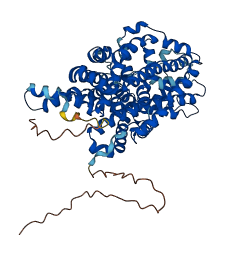
| 8GNK | EM | 310 A | A | 39-599 | PDB |
| AF-P23978-F1 | Predicted | AlphaFoldDB |
No variants for P23978
| Variant ID(s) | Position | Change | Description | Diseaes Association | Provenance |
|---|---|---|---|---|---|
| No variants for P23978 | |||||
No associated diseases with P23978
No regional properties for P23978
| Type | Name | Position | InterPro Accession |
|---|---|---|---|
| No domain, repeats, and functional sites for P23978 | |||
10 GO annotations of cellular component
| Name | Definition |
|---|---|
| anchoring junction | A cell junction that mechanically attaches a cell (and its cytoskeleton) to neighboring cells or to the extracellular matrix. |
| axon | The long process of a neuron that conducts nerve impulses, usually away from the cell body to the terminals and varicosities, which are sites of storage and release of neurotransmitter. |
| cell surface | The external part of the cell wall and/or plasma membrane. |
| GABA-ergic synapse | A synapse that uses GABA as a neurotransmitter. These synapses are typically inhibitory. |
| integral component of plasma membrane | The component of the plasma membrane consisting of the gene products and protein complexes having at least some part of their peptide sequence embedded in the hydrophobic region of the membrane. |
| integral component of postsynaptic membrane | The component of the postsynaptic membrane consisting of the gene products and protein complexes having at least some part of their peptide sequence embedded in the hydrophobic region of the membrane. |
| integral component of presynaptic membrane | The component of the presynaptic membrane consisting of the gene products and protein complexes having at least some part of their peptide sequence embedded in the hydrophobic region of the membrane. |
| neuron projection | A prolongation or process extending from a nerve cell, e.g. an axon or dendrite. |
| neuronal cell body | The portion of a neuron that includes the nucleus, but excludes cell projections such as axons and dendrites. |
| plasma membrane | The membrane surrounding a cell that separates the cell from its external environment. It consists of a phospholipid bilayer and associated proteins. |
6 GO annotations of molecular function
| Name | Definition |
|---|---|
| amino acid:sodium symporter activity | Enables the transfer of a solute or solutes from one side of a membrane to the other according to the reaction: amino acid(out) + Na+(out) = amino acid(in) + Na+(in). |
| gamma-aminobutyric acid transmembrane transporter activity | Enables the transfer of gamma-aminobutyric acid from one side of a membrane to the other. Gamma-aminobutyric acid is 4-aminobutyrate (GABA). |
| gamma-aminobutyric acid:sodium symporter activity | Enables the transfer of a solute or solutes from one side of a membrane to the other according to the reaction: gamma-aminobutyric acid(out) + Na+(out) + Cl-(out) = gamma-aminobutyric acid(in) + Na+(in) + Cl(in). |
| identical protein binding | Binding to an identical protein or proteins. |
| metal ion binding | Binding to a metal ion. |
| sodium:chloride symporter activity | Enables the transfer of a solute or solutes from one side of a membrane to the other according to the reaction: Na+(out) + Cl-(out) = Na+(in) + Cl-(in). |
23 GO annotations of biological process
| Name | Definition |
|---|---|
| associative learning | Learning by associating a stimulus (the cause) with a particular outcome (the effect). |
| chloride transmembrane transport | The process in which chloride is transported across a membrane. |
| gamma-aminobutyric acid import | The directed movement of gamma-aminobutyric acid (GABA, 4-aminobutyrate) into a cell or organelle. |
| inorganic anion import across plasma membrane | The directed movement of inorganic anions from outside of a cell, across the plasma membrane and into the cytosol. |
| learning | Any process in an organism in which a relatively long-lasting adaptive behavioral change occurs as the result of experience. |
| memory | The activities involved in the mental information processing system that receives (registers), modifies, stores, and retrieves informational stimuli. The main stages involved in the formation and retrieval of memory are encoding (processing of received information by acquisition), storage (building a permanent record of received information as a result of consolidation) and retrieval (calling back the stored information and use it in a suitable way to execute a given task). |
| negative regulation of synaptic transmission, GABAergic | Any process that stops, prevents, or reduces the frequency, rate or extent of GABAergic synaptic transmission, the process of communication from a neuron to another neuron across a synapse using the neurotransmitter gamma-aminobutyric acid (GABA). |
| neurotransmitter reuptake | The directed movement of neurotransmitter molecules from the extrasynaptic space into the presynaptic cytosol. |
| positive regulation of gamma-aminobutyric acid secretion | Any process that activates or increases the frequency, rate or extent of the regulated release of gamma-aminobutyric acid. |
| response to calcium ion | Any process that results in a change in state or activity of a cell or an organism (in terms of movement, secretion, enzyme production, gene expression, etc.) as a result of a calcium ion stimulus. |
| response to cocaine | Any process that results in a change in state or activity of a cell or an organism (in terms of movement, secretion, enzyme production, gene expression, etc.) as a result of a cocaine stimulus. Cocaine is a crystalline alkaloid obtained from the leaves of the coca plant. |
| response to estradiol | Any process that results in a change in state or activity of a cell or an organism (in terms of movement, secretion, enzyme production, gene expression, etc.) as a result of stimulus by estradiol, a C18 steroid hormone hydroxylated at C3 and C17 that acts as a potent estrogen. |
| response to inorganic substance | Any process that results in a change in state or activity of a cell or an organism (in terms of movement, secretion, enzyme production, gene expression, etc.) as a result of an inorganic substance stimulus. |
| response to lead ion | Any process that results in a change in state or activity of a cell or an organism (in terms of movement, secretion, enzyme production, gene expression, etc.) as a result of a lead ion stimulus. |
| response to organic cyclic compound | Any process that results in a change in state or activity of a cell or an organism (in terms of movement, secretion, enzyme production, gene expression, etc.) as a result of an organic cyclic compound stimulus. |
| response to organic substance | Any process that results in a change in state or activity of a cell or an organism (in terms of movement, secretion, enzyme production, gene expression, etc.) as a result of an organic substance stimulus. |
| response to organonitrogen compound | Any process that results in a change in state or activity of a cell or an organism (in terms of movement, secretion, enzyme production, gene expression, etc.) as a result of an organonitrogen stimulus. An organonitrogen compound is formally a compound containing at least one carbon-nitrogen bond. |
| response to purine-containing compound | Any process that results in a change in state or activity of a cell or an organism (in terms of movement, secretion, enzyme production, gene expression, etc.) as a result of a purine-containing compound stimulus. |
| response to sucrose | Any process that results in a change in state or activity of a cell or an organism (in terms of movement, secretion, enzyme production, gene expression, etc.) as a result of a sucrose stimulus. |
| response to toxic substance | Any process that results in a change in state or activity of a cell or an organism (in terms of movement, secretion, enzyme production, gene expression, etc.) as a result of a toxic stimulus. |
| sodium ion import across plasma membrane | The directed movement of sodium ions from outside of a cell, across the plasma membrane and into the cytosol. |
| sodium ion transmembrane transport | A process in which a sodium ion is transported from one side of a membrane to the other by means of some agent such as a transporter or pore. |
| synapse organization | A process that is carried out at the cellular level which results in the assembly, arrangement of constituent parts, or disassembly of a synapse, the junction between a neuron and a target (neuron, muscle, or secretory cell). |
24 homologous proteins in AiPD
| UniProt AC | Gene Name | Protein Name | Species | Evidence Code |
|---|---|---|---|---|
| O18875 | SLC6A8 | Sodium- and chloride-dependent creatine transporter 1 | Bos taurus (Bovine) | PR |
| Q9MZ34 | SLC6A6 | Sodium- and chloride-dependent taurine transporter | Bos taurus (Bovine) | PR |
| Q9W4C5 | NAAT1 | Sodium-dependent nutrient amino acid transporter 1 | Drosophila melanogaster (Fruit fly) | PR |
| P48029 | SLC6A8 | Sodium- and chloride-dependent creatine transporter 1 | Homo sapiens (Human) | PR |
| P48066 | SLC6A11 | Sodium- and chloride-dependent GABA transporter 3 | Homo sapiens (Human) | PR |
| Q9NSD5 | SLC6A13 | Sodium- and chloride-dependent GABA transporter 2 | Homo sapiens (Human) | PR |
| Q9Y345 | SLC6A5 | Sodium- and chloride-dependent glycine transporter 2 | Homo sapiens (Human) | PR |
| Q9UN76 | SLC6A14 | Sodium- and chloride-dependent neutral and basic amino acid transporter B(0+) | Homo sapiens (Human) | PR |
| P31641 | SLC6A6 | Sodium- and chloride-dependent taurine transporter | Homo sapiens (Human) | PR |
| P30531 | SLC6A1 | Sodium- and chloride-dependent GABA transporter 1 | Homo sapiens (Human) | PR |
| O35316 | Slc6a6 | Sodium- and chloride-dependent taurine transporter | Mus musculus (Mouse) | PR |
| P31650 | Slc6a11 | Sodium- and chloride-dependent GABA transporter 3 | Mus musculus (Mouse) | PR |
| Q9JMA9 | Slc6a14 | Sodium- and chloride-dependent neutral and basic amino acid transporter B(0+) | Mus musculus (Mouse) | PR |
| Q8VBW1 | Slc6a8 | Sodium- and chloride-dependent creatine transporter 1 | Mus musculus (Mouse) | PR |
| Q761V0 | Slc6a5 | Sodium- and chloride-dependent glycine transporter 2 | Mus musculus (Mouse) | PR |
| P31649 | Slc6a13 | Sodium- and chloride-dependent GABA transporter 2 | Mus musculus (Mouse) | PR |
| P31648 | Slc6a1 | Sodium- and chloride-dependent GABA transporter 1 | Mus musculus (Mouse) | PR |
| P28570 | Slc6a8 | Sodium- and chloride-dependent creatine transporter 1 | Rattus norvegicus (Rat) | PR |
| P31647 | Slc6a11 | Sodium- and chloride-dependent GABA transporter 3 | Rattus norvegicus (Rat) | PR |
| P31662 | Slc6a17 | Sodium-dependent neutral amino acid transporter SLC6A17 | Rattus norvegicus (Rat) | PR |
| Q64093 | Slc6a20 | Sodium- and chloride-dependent transporter XTRP3 | Rattus norvegicus (Rat) | PR |
| Q62687 | Slc6a18 | Sodium-dependent neutral amino acid transporter B(0)AT3 | Rattus norvegicus (Rat) | PR |
| O76689 | snf-6 | Sodium-dependent acetylcholine transporter | Caenorhabditis elegans | PR |
| G5EBN9 | snf-3 | Sodium- and chloride-dependent betaine transporter | Caenorhabditis elegans | PR |
| 10 | 20 | 30 | 40 | 50 | 60 |
| MATDNSKVAD | GQISTEVSEA | PVASDKPKTL | VVKVQKKAGD | LPDRDTWKGR | FDFLMSCVGY |
| 70 | 80 | 90 | 100 | 110 | 120 |
| AIGLGNVWRF | PYLCGKNGGG | AFLIPYFLTL | IFAGVPLFLL | ECSLGQYTSI | GGLGVWKLAP |
| 130 | 140 | 150 | 160 | 170 | 180 |
| MFKGVGLAAA | VLSFWLNIYY | IVIISWAIYY | LYNSFTTTLP | WKQCDNPWNT | DRCFSNYSLV |
| 190 | 200 | 210 | 220 | 230 | 240 |
| NTTNMTSAVV | EFWERNMHQM | TDGLDKPGQI | RWPLAITLAI | AWVLVYFCIW | KGVGWTGKVV |
| 250 | 260 | 270 | 280 | 290 | 300 |
| YFSATYPYIM | LIILFFRGVT | LPGAKEGILF | YITPNFRKLS | DSEVWLDAAT | QIFFSYGLGL |
| 310 | 320 | 330 | 340 | 350 | 360 |
| GSLIALGSYN | SFHNNVYRDS | IIVCCINSCT | SMFAGFVIFS | IVGFMAHVTK | RSIADVAASG |
| 370 | 380 | 390 | 400 | 410 | 420 |
| PGLAFLAYPE | AVTQLPISPL | WAILFFSMLL | MLGIDSQFCT | VEGFITALVD | EYPRLLRNRR |
| 430 | 440 | 450 | 460 | 470 | 480 |
| ELFIAAVCIV | SYLIGLSNIT | QGGIYVFKLF | DYYSASGMSL | LFLVFFECVS | ISWFYGVNRF |
| 490 | 500 | 510 | 520 | 530 | 540 |
| YDNIQEMVGS | RPCIWWKLCW | SFFTPIIVAG | VFLFSAVQMT | PLTMGSYVFP | KWGQGVGWLM |
| 550 | 560 | 570 | 580 | 590 | |
| ALSSMVLIPG | YMAYMFLTLK | GSLKQRLQVM | IQPSEDIVRP | ENGPEQPQAG | SSASKEAYI |