Descriptions
The autoinhibited protein was predicted that may have potential autoinhibitory elements via cis-regPred.
Autoinhibitory domains (AIDs)
Target domain |
|
Relief mechanism |
|
Assay |
cis-regPred |
Accessory elements
No accessory elements
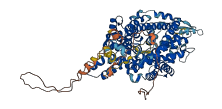
Autoinhibited structure

Activated structure
1 structures for O76689
| Entry ID | Method | Resolution | Chain | Position | Source |
|---|---|---|---|---|---|
| AF-O76689-F1 | Predicted | AlphaFoldDB |
No variants for O76689
| Variant ID(s) | Position | Change | Description | Diseaes Association | Provenance |
|---|---|---|---|---|---|
| No variants for O76689 | |||||
No associated diseases with O76689
6 regional properties for O76689
| Type | Name | Position | InterPro Accession |
|---|---|---|---|
| repeat | WD40 repeat | 478 - 561 | IPR001680-1 |
| repeat | WD40 repeat | 700 - 745 | IPR001680-2 |
| repeat | WD40 repeat | 749 - 788 | IPR001680-3 |
| repeat | WD40 repeat | 800 - 843 | IPR001680-4 |
| domain | BOP1, N-terminal domain | 218 - 478 | IPR012953 |
| conserved_site | WD40 repeat, conserved site | 504 - 518 | IPR019775 |
Functions
3 GO annotations of cellular component
| Name | Definition |
|---|---|
| anchoring junction | A cell junction that mechanically attaches a cell (and its cytoskeleton) to neighboring cells or to the extracellular matrix. |
| integral component of plasma membrane | The component of the plasma membrane consisting of the gene products and protein complexes having at least some part of their peptide sequence embedded in the hydrophobic region of the membrane. |
| postsynaptic membrane | A specialized area of membrane facing the presynaptic membrane on the tip of the nerve ending and separated from it by a minute cleft (the synaptic cleft). Neurotransmitters cross the synaptic cleft and transmit the signal to the postsynaptic membrane. |
4 GO annotations of molecular function
| Name | Definition |
|---|---|
| acetylcholine transmembrane transporter activity | Enables the transfer of acetylcholine from one side of a membrane to the other. Acetylcholine is an acetic acid ester of the organic base choline and functions as a neurotransmitter, released at the synapses of parasympathetic nerves and at neuromuscular junctions. |
| L-amino acid transmembrane transporter activity | Enables the transfer of an L-amino acid from one side of a membrane to the other. L-amino acids are the L-enantiomers of amino acids. |
| neurotransmitter:sodium symporter activity | Enables the transfer of a solute or solutes from one side of a membrane to the other according to the reaction: neurotransmitter(out) + Na+(out) = neurotransmitter(in) + Na+(in). |
| PDZ domain binding | Binding to a PDZ domain of a protein, a domain found in diverse signaling proteins. |
6 GO annotations of biological process
| Name | Definition |
|---|---|
| acetylcholine transport | The directed movement of acetylcholine into, out of or within a cell, or between cells, by means of some agent such as a transporter or pore. Acetylcholine is an acetic acid ester of the organic base choline and functions as a neurotransmitter, released at the synapses of parasympathetic nerves and at neuromuscular junctions. |
| choline transport | The directed movement of choline into, out of or within a cell, or between cells, by means of some agent such as a transporter or pore. Choline (2-hydroxyethyltrimethylammonium) is an amino alcohol that occurs widely in living organisms as a constituent of certain types of phospholipids and in the neurotransmitter acetylcholine. |
| neuromuscular synaptic transmission | The process of synaptic transmission from a neuron to a muscle, across a synapse. |
| neurotransmitter uptake | The directed movement of neurotransmitters into neurons or glial cells. This process leads to inactivation and recycling of neurotransmitters. |
| positive regulation of locomotion | Any process that activates or increases the frequency, rate or extent of locomotion of a cell or organism. |
| sodium ion transmembrane transport | A process in which a sodium ion is transported from one side of a membrane to the other by means of some agent such as a transporter or pore. |
21 homologous proteins in AiPD
| UniProt AC | Gene Name | Protein Name | Species | Evidence Code |
|---|---|---|---|---|
| O18875 | SLC6A8 | Sodium- and chloride-dependent creatine transporter 1 | Bos taurus (Bovine) | PR |
| Q9MZ34 | SLC6A6 | Sodium- and chloride-dependent taurine transporter | Bos taurus (Bovine) | PR |
| Q9W4C5 | NAAT1 | Sodium-dependent nutrient amino acid transporter 1 | Drosophila melanogaster (Fruit fly) | PR |
| P48029 | SLC6A8 | Sodium- and chloride-dependent creatine transporter 1 | Homo sapiens (Human) | PR |
| P48066 | SLC6A11 | Sodium- and chloride-dependent GABA transporter 3 | Homo sapiens (Human) | PR |
| P30531 | SLC6A1 | Sodium- and chloride-dependent GABA transporter 1 | Homo sapiens (Human) | PR |
| Q9NSD5 | SLC6A13 | Sodium- and chloride-dependent GABA transporter 2 | Homo sapiens (Human) | PR |
| Q9Y345 | SLC6A5 | Sodium- and chloride-dependent glycine transporter 2 | Homo sapiens (Human) | PR |
| Q9UN76 | SLC6A14 | Sodium- and chloride-dependent neutral and basic amino acid transporter B(0+) | Homo sapiens (Human) | PR |
| P31641 | SLC6A6 | Sodium- and chloride-dependent taurine transporter | Homo sapiens (Human) | PR |
| O35316 | Slc6a6 | Sodium- and chloride-dependent taurine transporter | Mus musculus (Mouse) | PR |
| P31650 | Slc6a11 | Sodium- and chloride-dependent GABA transporter 3 | Mus musculus (Mouse) | PR |
| P31648 | Slc6a1 | Sodium- and chloride-dependent GABA transporter 1 | Mus musculus (Mouse) | PR |
| Q9JMA9 | Slc6a14 | Sodium- and chloride-dependent neutral and basic amino acid transporter B(0+) | Mus musculus (Mouse) | PR |
| Q8VBW1 | Slc6a8 | Sodium- and chloride-dependent creatine transporter 1 | Mus musculus (Mouse) | PR |
| Q761V0 | Slc6a5 | Sodium- and chloride-dependent glycine transporter 2 | Mus musculus (Mouse) | PR |
| P31649 | Slc6a13 | Sodium- and chloride-dependent GABA transporter 2 | Mus musculus (Mouse) | PR |
| P31647 | Slc6a11 | Sodium- and chloride-dependent GABA transporter 3 | Rattus norvegicus (Rat) | PR |
| P23978 | Slc6a1 | Sodium- and chloride-dependent GABA transporter 1 | Rattus norvegicus (Rat) | PR |
| P28570 | Slc6a8 | Sodium- and chloride-dependent creatine transporter 1 | Rattus norvegicus (Rat) | PR |
| G5EBN9 | snf-3 | Sodium- and chloride-dependent betaine transporter | Caenorhabditis elegans | PR |
| 10 | 20 | 30 | 40 | 50 | 60 |
| MSVSSNDPEQ | RNGRGMASGN | NVDMSLYPPF | IKQLDAKLPD | YTREGDIEYP | FEEITGVGDE |
| 70 | 80 | 90 | 100 | 110 | 120 |
| NRIRGNWSNK | SDYLLAVIGF | TAGVGSFWKF | PFLVFQHGGA | AFLVPYLCML | CLASLPMFFM |
| 130 | 140 | 150 | 160 | 170 | 180 |
| EMVLGQFSSS | AAISVWKVVP | LFKGIGFAQV | TISGFFAVFF | NIISAWTLFY | LINSFSFSIP |
| 190 | 200 | 210 | 220 | 230 | 240 |
| WSNCANSWSG | ENCTLGTRIQ | CKEMNGTLLV | NGSCIVEHAS | SNETTVIPLH | DLGSIPSLKY |
| 250 | 260 | 270 | 280 | 290 | 300 |
| FHNDVLMLSK | GVDDFGTLNW | YLGLCVLACW | IAVFLCLFQG | VKSSGKVVYV | AVIVPFIILT |
| 310 | 320 | 330 | 340 | 350 | 360 |
| VLLTRLLTLD | GSLAAVFYFL | TPKWEILMDL | HVWGEAAVQA | FYSVSCCSGG | LFTIASYSRF |
| 370 | 380 | 390 | 400 | 410 | 420 |
| HNNIYKDIWL | VLIVDVIVSL | VGCLLTFSAI | GFTCYEFAIS | LDKFHIRDGF | HLVFVFLAEA |
| 430 | 440 | 450 | 460 | 470 | 480 |
| LAGVSVAPLY | AGLFFIMILL | VVHATQMFVV | ETIVSSICDE | YPERLRRNRR | HVLTTVCALF |
| 490 | 500 | 510 | 520 | 530 | 540 |
| ILLSIPFCLS | SGLFWMELLT | QFVLTWPLVV | IAFLECMAIN | WVYGVDNMLD | NAKWIVGYWP |
| 550 | 560 | 570 | 580 | 590 | 600 |
| PCYIFWKILF | KFICPMVYLA | ILCFLWLDWN | SIQYESYQFP | YWSILTAWCI | ASFPLILIPI |
| 610 | 620 | 630 | 640 | 650 | 660 |
| VGIWQFCIAK | GTITQKWWRV | LYPDDAWGPA | MAIHRAEKFP | LQIPEARRLL | LPPEVEIASS |
| 670 | 680 | 690 | 700 | 710 | |
| RGVLQEEMPM | SYDYNTSSAA | DVRSNRSTGH | GATDVRSVAA | TNNTIPKFER | ETAI |