Q9WVP1
Gene name |
Ap1m2 |
Protein name |
AP-1 complex subunit mu-2 |
Names |
AP-mu chain family member mu1B, Adaptor protein complex AP-1 subunit mu-2, Adaptor-related protein complex 1 subunit mu-2, Clathrin assembly protein complex 1 mu-2 medium chain 2, Golgi adaptor HA1/AP1 adaptin mu-2 subunit, Mu-adaptin 2, Mu1B-adaptin |
Species |
Mus musculus (Mouse) |
KEGG Pathway |
mmu:11768 |
EC number |
|
Protein Class |
|
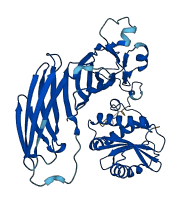
Descriptions
The autoinhibited protein was predicted that may have potential autoinhibitory elements via cis-regPred.
Autoinhibitory domains (AIDs)
Target domain |
|
Relief mechanism |
|
Assay |
cis-regPred |
Accessory elements
No accessory elements
Autoinhibited structure

Activated structure
1 structures for Q9WVP1
| Entry ID | Method | Resolution | Chain | Position | Source |
|---|---|---|---|---|---|
| AF-Q9WVP1-F1 | Predicted | AlphaFoldDB |
No variants for Q9WVP1
| Variant ID(s) | Position | Change | Description | Diseaes Association | Provenance |
|---|---|---|---|---|---|
| No variants for Q9WVP1 | |||||
No associated diseases with Q9WVP1
1 regional properties for Q9WVP1
| Type | Name | Position | InterPro Accession |
|---|---|---|---|
| domain | Zinc finger, GATA-type | 176 - 238 | IPR000679 |
Functions
6 GO annotations of cellular component
| Name | Definition |
|---|---|
| AP-1 adaptor complex | A heterotetrameric AP-type membrane coat adaptor complex that consists of beta1, gamma, mu1 and sigma1 subunits and links clathrin to the membrane surface of a vesicle; vesicles with AP-1-containing coats are normally found primarily in the trans-Golgi network. In at least humans, the AP-1 complex can be heterogeneric due to the existence of multiple subunit isoforms encoded by different genes (gamma1 and gamma2, mu1A and mu1B, and sigma1A, sigma1B and sigma1C). |
| clathrin-coated vesicle | A vesicle with a coat formed of clathrin connected to the membrane via one of the clathrin adaptor complexes. |
| cytoplasmic vesicle | A vesicle found in the cytoplasm of a cell. |
| intracellular membrane-bounded organelle | Organized structure of distinctive morphology and function, bounded by a single or double lipid bilayer membrane and occurring within the cell. Includes the nucleus, mitochondria, plastids, vacuoles, and vesicles. Excludes the plasma membrane. |
| trans-Golgi network | The network of interconnected tubular and cisternal structures located within the Golgi apparatus on the side distal to the endoplasmic reticulum, from which secretory vesicles emerge. The trans-Golgi network is important in the later stages of protein secretion where it is thought to play a key role in the sorting and targeting of secreted proteins to the correct destination. |
| trans-Golgi network membrane | The lipid bilayer surrounding any of the compartments that make up the trans-Golgi network. |
1 GO annotations of molecular function
| Name | Definition |
|---|---|
| clathrin adaptor activity | Bringing together a cargo protein with clathrin, responsible for the formation of endocytic vesicles. |
3 GO annotations of biological process
| Name | Definition |
|---|---|
| basolateral protein secretion | The controlled release of proteins from a cell at the sides which interface adjacent cells and near the base. |
| intracellular protein transport | The directed movement of proteins in a cell, including the movement of proteins between specific compartments or structures within a cell, such as organelles of a eukaryotic cell. |
| vesicle-mediated transport | A cellular transport process in which transported substances are moved in membrane-bounded vesicles; transported substances are enclosed in the vesicle lumen or located in the vesicle membrane. The process begins with a step that directs a substance to the forming vesicle, and includes vesicle budding and coating. Vesicles are then targeted to, and fuse with, an acceptor membrane. |
12 homologous proteins in AiPD
| UniProt AC | Gene Name | Protein Name | Species | Evidence Code |
|---|---|---|---|---|
| Q00776 | APM1 | AP-1 complex subunit mu-1-I | Saccharomyces cerevisiae (strain ATCC 204508 / S288c) (Baker's yeast) | PR |
| Q2KJ81 | AP1M1 | AP-1 complex subunit mu-1 | Bos taurus (Bovine) | PR |
| Q3SYW1 | AP1M2 | AP-1 complex subunit mu-2 | Bos taurus (Bovine) | PR |
| Q9BXS5 | AP1M1 | AP-1 complex subunit mu-1 | Homo sapiens (Human) | PR |
| Q9Y6Q5 | AP1M2 | AP-1 complex subunit mu-2 | Homo sapiens (Human) | PR |
| P35585 | Ap1m1 | AP-1 complex subunit mu-1 | Mus musculus (Mouse) | PR |
| Q8CDJ8 | Ston1 | Stonin-1 | Mus musculus (Mouse) | PR |
| P84091 | Ap2m1 | AP-2 complex subunit mu | Mus musculus (Mouse) | PR |
| Q32Q06 | Ap1m1 | AP-1 complex subunit mu-1 | Rattus norvegicus (Rat) | PR |
| Q9SB50 | AP4M | AP-4 complex subunit mu | Arabidopsis thaliana (Mouse-ear cress) | PR |
| Q9SAC9 | AP1M1 | AP-1 complex subunit mu-1 | Arabidopsis thaliana (Mouse-ear cress) | PR |
| O22715 | AP1M2 | AP-1 complex subunit mu-2 | Arabidopsis thaliana (Mouse-ear cress) | PR |
| 10 | 20 | 30 | 40 | 50 | 60 |
| MSASAVFILD | VKGKPLISRN | YKGDVPMTEI | DHFMPLLMQR | EEEGVLAPLL | SHGRVHFLWI |
| 70 | 80 | 90 | 100 | 110 | 120 |
| KHSNLYLVAT | TLKNANASLV | YSFLYKTVEV | FCEYFKELEE | ESIRDNFVIV | YDLLDELMDF |
| 130 | 140 | 150 | 160 | 170 | 180 |
| GFPQTTDSKI | LQEYITQQGN | KLETGKSRVP | PTVTNAVSWR | SEGIKYKKNE | VFIDVIESVN |
| 190 | 200 | 210 | 220 | 230 | 240 |
| LLVNANGSVL | LSEIVGTIKL | KVFLSGMPEL | RLGLNDRVLF | ELTGRSKNKS | VELEDVKFHQ |
| 250 | 260 | 270 | 280 | 290 | 300 |
| CVRLSRFDND | RTISFIPPDG | DFELMSYRLS | TQVKPLIWIE | SVIEKFSHSR | VEIMVKAKGQ |
| 310 | 320 | 330 | 340 | 350 | 360 |
| FKKQSVANGV | EISVPVPSDA | DSPRFKTSVG | SAKYVPEKNV | VIWSIKSFPG | GKEYLMRAHF |
| 370 | 380 | 390 | 400 | 410 | 420 |
| GLPSVETEEV | EGRPPIGVKF | EIPYFTVSGI | QVRYMKIIEK | SGYQALPWVR | YITQSGDYQL |
| RTS |