O22715
Gene name |
AP1M2 (HAP13, At1g60780, F8A5.29) |
Protein name |
AP-1 complex subunit mu-2 |
Names |
Adaptor protein complex AP-1 subunit mu-2, Adaptor protein-1 mu-adaptin 2, Adaptor-related protein complex 1 subunit mu-2, At-muB2-Ad, Clathrin assembly protein complex 1 mu-2 medium chain, Mu1-adaptin 2, Protein HAPLESS 13 |
Species |
Arabidopsis thaliana (Mouse-ear cress) |
KEGG Pathway |
ath:AT1G60780 |
EC number |
|
Protein Class |
|
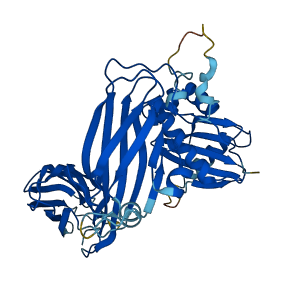
Descriptions
The autoinhibited protein was predicted that may have potential autoinhibitory elements via cis-regPred.
Autoinhibitory domains (AIDs)
Target domain |
|
Relief mechanism |
|
Assay |
cis-regPred |
Accessory elements
No accessory elements
Autoinhibited structure

Activated structure
1 structures for O22715
| Entry ID | Method | Resolution | Chain | Position | Source |
|---|---|---|---|---|---|
| AF-O22715-F1 | Predicted | AlphaFoldDB |
3 variants for O22715
| Variant ID(s) | Position | Change | Description | Diseaes Association | Provenance |
|---|---|---|---|---|---|
| ENSVATH14368968 | 148 | T>A | No | 1000Genomes | |
| ENSVATH14368966 | 295 | E>V | No | 1000Genomes | |
| tmp_1_22369309_A_C | 423 | Y>D | No | 1000Genomes |
No associated diseases with O22715
No regional properties for O22715
| Type | Name | Position | InterPro Accession |
|---|---|---|---|
| No domain, repeats, and functional sites for O22715 | |||
Functions
6 GO annotations of cellular component
| Name | Definition |
|---|---|
| AP-1 adaptor complex | A heterotetrameric AP-type membrane coat adaptor complex that consists of beta1, gamma, mu1 and sigma1 subunits and links clathrin to the membrane surface of a vesicle; vesicles with AP-1-containing coats are normally found primarily in the trans-Golgi network. In at least humans, the AP-1 complex can be heterogeneric due to the existence of multiple subunit isoforms encoded by different genes (gamma1 and gamma2, mu1A and mu1B, and sigma1A, sigma1B and sigma1C). |
| cytoplasmic vesicle | A vesicle found in the cytoplasm of a cell. |
| early endosome membrane | The lipid bilayer surrounding an early endosome. |
| nucleus | A membrane-bounded organelle of eukaryotic cells in which chromosomes are housed and replicated. In most cells, the nucleus contains all of the cell's chromosomes except the organellar chromosomes, and is the site of RNA synthesis and processing. In some species, or in specialized cell types, RNA metabolism or DNA replication may be absent. |
| trans-Golgi network | The network of interconnected tubular and cisternal structures located within the Golgi apparatus on the side distal to the endoplasmic reticulum, from which secretory vesicles emerge. The trans-Golgi network is important in the later stages of protein secretion where it is thought to play a key role in the sorting and targeting of secreted proteins to the correct destination. |
| trans-Golgi network transport vesicle membrane | The lipid bilayer surrounding a vesicle transporting substances between the trans-Golgi network and other parts of the cell. |
No GO annotations of molecular function
| Name | Definition |
|---|---|
| No GO annotations for molecular function |
5 GO annotations of biological process
| Name | Definition |
|---|---|
| clathrin-coated vesicle cargo loading, AP-1-mediated | Formation of a macromolecular complex between proteins of the AP-1 adaptor complex and proteins and/or lipoproteins that are going to be transported by a clathrin-coated vesicle. The AP-1 adaptor protein complex is a component of the cytoplasmic coat found on clathrin-coated vesicles, and binds to sorting signals of cargo to facilitate their trafficking. |
| intracellular protein transport | The directed movement of proteins in a cell, including the movement of proteins between specific compartments or structures within a cell, such as organelles of a eukaryotic cell. |
| post-Golgi vesicle-mediated transport | The directed movement of substances from the Golgi to other parts of the cell, including organelles and the plasma membrane, mediated by small transport vesicles. |
| vacuolar transport | The directed movement of substances into, out of or within a vacuole. |
| vesicle-mediated transport | A cellular transport process in which transported substances are moved in membrane-bounded vesicles; transported substances are enclosed in the vesicle lumen or located in the vesicle membrane. The process begins with a step that directs a substance to the forming vesicle, and includes vesicle budding and coating. Vesicles are then targeted to, and fuse with, an acceptor membrane. |
11 homologous proteins in AiPD
| UniProt AC | Gene Name | Protein Name | Species | Evidence Code |
|---|---|---|---|---|
| Q00776 | APM1 | AP-1 complex subunit mu-1-I | Saccharomyces cerevisiae (strain ATCC 204508 / S288c) (Baker's yeast) | PR |
| Q2KJ81 | AP1M1 | AP-1 complex subunit mu-1 | Bos taurus (Bovine) | PR |
| Q3SYW1 | AP1M2 | AP-1 complex subunit mu-2 | Bos taurus (Bovine) | PR |
| Q9Y6Q5 | AP1M2 | AP-1 complex subunit mu-2 | Homo sapiens (Human) | PR |
| Q9BXS5 | AP1M1 | AP-1 complex subunit mu-1 | Homo sapiens (Human) | PR |
| P35585 | Ap1m1 | AP-1 complex subunit mu-1 | Mus musculus (Mouse) | PR |
| Q9WVP1 | Ap1m2 | AP-1 complex subunit mu-2 | Mus musculus (Mouse) | PR |
| Q32Q06 | Ap1m1 | AP-1 complex subunit mu-1 | Rattus norvegicus (Rat) | PR |
| Q9SAC9 | AP1M1 | AP-1 complex subunit mu-1 | Arabidopsis thaliana (Mouse-ear cress) | PR |
| Q9SB50 | AP4M | AP-4 complex subunit mu | Arabidopsis thaliana (Mouse-ear cress) | PR |
| O23140 | AP2M | AP-2 complex subunit mu | Arabidopsis thaliana (Mouse-ear cress) | PR |
| 10 | 20 | 30 | 40 | 50 | 60 |
| MAGAASALFL | LDIKGRVLVW | RDYRGDVSAA | QAERFFTKLI | EKEGDSQSND | PVAYDNGVTY |
| 70 | 80 | 90 | 100 | 110 | 120 |
| MFVQHSNVYL | MIASRQNCNA | ASLLFFLHRV | VDVFKHYFEE | LEEESLRDNF | VVVYELLDEM |
| 130 | 140 | 150 | 160 | 170 | 180 |
| MDFGYPQYTE | ARILSEFIKT | DAYRMEVTQR | PPMAVTNAVS | WRSEGIQYKK | NEVFLDVIEN |
| 190 | 200 | 210 | 220 | 230 | 240 |
| VNILVNSNGQ | IVRSDVVGAL | KMRTYLTGMP | ECKLGLNDRV | LLEAQGRATK | GKAIDLEDIK |
| 250 | 260 | 270 | 280 | 290 | 300 |
| FHQCVRLARF | ENDRTISFIP | PDGAFDLMTY | RLSTQVKPLI | WVEAQIESHS | RSRVEMLIKA |
| 310 | 320 | 330 | 340 | 350 | 360 |
| RSQFKERSTA | TNVEIELPVP | TDASNPTVRT | SLGSASYAPE | KDALVWKIKS | FPGNKEYMLR |
| 370 | 380 | 390 | 400 | 410 | 420 |
| AEFHLPSITA | EEATPERKAP | IRVKFEIPYF | TVSGIQVRYL | KIIEKSGYQA | LPWVRYITMA |
| GEYELRLV |