Q9SB50
Gene name |
AP4M (CLH, At4g24550, F22K18.250) |
Protein name |
AP-4 complex subunit mu |
Names |
Adaptor protein complex AP-4 subunit mu, Adaptor protein-4 mu-adaptin, Adaptor-related protein complex 4 subunit mu, At-muC-Ad, Mu4-adaptin |
Species |
Arabidopsis thaliana (Mouse-ear cress) |
KEGG Pathway |
ath:AT4G24550 |
EC number |
|
Protein Class |
|
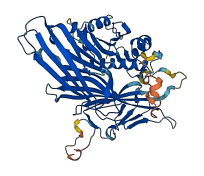
Descriptions
The autoinhibited protein was predicted that may have potential autoinhibitory elements via cis-regPred.
Autoinhibitory domains (AIDs)
Target domain |
|
Relief mechanism |
|
Assay |
cis-regPred |
Accessory elements
No accessory elements
Autoinhibited structure

Activated structure
1 structures for Q9SB50
| Entry ID | Method | Resolution | Chain | Position | Source |
|---|---|---|---|---|---|
| AF-Q9SB50-F1 | Predicted | AlphaFoldDB |
15 variants for Q9SB50
| Variant ID(s) | Position | Change | Description | Diseaes Association | Provenance |
|---|---|---|---|---|---|
| ENSVATH06767752 | 34 | F>L | No | 1000Genomes | |
| tmp_4_12676347_A_G | 47 | E>G | No | 1000Genomes | |
| tmp_4_12676440_G_A | 55 | D>N | No | 1000Genomes | |
| ENSVATH06767753 | 68 | Y>C | No | 1000Genomes | |
| ENSVATH00535526 | 92 | V>A | No | 1000Genomes | |
| tmp_4_12676828_G_T | 143 | V>L | No | 1000Genomes | |
| tmp_4_12677054_A_C | 196 | S>R | No | 1000Genomes | |
| ENSVATH12200574 | 268 | D>N | No | 1000Genomes | |
| tmp_4_12677920_C_T | 291 | R>C | No | 1000Genomes | |
| ENSVATH06767769 | 325 | P>S | No | 1000Genomes | |
| tmp_4_12678152_G_T | 336 | Q>H | No | 1000Genomes | |
| ENSVATH00535535 | 346 | A>G | No | 1000Genomes | |
| tmp_4_12678401_G_A | 367 | M>I | No | 1000Genomes | |
| tmp_4_12678511_T_C | 375 | I>T | No | 1000Genomes | |
| ENSVATH14292173 | 392 | E>G | No | 1000Genomes |
No associated diseases with Q9SB50
No regional properties for Q9SB50
| Type | Name | Position | InterPro Accession |
|---|---|---|---|
| No domain, repeats, and functional sites for Q9SB50 | |||
6 GO annotations of cellular component
| Name | Definition |
|---|---|
| AP-4 adaptor complex | An AP-type membrane coat adaptor complex that consists of beta4, epsilon, mu4 and sigma4 subunits and is found associated with membranes in the trans-Golgi network; it is not clear whether AP-4 forms clathrin coats in vivo. |
| clathrin adaptor complex | A membrane coat adaptor complex that links clathrin to a membrane. |
| clathrin-coated pit | A part of the endomembrane system in the form of an invagination of a membrane upon which a clathrin coat forms, and that can be converted by vesicle budding into a clathrin-coated vesicle. Coated pits form on the plasma membrane, where they are involved in receptor-mediated selective transport of many proteins and other macromolecules across the cell membrane, in the trans-Golgi network, and on some endosomes. |
| cytoplasmic vesicle | A vesicle found in the cytoplasm of a cell. |
| cytosol | The part of the cytoplasm that does not contain organelles but which does contain other particulate matter, such as protein complexes. |
| trans-Golgi network | The network of interconnected tubular and cisternal structures located within the Golgi apparatus on the side distal to the endoplasmic reticulum, from which secretory vesicles emerge. The trans-Golgi network is important in the later stages of protein secretion where it is thought to play a key role in the sorting and targeting of secreted proteins to the correct destination. |
No GO annotations of molecular function
| Name | Definition |
|---|---|
| No GO annotations for molecular function |
3 GO annotations of biological process
| Name | Definition |
|---|---|
| Golgi to lysosome transport | The directed movement of substances from the Golgi to lysosomes. |
| protein targeting | The process of targeting specific proteins to particular regions of the cell, typically membrane-bounded subcellular organelles. Usually requires an organelle specific protein sequence motif. |
| vesicle-mediated transport | A cellular transport process in which transported substances are moved in membrane-bounded vesicles; transported substances are enclosed in the vesicle lumen or located in the vesicle membrane. The process begins with a step that directs a substance to the forming vesicle, and includes vesicle budding and coating. Vesicles are then targeted to, and fuse with, an acceptor membrane. |
10 homologous proteins in AiPD
| UniProt AC | Gene Name | Protein Name | Species | Evidence Code |
|---|---|---|---|---|
| Q2KJ81 | AP1M1 | AP-1 complex subunit mu-1 | Bos taurus (Bovine) | PR |
| Q3SYW1 | AP1M2 | AP-1 complex subunit mu-2 | Bos taurus (Bovine) | PR |
| Q9Y6Q5 | AP1M2 | AP-1 complex subunit mu-2 | Homo sapiens (Human) | PR |
| Q9BXS5 | AP1M1 | AP-1 complex subunit mu-1 | Homo sapiens (Human) | PR |
| P35585 | Ap1m1 | AP-1 complex subunit mu-1 | Mus musculus (Mouse) | PR |
| Q9WVP1 | Ap1m2 | AP-1 complex subunit mu-2 | Mus musculus (Mouse) | PR |
| Q32Q06 | Ap1m1 | AP-1 complex subunit mu-1 | Rattus norvegicus (Rat) | PR |
| O22715 | AP1M2 | AP-1 complex subunit mu-2 | Arabidopsis thaliana (Mouse-ear cress) | PR |
| Q9SAC9 | AP1M1 | AP-1 complex subunit mu-1 | Arabidopsis thaliana (Mouse-ear cress) | PR |
| O23140 | AP2M | AP-2 complex subunit mu | Arabidopsis thaliana (Mouse-ear cress) | PR |
| 10 | 20 | 30 | 40 | 50 | 60 |
| MMISQFFVLS | QRGDNIVFRD | YRAEVPKGST | ETFFRKVKFW | KEDGNAEAPP | IFNVDGVNYF |
| 70 | 80 | 90 | 100 | 110 | 120 |
| HVKVVGLYFV | ATTRVNVSPS | LVLELLQRIA | RVIKDYLGVL | NEDSFRKNFV | LVYELLDEVI |
| 130 | 140 | 150 | 160 | 170 | 180 |
| DFGYVQTTST | EVLKSYIFNE | PIVVSPARLQ | PIDPAAIFTQ | GAKRMPGTAV | TKSVVANDPG |
| 190 | 200 | 210 | 220 | 230 | 240 |
| GRRREEIFVD | IIEKISVTFS | SSGYILTSEI | DGTIQMKSYL | SGNPEIRLAL | NEDLNIGRGG |
| 250 | 260 | 270 | 280 | 290 | 300 |
| RSVYDYRSSS | GSGVILDDCN | FHESVRLDSF | DSDRTLSLVP | PDGEFPVMNY | RMTQEFKPPF |
| 310 | 320 | 330 | 340 | 350 | 360 |
| HVNTLIEEAG | RLKAEVIIKI | RAEFPSDIIA | NTITVQMPLP | NYTSRASFEL | EPGAAGQRTD |
| 370 | 380 | 390 | 400 | 410 | 420 |
| FKESNKMLEW | NLKKIVGGGE | HTLRAKLTFS | QEFHGNITKE | AGPVSMTFTI | PMYNVSKLQV |
| 430 | 440 | 450 | |||
| KYLQIAKKSS | SYNPYRWVRY | VTQANSYVAR | I |