Q00776
Gene name |
APM1 (YAP54, YPL259C, P0394) |
Protein name |
AP-1 complex subunit mu-1-I |
Names |
Clathrin assembly protein complex 1 mu-1-I medium chain, Clathrin coat assembly protein AP54, Clathrin coat-associated protein AP54, Golgi adaptor AP-1 54 kDa protein, HA1 54 kDa subunit, Mu(1)-adaptin, Mu1-I-adaptin |
Species |
Saccharomyces cerevisiae (strain ATCC 204508 / S288c) (Baker's yeast) |
KEGG Pathway |
sce:YPL259C |
EC number |
|
Protein Class |
|
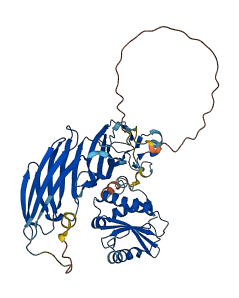
Descriptions
The autoinhibited protein was predicted that may have potential autoinhibitory elements via cis-regPred.
Autoinhibitory domains (AIDs)
Target domain |
|
Relief mechanism |
|
Assay |
cis-regPred |
Accessory elements
No accessory elements
Autoinhibited structure

Activated structure
1 structures for Q00776
| Entry ID | Method | Resolution | Chain | Position | Source |
|---|---|---|---|---|---|
| AF-Q00776-F1 | Predicted | AlphaFoldDB |
6 variants for Q00776
| Variant ID(s) | Position | Change | Description | Diseaes Association | Provenance |
|---|---|---|---|---|---|
| s16-51947 | 242 | A>V | No | SGRP | |
| s16-51884 | 263 | T>I | No | SGRP | |
| s16-51714 | 320 | V>L | No | SGRP | |
| s16-51613 | 353 | I>M | No | SGRP | |
| s16-51430 | 414 | M>I | No | SGRP | |
| s16-51396 | 426 | V>L | No | SGRP |
1 associated diseases with Q00776
[MIM: 608516]: Major depressive disorder (MDD)
A common psychiatric disorder. It is a complex trait characterized by one or more major depressive episodes without a history of manic, mixed, or hypomanic episodes. A major depressive episode is characterized by at least 2 weeks during which there is a new onset or clear worsening of either depressed mood or loss of interest or pleasure in nearly all activities. Four additional symptoms must also be present including changes in appetite, weight, sleep, and psychomotor activity; decreased energy; feelings of worthlessness or guilt; difficulty thinking, concentrating, or making decisions; or recurrent thoughts of death or suicidal ideation, plans, or attempts. The episode must be accompanied by distress or impairment in social, occupational, or other important areas of functioning. {ECO:0000269|PubMed:15229186}. Note=Disease susceptibility is associated with variants affecting the gene represented in this entry.
Without disease ID
- A common psychiatric disorder. It is a complex trait characterized by one or more major depressive episodes without a history of manic, mixed, or hypomanic episodes. A major depressive episode is characterized by at least 2 weeks during which there is a new onset or clear worsening of either depressed mood or loss of interest or pleasure in nearly all activities. Four additional symptoms must also be present including changes in appetite, weight, sleep, and psychomotor activity; decreased energy; feelings of worthlessness or guilt; difficulty thinking, concentrating, or making decisions; or recurrent thoughts of death or suicidal ideation, plans, or attempts. The episode must be accompanied by distress or impairment in social, occupational, or other important areas of functioning. {ECO:0000269|PubMed:15229186}. Note=Disease susceptibility is associated with variants affecting the gene represented in this entry.
1 regional properties for Q00776
| Type | Name | Position | InterPro Accession |
|---|---|---|---|
| domain | GPCR, rhodopsin-like, 7TM | 74 - 332 | IPR017452 |
Functions
5 GO annotations of cellular component
| Name | Definition |
|---|---|
| AP-1 adaptor complex | A heterotetrameric AP-type membrane coat adaptor complex that consists of beta1, gamma, mu1 and sigma1 subunits and links clathrin to the membrane surface of a vesicle; vesicles with AP-1-containing coats are normally found primarily in the trans-Golgi network. In at least humans, the AP-1 complex can be heterogeneric due to the existence of multiple subunit isoforms encoded by different genes (gamma1 and gamma2, mu1A and mu1B, and sigma1A, sigma1B and sigma1C). |
| clathrin-coated pit | A part of the endomembrane system in the form of an invagination of a membrane upon which a clathrin coat forms, and that can be converted by vesicle budding into a clathrin-coated vesicle. Coated pits form on the plasma membrane, where they are involved in receptor-mediated selective transport of many proteins and other macromolecules across the cell membrane, in the trans-Golgi network, and on some endosomes. |
| clathrin-coated vesicle | A vesicle with a coat formed of clathrin connected to the membrane via one of the clathrin adaptor complexes. |
| cytoplasmic vesicle | A vesicle found in the cytoplasm of a cell. |
| cytosol | The part of the cytoplasm that does not contain organelles but which does contain other particulate matter, such as protein complexes. |
1 GO annotations of molecular function
| Name | Definition |
|---|---|
| clathrin adaptor activity | Bringing together a cargo protein with clathrin, responsible for the formation of endocytic vesicles. |
4 GO annotations of biological process
| Name | Definition |
|---|---|
| Golgi to vacuole transport | The directed movement of substances from the Golgi to the vacuole. |
| intracellular protein transport | The directed movement of proteins in a cell, including the movement of proteins between specific compartments or structures within a cell, such as organelles of a eukaryotic cell. |
| vesicle targeting, trans-Golgi to endosome | The process in which vesicles are directed to specific destination membranes during transport from the trans-Golgi to the endosome. |
| vesicle-mediated transport | A cellular transport process in which transported substances are moved in membrane-bounded vesicles; transported substances are enclosed in the vesicle lumen or located in the vesicle membrane. The process begins with a step that directs a substance to the forming vesicle, and includes vesicle budding and coating. Vesicles are then targeted to, and fuse with, an acceptor membrane. |
11 homologous proteins in AiPD
| UniProt AC | Gene Name | Protein Name | Species | Evidence Code |
|---|---|---|---|---|
| P38700 | APM2 | Adaptin medium chain homolog APM2 | Saccharomyces cerevisiae (strain ATCC 204508 / S288c) (Baker's yeast) | PR |
| Q99186 | APM4 | AP-2 complex subunit mu | Saccharomyces cerevisiae (strain ATCC 204508 / S288c) (Baker's yeast) | PR |
| Q3SYW1 | AP1M2 | AP-1 complex subunit mu-2 | Bos taurus (Bovine) | PR |
| Q2KJ81 | AP1M1 | AP-1 complex subunit mu-1 | Bos taurus (Bovine) | PR |
| Q9Y6Q5 | AP1M2 | AP-1 complex subunit mu-2 | Homo sapiens (Human) | PR |
| Q9BXS5 | AP1M1 | AP-1 complex subunit mu-1 | Homo sapiens (Human) | PR |
| Q9WVP1 | Ap1m2 | AP-1 complex subunit mu-2 | Mus musculus (Mouse) | PR |
| P35585 | Ap1m1 | AP-1 complex subunit mu-1 | Mus musculus (Mouse) | PR |
| Q32Q06 | Ap1m1 | AP-1 complex subunit mu-1 | Rattus norvegicus (Rat) | PR |
| Q9SAC9 | AP1M1 | AP-1 complex subunit mu-1 | Arabidopsis thaliana (Mouse-ear cress) | PR |
| O22715 | AP1M2 | AP-1 complex subunit mu-2 | Arabidopsis thaliana (Mouse-ear cress) | PR |
| 10 | 20 | 30 | 40 | 50 | 60 |
| MASAVYFCDH | NGKPLLSRRY | RDDIPLSAID | KFPILLSDLE | EQSNLIPPCL | NHNGLEYLFI |
| 70 | 80 | 90 | 100 | 110 | 120 |
| QHNDLYVVAI | VTSLSANAAA | IFTFLHKLVE | VLSDYLKTVE | EESIRDNFVI | IYELLDEVMD |
| 130 | 140 | 150 | 160 | 170 | 180 |
| YGIPQITETK | MLKQYITQKS | FKLVKSAKKK | RNATRPPVAL | TNSVSWRPEG | ITHKKNEAFL |
| 190 | 200 | 210 | 220 | 230 | 240 |
| DIVESINMLM | TQKGQVLRSE | IIGDVKVNSK | LSGMPDLKLG | INDKGIFSKY | LDDDTNIPSA |
| 250 | 260 | 270 | 280 | 290 | 300 |
| SATTSDNNTE | TDKKPSITSS | SATNKKKVNI | ELEDLKFHQC | VRLSKFENEK | IITFIPPDGK |
| 310 | 320 | 330 | 340 | 350 | 360 |
| FDLMNYRLST | TIKPLIWCDV | NVQVHSNSRI | EIHCKAKAQI | KRKSTATNVE | ILIPVPDDAD |
| 370 | 380 | 390 | 400 | 410 | 420 |
| TPTFKYSHGS | LKYVPEKSAI | LWKIRSFPGG | KEYSMSAELG | LPSISNNEDG | NRTMPKSNAE |
| 430 | 440 | 450 | 460 | 470 | |
| ILKGPVQIKF | QIPYFTTSGI | QVRYLKINEP | KLQYKSYPWV | RYITQSGDDY | TIRLT |