Q9FKQ1
Gene name |
DTX27 |
Protein name |
Protein DETOXIFICATION 27 |
Names |
AtDTX27, Multidrug and toxic compound extrusion protein 27, MATE protein 27 |
Species |
Arabidopsis thaliana (Mouse-ear cress) |
KEGG Pathway |
ath:AT5G65380 |
EC number |
|
Protein Class |
|
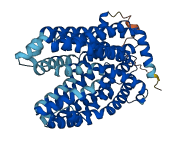
Descriptions
The autoinhibited protein was predicted that may have potential autoinhibitory elements via cis-regPred.
Autoinhibitory domains (AIDs)
Target domain |
|
Relief mechanism |
|
Assay |
cis-regPred |
Accessory elements
No accessory elements
Autoinhibited structure

Activated structure
1 structures for Q9FKQ1
| Entry ID | Method | Resolution | Chain | Position | Source |
|---|---|---|---|---|---|
| AF-Q9FKQ1-F1 | Predicted | AlphaFoldDB |
10 variants for Q9FKQ1
| Variant ID(s) | Position | Change | Description | Diseaes Association | Provenance |
|---|---|---|---|---|---|
| ENSVATH14649478 | 22 | T>A | No | 1000Genomes | |
| tmp_5_26126256_T_C | 33 | R>G | No | 1000Genomes | |
| tmp_5_26126122_T_C,A | 77 | I>M | No | 1000Genomes | |
| tmp_5_26125717_G_C | 183 | C>W | No | 1000Genomes | |
| tmp_5_26125309_A_T | 251 | S>T | No | 1000Genomes | |
| ENSVATH14649469 | 353 | F>I | No | 1000Genomes | |
| ENSVATH12940069 | 423 | I>V | No | 1000Genomes | |
| ENSVATH07483391 | 436 | K>N | No | 1000Genomes | |
| ENSVATH03478555 | 464 | R>K | No | 1000Genomes | |
| ENSVATH00752877 | 484 | T>A | No | 1000Genomes |
1 associated diseases with Q9FKQ1
[MIM: 618254]: Ciliary dyskinesia, primary, 39 (CILD39)
A form of primary ciliary dyskinesia, a disorder characterized by abnormalities of motile cilia. Respiratory infections leading to chronic inflammation and bronchiectasis are recurrent, due to defects in the respiratory cilia. Some patients exhibit randomization of left-right body asymmetry and situs inversus. Primary ciliary dyskinesia associated with situs inversus is referred to as Kartagener syndrome. CILD39 inheritance is autosomal recessive. {ECO:0000269|PubMed:30388400}. Note=The disease is caused by variants affecting the gene represented in this entry.
Without disease ID
- A form of primary ciliary dyskinesia, a disorder characterized by abnormalities of motile cilia. Respiratory infections leading to chronic inflammation and bronchiectasis are recurrent, due to defects in the respiratory cilia. Some patients exhibit randomization of left-right body asymmetry and situs inversus. Primary ciliary dyskinesia associated with situs inversus is referred to as Kartagener syndrome. CILD39 inheritance is autosomal recessive. {ECO:0000269|PubMed:30388400}. Note=The disease is caused by variants affecting the gene represented in this entry.
4 regional properties for Q9FKQ1
| Type | Name | Position | InterPro Accession |
|---|---|---|---|
| domain | Oxoglutarate/iron-dependent dioxygenase | 165 - 275 | IPR005123 |
| domain | Prolyl 4-hydroxylase, alpha subunit | 78 - 274 | IPR006620 |
| domain | Oxoglutarate/iron-dependent oxygenase, C-terminal degradation domain | 304 - 535 | IPR019601 |
| domain | Prolyl 3,4-dihydroxylase TPA1/OFD1, N-terminal domain | 172 - 274 | IPR039558 |
2 GO annotations of cellular component
| Name | Definition |
|---|---|
| integral component of membrane | The component of a membrane consisting of the gene products and protein complexes having at least some part of their peptide sequence embedded in the hydrophobic region of the membrane. |
| membrane | A lipid bilayer along with all the proteins and protein complexes embedded in it an attached to it. |
3 GO annotations of molecular function
| Name | Definition |
|---|---|
| antiporter activity | Enables the active transport of a solute across a membrane by a mechanism whereby two or more species are transported in opposite directions in a tightly coupled process not directly linked to a form of energy other than chemiosmotic energy. The reaction is: solute A(out) + solute B(in) = solute A(in) + solute B(out). |
| transmembrane transporter activity | Enables the transfer of a substance, usually a specific substance or a group of related substances, from one side of a membrane to the other. |
| xenobiotic transmembrane transporter activity | Enables the directed movement of a xenobiotic from one side of a membrane to the other. A xenobiotic is a compound foreign to the organim exposed to it. It may be synthesized by another organism (like ampicilin) or it can be a synthetic chemical. |
1 GO annotations of biological process
| Name | Definition |
|---|---|
| xenobiotic detoxification by transmembrane export across the plasma membrane | A process that reduces or removes the toxicity of a xenobiotic by exporting it outside the cell. |
12 homologous proteins in AiPD
| UniProt AC | Gene Name | Protein Name | Species | Evidence Code |
|---|---|---|---|---|
| Q05497 | YDR338C | Uncharacterized transporter YDR338C | Saccharomyces cerevisiae (strain ATCC 204508 / S288c) (Baker's yeast) | PR |
| Q9SYD6 | DTX42 | Protein DETOXIFICATION 42 | Arabidopsis thaliana (Mouse-ear cress) | PR |
| F4HPH1 | DTX22 | Protein DETOXIFICATION 22 | Arabidopsis thaliana (Mouse-ear cress) | PR |
| F4HQ05 | DTX8 | Protein DETOXIFICATION 8 | Arabidopsis thaliana (Mouse-ear cress) | PR |
| F4I4Q3 | DTX32 | Protein DETOXIFICATION 32 | Arabidopsis thaliana (Mouse-ear cress) | PR |
| O49660 | DTX56 | Protein DETOXIFICATION 56 | Arabidopsis thaliana (Mouse-ear cress) | PR |
| Q9C994 | DTX14 | Protein DETOXIFICATION 14 | Arabidopsis thaliana (Mouse-ear cress) | PR |
| Q9FHB6 | DTX16 | Protein DETOXIFICATION 16 | Arabidopsis thaliana (Mouse-ear cress) | PR |
| Q9FNC1 | DTX28 | Protein DETOXIFICATION 28 | Arabidopsis thaliana (Mouse-ear cress) | PR |
| Q9LPV4 | DTX31 | Protein DETOXIFICATION 31 | Arabidopsis thaliana (Mouse-ear cress) | PR |
| Q9SIA5 | DTX1 | Protein DETOXIFICATION 1 | Arabidopsis thaliana (Mouse-ear cress) | PR |
| Q8W488 | DTX21 | Protein DETOXIFICATION 21 | Arabidopsis thaliana (Mouse-ear cress) | PR |
| 10 | 20 | 30 | 40 | 50 | 60 |
| MRGGDGEEGS | ESRVALLKSP | HTAEEDGEGL | KDRILVETKK | LWQIVGPAIF | SRVTTYSMLV |
| 70 | 80 | 90 | 100 | 110 | 120 |
| ITQAFAGHLG | DLELAAISIV | NNVTVGFNFG | LLLGMASALE | TLCGQAFGAK | KYHMLGVYMQ |
| 130 | 140 | 150 | 160 | 170 | 180 |
| RSWIVLFFCC | VLLLPTYIFT | TPVLKFLGQP | DDIAELSGVV | AIWVIPLHFA | FTLSFPLQRF |
| 190 | 200 | 210 | 220 | 230 | 240 |
| LQCQLKNRVT | AYAAAVALVV | HILVCWLFVD | GLKLGVVGTV | ATISISWWVN | VLILLVYSTC |
| 250 | 260 | 270 | 280 | 290 | 300 |
| GGCPLTWTGL | SSEALTGLWE | FLKLSASSGV | MLCLENWYYR | ILIIMTGNLQ | NARIAVDSLS |
| 310 | 320 | 330 | 340 | 350 | 360 |
| ICMAINGWEM | MIPLAFFAGT | GVRVANELGA | GNGKGARFAT | IVSVTQSLII | GLFFWVLIML |
| 370 | 380 | 390 | 400 | 410 | 420 |
| LHNQIAWIFS | SSVAVLDAVN | KLSLLLAFTV | LLNSVQPVLS | GVAVGSGWQS | YVAYINLGCY |
| 430 | 440 | 450 | 460 | 470 | 480 |
| YCIGVPLGFL | MGWGFKLGVM | GIWGGMIFGG | TAVQTMILSF | ITMRCDWEKE | AQKASARINK |
| WSNTIK |