Q8K3F6
Gene name |
Kcnq3 |
Protein name |
Potassium voltage-gated channel subfamily KQT member 3 |
Names |
KQT-like 3, Potassium channel subunit alpha KvLQT3, Voltage-gated potassium channel subunit Kv7.3 |
Species |
Mus musculus (Mouse) |
KEGG Pathway |
mmu:110862 |
EC number |
|
Protein Class |
|
Descriptions
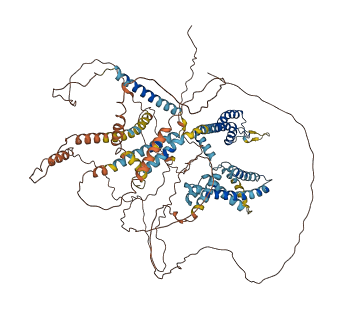
The autoinhibited protein was predicted that may have potential autoinhibitory elements via cis-regPred.
Autoinhibitory domains (AIDs)
Target domain |
|
Relief mechanism |
|
Assay |
cis-regPred |
Accessory elements
No accessory elements
Autoinhibited structure

Activated structure
1 structures for Q8K3F6
| Entry ID | Method | Resolution | Chain | Position | Source |
|---|---|---|---|---|---|
| AF-Q8K3F6-F1 | Predicted | AlphaFoldDB |
29 variants for Q8K3F6
| Variant ID(s) | Position | Change | Description | Diseaes Association | Provenance |
|---|---|---|---|---|---|
| rs3389357440 | 163 | F>L | No | EVA | |
| rs3389373819 | 165 | I>N | No | EVA | |
| rs3389378724 | 181 | C>Y | No | EVA | |
| rs3389353315 | 196 | R>K | No | EVA | |
| rs3389361885 | 197 | K>M | No | EVA | |
| rs3389334563 | 199 | L>P | No | EVA | |
| rs3389361393 | 213 | V>M | No | EVA | |
| rs3389361448 | 241 | M>K | No | EVA | |
| rs3389315420 | 247 | T>S | No | EVA | |
| rs3389370004 | 286 | D>V | No | EVA | |
| rs3389343298 | 319 | G>V | No | EVA | |
| rs3412613860 | 335 | A>T | No | EVA | |
| rs3389357870 | 345 | F>Y | No | EVA | |
| rs3389334547 | 426 | G>S | No | EVA | |
| rs3389361848 | 431 | V>I | No | EVA | |
| rs3389357572 | 450 | N>S | No | EVA | |
| rs3389373885 | 459 | S>P | No | EVA | |
| rs3389326165 | 531 | Y>H | No | EVA | |
| rs3389357569 | 534 | K>R | No | EVA | |
| rs3389361428 | 626 | V>F | No | EVA | |
| rs3389365129 | 629 | Q>L | No | EVA | |
| rs3389361364 | 679 | S>Y | No | EVA | |
| rs3389333048 | 684 | I>N | No | EVA | |
| rs3389326209 | 777 | P>T | No | EVA | |
| rs3389315395 | 794 | M>V | No | EVA | |
| rs3389369959 | 839 | T>* | No | EVA | |
| rs3389361927 | 839 | T>R | No | EVA | |
| rs3389357842 | 853 | P>L | No | EVA | |
| rs3405351269 | 859 | D>Y | No | EVA |
No associated diseases with Q8K3F6
12 GO annotations of cellular component
| Name | Definition |
|---|---|
| axon initial segment | Portion of the axon proximal to the neuronal cell body, at the level of the axon hillock. The action potentials that propagate along the axon are generated at the level of this initial segment. |
| cell surface | The external part of the cell wall and/or plasma membrane. |
| dendrite | A neuron projection that has a short, tapering, morphology. Dendrites receive and integrate signals from other neurons or from sensory stimuli, and conduct nerve impulses towards the axon or the cell body. In most neurons, the impulse is conveyed from dendrites to axon via the cell body, but in some types of unipolar neuron, the impulse does not travel via the cell body. |
| integral component of membrane | The component of a membrane consisting of the gene products and protein complexes having at least some part of their peptide sequence embedded in the hydrophobic region of the membrane. |
| integral component of plasma membrane | The component of the plasma membrane consisting of the gene products and protein complexes having at least some part of their peptide sequence embedded in the hydrophobic region of the membrane. |
| membrane raft | Any of the small (10-200 nm), heterogeneous, highly dynamic, sterol- and sphingolipid-enriched membrane domains that compartmentalize cellular processes. Small rafts can sometimes be stabilized to form larger platforms through protein-protein and protein-lipid interactions. |
| neuron projection | A prolongation or process extending from a nerve cell, e.g. an axon or dendrite. |
| neuronal cell body | The portion of a neuron that includes the nucleus, but excludes cell projections such as axons and dendrites. |
| node of Ranvier | An axon part that is a gap in the myelin where voltage-gated sodium channels cluster and saltatory conduction is executed. |
| plasma membrane | The membrane surrounding a cell that separates the cell from its external environment. It consists of a phospholipid bilayer and associated proteins. |
| somatodendritic compartment | The region of a neuron that includes the cell body (cell soma) and dendrite(s), but excludes the axon. |
| voltage-gated potassium channel complex | A protein complex that forms a transmembrane channel through which potassium ions may cross a cell membrane in response to changes in membrane potential. |
8 GO annotations of molecular function
| Name | Definition |
|---|---|
| calmodulin binding | Binding to calmodulin, a calcium-binding protein with many roles, both in the calcium-bound and calcium-free states. |
| delayed rectifier potassium channel activity | Enables the transmembrane transfer of a potassium ion by a delayed rectifying voltage-gated channel. A delayed rectifying current-voltage relation is one where channel activation kinetics are time-dependent, and inactivation is slow. |
| potassium channel activity | Enables the facilitated diffusion of a potassium ion (by an energy-independent process) involving passage through a transmembrane aqueous pore or channel without evidence for a carrier-mediated mechanism. |
| protein kinase binding | Binding to a protein kinase, any enzyme that catalyzes the transfer of a phosphate group, usually from ATP, to a protein substrate. |
| transmembrane transporter binding | Binding to a transmembrane transporter, a protein or protein complex that enables the transfer of a substance, usually a specific substance or a group of related substances, from one side of a membrane to the other. |
| ubiquitin protein ligase binding | Binding to a ubiquitin protein ligase enzyme, any of the E3 proteins. |
| voltage-gated ion channel activity | Enables the transmembrane transfer of an ion by a voltage-gated channel. An ion is an atom or group of atoms carrying an electric charge by virtue of having gained or lost one or more electrons. A voltage-gated channel is a channel whose open state is dependent on the voltage across the membrane in which it is embedded. |
| voltage-gated potassium channel activity | Enables the transmembrane transfer of a potassium ion by a voltage-gated channel. A voltage-gated channel is a channel whose open state is dependent on the voltage across the membrane in which it is embedded. |
6 GO annotations of biological process
| Name | Definition |
|---|---|
| cellular response to ammonium ion | Any process that results in a change in state or activity of a cell (in terms of movement, secretion, enzyme production, gene expression, etc.) as a result of an ammonium stimulus. |
| establishment of localization in cell | Any process, occuring in a cell, that localizes a substance or cellular component. This may occur via movement, tethering or selective degradation. |
| ion transmembrane transport | A process in which an ion is transported across a membrane. |
| membrane hyperpolarization | The process in which membrane potential increases with respect to its steady-state potential, usually from negative potential to a more negative potential. For example, during the repolarization phase of an action potential the membrane potential often becomes more negative or hyperpolarized before returning to the steady-state resting potential. |
| potassium ion transmembrane transport | A process in which a potassium ion is transported from one side of a membrane to the other. |
| regulation of ion transmembrane transport | Any process that modulates the frequency, rate or extent of the directed movement of ions from one side of a membrane to the other. |
19 homologous proteins in AiPD
| UniProt AC | Gene Name | Protein Name | Species | Evidence Code |
|---|---|---|---|---|
| P58126 | KCNQ3 | Potassium voltage-gated channel subfamily KQT member 3 | Bos taurus (Bovine) | PR |
| P56696 | KCNQ4 | Potassium voltage-gated channel subfamily KQT member 4 | Homo sapiens (Human) | PR |
| O43525 | KCNQ3 | Potassium voltage-gated channel subfamily KQT member 3 | Homo sapiens (Human) | PR |
| Q9JK45 | Kcnq5 | Potassium voltage-gated channel subfamily KQT member 5 | Mus musculus (Mouse) | PR |
| Q9JK97 | Kcnq4 | Potassium voltage-gated channel subfamily KQT member 4 | Mus musculus (Mouse) | PR |
| Q61423 | Kcna4 | Potassium voltage-gated channel subfamily A member 4 | Mus musculus (Mouse) | PR |
| P16390 | Kcna3 | Potassium voltage-gated channel subfamily A member 3 | Mus musculus (Mouse) | PR |
| P16388 | Kcna1 | Potassium voltage-gated channel subfamily A member 1 | Mus musculus (Mouse) | PR |
| Q80XM3 | Kcng4 | Potassium voltage-gated channel subfamily G member 4 | Mus musculus (Mouse) | PR |
| Q03717 | Kcnb1 | Potassium voltage-gated channel subfamily B member 1 | Mus musculus (Mouse) | PR |
| O35174 | Kcns2 | Potassium voltage-gated channel subfamily S member 2 | Mus musculus (Mouse) | PR |
| Q9Z0V2 | Kcnd2 | Potassium voltage-gated channel subfamily D member 2 | Mus musculus (Mouse) | PR |
| A6H8H5 | Kcnb2 | Potassium voltage-gated channel subfamily B member 2 | Mus musculus (Mouse) | PR |
| P97414 | Kcnq1 | Potassium voltage-gated channel subfamily KQT member 1 | Mus musculus (Mouse) | PR |
| Q17ST2 | Kcna7 | Potassium voltage-gated channel subfamily A member 7 | Mus musculus (Mouse) | PR |
| Q9Z0V1 | Kcnd3 | Potassium voltage-gated channel subfamily D member 3 | Mus musculus (Mouse) | PR |
| Q7TSH7 | Kcnf1 | Potassium voltage-gated channel subfamily F member 1 | Mus musculus (Mouse) | PR |
| Q9JK96 | Kcnq4 | Potassium voltage-gated channel subfamily KQT member 4 | Rattus norvegicus (Rat) | PR |
| O88944 | Kcnq3 | Potassium voltage-gated channel subfamily KQT member 3 | Rattus norvegicus (Rat) | PR |
| 10 | 20 | 30 | 40 | 50 | 60 |
| MGLKARRAAG | AAGGGGGEGG | GGGGGAANPA | GGDSAVAGDE | ERKVGLAPGD | VEQVTLALGA |
| 70 | 80 | 90 | 100 | 110 | 120 |
| GADKDGTLLL | EGGGREEGQR | RTPQGIGLLA | KTPLSRPVKR | NNAKYRRIQT | LIYDALERPR |
| 130 | 140 | 150 | 160 | 170 | 180 |
| GWALLYHALV | FLIVLGCLIL | AVLTTFKEYE | TVSGDWLLLL | ETFAIFIFGA | EFALRIWAAG |
| 190 | 200 | 210 | 220 | 230 | 240 |
| CCCRYKGWRG | RLKFARKPLC | MLDIFVLIAS | VPVVAVGNQG | NVLATSLRSL | RFLQILRMLR |
| 250 | 260 | 270 | 280 | 290 | 300 |
| MDRRGGTWKL | LGSAICAHSK | ELITAWYIGF | LTLILSSFLV | YLVEKDVPEM | DAQGEEMKEE |
| 310 | 320 | 330 | 340 | 350 | 360 |
| FETYADALWW | GLITLATIGY | GDKTPKTWEG | RLIAATFSLI | GVSFFALPAG | ILGSGLALKV |
| 370 | 380 | 390 | 400 | 410 | 420 |
| QEQHRQKHFE | KRRKPAAELI | QAAWRYYATN | PNRLDLVATW | RFYESVVSFP | FFRKEQLEAA |
| 430 | 440 | 450 | 460 | 470 | 480 |
| ASQKLGLLDR | VRLSNPRGSN | TKGKLFTPLN | VDAIEESPSK | EPKPVGLNNK | ERFRTAFRMK |
| 490 | 500 | 510 | 520 | 530 | 540 |
| AYAFWQSSED | AGTGDPMAED | RGYGNDFLIE | DMIPTLKAAI | RAVRILQFRL | YKKKFKETLR |
| 550 | 560 | 570 | 580 | 590 | 600 |
| PYDVKDVIEQ | YSAGHLDMLS | RIKYLQTRID | MIFTPGPPST | PKHKKSQKGS | AFTYPSQQSP |
| 610 | 620 | 630 | 640 | 650 | 660 |
| RNEPYVARAA | TSETEDQSMM | GKFVKVERQV | HDMGKKLDFL | VDMHMQHMER | LQVHVTEYYP |
| 670 | 680 | 690 | 700 | 710 | 720 |
| TKGASSPAEG | EKKEDNRYSD | LKTIICNYSE | TGPPDPPYSF | HQVPIDRVGP | YGFFAHDPVK |
| 730 | 740 | 750 | 760 | 770 | 780 |
| LTRGGPSSTK | AQANLPSSGS | TYAERPTVLP | ILTLLDSCVS | YHSQTELQGP | YSDHISPRQR |
| 790 | 800 | 810 | 820 | 830 | 840 |
| RSITRDSDTP | LSLMSVNHEE | LERSPSGFSI | SQDRDDYVFG | PSGGSSWMRE | KRYLAEGETD |
| 850 | 860 | 870 | |||
| TDTDPFTPSG | SMPMSSTGDG | ISDSIWTPSN | KPT |