Q17ST2
Gene name |
Kcna7 (Kcnc7) |
Protein name |
Potassium voltage-gated channel subfamily A member 7 |
Names |
Voltage-gated potassium channel subunit Kv1.7 |
Species |
Mus musculus (Mouse) |
KEGG Pathway |
mmu:16495 |
EC number |
|
Protein Class |
|
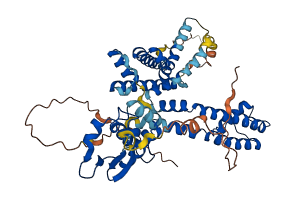
Descriptions
The autoinhibited protein was predicted that may have potential autoinhibitory elements via cis-regPred.
Autoinhibitory domains (AIDs)
Target domain |
|
Relief mechanism |
|
Assay |
cis-regPred |
Accessory elements
No accessory elements
Autoinhibited structure

Activated structure
1 structures for Q17ST2
| Entry ID | Method | Resolution | Chain | Position | Source |
|---|---|---|---|---|---|
| AF-Q17ST2-F1 | Predicted | AlphaFoldDB |
2 variants for Q17ST2
| Variant ID(s) | Position | Change | Description | Diseaes Association | Provenance |
|---|---|---|---|---|---|
| rs215960598 | 5 | P>R | No | EVA | |
| rs233028732 | 12 | T>A | No | EVA |
No associated diseases with Q17ST2
2 GO annotations of cellular component
| Name | Definition |
|---|---|
| integral component of membrane | The component of a membrane consisting of the gene products and protein complexes having at least some part of their peptide sequence embedded in the hydrophobic region of the membrane. |
| voltage-gated potassium channel complex | A protein complex that forms a transmembrane channel through which potassium ions may cross a cell membrane in response to changes in membrane potential. |
2 GO annotations of molecular function
| Name | Definition |
|---|---|
| delayed rectifier potassium channel activity | Enables the transmembrane transfer of a potassium ion by a delayed rectifying voltage-gated channel. A delayed rectifying current-voltage relation is one where channel activation kinetics are time-dependent, and inactivation is slow. |
| voltage-gated potassium channel activity | Enables the transmembrane transfer of a potassium ion by a voltage-gated channel. A voltage-gated channel is a channel whose open state is dependent on the voltage across the membrane in which it is embedded. |
3 GO annotations of biological process
| Name | Definition |
|---|---|
| potassium ion transmembrane transport | A process in which a potassium ion is transported from one side of a membrane to the other. |
| protein homooligomerization | The process of creating protein oligomers, compounds composed of a small number, usually between three and ten, of identical component monomers. Oligomers may be formed by the polymerization of a number of monomers or the depolymerization of a large protein polymer. |
| regulation of ion transmembrane transport | Any process that modulates the frequency, rate or extent of the directed movement of ions from one side of a membrane to the other. |
24 homologous proteins in AiPD
| UniProt AC | Gene Name | Protein Name | Species | Evidence Code |
|---|---|---|---|---|
| Q05037 | KCNA4 | Potassium voltage-gated channel subfamily A member 4 | Bos taurus (Bovine) | PR |
| Q7T199 | KCNA10 | Potassium voltage-gated channel subfamily A member 10 | Gallus gallus (Chicken) | PR |
| P22459 | KCNA4 | Potassium voltage-gated channel subfamily A member 4 | Homo sapiens (Human) | PR |
| P22001 | KCNA3 | Potassium voltage-gated channel subfamily A member 3 | Homo sapiens (Human) | PR |
| Q16322 | KCNA10 | Potassium voltage-gated channel subfamily A member 10 | Homo sapiens (Human) | PR |
| Q09470 | KCNA1 | Potassium voltage-gated channel subfamily A member 1 | Homo sapiens (Human) | PR |
| P16389 | KCNA2 | Potassium voltage-gated channel subfamily A member 2 | Homo sapiens (Human) | PR |
| Q96RP8 | KCNA7 | Potassium voltage-gated channel subfamily A member 7 | Homo sapiens (Human) | PR |
| Q8K3F6 | Kcnq3 | Potassium voltage-gated channel subfamily KQT member 3 | Mus musculus (Mouse) | PR |
| P97414 | Kcnq1 | Potassium voltage-gated channel subfamily KQT member 1 | Mus musculus (Mouse) | PR |
| Q61423 | Kcna4 | Potassium voltage-gated channel subfamily A member 4 | Mus musculus (Mouse) | PR |
| P16390 | Kcna3 | Potassium voltage-gated channel subfamily A member 3 | Mus musculus (Mouse) | PR |
| P16388 | Kcna1 | Potassium voltage-gated channel subfamily A member 1 | Mus musculus (Mouse) | PR |
| Q9Z0V1 | Kcnd3 | Potassium voltage-gated channel subfamily D member 3 | Mus musculus (Mouse) | PR |
| Q9Z0V2 | Kcnd2 | Potassium voltage-gated channel subfamily D member 2 | Mus musculus (Mouse) | PR |
| O35174 | Kcns2 | Potassium voltage-gated channel subfamily S member 2 | Mus musculus (Mouse) | PR |
| Q03717 | Kcnb1 | Potassium voltage-gated channel subfamily B member 1 | Mus musculus (Mouse) | PR |
| Q80XM3 | Kcng4 | Potassium voltage-gated channel subfamily G member 4 | Mus musculus (Mouse) | PR |
| Q7TSH7 | Kcnf1 | Potassium voltage-gated channel subfamily F member 1 | Mus musculus (Mouse) | PR |
| A6H8H5 | Kcnb2 | Potassium voltage-gated channel subfamily B member 2 | Mus musculus (Mouse) | PR |
| P15385 | Kcna4 | Potassium voltage-gated channel subfamily A member 4 | Rattus norvegicus (Rat) | PR |
| P15384 | Kcna3 | Potassium voltage-gated channel subfamily A member 3 | Rattus norvegicus (Rat) | PR |
| P10499 | Kcna1 | Potassium voltage-gated channel subfamily A member 1 | Rattus norvegicus (Rat) | PR |
| P63142 | Kcna2 | Potassium voltage-gated channel subfamily A member 2 | Rattus norvegicus (Rat) | PR |
| 10 | 20 | 30 | 40 | 50 | 60 |
| MLFLPADTGH | PTGVAAASGP | HVRSPVARAV | RAMEPRCPPP | CGCCERLVLN | VAGLRFETRA |
| 70 | 80 | 90 | 100 | 110 | 120 |
| RTLGRFPDTL | LGDPVRRSRF | YDGARREYFF | DRHRPSFDAV | LYYYQSGGRL | RRPAHVPLDV |
| 130 | 140 | 150 | 160 | 170 | 180 |
| FLEEVSFYGL | GAAALARLRE | DEGCAVPPER | PLPRRAFARQ | LWLLFEFPES | SQAARVLAVV |
| 190 | 200 | 210 | 220 | 230 | 240 |
| SVLVILVSIV | VFCLETLPDF | RDDRDDPGLA | PVAAATGPFL | ARLNGSSPMP | GAPPRQPFND |
| 250 | 260 | 270 | 280 | 290 | 300 |
| PFFVVETLCI | CWFSFELLVR | LVACPSKAVF | FKNVMNLIDF | VAILPYFVAL | GTELARQRGV |
| 310 | 320 | 330 | 340 | 350 | 360 |
| GQPAMSLAIL | RVIRLVRVFR | IFKLSRHSKG | LQILGQTLRA | SMRELGLLIF | FLFIGVVLFS |
| 370 | 380 | 390 | 400 | 410 | 420 |
| SAVYFAEVDR | VDTHFTSIPE | SFWWAVVTMT | TVGYGDMAPV | TVGGKIVGSL | CAIAGVLTIS |
| 430 | 440 | 450 | 460 | 470 | 480 |
| LPVPVIVSNF | SYFYHRETEG | EEAGMYSHVD | TQPCGTLEGK | ANGGLVDSEV | PELLPPLWPP |
| AGKHMVTEV |