P16388
Gene name |
Kcna1 |
Protein name |
Potassium voltage-gated channel subfamily A member 1 |
Names |
MBK1, MKI, Voltage-gated potassium channel subunit Kv1.1 |
Species |
Mus musculus (Mouse) |
KEGG Pathway |
mmu:16485 |
EC number |
|
Protein Class |
|
Descriptions
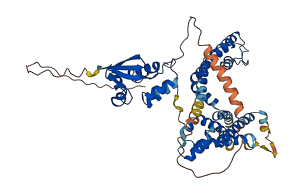
The autoinhibited protein was predicted that may have potential autoinhibitory elements via cis-regPred.
Autoinhibitory domains (AIDs)
Target domain |
|
Relief mechanism |
|
Assay |
cis-regPred |
Accessory elements
No accessory elements
Autoinhibited structure

Activated structure
1 structures for P16388
| Entry ID | Method | Resolution | Chain | Position | Source |
|---|---|---|---|---|---|
| AF-P16388-F1 | Predicted | AlphaFoldDB |
25 variants for P16388
| Variant ID(s) | Position | Change | Description | Diseaes Association | Provenance |
|---|---|---|---|---|---|
| rs38776367 | 25 | P>R | No | EVA | |
| rs3388863755 | 31 | D>A | No | EVA | |
| rs3388863775 | 32 | D>E | No | EVA | |
| rs3388863342 | 67 | K>E | No | EVA | |
| rs3388859849 | 150 | Q>P | No | EVA | |
| rs3388863751 | 182 | V>F | No | EVA | |
| rs3388826139 | 184 | F>L | No | EVA | |
| rs3388863739 | 186 | L>Q | No | EVA | |
| rs3388839709 | 215 | N>K | No | EVA | |
| rs3388864639 | 228 | C>R | No | EVA | |
| rs3388826169 | 274 | A>P | No | EVA | |
| rs3388863748 | 274 | A>VSDG* | No | EVA | |
| rs3388847252 | 276 | Q>* | No | EVA | |
| rs3388865029 | 282 | G>S | No | EVA | |
| rs3388858602 | 331 | F>L | No | EVA | |
| rs3388864624 | 384 | G>A | No | EVA | |
| rs3388863763 | 389 | G>D | No | EVA | |
| rs3388842774 | 396 | G>A | No | EVA | |
| 400 | I>V | RNA edited version [UniProt] | No | ||
| rs3388859821 | 408 | V>A | No | EVA | |
| rs3388847217 | 419 | T>I | No | EVA | |
| rs3388855815 | 426 | Q>R | No | EVA | |
| rs3388865087 | 453 | E>D | No | EVA | |
| rs3388859829 | 462 | N>I | No | EVA | |
| rs3388839747 | 466 | A>S | No | EVA |
1 associated diseases with P16388
Without disease ID
Functions
25 GO annotations of cellular component
| Name | Definition |
|---|---|
| anchoring junction | A cell junction that mechanically attaches a cell (and its cytoskeleton) to neighboring cells or to the extracellular matrix. |
| apical plasma membrane | The region of the plasma membrane located at the apical end of the cell. |
| axon | The long process of a neuron that conducts nerve impulses, usually away from the cell body to the terminals and varicosities, which are sites of storage and release of neurotransmitter. |
| axon initial segment | Portion of the axon proximal to the neuronal cell body, at the level of the axon hillock. The action potentials that propagate along the axon are generated at the level of this initial segment. |
| axon terminus | Terminal inflated portion of the axon, containing the specialized apparatus necessary to release neurotransmitters. The axon terminus is considered to be the whole region of thickening and the terminal button is a specialized region of it. |
| calyx of Held | The terminal specialization of a calyciferous axon which forms large synapses in the mammalian auditory central nervous system. |
| cell junction | A cellular component that forms a specialized region of connection between two or more cells, or between a cell and the extracellular matrix, or between two membrane-bound components of a cell, such as flagella. |
| cell surface | The external part of the cell wall and/or plasma membrane. |
| cytoplasmic vesicle | A vesicle found in the cytoplasm of a cell. |
| cytosol | The part of the cytoplasm that does not contain organelles but which does contain other particulate matter, such as protein complexes. |
| dendrite | A neuron projection that has a short, tapering, morphology. Dendrites receive and integrate signals from other neurons or from sensory stimuli, and conduct nerve impulses towards the axon or the cell body. In most neurons, the impulse is conveyed from dendrites to axon via the cell body, but in some types of unipolar neuron, the impulse does not travel via the cell body. |
| endoplasmic reticulum | The irregular network of unit membranes, visible only by electron microscopy, that occurs in the cytoplasm of many eukaryotic cells. The membranes form a complex meshwork of tubular channels, which are often expanded into slitlike cavities called cisternae. The ER takes two forms, rough (or granular), with ribosomes adhering to the outer surface, and smooth (with no ribosomes attached). |
| glutamatergic synapse | A synapse that uses glutamate as a neurotransmitter. |
| integral component of membrane | The component of a membrane consisting of the gene products and protein complexes having at least some part of their peptide sequence embedded in the hydrophobic region of the membrane. |
| integral component of plasma membrane | The component of the plasma membrane consisting of the gene products and protein complexes having at least some part of their peptide sequence embedded in the hydrophobic region of the membrane. |
| integral component of postsynaptic membrane | The component of the postsynaptic membrane consisting of the gene products and protein complexes having at least some part of their peptide sequence embedded in the hydrophobic region of the membrane. |
| integral component of presynaptic membrane | The component of the presynaptic membrane consisting of the gene products and protein complexes having at least some part of their peptide sequence embedded in the hydrophobic region of the membrane. |
| juxtaparanode region of axon | A region of an axon near a node of Ranvier that is between the paranode and internode regions. |
| neuronal cell body | The portion of a neuron that includes the nucleus, but excludes cell projections such as axons and dendrites. |
| paranode region of axon | An axon part that is located adjacent to the nodes of Ranvier and surrounded by lateral loop portions of myelin sheath. |
| perikaryon | The portion of the cell soma (neuronal cell body) that excludes the nucleus. |
| potassium channel complex | An ion channel complex through which potassium ions pass. |
| presynaptic membrane | A specialized area of membrane of the axon terminal that faces the plasma membrane of the neuron or muscle fiber with which the axon terminal establishes a synaptic junction; many synaptic junctions exhibit structural presynaptic characteristics, such as conical, electron-dense internal protrusions, that distinguish it from the remainder of the axon plasma membrane. |
| synapse | The junction between an axon of one neuron and a dendrite of another neuron, a muscle fiber or a glial cell. As the axon approaches the synapse it enlarges into a specialized structure, the presynaptic terminal bouton, which contains mitochondria and synaptic vesicles. At the tip of the terminal bouton is the presynaptic membrane; facing it, and separated from it by a minute cleft (the synaptic cleft) is a specialized area of membrane on the receiving cell, known as the postsynaptic membrane. In response to the arrival of nerve impulses, the presynaptic terminal bouton secretes molecules of neurotransmitters into the synaptic cleft. These diffuse across the cleft and transmit the signal to the postsynaptic membrane. |
| voltage-gated potassium channel complex | A protein complex that forms a transmembrane channel through which potassium ions may cross a cell membrane in response to changes in membrane potential. |
5 GO annotations of molecular function
| Name | Definition |
|---|---|
| delayed rectifier potassium channel activity | Enables the transmembrane transfer of a potassium ion by a delayed rectifying voltage-gated channel. A delayed rectifying current-voltage relation is one where channel activation kinetics are time-dependent, and inactivation is slow. |
| disordered domain specific binding | Binding to a disordered domain of a protein. |
| voltage-gated ion channel activity involved in regulation of postsynaptic membrane potential | Any voltage-gated ion channel activity that is involved in regulation of postsynaptic membrane potential. |
| voltage-gated ion channel activity involved in regulation of presynaptic membrane potential | Voltage-gated ion channel activity, occurring in the presynaptic membrane, involved in regulation of presynaptic membrane potential. This is a key step in synaptic transmission, following the arrival of an action potential at the synapse. |
| voltage-gated potassium channel activity | Enables the transmembrane transfer of a potassium ion by a voltage-gated channel. A voltage-gated channel is a channel whose open state is dependent on the voltage across the membrane in which it is embedded. |
18 GO annotations of biological process
| Name | Definition |
|---|---|
| brain development | The process whose specific outcome is the progression of the brain over time, from its formation to the mature structure. Brain development begins with patterning events in the neural tube and ends with the mature structure that is the center of thought and emotion. The brain is responsible for the coordination and control of bodily activities and the interpretation of information from the senses (sight, hearing, smell, etc.). |
| cell communication by electrical coupling | The process that mediates signaling interactions between one cell and another cell by transfer of current between their adjacent cytoplasms via intercellular protein channels. |
| cellular response to magnesium ion | Any process that results in a change in state or activity of a cell (in terms of movement, secretion, enzyme production, gene expression, etc.) as a result of a magnesium ion stimulus. |
| detection of mechanical stimulus involved in sensory perception of pain | The series of events involved in the perception of pain in which a mechanical stimulus is received and converted into a molecular signal. |
| detection of mechanical stimulus involved in sensory perception of touch | The series of events involved in the perception of touch in which a mechanical stimulus is received and converted into a molecular signal. |
| hippocampus development | The progression of the hippocampus over time from its initial formation until its mature state. |
| magnesium ion homeostasis | Any process involved in the maintenance of an internal steady state of magnesium ions within an organism or cell. |
| neuroblast proliferation | The expansion of a neuroblast population by cell division. A neuroblast is any cell that will divide and give rise to a neuron. |
| neuromuscular process | Any process pertaining to the functions of the nervous and muscular systems of an organism. |
| neuronal action potential | An action potential that occurs in a neuron. |
| neuronal signal transduction | The process in which an activated neuronal cell receptor conveys information down a signaling pathway, resulting in a change in the function or state of a cell. This process may be intracellular or intercellular. |
| positive regulation of voltage-gated potassium channel activity | Any process that activates or increases the frequency, rate or extent of voltage-gated potassium channel activity. |
| potassium ion transmembrane transport | A process in which a potassium ion is transported from one side of a membrane to the other. |
| protein homooligomerization | The process of creating protein oligomers, compounds composed of a small number, usually between three and ten, of identical component monomers. Oligomers may be formed by the polymerization of a number of monomers or the depolymerization of a large protein polymer. |
| protein localization | Any process in which a protein is transported to, or maintained in, a specific location. |
| regulation of membrane potential | Any process that modulates the establishment or extent of a membrane potential, the electric potential existing across any membrane arising from charges in the membrane itself and from the charges present in the media on either side of the membrane. |
| regulation of muscle contraction | Any process that modulates the frequency, rate or extent of muscle contraction. |
| startle response | An action or movement due to the application of a sudden unexpected stimulus. |
24 homologous proteins in AiPD
| UniProt AC | Gene Name | Protein Name | Species | Evidence Code |
|---|---|---|---|---|
| Q05037 | KCNA4 | Potassium voltage-gated channel subfamily A member 4 | Bos taurus (Bovine) | PR |
| Q7T199 | KCNA10 | Potassium voltage-gated channel subfamily A member 10 | Gallus gallus (Chicken) | PR |
| Q96RP8 | KCNA7 | Potassium voltage-gated channel subfamily A member 7 | Homo sapiens (Human) | PR |
| P22459 | KCNA4 | Potassium voltage-gated channel subfamily A member 4 | Homo sapiens (Human) | PR |
| P22001 | KCNA3 | Potassium voltage-gated channel subfamily A member 3 | Homo sapiens (Human) | PR |
| Q16322 | KCNA10 | Potassium voltage-gated channel subfamily A member 10 | Homo sapiens (Human) | PR |
| P16389 | KCNA2 | Potassium voltage-gated channel subfamily A member 2 | Homo sapiens (Human) | PR |
| Q09470 | KCNA1 | Potassium voltage-gated channel subfamily A member 1 | Homo sapiens (Human) | PR |
| P16390 | Kcna3 | Potassium voltage-gated channel subfamily A member 3 | Mus musculus (Mouse) | PR |
| Q61423 | Kcna4 | Potassium voltage-gated channel subfamily A member 4 | Mus musculus (Mouse) | PR |
| Q80XM3 | Kcng4 | Potassium voltage-gated channel subfamily G member 4 | Mus musculus (Mouse) | PR |
| Q03717 | Kcnb1 | Potassium voltage-gated channel subfamily B member 1 | Mus musculus (Mouse) | PR |
| Q8K3F6 | Kcnq3 | Potassium voltage-gated channel subfamily KQT member 3 | Mus musculus (Mouse) | PR |
| O35174 | Kcns2 | Potassium voltage-gated channel subfamily S member 2 | Mus musculus (Mouse) | PR |
| Q9Z0V2 | Kcnd2 | Potassium voltage-gated channel subfamily D member 2 | Mus musculus (Mouse) | PR |
| A6H8H5 | Kcnb2 | Potassium voltage-gated channel subfamily B member 2 | Mus musculus (Mouse) | PR |
| P97414 | Kcnq1 | Potassium voltage-gated channel subfamily KQT member 1 | Mus musculus (Mouse) | PR |
| Q17ST2 | Kcna7 | Potassium voltage-gated channel subfamily A member 7 | Mus musculus (Mouse) | PR |
| Q9Z0V1 | Kcnd3 | Potassium voltage-gated channel subfamily D member 3 | Mus musculus (Mouse) | PR |
| Q7TSH7 | Kcnf1 | Potassium voltage-gated channel subfamily F member 1 | Mus musculus (Mouse) | PR |
| P15385 | Kcna4 | Potassium voltage-gated channel subfamily A member 4 | Rattus norvegicus (Rat) | PR |
| P15384 | Kcna3 | Potassium voltage-gated channel subfamily A member 3 | Rattus norvegicus (Rat) | PR |
| P63142 | Kcna2 | Potassium voltage-gated channel subfamily A member 2 | Rattus norvegicus (Rat) | PR |
| P10499 | Kcna1 | Potassium voltage-gated channel subfamily A member 1 | Rattus norvegicus (Rat) | PR |
| 10 | 20 | 30 | 40 | 50 | 60 |
| MTVMSGENAD | EASTAPGHPQ | DGSYPRQADH | DDHECCERVV | INISGLRFET | QLKTLAQFPN |
| 70 | 80 | 90 | 100 | 110 | 120 |
| TLLGNPKKRM | RYFDPLRNEY | FFDRNRPSFD | AILYYYQSGG | RLRRPVNVPL | DMFSEEIKFY |
| 130 | 140 | 150 | 160 | 170 | 180 |
| ELGEEAMEKF | REDEGFIKEE | ERPLPEKEYQ | RQVWLLFEYP | ESSGPARVIA | IVSVMVILIS |
| 190 | 200 | 210 | 220 | 230 | 240 |
| IVIFCLETLP | ELKDDKDFTG | TIHRIDNTTV | IYTSNIFTDP | FFIVETLCII | WFSFELVVRF |
| 250 | 260 | 270 | 280 | 290 | 300 |
| FACPSKTDFF | KNIMNFIDIV | AIIPYFITLG | TEIAEQEGNQ | KGEQATSLAI | LRVIRLVRVF |
| 310 | 320 | 330 | 340 | 350 | 360 |
| RIFKLSRHSK | GLQILGQTLK | ASMRELGLLI | FFLFIGVILF | SSAVYFAEAE | EAESHFSSIP |
| 370 | 380 | 390 | 400 | 410 | 420 |
| DAFWWAVVSM | TTVGYGDMYP | VTIGGKIVGS | LCAIAGVLTI | ALPVPVIVSN | FNYFYHRETE |
| 430 | 440 | 450 | 460 | 470 | 480 |
| GEEQAQLLHV | SSPNLASDSD | LSRRSSSTIS | KSEYMEIEED | MNNSIAHYRQ | ANIRTGNCTT |
| 490 | |||||
| ADQNCVNKSK | LLTDV |