P63142
Gene name |
Kcna2 |
Protein name |
Potassium voltage-gated channel subfamily A member 2 |
Names |
RAK, RBK2, RCK5, Voltage-gated potassium channel subunit Kv1.2 |
Species |
Rattus norvegicus (Rat) |
KEGG Pathway |
rno:25468 |
EC number |
|
Protein Class |
|
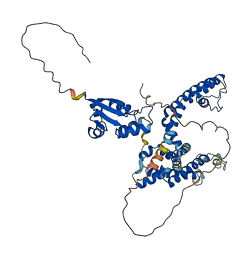
Descriptions
The autoinhibited protein was predicted that may have potential autoinhibitory elements via cis-regPred.
Autoinhibitory domains (AIDs)
Target domain |
|
Relief mechanism |
|
Assay |
cis-regPred |
Accessory elements
No accessory elements
Autoinhibited structure

Activated structure
17 structures for P63142
| Entry ID | Method | Resolution | Chain | Position | Source |
|---|---|---|---|---|---|
| 1DSX | X-ray | 160 A | A/B/C/D/E/F/G/H | 33-119 | PDB |
| 1QDV | X-ray | 160 A | A/B/C/D | 33-131 | PDB |
| 1QDW | X-ray | 210 A | A/B/C/D/E/F/G/H | 33-119 | PDB |
| 2A79 | X-ray | 290 A | B | 1-499 | PDB |
| 2R9R | X-ray | 240 A | B/H | 1-499 | PDB |
| 3LNM | X-ray | 290 A | PDB | ||
| 3LUT | X-ray | 290 A | B | 1-499 | PDB |
| 4JTA | X-ray | 250 A | PDB | ||
| 4JTC | X-ray | 256 A | PDB | ||
| 4JTD | X-ray | 254 A | PDB | ||
| 5WIE | X-ray | 330 A | B/H | 1-42 | PDB |
| 6EBK | EM | 330 A | PDB | ||
| 6EBL | EM | 300 A | PDB | ||
| 6EBM | EM | 400 A | PDB | ||
| 7SIT | X-ray | 332 A | B/D | 1-499 | PDB |
| 7SIZ | X-ray | 310 A | B/D | 1-499 | PDB |
| AF-P63142-F1 | Predicted | AlphaFoldDB |
No variants for P63142
| Variant ID(s) | Position | Change | Description | Diseaes Association | Provenance |
|---|---|---|---|---|---|
| No variants for P63142 | |||||
No associated diseases with P63142
Functions
18 GO annotations of cellular component
| Name | Definition |
|---|---|
| axon | The long process of a neuron that conducts nerve impulses, usually away from the cell body to the terminals and varicosities, which are sites of storage and release of neurotransmitter. |
| axon initial segment | Portion of the axon proximal to the neuronal cell body, at the level of the axon hillock. The action potentials that propagate along the axon are generated at the level of this initial segment. |
| axon terminus | Terminal inflated portion of the axon, containing the specialized apparatus necessary to release neurotransmitters. The axon terminus is considered to be the whole region of thickening and the terminal button is a specialized region of it. |
| calyx of Held | The terminal specialization of a calyciferous axon which forms large synapses in the mammalian auditory central nervous system. |
| dendrite | A neuron projection that has a short, tapering, morphology. Dendrites receive and integrate signals from other neurons or from sensory stimuli, and conduct nerve impulses towards the axon or the cell body. In most neurons, the impulse is conveyed from dendrites to axon via the cell body, but in some types of unipolar neuron, the impulse does not travel via the cell body. |
| endoplasmic reticulum membrane | The lipid bilayer surrounding the endoplasmic reticulum. |
| endosome | A vacuole to which materials ingested by endocytosis are delivered. |
| integral component of membrane | The component of a membrane consisting of the gene products and protein complexes having at least some part of their peptide sequence embedded in the hydrophobic region of the membrane. |
| integral component of plasma membrane | The component of the plasma membrane consisting of the gene products and protein complexes having at least some part of their peptide sequence embedded in the hydrophobic region of the membrane. |
| integral component of presynaptic membrane | The component of the presynaptic membrane consisting of the gene products and protein complexes having at least some part of their peptide sequence embedded in the hydrophobic region of the membrane. |
| juxtaparanode region of axon | A region of an axon near a node of Ranvier that is between the paranode and internode regions. |
| lamellipodium | A thin sheetlike process extended by the leading edge of a migrating cell or extending cell process; contains a dense meshwork of actin filaments. |
| lamellipodium membrane | The portion of the plasma membrane surrounding a lamellipodium. |
| neuronal cell body membrane | The plasma membrane of a neuron cell body - excludes the plasma membrane of cell projections such as axons and dendrites. |
| paranodal junction | A highly specialized cell-cell junction found in vertebrates, which forms between a neuron and a glial cell, and has structural similarity to Drosophila septate junctions. It flanks the node of Ranvier in myelinated nerve and electrically isolates the myelinated from unmyelinated nerve segments and physically separates the voltage-gated sodium channels at the node from the cluster of potassium channels underneath the myelin sheath. |
| perikaryon | The portion of the cell soma (neuronal cell body) that excludes the nucleus. |
| potassium channel complex | An ion channel complex through which potassium ions pass. |
| voltage-gated potassium channel complex | A protein complex that forms a transmembrane channel through which potassium ions may cross a cell membrane in response to changes in membrane potential. |
4 GO annotations of molecular function
| Name | Definition |
|---|---|
| delayed rectifier potassium channel activity | Enables the transmembrane transfer of a potassium ion by a delayed rectifying voltage-gated channel. A delayed rectifying current-voltage relation is one where channel activation kinetics are time-dependent, and inactivation is slow. |
| kinesin binding | Interacting selectively and non-covalently and stoichiometrically with kinesin, a member of a superfamily of microtubule-based motor proteins that perform force-generating tasks such as organelle transport and chromosome segregation. |
| outward rectifier potassium channel activity | Enables the transmembrane transfer of a potassium ion by an outwardly-rectifying voltage-gated channel. An outwardly rectifying current-voltage relation is one where at any given driving force the outward flow of K+ ions exceeds the inward flow for the opposite driving force. |
| voltage-gated potassium channel activity | Enables the transmembrane transfer of a potassium ion by a voltage-gated channel. A voltage-gated channel is a channel whose open state is dependent on the voltage across the membrane in which it is embedded. |
9 GO annotations of biological process
| Name | Definition |
|---|---|
| neuronal action potential | An action potential that occurs in a neuron. |
| optic nerve structural organization | The process that contributes to the act of creating the structural organization of the optic nerve. This process pertains to the physical shaping of a rudimentary structure. The sensory optic nerve originates from the bipolar cells of the retina and conducts visual information to the brainstem. The optic nerve exits the back of the eye in the orbit, enters the optic canal, and enters the central nervous system at the optic chiasm (crossing) where the nerve fibers become the optic tract just prior to entering the hindbrain. |
| potassium ion export across plasma membrane | The directed movement of potassium ions from inside of a cell, across the plasma membrane and into the extracellular region. |
| potassium ion transmembrane transport | A process in which a potassium ion is transported from one side of a membrane to the other. |
| protein homooligomerization | The process of creating protein oligomers, compounds composed of a small number, usually between three and ten, of identical component monomers. Oligomers may be formed by the polymerization of a number of monomers or the depolymerization of a large protein polymer. |
| regulation of circadian sleep/wake cycle, non-REM sleep | Any process that modulates the frequency, rate or extent of non-rapid eye movement sleep. |
| regulation of dopamine secretion | Any process that modulates the frequency, rate or extent of the regulated release of dopamine. |
| regulation of ion transmembrane transport | Any process that modulates the frequency, rate or extent of the directed movement of ions from one side of a membrane to the other. |
| sensory perception of pain | The series of events required for an organism to receive a painful stimulus, convert it to a molecular signal, and recognize and characterize the signal. Pain is medically defined as the physical sensation of discomfort or distress caused by injury or illness, so can hence be described as a harmful stimulus which signals current (or impending) tissue damage. Pain may come from extremes of temperature, mechanical damage, electricity or from noxious chemical substances. This is a neurological process. |
19 homologous proteins in AiPD
| UniProt AC | Gene Name | Protein Name | Species | Evidence Code |
|---|---|---|---|---|
| Q05037 | KCNA4 | Potassium voltage-gated channel subfamily A member 4 | Bos taurus (Bovine) | PR |
| Q7T199 | KCNA10 | Potassium voltage-gated channel subfamily A member 10 | Gallus gallus (Chicken) | PR |
| Q96RP8 | KCNA7 | Potassium voltage-gated channel subfamily A member 7 | Homo sapiens (Human) | PR |
| P22459 | KCNA4 | Potassium voltage-gated channel subfamily A member 4 | Homo sapiens (Human) | PR |
| P22001 | KCNA3 | Potassium voltage-gated channel subfamily A member 3 | Homo sapiens (Human) | PR |
| Q16322 | KCNA10 | Potassium voltage-gated channel subfamily A member 10 | Homo sapiens (Human) | PR |
| Q09470 | KCNA1 | Potassium voltage-gated channel subfamily A member 1 | Homo sapiens (Human) | PR |
| P16389 | KCNA2 | Potassium voltage-gated channel subfamily A member 2 | Homo sapiens (Human) | PR |
| Q61423 | Kcna4 | Potassium voltage-gated channel subfamily A member 4 | Mus musculus (Mouse) | PR |
| P16390 | Kcna3 | Potassium voltage-gated channel subfamily A member 3 | Mus musculus (Mouse) | PR |
| P16388 | Kcna1 | Potassium voltage-gated channel subfamily A member 1 | Mus musculus (Mouse) | PR |
| Q17ST2 | Kcna7 | Potassium voltage-gated channel subfamily A member 7 | Mus musculus (Mouse) | PR |
| P10499 | Kcna1 | Potassium voltage-gated channel subfamily A member 1 | Rattus norvegicus (Rat) | PR |
| P15384 | Kcna3 | Potassium voltage-gated channel subfamily A member 3 | Rattus norvegicus (Rat) | PR |
| Q9ER26 | Kcns2 | Potassium voltage-gated channel subfamily S member 2 | Rattus norvegicus (Rat) | PR |
| P15385 | Kcna4 | Potassium voltage-gated channel subfamily A member 4 | Rattus norvegicus (Rat) | PR |
| Q62897 | Kcnd3 | Potassium voltage-gated channel subfamily D member 3 | Rattus norvegicus (Rat) | PR |
| P15387 | Kcnb1 | Potassium voltage-gated channel subfamily B member 1 | Rattus norvegicus (Rat) | PR |
| O88944 | Kcnq3 | Potassium voltage-gated channel subfamily KQT member 3 | Rattus norvegicus (Rat) | PR |
| 10 | 20 | 30 | 40 | 50 | 60 |
| MTVATGDPVD | EAAALPGHPQ | DTYDPEADHE | CCERVVINIS | GLRFETQLKT | LAQFPETLLG |
| 70 | 80 | 90 | 100 | 110 | 120 |
| DPKKRMRYFD | PLRNEYFFDR | NRPSFDAILY | YYQSGGRLRR | PVNVPLDIFS | EEIRFYELGE |
| 130 | 140 | 150 | 160 | 170 | 180 |
| EAMEMFREDE | GYIKEEERPL | PENEFQRQVW | LLFEYPESSG | PARIIAIVSV | MVILISIVSF |
| 190 | 200 | 210 | 220 | 230 | 240 |
| CLETLPIFRD | ENEDMHGGGV | TFHTYSNSTI | GYQQSTSFTD | PFFIVETLCI | IWFSFEFLVR |
| 250 | 260 | 270 | 280 | 290 | 300 |
| FFACPSKAGF | FTNIMNIIDI | VAIIPYFITL | GTELAEKPED | AQQGQQAMSL | AILRVIRLVR |
| 310 | 320 | 330 | 340 | 350 | 360 |
| VFRIFKLSRH | SKGLQILGQT | LKASMRELGL | LIFFLFIGVI | LFSSAVYFAE | ADERDSQFPS |
| 370 | 380 | 390 | 400 | 410 | 420 |
| IPDAFWWAVV | SMTTVGYGDM | VPTTIGGKIV | GSLCAIAGVL | TIALPVPVIV | SNFNYFYHRE |
| 430 | 440 | 450 | 460 | 470 | 480 |
| TEGEEQAQYL | QVTSCPKIPS | SPDLKKSRSA | STISKSDYME | IQEGVNNSNE | DFREENLKTA |
| 490 | |||||
| NCTLANTNYV | NITKMLTDV |