Q9ER26
Gene name |
Kcns2 |
Protein name |
Potassium voltage-gated channel subfamily S member 2 |
Names |
Delayed-rectifier K(+) channel alpha subunit 2, Voltage-gated potassium channel subunit Kv9.2 |
Species |
Rattus norvegicus (Rat) |
KEGG Pathway |
rno:66022 |
EC number |
|
Protein Class |
|
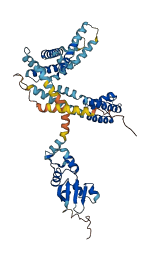
Descriptions
The autoinhibited protein was predicted that may have potential autoinhibitory elements via cis-regPred.
Autoinhibitory domains (AIDs)
Target domain |
|
Relief mechanism |
|
Assay |
cis-regPred |
Accessory elements
No accessory elements
Autoinhibited structure

Activated structure
1 structures for Q9ER26
| Entry ID | Method | Resolution | Chain | Position | Source |
|---|---|---|---|---|---|
| AF-Q9ER26-F1 | Predicted | AlphaFoldDB |
No variants for Q9ER26
| Variant ID(s) | Position | Change | Description | Diseaes Association | Provenance |
|---|---|---|---|---|---|
| No variants for Q9ER26 | |||||
No associated diseases with Q9ER26
Functions
4 GO annotations of cellular component
| Name | Definition |
|---|---|
| integral component of membrane | The component of a membrane consisting of the gene products and protein complexes having at least some part of their peptide sequence embedded in the hydrophobic region of the membrane. |
| perinuclear region of cytoplasm | Cytoplasm situated near, or occurring around, the nucleus. |
| plasma membrane | The membrane surrounding a cell that separates the cell from its external environment. It consists of a phospholipid bilayer and associated proteins. |
| voltage-gated potassium channel complex | A protein complex that forms a transmembrane channel through which potassium ions may cross a cell membrane in response to changes in membrane potential. |
1 GO annotations of molecular function
| Name | Definition |
|---|---|
| voltage-gated potassium channel activity | Enables the transmembrane transfer of a potassium ion by a voltage-gated channel. A voltage-gated channel is a channel whose open state is dependent on the voltage across the membrane in which it is embedded. |
4 GO annotations of biological process
| Name | Definition |
|---|---|
| potassium ion transmembrane transport | A process in which a potassium ion is transported from one side of a membrane to the other. |
| potassium ion transport | The directed movement of potassium ions (K+) into, out of or within a cell, or between cells, by means of some agent such as a transporter or pore. |
| protein homooligomerization | The process of creating protein oligomers, compounds composed of a small number, usually between three and ten, of identical component monomers. Oligomers may be formed by the polymerization of a number of monomers or the depolymerization of a large protein polymer. |
| regulation of delayed rectifier potassium channel activity | Any process that modulates the frequency, rate or extent of delayed rectifier potassium channel activity. |
21 homologous proteins in AiPD
| UniProt AC | Gene Name | Protein Name | Species | Evidence Code |
|---|---|---|---|---|
| Q4ZHA6 | KCNB2 | Potassium voltage-gated channel subfamily B member 2 | Bos taurus (Bovine) | PR |
| P17972 | Shaw | Potassium voltage-gated channel protein Shaw | Drosophila melanogaster (Fruit fly) | PR |
| Q9H3M0 | KCNF1 | Potassium voltage-gated channel subfamily F member 1 | Homo sapiens (Human) | PR |
| Q03721 | KCNC4 | Potassium voltage-gated channel subfamily C member 4 | Homo sapiens (Human) | PR |
| Q14721 | KCNB1 | Potassium voltage-gated channel subfamily B member 1 | Homo sapiens (Human) | PR |
| Q8TDN2 | KCNV2 | Potassium voltage-gated channel subfamily V member 2 | Homo sapiens (Human) | PR |
| Q92953 | KCNB2 | Potassium voltage-gated channel subfamily B member 2 | Homo sapiens (Human) | PR |
| Q9ULS6 | KCNS2 | Potassium voltage-gated channel subfamily S member 2 | Homo sapiens (Human) | PR |
| Q80XM3 | Kcng4 | Potassium voltage-gated channel subfamily G member 4 | Mus musculus (Mouse) | PR |
| Q03717 | Kcnb1 | Potassium voltage-gated channel subfamily B member 1 | Mus musculus (Mouse) | PR |
| A6H8H5 | Kcnb2 | Potassium voltage-gated channel subfamily B member 2 | Mus musculus (Mouse) | PR |
| Q7TSH7 | Kcnf1 | Potassium voltage-gated channel subfamily F member 1 | Mus musculus (Mouse) | PR |
| O35174 | Kcns2 | Potassium voltage-gated channel subfamily S member 2 | Mus musculus (Mouse) | PR |
| O18868 | KCNB1 | Potassium voltage-gated channel subfamily B member 1 | Sus scrofa (Pig) | PR |
| P15384 | Kcna3 | Potassium voltage-gated channel subfamily A member 3 | Rattus norvegicus (Rat) | PR |
| P10499 | Kcna1 | Potassium voltage-gated channel subfamily A member 1 | Rattus norvegicus (Rat) | PR |
| P63142 | Kcna2 | Potassium voltage-gated channel subfamily A member 2 | Rattus norvegicus (Rat) | PR |
| P15385 | Kcna4 | Potassium voltage-gated channel subfamily A member 4 | Rattus norvegicus (Rat) | PR |
| Q62897 | Kcnd3 | Potassium voltage-gated channel subfamily D member 3 | Rattus norvegicus (Rat) | PR |
| P15387 | Kcnb1 | Potassium voltage-gated channel subfamily B member 1 | Rattus norvegicus (Rat) | PR |
| O88944 | Kcnq3 | Potassium voltage-gated channel subfamily KQT member 3 | Rattus norvegicus (Rat) | PR |
| 10 | 20 | 30 | 40 | 50 | 60 |
| MTRQSLWDLS | ETDVEDGEIR | INVGGFKRRL | RSHTLLRFPE | TRLGRLLLCH | SREAILELCD |
| 70 | 80 | 90 | 100 | 110 | 120 |
| DYDDVQREFY | FDRNPELFPY | VLHFYHTGKL | HVMAELCVFS | FSQEIEYWGI | NEFFIDSCCS |
| 130 | 140 | 150 | 160 | 170 | 180 |
| YSYHGRKVEP | EQEKWDEQSD | QESTTSSFDE | ILAFYNDASK | FDGQPLGNFR | RQLWLALDNP |
| 190 | 200 | 210 | 220 | 230 | 240 |
| GYSVLSRVFS | VLSILVVLGS | IITMCLNSLP | DFQIPDSQGN | PGEDPRFEIV | EHFGIAWFTF |
| 250 | 260 | 270 | 280 | 290 | 300 |
| ELVARFAVAP | DFLKFFKNAL | NLIDLMSIVP | FYITLVVNLV | VESSPTLANL | GRVAQVLRLM |
| 310 | 320 | 330 | 340 | 350 | 360 |
| RIFRILKLAR | HSTGLRSLGA | TLKYSYKEVG | LLLLYLSVGI | SIFSVVAYTI | EKEENEGLAT |
| 370 | 380 | 390 | 400 | 410 | 420 |
| IPACWWWATV | SMTTVGYGDV | VPGTTAGKLT | ASACILAGIL | VVVLPITLIF | NKFSHFYRRQ |
| 430 | 440 | 450 | 460 | 470 | |
| KQLESAMRSC | DFGDGMKEVP | SVNLRDYYAH | KVKSLMASLT | NMSRSSPSEL | SLDDSLH |