O18868
Gene name |
KCNB1 |
Protein name |
Potassium voltage-gated channel subfamily B member 1 |
Names |
Delayed rectifier potassium channel 1, DRK1, Voltage-gated potassium channel subunit Kv2.1 |
Species |
Sus scrofa (Pig) |
KEGG Pathway |
ssc:397433 |
EC number |
|
Protein Class |
|
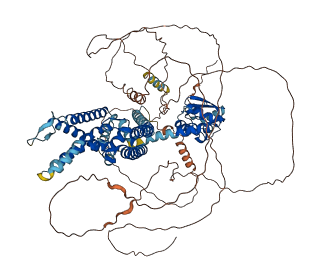
Descriptions
The autoinhibited protein was predicted that may have potential autoinhibitory elements via cis-regPred.
Autoinhibitory domains (AIDs)
Target domain |
|
Relief mechanism |
|
Assay |
cis-regPred |
Accessory elements
No accessory elements
Autoinhibited structure

Activated structure
1 structures for O18868
| Entry ID | Method | Resolution | Chain | Position | Source |
|---|---|---|---|---|---|
| AF-O18868-F1 | Predicted | AlphaFoldDB |
No variants for O18868
| Variant ID(s) | Position | Change | Description | Diseaes Association | Provenance |
|---|---|---|---|---|---|
| No variants for O18868 | |||||
No associated diseases with O18868
Functions
10 GO annotations of cellular component
| Name | Definition |
|---|---|
| anchoring junction | A cell junction that mechanically attaches a cell (and its cytoskeleton) to neighboring cells or to the extracellular matrix. |
| axon | The long process of a neuron that conducts nerve impulses, usually away from the cell body to the terminals and varicosities, which are sites of storage and release of neurotransmitter. |
| dendrite | A neuron projection that has a short, tapering, morphology. Dendrites receive and integrate signals from other neurons or from sensory stimuli, and conduct nerve impulses towards the axon or the cell body. In most neurons, the impulse is conveyed from dendrites to axon via the cell body, but in some types of unipolar neuron, the impulse does not travel via the cell body. |
| lateral plasma membrane | The portion of the plasma membrane at the lateral side of the cell. In epithelial cells, lateral plasma membranes are on the sides of cells which lie at the interface of adjacent cells. |
| neuronal cell body membrane | The plasma membrane of a neuron cell body - excludes the plasma membrane of cell projections such as axons and dendrites. |
| perikaryon | The portion of the cell soma (neuronal cell body) that excludes the nucleus. |
| plasma membrane | The membrane surrounding a cell that separates the cell from its external environment. It consists of a phospholipid bilayer and associated proteins. |
| postsynaptic membrane | A specialized area of membrane facing the presynaptic membrane on the tip of the nerve ending and separated from it by a minute cleft (the synaptic cleft). Neurotransmitters cross the synaptic cleft and transmit the signal to the postsynaptic membrane. |
| sarcolemma | The outer membrane of a muscle cell, consisting of the plasma membrane, a covering basement membrane (about 100 nm thick and sometimes common to more than one fiber), and the associated loose network of collagen fibers. |
| voltage-gated potassium channel complex | A protein complex that forms a transmembrane channel through which potassium ions may cross a cell membrane in response to changes in membrane potential. |
2 GO annotations of molecular function
| Name | Definition |
|---|---|
| delayed rectifier potassium channel activity | Enables the transmembrane transfer of a potassium ion by a delayed rectifying voltage-gated channel. A delayed rectifying current-voltage relation is one where channel activation kinetics are time-dependent, and inactivation is slow. |
| protein heterodimerization activity | Binding to a nonidentical protein to form a heterodimer. |
19 GO annotations of biological process
| Name | Definition |
|---|---|
| action potential | A process in which membrane potential cycles through a depolarizing spike, triggered in response to depolarization above some threshold, followed by repolarization. This cycle is driven by the flow of ions through various voltage gated channels with different thresholds and ion specificities. |
| cellular response to glucose stimulus | Any process that results in a change in state or activity of a cell (in terms of movement, secretion, enzyme production, gene expression, etc.) as a result of a glucose stimulus. |
| cellular response to nutrient levels | Any process that results in a change in state or activity of a cell (in terms of movement, secretion, enzyme production, gene expression, etc.) as a result of a stimulus reflecting the presence, absence, or concentration of nutrients. |
| glucose homeostasis | Any process involved in the maintenance of an internal steady state of glucose within an organism or cell. |
| glutamate receptor signaling pathway | The series of molecular signals initiated by the binding of glutamate to its receptor on the surface of a target cell, and ending with the regulation of a downstream cellular process, e.g. transcription. |
| negative regulation of insulin secretion | Any process that stops, prevents, or reduces the frequency, rate or extent of the regulated release of insulin. |
| positive regulation of calcium ion-dependent exocytosis | Any process that activates or increases the frequency, rate or extent of calcium ion-dependent exocytosis. |
| positive regulation of catecholamine secretion | Any process that activates or increases the frequency, rate or extent of the regulated release of a catecholamine. |
| positive regulation of long-term synaptic depression | Any process that activates or increases the frequency, rate or extent of long term synaptic depression. |
| positive regulation of norepinephrine secretion | Any process that increases the frequency, rate or extent of the regulated release of norepinephrine. |
| positive regulation of protein targeting to membrane | Any process that increases the frequency, rate or extent of the process of directing proteins towards a membrane, usually using signals contained within the protein. |
| potassium ion transmembrane transport | A process in which a potassium ion is transported from one side of a membrane to the other. |
| potassium ion transport | The directed movement of potassium ions (K+) into, out of or within a cell, or between cells, by means of some agent such as a transporter or pore. |
| protein homooligomerization | The process of creating protein oligomers, compounds composed of a small number, usually between three and ten, of identical component monomers. Oligomers may be formed by the polymerization of a number of monomers or the depolymerization of a large protein polymer. |
| protein localization to plasma membrane | A process in which a protein is transported to, or maintained in, a specific location in the plasma membrane. |
| regulation of action potential | Any process that modulates the frequency, rate or extent of action potential creation, propagation or termination. This typically occurs via modulation of the activity or expression of voltage-gated ion channels. |
| regulation of ion transmembrane transport | Any process that modulates the frequency, rate or extent of the directed movement of ions from one side of a membrane to the other. |
| regulation of motor neuron apoptotic process | Any process that modulates the frequency, rate or extent of motor neuron apoptotic process. |
| vesicle docking involved in exocytosis | The initial attachment of a vesicle membrane to a target membrane, mediated by proteins protruding from the membrane of the vesicle and the target membrane, that contributes to exocytosis. |
15 homologous proteins in AiPD
| UniProt AC | Gene Name | Protein Name | Species | Evidence Code |
|---|---|---|---|---|
| Q4ZHA6 | KCNB2 | Potassium voltage-gated channel subfamily B member 2 | Bos taurus (Bovine) | PR |
| P17972 | Shaw | Potassium voltage-gated channel protein Shaw | Drosophila melanogaster (Fruit fly) | PR |
| Q9ULS6 | KCNS2 | Potassium voltage-gated channel subfamily S member 2 | Homo sapiens (Human) | PR |
| Q9H3M0 | KCNF1 | Potassium voltage-gated channel subfamily F member 1 | Homo sapiens (Human) | PR |
| Q03721 | KCNC4 | Potassium voltage-gated channel subfamily C member 4 | Homo sapiens (Human) | PR |
| Q8TDN2 | KCNV2 | Potassium voltage-gated channel subfamily V member 2 | Homo sapiens (Human) | PR |
| Q92953 | KCNB2 | Potassium voltage-gated channel subfamily B member 2 | Homo sapiens (Human) | PR |
| Q14721 | KCNB1 | Potassium voltage-gated channel subfamily B member 1 | Homo sapiens (Human) | PR |
| Q80XM3 | Kcng4 | Potassium voltage-gated channel subfamily G member 4 | Mus musculus (Mouse) | PR |
| O35174 | Kcns2 | Potassium voltage-gated channel subfamily S member 2 | Mus musculus (Mouse) | PR |
| A6H8H5 | Kcnb2 | Potassium voltage-gated channel subfamily B member 2 | Mus musculus (Mouse) | PR |
| Q7TSH7 | Kcnf1 | Potassium voltage-gated channel subfamily F member 1 | Mus musculus (Mouse) | PR |
| Q03717 | Kcnb1 | Potassium voltage-gated channel subfamily B member 1 | Mus musculus (Mouse) | PR |
| Q9ER26 | Kcns2 | Potassium voltage-gated channel subfamily S member 2 | Rattus norvegicus (Rat) | PR |
| P15387 | Kcnb1 | Potassium voltage-gated channel subfamily B member 1 | Rattus norvegicus (Rat) | PR |
| 10 | 20 | 30 | 40 | 50 | 60 |
| MPAGMTKHGS | RSTSSLPPEP | MEIVRSKACS | RRVRLNVGGL | AHEVLWRTLD | RLPRTRLGKL |
| 70 | 80 | 90 | 100 | 110 | 120 |
| RDCNTHDSLL | EVCDDYSLDD | NEYFFDRHPG | AFTSILNFYR | TGRLHMMEEM | CALSFSQELD |
| 130 | 140 | 150 | 160 | 170 | 180 |
| YWGIDEIYLE | SCCQARYHQK | KEQMNEELKR | EAETLREREG | EEFDNTCCAE | KRKKLWDLLE |
| 190 | 200 | 210 | 220 | 230 | 240 |
| KPNSSVAAKI | LAIISIMFIV | LSTIALSLNT | LPELQSLDEF | GQTTDNPQLA | HVEAVCIAWF |
| 250 | 260 | 270 | 280 | 290 | 300 |
| TMEYLLRFLS | SPKKWKFFKG | PLNAIDLLAI | LPYYVTIFLT | ESNKSVLQFQ | NVRRVVQIFR |
| 310 | 320 | 330 | 340 | 350 | 360 |
| IMRILRILKL | ARHSTGLQSL | GFTLRRSYNE | LGLLILFLAM | GIMIFSSLVF | FAEKDEDDTK |
| 370 | 380 | 390 | 400 | 410 | 420 |
| FKSIPASFWW | ATITMTTVGY | GDIYPKTLLG | KIVGGLCCIA | GVLVIALPIP | IIVNNFSEFY |
| 430 | 440 | 450 | 460 | 470 | 480 |
| KEQKRQEKAI | KRREALERAK | RNGSIVSMNM | KDAFPRSIEM | MDIVVEKNVE | NMGQKDKVQD |
| 490 | 500 | 510 | 520 | 530 | 540 |
| NHLSPNKWKW | TKRTLSETSS | SKSFETKEQG | SPEKARSSSS | PQHLNVQQLE | DMYNKMAKTQ |
| 550 | 560 | 570 | 580 | 590 | 600 |
| SQPILNTKES | ATQSKPKEEL | EMESIPSPVA | PLPTRTEGVI | DMRSMSSIDS | FISCATDFPE |
| 610 | 620 | 630 | 640 | 650 | 660 |
| ATRFSHSPLA | SLPSKSGGSM | APEVGWRGAL | GATGGRFVEA | NPTPDASHHS | TFFIESPKSS |
| 670 | 680 | 690 | 700 | 710 | 720 |
| MKTTNPLKLR | ALKVNFMEGD | PSPLVPVLGM | YHDPLRNRGG | AAAAVAGLEC | ATLLDRPVLS |
| 730 | 740 | 750 | 760 | 770 | 780 |
| PESSIYTTAS | ARTPPRSPEK | HTAIAFNFEA | GIHQYIDADT | DDEGQVLYSV | DSSPPKSLHG |
| 790 | 800 | 810 | 820 | 830 | 840 |
| STSPKFSIGT | RSEKNHFESS | PLPTSPKFLR | QNCIYSTEAL | TGKAPSGQEK | CKLENHISPD |
| 850 | |||||
| VRVLPGGGAH | GSTRDQSI |