Q7TSH7
Gene name |
Kcnf1 |
Protein name |
Potassium voltage-gated channel subfamily F member 1 |
Names |
Voltage-gated potassium channel subunit Kv5.1 |
Species |
Mus musculus (Mouse) |
KEGG Pathway |
mmu:382571 |
EC number |
|
Protein Class |
|
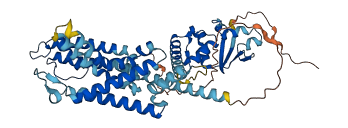
Descriptions
The autoinhibited protein was predicted that may have potential autoinhibitory elements via cis-regPred.
Autoinhibitory domains (AIDs)
Target domain |
|
Relief mechanism |
|
Assay |
cis-regPred |
Accessory elements
No accessory elements
Autoinhibited structure

Activated structure
1 structures for Q7TSH7
| Entry ID | Method | Resolution | Chain | Position | Source |
|---|---|---|---|---|---|
| AF-Q7TSH7-F1 | Predicted | AlphaFoldDB |
33 variants for Q7TSH7
| Variant ID(s) | Position | Change | Description | Diseaes Association | Provenance |
|---|---|---|---|---|---|
| rs3402348136 | 38 | G>* | No | EVA | |
| rs3389226283 | 44 | Y>H | No | EVA | |
| rs3389234813 | 49 | L>F | No | EVA | |
| rs3389229552 | 81 | R>Q | No | EVA | |
| rs3389205336 | 97 | E>* | No | EVA | |
| rs3389230400 | 106 | P>L | No | EVA | |
| rs3389232499 | 112 | E>V | No | EVA | |
| rs3389201482 | 125 | D>E | No | EVA | |
| rs3389165457 | 143 | R>C | No | EVA | |
| rs3389219134 | 157 | A>G | No | EVA | |
| rs3389234761 | 160 | R>H | No | EVA | |
| rs3389226294 | 173 | E>K | No | EVA | |
| rs3389226270 | 174 | K>E | No | EVA | |
| rs3389246724 | 180 | P>H | No | EVA | |
| rs3389205367 | 184 | V>M | No | EVA | |
| rs3389205363 | 185 | A>V | No | EVA | |
| rs3389230469 | 214 | G>S | No | EVA | |
| rs3389243067 | 220 | P>T | No | EVA | |
| rs3403014483 | 222 | L>R | No | EVA | |
| rs3389229569 | 226 | E>K | No | EVA | |
| rs3389232493 | 232 | W>R | No | EVA | |
| rs3389201444 | 234 | T>N | No | EVA | |
| rs3389165517 | 250 | F>Y | No | EVA | |
| rs1132933884 | 261 | L>M | No | EVA | |
| rs3389235041 | 268 | V>M | No | EVA | |
| rs3389201530 | 311 | Q>* | No | EVA | |
| rs3389243106 | 316 | A>V | No | EVA | |
| rs3389234973 | 322 | K>N | No | EVA | |
| rs3389230475 | 332 | A>P | No | EVA | |
| rs3403016676 | 368 | M>I | No | EVA | |
| rs3389234976 | 410 | V>I | No | EVA | |
| rs3403008812 | 433 | N>H | No | EVA | |
| rs3389165492 | 454 | E>D | No | EVA |
No associated diseases with Q7TSH7
3 GO annotations of cellular component
| Name | Definition |
|---|---|
| ciliary base | Area of the cilium (also called flagellum) where the basal body and the axoneme are anchored to the plasma membrane. The ciliary base encompasses the distal part of the basal body, transition fibers and transition zone and is structurally and functionally very distinct from the rest of the cilium. In this area proteins are sorted and filtered before entering the cilium, and many ciliary proteins localize specifically to this area. |
| integral component of membrane | The component of a membrane consisting of the gene products and protein complexes having at least some part of their peptide sequence embedded in the hydrophobic region of the membrane. |
| voltage-gated potassium channel complex | A protein complex that forms a transmembrane channel through which potassium ions may cross a cell membrane in response to changes in membrane potential. |
1 GO annotations of molecular function
| Name | Definition |
|---|---|
| voltage-gated potassium channel activity | Enables the transmembrane transfer of a potassium ion by a voltage-gated channel. A voltage-gated channel is a channel whose open state is dependent on the voltage across the membrane in which it is embedded. |
4 GO annotations of biological process
| Name | Definition |
|---|---|
| non-motile cilium assembly | The aggregation, arrangement and bonding together of a set of components to form a non-motile cilium. |
| potassium ion transmembrane transport | A process in which a potassium ion is transported from one side of a membrane to the other. |
| protein homooligomerization | The process of creating protein oligomers, compounds composed of a small number, usually between three and ten, of identical component monomers. Oligomers may be formed by the polymerization of a number of monomers or the depolymerization of a large protein polymer. |
| regulation of ion transmembrane transport | Any process that modulates the frequency, rate or extent of the directed movement of ions from one side of a membrane to the other. |
23 homologous proteins in AiPD
| UniProt AC | Gene Name | Protein Name | Species | Evidence Code |
|---|---|---|---|---|
| Q4ZHA6 | KCNB2 | Potassium voltage-gated channel subfamily B member 2 | Bos taurus (Bovine) | PR |
| P17972 | Shaw | Potassium voltage-gated channel protein Shaw | Drosophila melanogaster (Fruit fly) | PR |
| Q9ULS6 | KCNS2 | Potassium voltage-gated channel subfamily S member 2 | Homo sapiens (Human) | PR |
| Q03721 | KCNC4 | Potassium voltage-gated channel subfamily C member 4 | Homo sapiens (Human) | PR |
| Q14721 | KCNB1 | Potassium voltage-gated channel subfamily B member 1 | Homo sapiens (Human) | PR |
| Q8TDN2 | KCNV2 | Potassium voltage-gated channel subfamily V member 2 | Homo sapiens (Human) | PR |
| Q92953 | KCNB2 | Potassium voltage-gated channel subfamily B member 2 | Homo sapiens (Human) | PR |
| Q9H3M0 | KCNF1 | Potassium voltage-gated channel subfamily F member 1 | Homo sapiens (Human) | PR |
| Q8K3F6 | Kcnq3 | Potassium voltage-gated channel subfamily KQT member 3 | Mus musculus (Mouse) | PR |
| P97414 | Kcnq1 | Potassium voltage-gated channel subfamily KQT member 1 | Mus musculus (Mouse) | PR |
| Q61423 | Kcna4 | Potassium voltage-gated channel subfamily A member 4 | Mus musculus (Mouse) | PR |
| P16390 | Kcna3 | Potassium voltage-gated channel subfamily A member 3 | Mus musculus (Mouse) | PR |
| Q17ST2 | Kcna7 | Potassium voltage-gated channel subfamily A member 7 | Mus musculus (Mouse) | PR |
| P16388 | Kcna1 | Potassium voltage-gated channel subfamily A member 1 | Mus musculus (Mouse) | PR |
| Q9Z0V1 | Kcnd3 | Potassium voltage-gated channel subfamily D member 3 | Mus musculus (Mouse) | PR |
| Q9Z0V2 | Kcnd2 | Potassium voltage-gated channel subfamily D member 2 | Mus musculus (Mouse) | PR |
| O35174 | Kcns2 | Potassium voltage-gated channel subfamily S member 2 | Mus musculus (Mouse) | PR |
| Q03717 | Kcnb1 | Potassium voltage-gated channel subfamily B member 1 | Mus musculus (Mouse) | PR |
| Q80XM3 | Kcng4 | Potassium voltage-gated channel subfamily G member 4 | Mus musculus (Mouse) | PR |
| A6H8H5 | Kcnb2 | Potassium voltage-gated channel subfamily B member 2 | Mus musculus (Mouse) | PR |
| O18868 | KCNB1 | Potassium voltage-gated channel subfamily B member 1 | Sus scrofa (Pig) | PR |
| Q9ER26 | Kcns2 | Potassium voltage-gated channel subfamily S member 2 | Rattus norvegicus (Rat) | PR |
| P15387 | Kcnb1 | Potassium voltage-gated channel subfamily B member 1 | Rattus norvegicus (Rat) | PR |
| 10 | 20 | 30 | 40 | 50 | 60 |
| MDASAEQSLP | EPGSQDSVAG | EDIEIVVNVG | GVRQVLYGDL | LSQYPETRLA | ELINCLAGGY |
| 70 | 80 | 90 | 100 | 110 | 120 |
| DTIFSLCDDY | DPGKREFYFD | RDPDAFKCVI | EVYYFGEVHM | KKGICPICFK | NEMDFWKVDL |
| 130 | 140 | 150 | 160 | 170 | 180 |
| KFLDDCCKSH | LSEKREELEE | IARRVQLILD | DLGVDAAEGR | WRRCQKCVWK | FLEKPESSCP |
| 190 | 200 | 210 | 220 | 230 | 240 |
| ARVVAVLSFL | LILVSSVVMC | MGTIPELQVV | DSEGNRVEHP | TLENVETACI | GWFTLEYLLR |
| 250 | 260 | 270 | 280 | 290 | 300 |
| LFSSPNKLHF | ALSFMNIVDV | LAILPFYVSL | TLTHLGARMM | ELTNVQQAVQ | ALRIMRIARI |
| 310 | 320 | 330 | 340 | 350 | 360 |
| FKLARHSSGL | QTLTYALKRS | FKELGLLLMY | LAVGIFVFSA | LGYTMEQSHP | ETLFKSIPQS |
| 370 | 380 | 390 | 400 | 410 | 420 |
| FWWAIITMTT | VGYGDIYPKT | TLGKLNAAIS | FLCGVIAIAL | PIHPIINNFV | RYYNKQRVLE |
| 430 | 440 | 450 | 460 | 470 | 480 |
| TAAKHELELM | ELNSSSAEGK | PGGSRSDLDT | LPPEPAAREG | PSWGSRLKLS | HSDTFIPLLT |
| 490 | |||||
| EEKHHRTRLQ | SCK |