P15384
Gene name |
Kcna3 |
Protein name |
Potassium voltage-gated channel subfamily A member 3 |
Names |
RCK3, RGK5, Voltage-gated potassium channel subunit Kv1.3, Voltage-gated potassium channel subunit Kv3 |
Species |
Rattus norvegicus (Rat) |
KEGG Pathway |
rno:29731 |
EC number |
|
Protein Class |
|
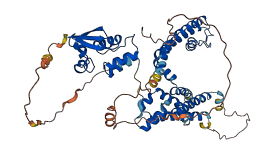
Descriptions
The autoinhibited protein was predicted that may have potential autoinhibitory elements via cis-regPred.
Autoinhibitory domains (AIDs)
Target domain |
|
Relief mechanism |
|
Assay |
cis-regPred |
Accessory elements
No accessory elements
Autoinhibited structure

Activated structure
1 structures for P15384
| Entry ID | Method | Resolution | Chain | Position | Source |
|---|---|---|---|---|---|
| AF-P15384-F1 | Predicted | AlphaFoldDB |
No variants for P15384
| Variant ID(s) | Position | Change | Description | Diseaes Association | Provenance |
|---|---|---|---|---|---|
| No variants for P15384 | |||||
No associated diseases with P15384
10 GO annotations of cellular component
| Name | Definition |
|---|---|
| axon | The long process of a neuron that conducts nerve impulses, usually away from the cell body to the terminals and varicosities, which are sites of storage and release of neurotransmitter. |
| calyx of Held | The terminal specialization of a calyciferous axon which forms large synapses in the mammalian auditory central nervous system. |
| glutamatergic synapse | A synapse that uses glutamate as a neurotransmitter. |
| integral component of membrane | The component of a membrane consisting of the gene products and protein complexes having at least some part of their peptide sequence embedded in the hydrophobic region of the membrane. |
| integral component of plasma membrane | The component of the plasma membrane consisting of the gene products and protein complexes having at least some part of their peptide sequence embedded in the hydrophobic region of the membrane. |
| integral component of postsynaptic membrane | The component of the postsynaptic membrane consisting of the gene products and protein complexes having at least some part of their peptide sequence embedded in the hydrophobic region of the membrane. |
| integral component of presynaptic membrane | The component of the presynaptic membrane consisting of the gene products and protein complexes having at least some part of their peptide sequence embedded in the hydrophobic region of the membrane. |
| membrane raft | Any of the small (10-200 nm), heterogeneous, highly dynamic, sterol- and sphingolipid-enriched membrane domains that compartmentalize cellular processes. Small rafts can sometimes be stabilized to form larger platforms through protein-protein and protein-lipid interactions. |
| plasma membrane | The membrane surrounding a cell that separates the cell from its external environment. It consists of a phospholipid bilayer and associated proteins. |
| voltage-gated potassium channel complex | A protein complex that forms a transmembrane channel through which potassium ions may cross a cell membrane in response to changes in membrane potential. |
3 GO annotations of molecular function
| Name | Definition |
|---|---|
| delayed rectifier potassium channel activity | Enables the transmembrane transfer of a potassium ion by a delayed rectifying voltage-gated channel. A delayed rectifying current-voltage relation is one where channel activation kinetics are time-dependent, and inactivation is slow. |
| outward rectifier potassium channel activity | Enables the transmembrane transfer of a potassium ion by an outwardly-rectifying voltage-gated channel. An outwardly rectifying current-voltage relation is one where at any given driving force the outward flow of K+ ions exceeds the inward flow for the opposite driving force. |
| voltage-gated potassium channel activity | Enables the transmembrane transfer of a potassium ion by a voltage-gated channel. A voltage-gated channel is a channel whose open state is dependent on the voltage across the membrane in which it is embedded. |
4 GO annotations of biological process
| Name | Definition |
|---|---|
| potassium ion transmembrane transport | A process in which a potassium ion is transported from one side of a membrane to the other. |
| potassium ion transport | The directed movement of potassium ions (K+) into, out of or within a cell, or between cells, by means of some agent such as a transporter or pore. |
| protein homooligomerization | The process of creating protein oligomers, compounds composed of a small number, usually between three and ten, of identical component monomers. Oligomers may be formed by the polymerization of a number of monomers or the depolymerization of a large protein polymer. |
| regulation of ion transmembrane transport | Any process that modulates the frequency, rate or extent of the directed movement of ions from one side of a membrane to the other. |
19 homologous proteins in AiPD
| UniProt AC | Gene Name | Protein Name | Species | Evidence Code |
|---|---|---|---|---|
| Q05037 | KCNA4 | Potassium voltage-gated channel subfamily A member 4 | Bos taurus (Bovine) | PR |
| Q7T199 | KCNA10 | Potassium voltage-gated channel subfamily A member 10 | Gallus gallus (Chicken) | PR |
| Q96RP8 | KCNA7 | Potassium voltage-gated channel subfamily A member 7 | Homo sapiens (Human) | PR |
| P22459 | KCNA4 | Potassium voltage-gated channel subfamily A member 4 | Homo sapiens (Human) | PR |
| Q16322 | KCNA10 | Potassium voltage-gated channel subfamily A member 10 | Homo sapiens (Human) | PR |
| Q09470 | KCNA1 | Potassium voltage-gated channel subfamily A member 1 | Homo sapiens (Human) | PR |
| P16389 | KCNA2 | Potassium voltage-gated channel subfamily A member 2 | Homo sapiens (Human) | PR |
| P22001 | KCNA3 | Potassium voltage-gated channel subfamily A member 3 | Homo sapiens (Human) | PR |
| Q61423 | Kcna4 | Potassium voltage-gated channel subfamily A member 4 | Mus musculus (Mouse) | PR |
| P16388 | Kcna1 | Potassium voltage-gated channel subfamily A member 1 | Mus musculus (Mouse) | PR |
| Q17ST2 | Kcna7 | Potassium voltage-gated channel subfamily A member 7 | Mus musculus (Mouse) | PR |
| P16390 | Kcna3 | Potassium voltage-gated channel subfamily A member 3 | Mus musculus (Mouse) | PR |
| P10499 | Kcna1 | Potassium voltage-gated channel subfamily A member 1 | Rattus norvegicus (Rat) | PR |
| P63142 | Kcna2 | Potassium voltage-gated channel subfamily A member 2 | Rattus norvegicus (Rat) | PR |
| Q9ER26 | Kcns2 | Potassium voltage-gated channel subfamily S member 2 | Rattus norvegicus (Rat) | PR |
| P15385 | Kcna4 | Potassium voltage-gated channel subfamily A member 4 | Rattus norvegicus (Rat) | PR |
| Q62897 | Kcnd3 | Potassium voltage-gated channel subfamily D member 3 | Rattus norvegicus (Rat) | PR |
| P15387 | Kcnb1 | Potassium voltage-gated channel subfamily B member 1 | Rattus norvegicus (Rat) | PR |
| O88944 | Kcnq3 | Potassium voltage-gated channel subfamily KQT member 3 | Rattus norvegicus (Rat) | PR |
| 10 | 20 | 30 | 40 | 50 | 60 |
| MTVVPGDHLL | EPEAAGGGGG | DPPQGGCVSG | GGCDRYEPLP | PALPAAGEQD | CCGERVVINI |
| 70 | 80 | 90 | 100 | 110 | 120 |
| SGLRFETQLK | TLCQFPETLL | GDPKRRMRYF | DPLRNEYFFD | RNRPSFDAIL | YYYQSGGRIR |
| 130 | 140 | 150 | 160 | 170 | 180 |
| RPVNVPIDIF | SEEIRFYQLG | EEAMEKFRED | EGFLREEERP | LPRRDFQRQV | WLLFEYPESS |
| 190 | 200 | 210 | 220 | 230 | 240 |
| GPARGIAIVS | VLVILISIVI | FCLETLPEFR | DEKDYPASPS | QDVFEAANNS | TSGASSGASS |
| 250 | 260 | 270 | 280 | 290 | 300 |
| FSDPFFVVET | LCIIWFSFEL | LVRFFACPSK | ATFSRNIMNL | IDIVAIIPYF | ITLGTELAER |
| 310 | 320 | 330 | 340 | 350 | 360 |
| QGNGQQAMSL | AILRVIRLVR | VFRIFKLSRH | SKGLQILGQT | LKASMRELGL | LIFFLFIGVI |
| 370 | 380 | 390 | 400 | 410 | 420 |
| LFSSAVYFAE | ADDPSSGFNS | IPDAFWWAVV | TMTTVGYGDM | HPVTIGGKIV | GSLCAIAGVL |
| 430 | 440 | 450 | 460 | 470 | 480 |
| TIALPVPVIV | SNFNYFYHRE | TEGEEQAQYM | HVGSCQHLSS | SAEELRKARS | NSTLSKSEYM |
| 490 | 500 | 510 | 520 | ||
| VIEEGGMNHS | AFPQTPFKTG | NSTATCTTNN | NPNSCVNIKK | IFTDV |