Descriptions
The autoinhibited protein was predicted that may have potential autoinhibitory elements via cis-regPred.
Autoinhibitory domains (AIDs)
Target domain |
|
Relief mechanism |
|
Assay |
cis-regPred |
Accessory elements
No accessory elements
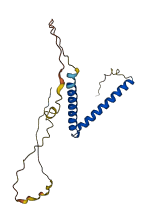
Autoinhibited structure

Activated structure
1 structures for Q9JK96
| Entry ID | Method | Resolution | Chain | Position | Source |
|---|---|---|---|---|---|
| AF-Q9JK96-F1 | Predicted | AlphaFoldDB |
No variants for Q9JK96
| Variant ID(s) | Position | Change | Description | Diseaes Association | Provenance |
|---|---|---|---|---|---|
| No variants for Q9JK96 | |||||
No associated diseases with Q9JK96
1 regional properties for Q9JK96
| Type | Name | Position | InterPro Accession |
|---|---|---|---|
| domain | Potassium channel, voltage dependent, KCNQ, C-terminal | 27 - 165 | IPR013821 |
5 GO annotations of cellular component
| Name | Definition |
|---|---|
| basal plasma membrane | The region of the plasma membrane located at the basal end of the cell. Often used in reference to animal polarized epithelial membranes, where the basal membrane is the part attached to the extracellular matrix, or in plant cells, where the basal membrane is defined with respect to the zygotic axis. |
| cytoplasm | The contents of a cell excluding the plasma membrane and nucleus, but including other subcellular structures. |
| integral component of membrane | The component of a membrane consisting of the gene products and protein complexes having at least some part of their peptide sequence embedded in the hydrophobic region of the membrane. |
| neuron projection | A prolongation or process extending from a nerve cell, e.g. an axon or dendrite. |
| plasma membrane | The membrane surrounding a cell that separates the cell from its external environment. It consists of a phospholipid bilayer and associated proteins. |
2 GO annotations of molecular function
| Name | Definition |
|---|---|
| potassium channel activity | Enables the facilitated diffusion of a potassium ion (by an energy-independent process) involving passage through a transmembrane aqueous pore or channel without evidence for a carrier-mediated mechanism. |
| voltage-gated potassium channel activity | Enables the transmembrane transfer of a potassium ion by a voltage-gated channel. A voltage-gated channel is a channel whose open state is dependent on the voltage across the membrane in which it is embedded. |
5 GO annotations of biological process
| Name | Definition |
|---|---|
| inner ear morphogenesis | The process in which the anatomical structures of the inner ear are generated and organized. The inner ear is the structure in vertebrates that contains the organs of balance and hearing. It consists of soft hollow sensory structures (the membranous labyrinth) containing fluid (endolymph) surrounded by fluid (perilymph) and encased in a bony cavity (the bony labyrinth). It consists of two chambers, the sacculus and utriculus, from which arise the cochlea and semicircular canals respectively. |
| negative regulation of synaptic transmission, dopaminergic | Any process that stops, prevents, or reduces the frequency, rate or extent of dopaminergic synaptic transmission, the process of communication from a neuron to another neuron across a synapse using the neurotransmitter dopamine. |
| potassium ion transport | The directed movement of potassium ions (K+) into, out of or within a cell, or between cells, by means of some agent such as a transporter or pore. |
| regulation of ion transmembrane transport | Any process that modulates the frequency, rate or extent of the directed movement of ions from one side of a membrane to the other. |
| sensory perception of sound | The series of events required for an organism to receive an auditory stimulus, convert it to a molecular signal, and recognize and characterize the signal. Sonic stimuli are detected in the form of vibrations and are processed to form a sound. |
8 homologous proteins in AiPD
| UniProt AC | Gene Name | Protein Name | Species | Evidence Code |
|---|---|---|---|---|
| P58126 | KCNQ3 | Potassium voltage-gated channel subfamily KQT member 3 | Bos taurus (Bovine) | PR |
| P56696 | KCNQ4 | Potassium voltage-gated channel subfamily KQT member 4 | Homo sapiens (Human) | PR |
| O43525 | KCNQ3 | Potassium voltage-gated channel subfamily KQT member 3 | Homo sapiens (Human) | PR |
| P97414 | Kcnq1 | Potassium voltage-gated channel subfamily KQT member 1 | Mus musculus (Mouse) | PR |
| Q9JK97 | Kcnq4 | Potassium voltage-gated channel subfamily KQT member 4 | Mus musculus (Mouse) | PR |
| Q8K3F6 | Kcnq3 | Potassium voltage-gated channel subfamily KQT member 3 | Mus musculus (Mouse) | PR |
| Q9JK45 | Kcnq5 | Potassium voltage-gated channel subfamily KQT member 5 | Mus musculus (Mouse) | PR |
| O88944 | Kcnq3 | Potassium voltage-gated channel subfamily KQT member 3 | Rattus norvegicus (Rat) | PR |
| 10 | 20 | 30 | 40 | 50 | 60 |
| DRIRISISQK | RTGPSKQHLA | PPPIPTSPSS | EQVGEASSPS | KVQKSWSFND | RTRFRASLRL |
| 70 | 80 | 90 | 100 | 110 | 120 |
| KPRCSAEEGP | SEEVAEEKSY | QCELTVDDVM | PAVKTVIRSV | RILKFLVAKR | KFKETLRPYD |
| 130 | 140 | 150 | 160 | ||
| VKDVIEQYSA | GHLDMLGRIK | SLQARVDQIV | GRGPGDRKTR | EKGDKGPS |