P13607
Gene name |
Atpalpha (Na-p, CG5670) |
Protein name |
Sodium/potassium-transporting ATPase subunit alpha |
Names |
Na(+)/K(+) ATPase alpha subunit, Sodium pump subunit alpha |
Species |
Drosophila melanogaster (Fruit fly) |
KEGG Pathway |
dme:Dmel_CG5670 |
EC number |
7.2.2.13: Linked to the hydrolysis of a nucleoside triphosphate |
Protein Class |
|
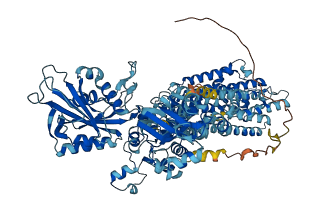
Descriptions
The autoinhibited protein was predicted that may have potential autoinhibitory elements via cis-regPred.
Autoinhibitory domains (AIDs)
Target domain |
|
Relief mechanism |
|
Assay |
cis-regPred |
Accessory elements
No accessory elements
Autoinhibited structure

Activated structure
1 structures for P13607
| Entry ID | Method | Resolution | Chain | Position | Source |
|---|---|---|---|---|---|
| AF-P13607-F1 | Predicted | AlphaFoldDB |
1 variants for P13607
| Variant ID(s) | Position | Change | Description | Diseaes Association | Provenance |
|---|---|---|---|---|---|
| 429 | Y>C | RNA edited version [UniProt] | No |
No associated diseases with P13607
4 regional properties for P13607
| Type | Name | Position | InterPro Accession |
|---|---|---|---|
| domain | Cation-transporting P-type ATPase, N-terminal | 60 - 134 | IPR004014 |
| domain | Cation-transporting P-type ATPase, C-terminal | 817 - 1025 | IPR006068 |
| ptm | P-type ATPase, phosphorylation site | 394 - 400 | IPR018303 |
| domain | P-type ATPase, haloacid dehalogenase domain | 373 - 785 | IPR044492 |
Functions
| Description | ||
|---|---|---|
| EC Number | 7.2.2.13 | Linked to the hydrolysis of a nucleoside triphosphate |
| Subcellular Localization |
|
|
| PANTHER Family | ||
| PANTHER Subfamily | ||
| PANTHER Protein Class | ||
| PANTHER Pathway Category | No pathway information available | |
7 GO annotations of cellular component
| Name | Definition |
|---|---|
| basolateral plasma membrane | The region of the plasma membrane that includes the basal end and sides of the cell. Often used in reference to animal polarized epithelial membranes, where the basal membrane is the part attached to the extracellular matrix, or in plant cells, where the basal membrane is defined with respect to the zygotic axis. |
| cytoplasm | The contents of a cell excluding the plasma membrane and nucleus, but including other subcellular structures. |
| nucleus | A membrane-bounded organelle of eukaryotic cells in which chromosomes are housed and replicated. In most cells, the nucleus contains all of the cell's chromosomes except the organellar chromosomes, and is the site of RNA synthesis and processing. In some species, or in specialized cell types, RNA metabolism or DNA replication may be absent. |
| plasma membrane | The membrane surrounding a cell that separates the cell from its external environment. It consists of a phospholipid bilayer and associated proteins. |
| septate junction | A cell-cell junction that forms a continuous band around each cell in an epithelium; within the septate junction the membranes of adjacent cells maintain a constant distance of approximately 15 nm; found in arthropods. |
| sodium:potassium-exchanging ATPase complex | Sodium:potassium-exchanging ATPases are tetrameric proteins, consisting of two large alpha subunits and two smaller beta subunits. The alpha subunits bear the active site and penetrate the membrane, while the beta subunits carry oligosaccharide groups and face the cell exterior. |
| synapse | The junction between an axon of one neuron and a dendrite of another neuron, a muscle fiber or a glial cell. As the axon approaches the synapse it enlarges into a specialized structure, the presynaptic terminal bouton, which contains mitochondria and synaptic vesicles. At the tip of the terminal bouton is the presynaptic membrane; facing it, and separated from it by a minute cleft (the synaptic cleft) is a specialized area of membrane on the receiving cell, known as the postsynaptic membrane. In response to the arrival of nerve impulses, the presynaptic terminal bouton secretes molecules of neurotransmitters into the synaptic cleft. These diffuse across the cleft and transmit the signal to the postsynaptic membrane. |
4 GO annotations of molecular function
| Name | Definition |
|---|---|
| ATP binding | Binding to ATP, adenosine 5'-triphosphate, a universally important coenzyme and enzyme regulator. |
| ATP hydrolysis activity | Catalysis of the reaction: ATP + H2O = ADP + H+ phosphate. ATP hydrolysis is used in some reactions as an energy source, for example to catalyze a reaction or drive transport against a concentration gradient. |
| ATPase-coupled cation transmembrane transporter activity | Enables the transfer of a solute or solutes from one side of a membrane to the other according to the reaction: ATP + H2O + cation(out) = ADP + phosphate + cation(in). |
| P-type sodium:potassium-exchanging transporter activity | Enables the transfer of a solute or solutes from one side of a membrane to the other according to the reaction: ATP + H2O + Na+(in) + K+(out) = ADP + phosphate + Na+(out) + K+(in). |
21 GO annotations of biological process
| Name | Definition |
|---|---|
| adult locomotory behavior | Locomotory behavior in a fully developed and mature organism. |
| cation transport | The directed movement of cations, atoms or small molecules with a net positive charge, into, out of or within a cell, or between cells, by means of some agent such as a transporter or pore. |
| cellular potassium ion homeostasis | Any process involved in the maintenance of an internal steady state of potassium ions at the level of a cell. |
| cellular sodium ion homeostasis | Any process involved in the maintenance of an internal steady state of sodium ions at the level of a cell. |
| chemical synaptic transmission | The vesicular release of classical neurotransmitter molecules from a presynapse, across a chemical synapse, the subsequent activation of neurotransmitter receptors at the postsynapse of a target cell (neuron, muscle, or secretory cell) and the effects of this activation on the postsynaptic membrane potential and ionic composition of the postsynaptic cytosol. This process encompasses both spontaneous and evoked release of neurotransmitter and all parts of synaptic vesicle exocytosis. Evoked transmission starts with the arrival of an action potential at the presynapse. |
| determination of adult lifespan | The pathways that regulate the duration of the adult phase of the life-cycle of an animal. |
| jump response | The sudden, usually upward, movement off the ground or other surface through sudden muscular effort in the legs, following exposure to an external stimulus. |
| locomotory behavior | The specific movement from place to place of an organism in response to external or internal stimuli. Locomotion of a whole organism in a manner dependent upon some combination of that organism's internal state and external conditions. |
| neuromuscular process | Any process pertaining to the functions of the nervous and muscular systems of an organism. |
| potassium ion import across plasma membrane | The directed movement of potassium ions from outside of a cell, across the plasma membrane and into the cytosol. |
| proton transmembrane transport | The directed movement of a proton across a membrane. |
| regulation of tube diameter, open tracheal system | Ensuring that a tube in an open tracheal system is of the correct diameter. When primary branches form their lumens are small (less than 2 micrometers) in caliber and must undergo regulated expansion during larval life to reach their mature size. |
| regulation of tube length, open tracheal system | Ensuring that a tube in an open tracheal system is of the correct length. |
| response to mechanical stimulus | Any process that results in a change in state or activity of a cell or an organism (in terms of movement, secretion, enzyme production, gene expression, etc.) as a result of a mechanical stimulus. |
| response to temperature stimulus | Any process that results in a change in state or activity of a cell or an organism (in terms of movement, secretion, enzyme production, gene expression, etc.) as a result of a temperature stimulus. |
| sensory perception of sound | The series of events required for an organism to receive an auditory stimulus, convert it to a molecular signal, and recognize and characterize the signal. Sonic stimuli are detected in the form of vibrations and are processed to form a sound. |
| septate junction assembly | The assembly of a septate junction, an intercellular junction found in invertebrate epithelia that is characterized by a ladder like appearance in electron micrographs and thought to provide structural strength and to provide a barrier to diffusion of solutes through the intercellular space. |
| sodium ion export across plasma membrane | The directed movement of sodium ions from inside of a cell, across the plasma membrane and into the extracellular region. |
| synaptic assembly at neuromuscular junction | The assembly of a synapse at a neuromuscular junction. |
| tissue homeostasis | A homeostatic process involved in the maintenance of an internal steady state within a defined tissue of an organism, including control of cellular proliferation and death and control of metabolic function. |
| trachea morphogenesis | The process in which a trachea is generated and organized. The trachea is the portion of the airway that attaches to the bronchi as it branches. |
15 homologous proteins in AiPD
| UniProt AC | Gene Name | Protein Name | Species | Evidence Code |
|---|---|---|---|---|
| P50996 | ATP4A | Potassium-transporting ATPase alpha chain 1 | Canis lupus familiaris (Dog) (Canis familiaris) | PR |
| P05023 | ATP1A1 | Sodium/potassium-transporting ATPase subunit alpha-1 | Homo sapiens (Human) | PR |
| P54707 | ATP12A | Potassium-transporting ATPase alpha chain 2 | Homo sapiens (Human) | PR |
| P20648 | ATP4A | Potassium-transporting ATPase alpha chain 1 | Homo sapiens (Human) | PR |
| Q6PIC6 | Atp1a3 | Sodium/potassium-transporting ATPase subunit alpha-3 | Mus musculus (Mouse) | PR |
| Q6PIE5 | Atp1a2 | Sodium/potassium-transporting ATPase subunit alpha-2 | Mus musculus (Mouse) | PR |
| Q8VDN2 | Atp1a1 | Sodium/potassium-transporting ATPase subunit alpha-1 | Mus musculus (Mouse) | PR |
| Q9WV27 | Atp1a4 | Sodium/potassium-transporting ATPase subunit alpha-4 | Mus musculus (Mouse) | PR |
| Q9Z1W8 | Atp12a | Potassium-transporting ATPase alpha chain 2 | Mus musculus (Mouse) | PR |
| Q64436 | Atp4a | Potassium-transporting ATPase alpha chain 1 | Mus musculus (Mouse) | PR |
| P19156 | ATP4A | Potassium-transporting ATPase alpha chain 1 | Sus scrofa (Pig) | PR |
| P06685 | Atp1a1 | Sodium/potassium-transporting ATPase subunit alpha-1 | Rattus norvegicus (Rat) | PR |
| Q64541 | Atp1a4 | Sodium/potassium-transporting ATPase subunit alpha-4 | Rattus norvegicus (Rat) | PR |
| P09626 | Atp4a | Potassium-transporting ATPase alpha chain 1 | Rattus norvegicus (Rat) | PR |
| P54708 | Atp12a | Potassium-transporting ATPase alpha chain 2 | Rattus norvegicus (Rat) | PR |
| 10 | 20 | 30 | 40 | 50 | 60 |
| MALRSDYEHG | RADSYRVATV | IATDDDNRTA | DGQYKSRRKM | PAKVNKKENL | DDLKQELDID |
| 70 | 80 | 90 | 100 | 110 | 120 |
| FHKISPEELY | QRFQTHPENG | LSHAKAKENL | ERDGPNALTP | PKQTPEWVKF | CKNLFGGFAM |
| 130 | 140 | 150 | 160 | 170 | 180 |
| LLWIGAILCF | VAYSIQASTS | EEPADDNLYL | GIVLSAVVIV | TGIFSYYQES | KSSKIMESFK |
| 190 | 200 | 210 | 220 | 230 | 240 |
| NMVPQFATVI | REGEKLTLRA | EDLVLGDVVE | VKFGDRIPAD | IRIIEARNFK | VDNSSLTGES |
| 250 | 260 | 270 | 280 | 290 | 300 |
| EPQSRGAEFT | HENPLETKNL | AFFSTNAVEG | TAKGVVISCG | DHTVMGRIAG | LASGLDTGET |
| 310 | 320 | 330 | 340 | 350 | 360 |
| PIAKEIHHFI | HLITGVAVFL | GVTFFVIAFI | LGYHWLDAVI | FLIGIIVANV | PEGLLATVTV |
| 370 | 380 | 390 | 400 | 410 | 420 |
| CLTLTAKRMA | SKNCLVKNLE | AVETLGSTST | ICSDKTGTLT | QNRMTVAHMW | FDNQIIEADT |
| 430 | 440 | 450 | 460 | 470 | 480 |
| TEDQSGVQYD | RTSPGFKALS | RIATLCNRAE | FKGGQDGVPI | LKKEVSGDAS | EAALLKCMEL |
| 490 | 500 | 510 | 520 | 530 | 540 |
| ALGDVMNIRK | RNKKIAEVPF | NSTNKYQVSI | HETEDTNDPR | YLLVMKGAPE | RILERCSTIF |
| 550 | 560 | 570 | 580 | 590 | 600 |
| INGKEKVLDE | EMKEAFNNAY | MELGGLGERV | LGFCDFMLPS | DKYPNGFKFN | TDDINFPIDN |
| 610 | 620 | 630 | 640 | 650 | 660 |
| LRFVGLMSMI | DPPRAAVPDA | VAKCRSAGIK | VIMVTGDHPI | TAKAIAKSVG | IISEGNETVE |
| 670 | 680 | 690 | 700 | 710 | 720 |
| DIAQRLNIPV | SEVNPREAKA | AVVHGAELRD | VSSDQLDEIL | RYHTEIVFAR | TSPQQKLIIV |
| 730 | 740 | 750 | 760 | 770 | 780 |
| EGCQRMGAIV | AVTGDGVNDS | PALKKADIGV | AMGIAGSDVS | KQAADMILLD | DNFASIVTGV |
| 790 | 800 | 810 | 820 | 830 | 840 |
| EEGRLIFDNL | KKSIAYTLTS | NIPEISPFLA | FILCDIPLPL | GTVTILCIDL | GTDMVPAISL |
| 850 | 860 | 870 | 880 | 890 | 900 |
| AYEHAEADIM | KRPPRDPFND | KLVNSRLISM | AYGQIGMIQA | AAGFFVYFVI | MAENGFLPKK |
| 910 | 920 | 930 | 940 | 950 | 960 |
| LFGIRKMWDS | KAVNDLTDSY | GQEWTYRDRK | TLEYTCHTAF | FISIVVVQWA | DLIICKTRRN |
| 970 | 980 | 990 | 1000 | 1010 | 1020 |
| SIFQQGMRNW | ALNFGLVFET | VLAAFLSYCP | GMEKGLRMYP | LKLVWWFPAI | PFALAIFIYD |
| 1030 | 1040 | ||||
| ETRRFYLRRN | PGGWLEQETY | Y |