Q8VDN2
Gene name |
Atp1a1 |
Protein name |
Sodium/potassium-transporting ATPase subunit alpha-1 |
Names |
Na(+)/K(+) ATPase alpha-1 subunit, Sodium pump subunit alpha-1 |
Species |
Mus musculus (Mouse) |
KEGG Pathway |
mmu:11928 |
EC number |
7.2.2.13: Linked to the hydrolysis of a nucleoside triphosphate |
Protein Class |
|
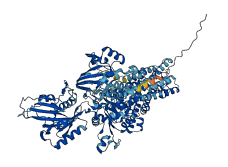
Descriptions
The autoinhibited protein was predicted that may have potential autoinhibitory elements via cis-regPred.
Autoinhibitory domains (AIDs)
Target domain |
|
Relief mechanism |
|
Assay |
cis-regPred |
Accessory elements
No accessory elements
Autoinhibited structure

Activated structure
1 structures for Q8VDN2
| Entry ID | Method | Resolution | Chain | Position | Source |
|---|---|---|---|---|---|
| AF-Q8VDN2-F1 | Predicted | AlphaFoldDB |
53 variants for Q8VDN2
| Variant ID(s) | Position | Change | Description | Diseaes Association | Provenance |
|---|---|---|---|---|---|
| rs3388647080 | 63 | L>F | No | EVA | |
| rs3388657526 | 64 | T>K | No | EVA | |
| rs3388647053 | 94 | R>W | No | EVA | |
| rs3388651381 | 154 | S>G | No | EVA | |
| rs3393380552 | 156 | K>M | No | EVA | |
| rs3393444926 | 170 | L>H | No | EVA | |
| rs3388655112 | 182 | A>V | No | EVA | |
| rs3388656304 | 204 | R>I | No | EVA | |
| rs3388654510 | 212 | K>T | No | EVA | |
| rs3388634175 | 320 | A>V | No | EVA | |
| rs3388655121 | 327 | I>T | No | EVA | |
| rs3388641120 | 332 | V>M | No | EVA | |
| rs3388642856 | 337 | L>M | No | EVA | |
| rs3393380539 | 338 | A>S | No | EVA | |
| rs3393462728 | 340 | V>G | No | EVA | |
| rs3388648963 | 341 | T>M | No | EVA | |
| rs3388655062 | 343 | C>F | No | EVA | |
| rs3393460747 | 378 | T>M | No | EVA | |
| rs3388647087 | 391 | M>L | No | EVA | |
| rs3388657506 | 405 | N>K | No | EVA | |
| rs3388642801 | 423 | R>T | No | EVA | |
| rs3388656369 | 435 | A>T | No | EVA | |
| rs3388650895 | 537 | A>V | No | EVA | |
| rs3388654174 | 552 | V>M | No | EVA | |
| rs3388650553 | 587 | G>S | No | EVA | |
| rs3388651046 | 598 | A>G | No | EVA | |
| rs3388651046 | 598 | A>V | No | EVA | |
| rs3388648975 | 599 | V>A | No | EVA | |
| rs3393527333 | 599 | V>I | No | EVA | |
| rs3393472238 | 601 | D>A | No | EVA | |
| rs3393462744 | 605 | K>I | No | EVA | |
| rs3393209984 | 605 | K>N | No | EVA | |
| rs3388656376 | 616 | V>I | No | EVA | |
| rs3393460761 | 669 | D>H | No | EVA | |
| rs3388650548 | 672 | D>V | No | EVA | |
| rs3388654535 | 697 | Q>H | No | EVA | |
| rs3388648650 | 738 | G>C | No | EVA | |
| rs3388657509 | 739 | S>F | No | EVA | |
| rs3388654514 | 781 | T>S | No | EVA | |
| rs3388634179 | 804 | T>N | No | EVA | |
| rs3388647124 | 856 | Q>* | No | EVA | |
| rs3388642769 | 865 | G>S | No | EVA | |
| rs3388648655 | 886 | I>V | No | EVA | |
| rs3388648594 | 888 | E>G | No | EVA | |
| rs3388648997 | 890 | W>* | No | EVA | |
| rs3388647081 | 919 | H>Q | No | EVA | |
| rs3388650530 | 922 | F>V | No | EVA | |
| rs3388648626 | 932 | A>T | No | EVA | |
| rs3393527306 | 945 | F>L | No | EVA | |
| rs3388651045 | 975 | G>W | No | EVA | |
| rs3388655027 | 984 | K>I | No | EVA | |
| rs3393423313 | 984 | K>TTM* | No | EVA | |
| rs3388641038 | 997 | L>I | No | EVA |
No associated diseases with Q8VDN2
4 regional properties for Q8VDN2
| Type | Name | Position | InterPro Accession |
|---|---|---|---|
| domain | Cation-transporting P-type ATPase, N-terminal | 42 - 116 | IPR004014 |
| domain | Cation-transporting P-type ATPase, C-terminal | 799 - 1008 | IPR006068 |
| ptm | P-type ATPase, phosphorylation site | 376 - 382 | IPR018303 |
| domain | P-type ATPase, haloacid dehalogenase domain | 355 - 767 | IPR044492 |
Functions
| Description | ||
|---|---|---|
| EC Number | 7.2.2.13 | Linked to the hydrolysis of a nucleoside triphosphate |
| Subcellular Localization |
|
|
| PANTHER Family | ||
| PANTHER Subfamily | ||
| PANTHER Protein Class | ||
| PANTHER Pathway Category | No pathway information available | |
22 GO annotations of cellular component
| Name | Definition |
|---|---|
| apical plasma membrane | The region of the plasma membrane located at the apical end of the cell. |
| axon | The long process of a neuron that conducts nerve impulses, usually away from the cell body to the terminals and varicosities, which are sites of storage and release of neurotransmitter. |
| basolateral plasma membrane | The region of the plasma membrane that includes the basal end and sides of the cell. Often used in reference to animal polarized epithelial membranes, where the basal membrane is the part attached to the extracellular matrix, or in plant cells, where the basal membrane is defined with respect to the zygotic axis. |
| caveola | A membrane raft that forms small pit, depression, or invagination that communicates with the outside of a cell and extends inward, indenting the cytoplasm and the cell membrane. Examples include flask-shaped invaginations of the plasma membrane in adipocytes associated with caveolin proteins, and minute pits or incuppings of the cell membrane formed during pinocytosis. Caveolae may be pinched off to form free vesicles within the cytoplasm. |
| endoplasmic reticulum | The irregular network of unit membranes, visible only by electron microscopy, that occurs in the cytoplasm of many eukaryotic cells. The membranes form a complex meshwork of tubular channels, which are often expanded into slitlike cavities called cisternae. The ER takes two forms, rough (or granular), with ribosomes adhering to the outer surface, and smooth (with no ribosomes attached). |
| endosome | A vacuole to which materials ingested by endocytosis are delivered. |
| Golgi apparatus | A membrane-bound cytoplasmic organelle of the endomembrane system that further processes the core oligosaccharides (e.g. N-glycans) added to proteins in the endoplasmic reticulum and packages them into membrane-bound vesicles. The Golgi apparatus operates at the intersection of the secretory, lysosomal, and endocytic pathways. |
| integral component of membrane | The component of a membrane consisting of the gene products and protein complexes having at least some part of their peptide sequence embedded in the hydrophobic region of the membrane. |
| intercalated disc | A complex cell-cell junction at which myofibrils terminate in cardiomyocytes; mediates mechanical and electrochemical integration between individual cardiomyocytes. The intercalated disc contains regions of tight mechanical attachment (fasciae adherentes and desmosomes) and electrical coupling (gap junctions) between adjacent cells. |
| lateral plasma membrane | The portion of the plasma membrane at the lateral side of the cell. In epithelial cells, lateral plasma membranes are on the sides of cells which lie at the interface of adjacent cells. |
| melanosome | A tissue-specific, membrane-bounded cytoplasmic organelle within which melanin pigments are synthesized and stored. Melanosomes are synthesized in melanocyte cells. |
| membrane | A lipid bilayer along with all the proteins and protein complexes embedded in it an attached to it. |
| membrane raft | Any of the small (10-200 nm), heterogeneous, highly dynamic, sterol- and sphingolipid-enriched membrane domains that compartmentalize cellular processes. Small rafts can sometimes be stabilized to form larger platforms through protein-protein and protein-lipid interactions. |
| myelin sheath | An electrically insulating fatty layer that surrounds the axons of many neurons. It is an outgrowth of glial cells: Schwann cells supply the myelin for peripheral neurons while oligodendrocytes supply it to those of the central nervous system. |
| organelle membrane | A membrane that is one of the two lipid bilayers of an organelle envelope or the outermost membrane of single membrane bound organelle. |
| plasma membrane | The membrane surrounding a cell that separates the cell from its external environment. It consists of a phospholipid bilayer and associated proteins. |
| postsynaptic density | An electron dense network of proteins within and adjacent to the postsynaptic membrane of an asymmetric, neuron-neuron synapse. Its major components include neurotransmitter receptors and the proteins that spatially and functionally organize them such as anchoring and scaffolding molecules, signaling enzymes and cytoskeletal components. |
| protein-containing complex | A stable assembly of two or more macromolecules, i.e. proteins, nucleic acids, carbohydrates or lipids, in which at least one component is a protein and the constituent parts function together. |
| sarcolemma | The outer membrane of a muscle cell, consisting of the plasma membrane, a covering basement membrane (about 100 nm thick and sometimes common to more than one fiber), and the associated loose network of collagen fibers. |
| sodium:potassium-exchanging ATPase complex | Sodium:potassium-exchanging ATPases are tetrameric proteins, consisting of two large alpha subunits and two smaller beta subunits. The alpha subunits bear the active site and penetrate the membrane, while the beta subunits carry oligosaccharide groups and face the cell exterior. |
| sperm flagellum | A microtubule-based flagellum (or cilium) that is part of a sperm, a mature male germ cell that develops from a spermatid. |
| T-tubule | Invagination of the plasma membrane of a muscle cell that extends inward from the cell surface around each myofibril. The ends of T-tubules make contact with the sarcoplasmic reticulum membrane. |
15 GO annotations of molecular function
| Name | Definition |
|---|---|
| ADP binding | Binding to ADP, adenosine 5'-diphosphate. |
| ankyrin binding | Binding to ankyrin, a 200 kDa cytoskeletal protein that attaches other cytoskeletal proteins to integral membrane proteins. |
| ATP binding | Binding to ATP, adenosine 5'-triphosphate, a universally important coenzyme and enzyme regulator. |
| ATP hydrolysis activity | Catalysis of the reaction: ATP + H2O = ADP + H+ phosphate. ATP hydrolysis is used in some reactions as an energy source, for example to catalyze a reaction or drive transport against a concentration gradient. |
| ATPase-coupled cation transmembrane transporter activity | Enables the transfer of a solute or solutes from one side of a membrane to the other according to the reaction: ATP + H2O + cation(out) = ADP + phosphate + cation(in). |
| chaperone binding | Binding to a chaperone protein, a class of proteins that bind to nascent or unfolded polypeptides and ensure correct folding or transport. |
| P-type sodium:potassium-exchanging transporter activity | Enables the transfer of a solute or solutes from one side of a membrane to the other according to the reaction: ATP + H2O + Na+(in) + K+(out) = ADP + phosphate + Na+(out) + K+(in). |
| phosphatase activity | Catalysis of the hydrolysis of phosphoric monoesters, releasing inorganic phosphate. |
| phosphatidylinositol 3-kinase binding | Binding to a phosphatidylinositol 3-kinase, any enzyme that catalyzes the addition of a phosphate group to an inositol lipid at the 3' position of the inositol ring. |
| potassium ion binding | Binding to a potassium ion (K+). |
| protein domain specific binding | Binding to a specific domain of a protein. |
| protein heterodimerization activity | Binding to a nonidentical protein to form a heterodimer. |
| protein kinase binding | Binding to a protein kinase, any enzyme that catalyzes the transfer of a phosphate group, usually from ATP, to a protein substrate. |
| sodium ion binding | Binding to a sodium ion (Na+). |
| steroid hormone binding | Binding to a steroid hormone. |
23 GO annotations of biological process
| Name | Definition |
|---|---|
| cellular potassium ion homeostasis | Any process involved in the maintenance of an internal steady state of potassium ions at the level of a cell. |
| cellular response to mechanical stimulus | Any process that results in a change in state or activity of a cell (in terms of movement, secretion, enzyme production, gene expression, etc.) as a result of a mechanical stimulus. |
| cellular response to steroid hormone stimulus | Any process that results in a change in state or activity of a cell (in terms of movement, secretion, enzyme production, gene expression, etc.) as a result of a steroid hormone stimulus. |
| cellular sodium ion homeostasis | Any process involved in the maintenance of an internal steady state of sodium ions at the level of a cell. |
| establishment or maintenance of transmembrane electrochemical gradient | The directed movement of ions to establish or maintain an electrochemical gradient across a membrane by means of some agent such as a transporter or pore. |
| heart contraction | The multicellular organismal process in which the heart decreases in volume in a characteristic way to propel blood through the body. |
| membrane hyperpolarization | The process in which membrane potential increases with respect to its steady-state potential, usually from negative potential to a more negative potential. For example, during the repolarization phase of an action potential the membrane potential often becomes more negative or hyperpolarized before returning to the steady-state resting potential. |
| membrane repolarization | The process in which ions are transported across a membrane such that the membrane potential changes in the repolarizing direction, toward the steady state potential. For example, the repolarization during an action potential is from a positive membrane potential towards a negative resting potential. |
| negative regulation of glucocorticoid biosynthetic process | Any process that stops, prevents, or reduces the frequency, rate or extent of the chemical reactions and pathways resulting in the formation of glucocorticoids. |
| negative regulation of heart contraction | Any process that stops, prevents, or reduces the frequency, rate or extent of heart contraction. |
| positive regulation of heart contraction | Any process that activates or increases the frequency, rate or extent of heart contraction. |
| positive regulation of striated muscle contraction | Any process that activates or increases the frequency, rate or extent of striated muscle contraction. |
| potassium ion import across plasma membrane | The directed movement of potassium ions from outside of a cell, across the plasma membrane and into the cytosol. |
| potassium ion transport | The directed movement of potassium ions (K+) into, out of or within a cell, or between cells, by means of some agent such as a transporter or pore. |
| proton transmembrane transport | The directed movement of a proton across a membrane. |
| regulation of blood pressure | Any process that modulates the force with which blood travels through the circulatory system. The process is controlled by a balance of processes that increase pressure and decrease pressure. |
| regulation of cardiac muscle cell contraction | Any process that modulates the frequency, rate or extent of cardiac muscle cell contraction. |
| regulation of sodium ion transport | Any process that modulates the frequency, rate or extent of the directed movement of sodium ions (Na+) into, out of or within a cell, or between cells, by means of some agent such as a transporter or pore. |
| regulation of the force of heart contraction | Any process that modulates the extent of heart contraction, changing the force with which blood is propelled. |
| response to xenobiotic stimulus | Any process that results in a change in state or activity of a cell or an organism (in terms of movement, secretion, enzyme production, gene expression, etc.) as a result of a stimulus from a xenobiotic, a compound foreign to the organim exposed to it. It may be synthesized by another organism (like ampicilin) or it can be a synthetic chemical. |
| sodium ion export across plasma membrane | The directed movement of sodium ions from inside of a cell, across the plasma membrane and into the extracellular region. |
| sodium ion transport | The directed movement of sodium ions (Na+) into, out of or within a cell, or between cells, by means of some agent such as a transporter or pore. |
| transmembrane transport | The process in which a solute is transported across a lipid bilayer, from one side of a membrane to the other. |
14 homologous proteins in AiPD
| UniProt AC | Gene Name | Protein Name | Species | Evidence Code |
|---|---|---|---|---|
| P13607 | Atpalpha | Sodium/potassium-transporting ATPase subunit alpha | Drosophila melanogaster (Fruit fly) | PR |
| P54707 | ATP12A | Potassium-transporting ATPase alpha chain 2 | Homo sapiens (Human) | PR |
| P20648 | ATP4A | Potassium-transporting ATPase alpha chain 1 | Homo sapiens (Human) | PR |
| P05023 | ATP1A1 | Sodium/potassium-transporting ATPase subunit alpha-1 | Homo sapiens (Human) | PR |
| Q6PIC6 | Atp1a3 | Sodium/potassium-transporting ATPase subunit alpha-3 | Mus musculus (Mouse) | PR |
| Q6PIE5 | Atp1a2 | Sodium/potassium-transporting ATPase subunit alpha-2 | Mus musculus (Mouse) | PR |
| Q9WV27 | Atp1a4 | Sodium/potassium-transporting ATPase subunit alpha-4 | Mus musculus (Mouse) | PR |
| Q9Z1W8 | Atp12a | Potassium-transporting ATPase alpha chain 2 | Mus musculus (Mouse) | PR |
| Q64436 | Atp4a | Potassium-transporting ATPase alpha chain 1 | Mus musculus (Mouse) | PR |
| P19156 | ATP4A | Potassium-transporting ATPase alpha chain 1 | Sus scrofa (Pig) | PR |
| P54708 | Atp12a | Potassium-transporting ATPase alpha chain 2 | Rattus norvegicus (Rat) | PR |
| P09626 | Atp4a | Potassium-transporting ATPase alpha chain 1 | Rattus norvegicus (Rat) | PR |
| Q64541 | Atp1a4 | Sodium/potassium-transporting ATPase subunit alpha-4 | Rattus norvegicus (Rat) | PR |
| P06685 | Atp1a1 | Sodium/potassium-transporting ATPase subunit alpha-1 | Rattus norvegicus (Rat) | PR |
| 10 | 20 | 30 | 40 | 50 | 60 |
| MGKGVGRDKY | EPAAVSEHGD | KKGKKAKKER | DMDELKKEVS | MDDHKLSLDE | LHRKYGTDLS |
| 70 | 80 | 90 | 100 | 110 | 120 |
| RGLTPARAAE | ILARDGPNAL | TPPPTTPEWV | KFCRQLFGGF | SMLLWIGAIL | CFLAYGIRSA |
| 130 | 140 | 150 | 160 | 170 | 180 |
| TEEEPPNDDL | YLGVVLSAVV | IITGCFSYYQ | EAKSSKIMES | FKNMVPQQAL | VIRNGEKMSI |
| 190 | 200 | 210 | 220 | 230 | 240 |
| NAEDVVVGDL | VEVKGGDRIP | ADLRIISANG | CKVDNSSLTG | ESEPQTRSPD | FTNENPLETR |
| 250 | 260 | 270 | 280 | 290 | 300 |
| NIAFFSTNCV | EGTARGIVVY | TGDRTVMGRI | ATLASGLEGG | QTPIAEEIEH | FIHLITGVAV |
| 310 | 320 | 330 | 340 | 350 | 360 |
| FLGVSFFILS | LILEYTWLEA | VIFLIGIIVA | NVPEGLLATV | TVCLTLTAKR | MARKNCLVKN |
| 370 | 380 | 390 | 400 | 410 | 420 |
| LEAVETLGST | STICSDKTGT | LTQNRMTVAH | MWFDNQIHEA | DTTENQSGVS | FDKTSATWFA |
| 430 | 440 | 450 | 460 | 470 | 480 |
| LSRIAGLCNR | AVFQANQENL | PILKRAVAGD | ASESALLKCI | EVCCGSVMEM | REKYSKIVEI |
| 490 | 500 | 510 | 520 | 530 | 540 |
| PFNSTNKYQL | SIHKNPNASE | PKHLLVMKGA | PERILDRCSS | ILLHGKEQPL | DEELKDAFQN |
| 550 | 560 | 570 | 580 | 590 | 600 |
| AYLELGGLGE | RVLGFCHLLL | PDEQFPEGFQ | FDTDDVNFPV | DNLCFVGLIS | MIDPPRAAVP |
| 610 | 620 | 630 | 640 | 650 | 660 |
| DAVGKCRSAG | IKVIMVTGDH | PITAKAIAKG | VGIISEGNET | VEDIAARLNI | PVNQVNPRDA |
| 670 | 680 | 690 | 700 | 710 | 720 |
| KACVVHGSDL | KDMTSEELDD | ILRYHTEIVF | ARTSPQQKLI | IVEGCQRQGA | IVAVTGDGVN |
| 730 | 740 | 750 | 760 | 770 | 780 |
| DSPALKKADI | GVAMGIVGSD | VSKQAADMIL | LDDNFASIVT | GVEEGRLIFD | NLKKSIAYTL |
| 790 | 800 | 810 | 820 | 830 | 840 |
| TSNIPEITPF | LIFIIANIPL | PLGTVTILCI | DLGTDMVPAI | SLAYEQAESD | IMKRQPRNPK |
| 850 | 860 | 870 | 880 | 890 | 900 |
| TDKLVNERLI | SMAYGQIGMI | QALGGFFTYF | VILAENGFLP | FHLLGIRETW | DDRWVNDVED |
| 910 | 920 | 930 | 940 | 950 | 960 |
| SYGQQWTYEQ | RKIVEFTCHT | AFFVSIVVVQ | WADLVICKTR | RNSVFQQGMK | NKILIFGLFE |
| 970 | 980 | 990 | 1000 | 1010 | 1020 |
| ETALAAFLSY | CPGMGAALRM | YPLKPTWWFC | AFPYSLLIFV | YDEVRKLIIR | RRPGGWVEKE |
| TYY |