Q6PIE5
Gene name |
Atp1a2 |
Protein name |
Sodium/potassium-transporting ATPase subunit alpha-2 |
Names |
Na(+)/K(+) ATPase alpha-2 subunit, Na(+)/K(+) ATPase alpha(+) subunit, Sodium pump subunit alpha-2 |
Species |
Mus musculus (Mouse) |
KEGG Pathway |
mmu:98660 |
EC number |
7.2.2.13: Linked to the hydrolysis of a nucleoside triphosphate |
Protein Class |
|
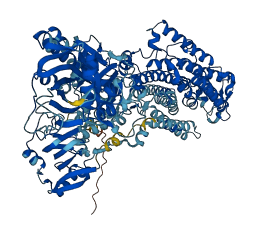
Descriptions
The autoinhibited protein was predicted that may have potential autoinhibitory elements via cis-regPred.
Autoinhibitory domains (AIDs)
Target domain |
|
Relief mechanism |
|
Assay |
cis-regPred |
Accessory elements
No accessory elements
Autoinhibited structure

Activated structure
1 structures for Q6PIE5
| Entry ID | Method | Resolution | Chain | Position | Source |
|---|---|---|---|---|---|
| AF-Q6PIE5-F1 | Predicted | AlphaFoldDB |
35 variants for Q6PIE5
| Variant ID(s) | Position | Change | Description | Diseaes Association | Provenance |
|---|---|---|---|---|---|
| rs3388514023 | 49 | L>M | No | EVA | |
| rs3388518648 | 83 | T>I | No | EVA | |
| rs3388516401 | 94 | L>P | No | EVA | |
| rs3388513164 | 100 | I>T | No | EVA | |
| rs3388517973 | 162 | M>T | No | EVA | |
| rs3388518068 | 189 | V>M | No | EVA | |
| rs3388515206 | 209 | C>S | No | EVA | |
| rs3388513168 | 297 | A>V | No | EVA | |
| rs3388517739 | 325 | I>T | No | EVA | |
| rs3390988851 | 361 | A>D | No | EVA | |
| rs3388517327 | 424 | G>D | No | EVA | |
| rs3388516410 | 498 | Q>H | No | EVA | |
| rs3388516419 | 542 | L>M | No | EVA | |
| rs3388516587 | 559 | S>F | No | EVA | |
| rs3388514906 | 579 | K>T | No | EVA | |
| rs3388518393 | 591 | P>H | No | EVA | |
| rs3388518411 | 600 | V>M | No | EVA | |
| rs3388520431 | 638 | V>L | No | EVA | |
| rs3388517711 | 732 | G>C | No | EVA | |
| rs3388513464 | 756 | V>L | No | EVA | |
| rs3388516579 | 779 | S>N | No | EVA | |
| rs3390992244 | 790 | F>V | No | EVA | |
| rs3388515763 | 837 | Q>* | No | EVA | |
| rs3391004218 | 868 | V>E | No | EVA | |
| rs3388518600 | 877 | P>S | No | EVA | |
| rs3388515287 | 903 | W>C | No | EVA | |
| rs3388518400 | 911 | V>M | No | EVA | |
| rs3388515711 | 953 | F>S | No | EVA | |
| rs3388517397 | 967 | Y>* | No | EVA | |
| rs3388515801 | 980 | L>F | No | EVA | |
| rs3388513986 | 983 | T>M | No | EVA | |
| rs3388511895 | 996 | F>V | No | EVA | |
| rs3390910587 | 1001 | V>D | No | EVA | |
| rs3388518631 | 1010 | P>L | No | EVA | |
| rs3388520432 | 1020 | Y>* | No | EVA |
No associated diseases with Q6PIE5
4 regional properties for Q6PIE5
| Type | Name | Position | InterPro Accession |
|---|---|---|---|
| domain | Cation-transporting P-type ATPase, N-terminal | 40 - 114 | IPR004014 |
| domain | Cation-transporting P-type ATPase, C-terminal | 796 - 1005 | IPR006068 |
| ptm | P-type ATPase, phosphorylation site | 374 - 380 | IPR018303 |
| domain | P-type ATPase, haloacid dehalogenase domain | 353 - 764 | IPR044492 |
Functions
| Description | ||
|---|---|---|
| EC Number | 7.2.2.13 | Linked to the hydrolysis of a nucleoside triphosphate |
| Subcellular Localization |
|
|
| PANTHER Family | ||
| PANTHER Subfamily | ||
| PANTHER Protein Class | ||
| PANTHER Pathway Category | No pathway information available | |
16 GO annotations of cellular component
| Name | Definition |
|---|---|
| caveola | A membrane raft that forms small pit, depression, or invagination that communicates with the outside of a cell and extends inward, indenting the cytoplasm and the cell membrane. Examples include flask-shaped invaginations of the plasma membrane in adipocytes associated with caveolin proteins, and minute pits or incuppings of the cell membrane formed during pinocytosis. Caveolae may be pinched off to form free vesicles within the cytoplasm. |
| cell projection | A prolongation or process extending from a cell, e.g. a flagellum or axon. |
| cytoplasm | The contents of a cell excluding the plasma membrane and nucleus, but including other subcellular structures. |
| dendritic spine | A small, membranous protrusion from a dendrite that forms a postsynaptic compartment, typically receiving input from a single presynapse. They function as partially isolated biochemical and an electrical compartments. Spine morphology is variable:they can be thin, stubby, mushroom, or branched, with a continuum of intermediate morphologies. They typically terminate in a bulb shape, linked to the dendritic shaft by a restriction. Spine remodeling is though to be involved in synaptic plasticity. |
| endosome | A vacuole to which materials ingested by endocytosis are delivered. |
| intercalated disc | A complex cell-cell junction at which myofibrils terminate in cardiomyocytes; mediates mechanical and electrochemical integration between individual cardiomyocytes. The intercalated disc contains regions of tight mechanical attachment (fasciae adherentes and desmosomes) and electrical coupling (gap junctions) between adjacent cells. |
| membrane | A lipid bilayer along with all the proteins and protein complexes embedded in it an attached to it. |
| myelin sheath | An electrically insulating fatty layer that surrounds the axons of many neurons. It is an outgrowth of glial cells: Schwann cells supply the myelin for peripheral neurons while oligodendrocytes supply it to those of the central nervous system. |
| neuron projection | A prolongation or process extending from a nerve cell, e.g. an axon or dendrite. |
| neuronal cell body | The portion of a neuron that includes the nucleus, but excludes cell projections such as axons and dendrites. |
| organelle membrane | A membrane that is one of the two lipid bilayers of an organelle envelope or the outermost membrane of single membrane bound organelle. |
| plasma membrane | The membrane surrounding a cell that separates the cell from its external environment. It consists of a phospholipid bilayer and associated proteins. |
| sarcolemma | The outer membrane of a muscle cell, consisting of the plasma membrane, a covering basement membrane (about 100 nm thick and sometimes common to more than one fiber), and the associated loose network of collagen fibers. |
| sodium:potassium-exchanging ATPase complex | Sodium:potassium-exchanging ATPases are tetrameric proteins, consisting of two large alpha subunits and two smaller beta subunits. The alpha subunits bear the active site and penetrate the membrane, while the beta subunits carry oligosaccharide groups and face the cell exterior. |
| synapse | The junction between an axon of one neuron and a dendrite of another neuron, a muscle fiber or a glial cell. As the axon approaches the synapse it enlarges into a specialized structure, the presynaptic terminal bouton, which contains mitochondria and synaptic vesicles. At the tip of the terminal bouton is the presynaptic membrane; facing it, and separated from it by a minute cleft (the synaptic cleft) is a specialized area of membrane on the receiving cell, known as the postsynaptic membrane. In response to the arrival of nerve impulses, the presynaptic terminal bouton secretes molecules of neurotransmitters into the synaptic cleft. These diffuse across the cleft and transmit the signal to the postsynaptic membrane. |
| T-tubule | Invagination of the plasma membrane of a muscle cell that extends inward from the cell surface around each myofibril. The ends of T-tubules make contact with the sarcoplasmic reticulum membrane. |
10 GO annotations of molecular function
| Name | Definition |
|---|---|
| ATP binding | Binding to ATP, adenosine 5'-triphosphate, a universally important coenzyme and enzyme regulator. |
| ATP hydrolysis activity | Catalysis of the reaction: ATP + H2O = ADP + H+ phosphate. ATP hydrolysis is used in some reactions as an energy source, for example to catalyze a reaction or drive transport against a concentration gradient. |
| ATPase-coupled cation transmembrane transporter activity | Enables the transfer of a solute or solutes from one side of a membrane to the other according to the reaction: ATP + H2O + cation(out) = ADP + phosphate + cation(in). |
| chaperone binding | Binding to a chaperone protein, a class of proteins that bind to nascent or unfolded polypeptides and ensure correct folding or transport. |
| P-type sodium:potassium-exchanging transporter activity | Enables the transfer of a solute or solutes from one side of a membrane to the other according to the reaction: ATP + H2O + Na+(in) + K+(out) = ADP + phosphate + Na+(out) + K+(in). |
| potassium ion binding | Binding to a potassium ion (K+). |
| protein heterodimerization activity | Binding to a nonidentical protein to form a heterodimer. |
| sodium ion binding | Binding to a sodium ion (Na+). |
| steroid binding | Binding to a steroid, any of a large group of substances that have in common a ring system based on 1,2-cyclopentanoperhydrophenanthrene. |
| steroid hormone binding | Binding to a steroid hormone. |
37 GO annotations of biological process
| Name | Definition |
|---|---|
| adult locomotory behavior | Locomotory behavior in a fully developed and mature organism. |
| amygdala development | The progression of the amygdala over time from its initial formation until its mature state. The amygdala is an almond-shaped set of neurons in the medial temporal lobe of the brain that play a key role in processing emotions such as fear and pleasure. |
| ATP metabolic process | The chemical reactions and pathways involving ATP, adenosine triphosphate, a universally important coenzyme and enzyme regulator. |
| behavioral fear response | An acute behavioral change resulting from a perceived external threat. |
| cation transmembrane transport | The process in which a cation is transported across a membrane. |
| cellular potassium ion homeostasis | Any process involved in the maintenance of an internal steady state of potassium ions at the level of a cell. |
| cellular response to mechanical stimulus | Any process that results in a change in state or activity of a cell (in terms of movement, secretion, enzyme production, gene expression, etc.) as a result of a mechanical stimulus. |
| cellular response to steroid hormone stimulus | Any process that results in a change in state or activity of a cell (in terms of movement, secretion, enzyme production, gene expression, etc.) as a result of a steroid hormone stimulus. |
| cellular sodium ion homeostasis | Any process involved in the maintenance of an internal steady state of sodium ions at the level of a cell. |
| locomotion | Self-propelled movement of a cell or organism from one location to another. |
| locomotory exploration behavior | The specific movement from place to place of an organism in response to a novel environment. |
| negative regulation of calcium ion transmembrane transport | Any process that stops, prevents or reduces the frequency, rate or extent of calcium ion transmembrane transport. |
| negative regulation of calcium:sodium antiporter activity | Any process that stops, prevents or reduces the frequency, rate or extent of calcium:sodium antiporter activity. |
| negative regulation of cytosolic calcium ion concentration | Any process that decreases the concentration of calcium ions in the cytosol. |
| negative regulation of heart contraction | Any process that stops, prevents, or reduces the frequency, rate or extent of heart contraction. |
| negative regulation of striated muscle contraction | Any process that stops, prevents, or reduces the frequency, rate or extent of striated muscle contraction. |
| neurotransmitter uptake | The directed movement of neurotransmitters into neurons or glial cells. This process leads to inactivation and recycling of neurotransmitters. |
| olfactory cortex development | The progression of the olfactory cortex over time from its initial formation until its mature state. The olfactory cortex is involved in the perception of smell. It receives input from the olfactory bulb and is responsible for the identification of odors. |
| potassium ion import across plasma membrane | The directed movement of potassium ions from outside of a cell, across the plasma membrane and into the cytosol. |
| potassium ion transmembrane transport | A process in which a potassium ion is transported from one side of a membrane to the other. |
| potassium ion transport | The directed movement of potassium ions (K+) into, out of or within a cell, or between cells, by means of some agent such as a transporter or pore. |
| proton transmembrane transport | The directed movement of a proton across a membrane. |
| regulation of blood pressure | Any process that modulates the force with which blood travels through the circulatory system. The process is controlled by a balance of processes that increase pressure and decrease pressure. |
| regulation of cardiac muscle cell contraction | Any process that modulates the frequency, rate or extent of cardiac muscle cell contraction. |
| regulation of muscle contraction | Any process that modulates the frequency, rate or extent of muscle contraction. |
| regulation of respiratory gaseous exchange by nervous system process | A process carried out by the nervous system that is required for the proper control of respiratory gaseous exchange. This process occurs in the respiratory center of the brain in vertebrates. |
| regulation of smooth muscle contraction | Any process that modulates the frequency, rate or extent of smooth muscle contraction. |
| regulation of striated muscle contraction | Any process that modulates the frequency, rate or extent of striated muscle contraction. |
| regulation of the force of heart contraction | Any process that modulates the extent of heart contraction, changing the force with which blood is propelled. |
| regulation of vasoconstriction | Any process that modulates the frequency, rate or extent of reductions in the diameter of blood vessels. |
| response to auditory stimulus | Any process that results in a change in state or activity of a cell or an organism (in terms of movement, secretion, enzyme production, gene expression, etc.) as a result of an auditory stimulus. |
| response to glycoside | Any process that results in a change in state or activity of a cell or an organism (in terms of movement, secretion, enzyme production, gene expression, etc.) as a result of a glycoside stimulus. |
| response to nicotine | Any process that results in a change in state or activity of a cell or an organism (in terms of movement, secretion, enzyme production, gene expression, etc.) as a result of a nicotine stimulus. |
| sodium ion export across plasma membrane | The directed movement of sodium ions from inside of a cell, across the plasma membrane and into the extracellular region. |
| sodium ion transmembrane transport | A process in which a sodium ion is transported from one side of a membrane to the other by means of some agent such as a transporter or pore. |
| sodium ion transport | The directed movement of sodium ions (Na+) into, out of or within a cell, or between cells, by means of some agent such as a transporter or pore. |
| visual learning | Any process in an organism in which a change in behavior of an individual occurs in response to repeated exposure to a visual cue. |
14 homologous proteins in AiPD
| UniProt AC | Gene Name | Protein Name | Species | Evidence Code |
|---|---|---|---|---|
| P13607 | Atpalpha | Sodium/potassium-transporting ATPase subunit alpha | Drosophila melanogaster (Fruit fly) | PR |
| P54707 | ATP12A | Potassium-transporting ATPase alpha chain 2 | Homo sapiens (Human) | PR |
| P20648 | ATP4A | Potassium-transporting ATPase alpha chain 1 | Homo sapiens (Human) | PR |
| P05023 | ATP1A1 | Sodium/potassium-transporting ATPase subunit alpha-1 | Homo sapiens (Human) | PR |
| Q6PIC6 | Atp1a3 | Sodium/potassium-transporting ATPase subunit alpha-3 | Mus musculus (Mouse) | PR |
| Q8VDN2 | Atp1a1 | Sodium/potassium-transporting ATPase subunit alpha-1 | Mus musculus (Mouse) | PR |
| Q9WV27 | Atp1a4 | Sodium/potassium-transporting ATPase subunit alpha-4 | Mus musculus (Mouse) | PR |
| Q9Z1W8 | Atp12a | Potassium-transporting ATPase alpha chain 2 | Mus musculus (Mouse) | PR |
| Q64436 | Atp4a | Potassium-transporting ATPase alpha chain 1 | Mus musculus (Mouse) | PR |
| P19156 | ATP4A | Potassium-transporting ATPase alpha chain 1 | Sus scrofa (Pig) | PR |
| P54708 | Atp12a | Potassium-transporting ATPase alpha chain 2 | Rattus norvegicus (Rat) | PR |
| P09626 | Atp4a | Potassium-transporting ATPase alpha chain 1 | Rattus norvegicus (Rat) | PR |
| P06685 | Atp1a1 | Sodium/potassium-transporting ATPase subunit alpha-1 | Rattus norvegicus (Rat) | PR |
| Q64541 | Atp1a4 | Sodium/potassium-transporting ATPase subunit alpha-4 | Rattus norvegicus (Rat) | PR |
| 10 | 20 | 30 | 40 | 50 | 60 |
| MGRGAGREYS | PAATTAENGG | GKKKQKEKEL | DELKKEVAMD | DHKLSLDELG | RKYQVDLSKG |
| 70 | 80 | 90 | 100 | 110 | 120 |
| LTNQRAQDIL | ARDGPNALTP | PPTTPEWVKF | CRQLFGGFSI | LLWIGALLCF | LAYGILAAME |
| 130 | 140 | 150 | 160 | 170 | 180 |
| DEPSNDNLYL | GIVLAAVVIV | TGCFSYYQEA | KSSKIMDSFK | NMVPQQALVI | REGEKMQINA |
| 190 | 200 | 210 | 220 | 230 | 240 |
| EEVVVGDLVE | VKGGDRVPAD | LRIISSHGCK | VDNSSLTGES | EPQTRSPEFT | HENPLETRNI |
| 250 | 260 | 270 | 280 | 290 | 300 |
| CFFSTNCVEG | TARGIVIATG | DRTVMGRIAT | LASGLEVGQT | PIAMEIEHFI | QLITGVAVFL |
| 310 | 320 | 330 | 340 | 350 | 360 |
| GVSFFVLSLI | LGYSWLEAVI | FLIGIIVANV | PEGLLATVTV | CLTLTAKRMA | RKNCLVKNLE |
| 370 | 380 | 390 | 400 | 410 | 420 |
| AVETLGSTST | ICSDKTGTLT | QNRMTVAHMW | FDNQIHEADT | TEDQSGATFD | KRSPTWTALS |
| 430 | 440 | 450 | 460 | 470 | 480 |
| RIAGLCNRAV | FKAGQENISV | SKRDTAGDAS | ESALLKCIEL | SCGSVRKMRD | RNPKVAEIPF |
| 490 | 500 | 510 | 520 | 530 | 540 |
| NSTNKYQLSI | HEREDSPQSH | VLVMKGAPER | ILDRCSTILV | QGKEIPLDKE | MQDAFQNAYM |
| 550 | 560 | 570 | 580 | 590 | 600 |
| ELGGLGERVL | GFCQLNLPSG | KFPRGFKFDT | DELNFPTEKL | CFVGLMSMID | PPRAAVPDAV |
| 610 | 620 | 630 | 640 | 650 | 660 |
| GKCRSAGIKV | IMVTGDHPIT | AKAIAKGVGI | ISEGNETVED | IAARLNIPVS | QVNPREAKAC |
| 670 | 680 | 690 | 700 | 710 | 720 |
| VVHGSDLKDM | TSEQLDEILR | DHTEIVFART | SPQQKLIIVE | GCQRQGAIVA | VTGDGVNDSP |
| 730 | 740 | 750 | 760 | 770 | 780 |
| ALKKADIGIA | MGISGSDVSK | QAADMILLDD | NFASIVTGVE | EGRLIFDNLK | KSIAYTLTSN |
| 790 | 800 | 810 | 820 | 830 | 840 |
| IPEITPFLLF | IIANIPLPLG | TVTILCIDLG | TDMVPAISLA | YEAAESDIMK | RQPRNSQTDK |
| 850 | 860 | 870 | 880 | 890 | 900 |
| LVNERLISMA | YGQIGMIQAL | GGFFTYFVIL | AENGFLPSRL | LGIRLDWDDR | TTNDLEDSYG |
| 910 | 920 | 930 | 940 | 950 | 960 |
| QEWTYEQRKV | VEFTCHTAFF | ASIVVVQWAD | LIICKTRRNS | VFQQGMKNKI | LIFGLLEETA |
| 970 | 980 | 990 | 1000 | 1010 | |
| LAAFLSYCPG | MGVALRMYPL | KVTWWFCAFP | YSLLIFIYDE | VRKLILRRYP | GGWVEKETYY |