Q9R0N3
Gene name |
Syt11 |
Protein name |
Synaptotagmin-11 |
Names |
Synaptotagmin XI, SytXI |
Species |
Mus musculus (Mouse) |
KEGG Pathway |
mmu:229521 |
EC number |
|
Protein Class |
|
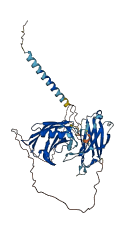
Descriptions
The autoinhibited protein was predicted that may have potential autoinhibitory elements via cis-regPred.
Autoinhibitory domains (AIDs)
Target domain |
|
Relief mechanism |
|
Assay |
cis-regPred |
Accessory elements
No accessory elements
Autoinhibited structure

Activated structure
1 structures for Q9R0N3
| Entry ID | Method | Resolution | Chain | Position | Source |
|---|---|---|---|---|---|
| AF-Q9R0N3-F1 | Predicted | AlphaFoldDB |
20 variants for Q9R0N3
| Variant ID(s) | Position | Change | Description | Diseaes Association | Provenance |
|---|---|---|---|---|---|
| rs3393106854 | 15 | P>ARRPR* | No | EVA | |
| rs3388643234 | 26 | L>M | No | EVA | |
| rs3388643886 | 26 | L>R | No | EVA | |
| rs3388641530 | 87 | R>E | No | EVA | |
| rs3388637411 | 89 | S>R | No | EVA | |
| rs3388635743 | 96 | I>T | No | EVA | |
| rs220909566 | 105 | H>Q | No | EVA | |
| rs3388640117 | 129 | E>K | No | EVA | |
| rs3388642162 | 155 | V>M | No | EVA | |
| rs3393204598 | 166 | Y>* | No | EVA | |
| rs3413098470 | 166 | Y>H | No | EVA | |
| rs3393313364 | 167 | N>S | No | EVA | |
| rs3388642151 | 189 | Q>H | No | EVA | |
| rs3388643786 | 205 | K>R | No | EVA | |
| rs3393363996 | 234 | S>R | No | EVA | |
| rs3388635342 | 265 | A>T | No | EVA | |
| rs3388641528 | 267 | V>A | No | EVA | |
| rs3388630053 | 327 | G>C | No | EVA | |
| rs3388635745 | 338 | G>V | No | EVA | |
| rs3388642187 | 415 | E>* | No | EVA |
No associated diseases with Q9R0N3
6 regional properties for Q9R0N3
| Type | Name | Position | InterPro Accession |
|---|---|---|---|
| domain | C2 domain | 156 - 278 | IPR000008-1 |
| domain | C2 domain | 290 - 425 | IPR000008-2 |
| domain | Synaptotagmin | 160 - 175 | IPR001565-1 |
| domain | Synaptotagmin | 175 - 188 | IPR001565-2 |
| domain | Synaptotagmin | 232 - 247 | IPR001565-3 |
| domain | Synaptotagmin | 252 - 262 | IPR001565-4 |
Functions
33 GO annotations of cellular component
| Name | Definition |
|---|---|
| anchoring junction | A cell junction that mechanically attaches a cell (and its cytoskeleton) to neighboring cells or to the extracellular matrix. |
| axon | The long process of a neuron that conducts nerve impulses, usually away from the cell body to the terminals and varicosities, which are sites of storage and release of neurotransmitter. |
| cell body | The portion of a cell bearing surface projections such as axons, dendrites, cilia, or flagella that includes the nucleus, but excludes all cell projections. |
| clathrin-coated vesicle membrane | The lipid bilayer surrounding a clathrin-coated vesicle. |
| cytoplasm | The contents of a cell excluding the plasma membrane and nucleus, but including other subcellular structures. |
| dendrite | A neuron projection that has a short, tapering, morphology. Dendrites receive and integrate signals from other neurons or from sensory stimuli, and conduct nerve impulses towards the axon or the cell body. In most neurons, the impulse is conveyed from dendrites to axon via the cell body, but in some types of unipolar neuron, the impulse does not travel via the cell body. |
| dendritic spine | A small, membranous protrusion from a dendrite that forms a postsynaptic compartment, typically receiving input from a single presynapse. They function as partially isolated biochemical and an electrical compartments. Spine morphology is variable:they can be thin, stubby, mushroom, or branched, with a continuum of intermediate morphologies. They typically terminate in a bulb shape, linked to the dendritic shaft by a restriction. Spine remodeling is though to be involved in synaptic plasticity. |
| early phagosome | A membrane-bounded intracellular vesicle as initially formed upon the ingestion of particulate material by phagocytosis. |
| excitatory synapse | A synapse in which an action potential in the presynaptic cell increases the probability of an action potential occurring in the postsynaptic cell. |
| exocytic vesicle | A transport vesicle that mediates transport from an intracellular compartment to the plasma membrane, and fuses with the plasma membrane to release various cargo molecules, such as proteins or hormones, by exocytosis. |
| inhibitory synapse | A synapse in which an action potential in the presynaptic cell reduces the probability of an action potential occurring in the postsynaptic cell. |
| integral component of plasma membrane | The component of the plasma membrane consisting of the gene products and protein complexes having at least some part of their peptide sequence embedded in the hydrophobic region of the membrane. |
| integral component of presynaptic active zone membrane | The component of the presynaptic active zone membrane consisting of the gene products and protein complexes having at least some part of their peptide sequence embedded in the hydrophobic region of the membrane. |
| integral component of synaptic vesicle membrane | The component of the synaptic vesicle membrane consisting of the gene products and protein complexes having at least some part of their peptide sequence embedded in the hydrophobic region of the membrane. |
| lysosomal membrane | The lipid bilayer surrounding the lysosome and separating its contents from the cell cytoplasm. |
| lysosome | A small lytic vacuole that has cell cycle-independent morphology found in most animal cells and that contains a variety of hydrolases, most of which have their maximal activities in the pH range 5-6. The contained enzymes display latency if properly isolated. About 40 different lysosomal hydrolases are known and lysosomes have a great variety of morphologies and functions. |
| neuron projection | A prolongation or process extending from a nerve cell, e.g. an axon or dendrite. |
| perikaryon | The portion of the cell soma (neuronal cell body) that excludes the nucleus. |
| perinuclear region of cytoplasm | Cytoplasm situated near, or occurring around, the nucleus. |
| phagocytic cup | An invagination of the cell membrane formed by an actin dependent process during phagocytosis. Following internalization it is converted into a phagosome. |
| phagocytic vesicle | A membrane-bounded intracellular vesicle that arises from the ingestion of particulate material by phagocytosis. |
| plasma membrane | The membrane surrounding a cell that separates the cell from its external environment. It consists of a phospholipid bilayer and associated proteins. |
| postsynapse | The part of a synapse that is part of the post-synaptic cell. |
| postsynaptic density | An electron dense network of proteins within and adjacent to the postsynaptic membrane of an asymmetric, neuron-neuron synapse. Its major components include neurotransmitter receptors and the proteins that spatially and functionally organize them such as anchoring and scaffolding molecules, signaling enzymes and cytoskeletal components. |
| presynapse | The part of a synapse that is part of the presynaptic cell. |
| presynaptic active zone membrane | The membrane portion of the presynaptic active zone; it is the site where docking and fusion of synaptic vesicles occurs for the release of neurotransmitters. |
| recycling endosome | An organelle consisting of a network of tubules that functions in targeting molecules, such as receptors transporters and lipids, to the plasma membrane. |
| recycling endosome membrane | The lipid bilayer surrounding a recycling endosome. |
| Schaffer collateral - CA1 synapse | A synapse between the Schaffer collateral axon of a CA3 pyramidal cell and a CA1 pyramidal cell. |
| synapse | The junction between an axon of one neuron and a dendrite of another neuron, a muscle fiber or a glial cell. As the axon approaches the synapse it enlarges into a specialized structure, the presynaptic terminal bouton, which contains mitochondria and synaptic vesicles. At the tip of the terminal bouton is the presynaptic membrane; facing it, and separated from it by a minute cleft (the synaptic cleft) is a specialized area of membrane on the receiving cell, known as the postsynaptic membrane. In response to the arrival of nerve impulses, the presynaptic terminal bouton secretes molecules of neurotransmitters into the synaptic cleft. These diffuse across the cleft and transmit the signal to the postsynaptic membrane. |
| terminal bouton | Terminal inflated portion of the axon, containing the specialized apparatus necessary to release neurotransmitters. The axon terminus is considered to be the whole region of thickening and the terminal bouton is a specialized region of it. |
| trans-Golgi network | The network of interconnected tubular and cisternal structures located within the Golgi apparatus on the side distal to the endoplasmic reticulum, from which secretory vesicles emerge. The trans-Golgi network is important in the later stages of protein secretion where it is thought to play a key role in the sorting and targeting of secreted proteins to the correct destination. |
| vesicle | Any small, fluid-filled, spherical organelle enclosed by membrane. |
9 GO annotations of molecular function
| Name | Definition |
|---|---|
| beta-tubulin binding | Binding to the microtubule constituent protein beta-tubulin. |
| calcium ion binding | Binding to a calcium ion (Ca2+). |
| calcium-dependent phospholipid binding | Binding to a phospholipid, a class of lipids containing phosphoric acid as a mono- or diester, in the presence of calcium. |
| clathrin binding | Binding to a clathrin heavy or light chain, the main components of the coat of coated vesicles and coated pits, and which also occurs in synaptic vesicles. |
| identical protein binding | Binding to an identical protein or proteins. |
| phosphatidylserine binding | Binding to phosphatidylserine, a class of glycophospholipids in which a phosphatidyl group is esterified to the hydroxyl group of L-serine. |
| SNARE binding | Binding to a SNARE (soluble N-ethylmaleimide-sensitive factor attached protein receptor) protein. |
| translation initiation factor binding | Binding to a translation initiation factor, any polypeptide factor involved in the initiation of ribosome-mediated translation. |
| ubiquitin protein ligase binding | Binding to a ubiquitin protein ligase enzyme, any of the E3 proteins. |
27 GO annotations of biological process
| Name | Definition |
|---|---|
| autophagy | The cellular catabolic process in which cells digest parts of their own cytoplasm; allows for both recycling of macromolecular constituents under conditions of cellular stress and remodeling the intracellular structure for cell differentiation. |
| calcium ion regulated lysosome exocytosis | The process of secretion by a cell that results in the release of intracellular molecules contained within a lysosome by fusion of the vesicle with the plasma membrane of a cell, induced by a rise in cytosolic calcium-ion levels. |
| calcium-ion regulated exocytosis | The release of intracellular molecules (e.g. hormones, matrix proteins) contained within a membrane-bounded vesicle by fusion of the vesicle with the plasma membrane of a cell, induced by a rise in cytosolic calcium-ion levels. |
| cellular response to calcium ion | Any process that results in a change in state or activity of a cell (in terms of movement, secretion, enzyme production, gene expression, etc.) as a result of a calcium ion stimulus. |
| establishment of vesicle localization | The directed movement of a vesicle to a specific location. |
| learning | Any process in an organism in which a relatively long-lasting adaptive behavioral change occurs as the result of experience. |
| memory | The activities involved in the mental information processing system that receives (registers), modifies, stores, and retrieves informational stimuli. The main stages involved in the formation and retrieval of memory are encoding (processing of received information by acquisition), storage (building a permanent record of received information as a result of consolidation) and retrieval (calling back the stored information and use it in a suitable way to execute a given task). |
| negative regulation of clathrin-coated pit assembly | Any process that stops, prevents or reduces the frequency, rate or extent of clathrin-coated pit assembly. |
| negative regulation of clathrin-dependent endocytosis | Any process that stops, prevents or reduces the frequency, rate or extent of clathrin-mediated endocytosis. |
| negative regulation of cytokine production | Any process that stops, prevents, or reduces the rate of production of a cytokine. |
| negative regulation of dopamine secretion | Any process that stops, prevents, or reduces the frequency, rate or extent of the regulated release of dopamine. |
| negative regulation of endocytosis | Any process that stops, prevents, or reduces the frequency, rate or extent of endocytosis. |
| negative regulation of interleukin-6 production | Any process that stops, prevents, or reduces the frequency, rate, or extent of interleukin-6 production. |
| negative regulation of membrane invagination | Any process that stops, prevents or reduces the frequency, rate or extent of membrane invagination. |
| negative regulation of microglial cell activation | Any process that stops, prevents or reduces the frequency, rate or extent of microglial cell activation. |
| negative regulation of phagocytosis | Any process that stops, prevents, or reduces the frequency, rate or extent of phagocytosis. |
| negative regulation of synaptic vesicle endocytosis | Any process that stops, prevents or reduces the frequency, rate or extent of synaptic vesicle endocytosis. |
| negative regulation of tumor necrosis factor production | Any process that stops, prevents, or reduces the frequency, rate, or extent of tumor necrosis factor production. |
| plasma membrane repair | The resealing of a cell plasma membrane after cellular wounding due to, for instance, mechanical stress. |
| positive regulation of protein localization to phagocytic vesicle | Any process that activates or increases the frequency, rate or extent of protein localization to phagocytic vesicle. |
| regulation of calcium ion-dependent exocytosis | Any process that modulates the frequency, rate or extent of calcium ion-dependent exocytosis. |
| regulation of defense response to bacterium | Any process that modulates the frequency, rate or extent of defense response to bacterium. |
| regulation of dopamine secretion | Any process that modulates the frequency, rate or extent of the regulated release of dopamine. |
| regulation of phagosome maturation | Any process that modulates the frequency, rate or extent of phagosome maturation. |
| response to wounding | Any process that results in a change in state or activity of a cell or an organism (in terms of movement, secretion, enzyme production, gene expression, etc.) as a result of a stimulus indicating damage to the organism. |
| vesicle fusion | Fusion of the membrane of a transport vesicle with its target membrane. |
| vesicle-mediated transport | A cellular transport process in which transported substances are moved in membrane-bounded vesicles; transported substances are enclosed in the vesicle lumen or located in the vesicle membrane. The process begins with a step that directs a substance to the forming vesicle, and includes vesicle budding and coating. Vesicles are then targeted to, and fuse with, an acceptor membrane. |
45 homologous proteins in AiPD
| UniProt AC | Gene Name | Protein Name | Species | Evidence Code |
|---|---|---|---|---|
| P48018 | SYT1 | Synaptotagmin-1 | Bos taurus (Bovine) | PR |
| P21521 | Syt1 | Synaptotagmin 1 | Drosophila melanogaster (Fruit fly) | PR |
| Q7L8C5 | SYT13 | Synaptotagmin-13 | Homo sapiens (Human) | PR |
| Q6XYQ8 | SYT10 | Synaptotagmin-10 | Homo sapiens (Human) | PR |
| Q9H2B2 | SYT4 | Synaptotagmin-4 | Homo sapiens (Human) | PR |
| P21579 | SYT1 | Synaptotagmin-1 | Homo sapiens (Human) | PR |
| Q86XP0 | PLA2G4D | Cytosolic phospholipase A2 delta | Homo sapiens (Human) | PR |
| Q9HCH5 | SYTL2 | Synaptotagmin-like protein 2 | Homo sapiens (Human) | PR |
| Q86SS6 | SYT9 | Synaptotagmin-9 | Homo sapiens (Human) | PR |
| Q9BQG1 | SYT3 | Synaptotagmin-3 | Homo sapiens (Human) | PR |
| O00445 | SYT5 | Synaptotagmin-5 | Homo sapiens (Human) | PR |
| Q96C24 | SYTL4 | Synaptotagmin-like protein 4 | Homo sapiens (Human) | PR |
| Q9BQS2 | SYT15 | Synaptotagmin-15 | Homo sapiens (Human) | PR |
| Q8N9U0 | TC2N | Tandem C2 domains nuclear protein | Homo sapiens (Human) | PR |
| Q8TDW5 | SYTL5 | Synaptotagmin-like protein 5 | Homo sapiens (Human) | PR |
| Q8IYJ3 | SYTL1 | Synaptotagmin-like protein 1 | Homo sapiens (Human) | PR |
| O43581 | SYT7 | Synaptotagmin-7 | Homo sapiens (Human) | PR |
| Q5T7P8 | SYT6 | Synaptotagmin-6 | Homo sapiens (Human) | PR |
| Q9BT88 | SYT11 | Synaptotagmin-11 | Homo sapiens (Human) | PR |
| Q99N80 | Sytl1 | Synaptotagmin-like protein 1 | Mus musculus (Mouse) | PR |
| Q9R0Q1 | Sytl4 | Synaptotagmin-like protein 4 | Mus musculus (Mouse) | PR |
| Q80T23 | Sytl5 | Synaptotagmin-like protein 5 | Mus musculus (Mouse) | PR |
| Q50L43 | Pla2g4d | Cytosolic phospholipase A2 delta | Mus musculus (Mouse) | PR |
| Q91XT6 | Tc2n | Tandem C2 domains nuclear protein | Mus musculus (Mouse) | PR |
| P40749 | Syt4 | Synaptotagmin-4 | Mus musculus (Mouse) | PR |
| P46096 | Syt1 | Synaptotagmin-1 | Mus musculus (Mouse) | PR |
| Q920N7 | Syt12 | Synaptotagmin-12 | Mus musculus (Mouse) | PR |
| Q9EQT6 | Syt13 | Synaptotagmin-13 | Mus musculus (Mouse) | PR |
| Q9R0N4 | Syt10 | Synaptotagmin-10 | Mus musculus (Mouse) | PR |
| Q9R0N5 | Syt5 | Synaptotagmin-5 | Mus musculus (Mouse) | PR |
| Q9R0N9 | Syt9 | Synaptotagmin-9 | Mus musculus (Mouse) | PR |
| O35681 | Syt3 | Synaptotagmin-3 | Mus musculus (Mouse) | PR |
| P46097 | Syt2 | Synaptotagmin-2 | Mus musculus (Mouse) | PR |
| Q8C6N3 | Syt15 | Synaptotagmin-15 | Mus musculus (Mouse) | PR |
| Q9R0N8 | Syt6 | Synaptotagmin-6 | Mus musculus (Mouse) | PR |
| Q812E4 | Sytl5 | Synaptotagmin-like protein 5 | Rattus norvegicus (Rat) | PR |
| Q925B5 | Syt13 | Synaptotagmin-13 | Rattus norvegicus (Rat) | PR |
| O08625 | Syt10 | Synaptotagmin-10 | Rattus norvegicus (Rat) | PR |
| P47861 | Syt5 | Synaptotagmin-5 | Rattus norvegicus (Rat) | PR |
| Q62746 | Syt6 | Synaptotagmin-6 | Rattus norvegicus (Rat) | PR |
| P97610 | Syt12 | Synaptotagmin-12 | Rattus norvegicus (Rat) | PR |
| P40748 | Syt3 | Synaptotagmin-3 | Rattus norvegicus (Rat) | PR |
| Q925C0 | Syt9 | Synaptotagmin-9 | Rattus norvegicus (Rat) | PR |
| P59926 | Syt15 | Synaptotagmin-15 | Rattus norvegicus (Rat) | PR |
| P21707 | Syt1 | Synaptotagmin-1 | Rattus norvegicus (Rat) | PR |
| 10 | 20 | 30 | 40 | 50 | 60 |
| MAEITNIRPS | FDVSPVAAGL | IGASVLVVCV | SVTVFVWTCC | HQQAEKKHKT | PPYKFIHMLK |
| 70 | 80 | 90 | 100 | 110 | 120 |
| GISIYPETLS | NKKKIIKVRR | DKDGPRRESG | RGNLLINAES | GLLSHDKDPR | GPSPASCMDQ |
| 130 | 140 | 150 | 160 | 170 | 180 |
| LPIKRDYGEE | LRSPMTSLTP | GESKATSPSS | PEEDVMLGSL | TFSVDYNFPK | KALVVTIQEA |
| 190 | 200 | 210 | 220 | 230 | 240 |
| HGLPVMDDQT | QGSDPYIKMT | ILPDKRHRVK | TRVLRKTLDP | VFDETFTFYG | IPYSQLQDLV |
| 250 | 260 | 270 | 280 | 290 | 300 |
| LHFLVLSFDR | FSRDDVIGEV | MVPLAGVDPS | TGKVQLTRDI | IKRNIQKCIS | RGELQVSLSY |
| 310 | 320 | 330 | 340 | 350 | 360 |
| QPVAQRMTVV | VLKARHLPKM | DITGLSGNPY | VKVNVYYGRK | RIAKKKTHVK | KCTLNPVFNE |
| 370 | 380 | 390 | 400 | 410 | 420 |
| SFIYDIPTDL | LPDISIEFLV | IDFDRTTKNE | VVGRLILGAH | SVTTSGAEHW | REVCESPRKP |
| IAKWHSLSEY |