Q9QX01
Gene name |
Trpc1 (Trp1) |
Protein name |
Short transient receptor potential channel 1 |
Names |
TrpC1, Transient receptor protein 1, TRP-1 |
Species |
Rattus norvegicus (Rat) |
KEGG Pathway |
rno:89821 |
EC number |
|
Protein Class |
|
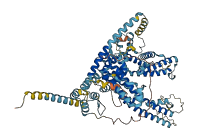
Descriptions
The autoinhibited protein was predicted that may have potential autoinhibitory elements via cis-regPred.
Autoinhibitory domains (AIDs)
Target domain |
|
Relief mechanism |
|
Assay |
cis-regPred |
Accessory elements
No accessory elements
Autoinhibited structure

Activated structure
1 structures for Q9QX01
| Entry ID | Method | Resolution | Chain | Position | Source |
|---|---|---|---|---|---|
| AF-Q9QX01-F1 | Predicted | AlphaFoldDB |
No variants for Q9QX01
| Variant ID(s) | Position | Change | Description | Diseaes Association | Provenance |
|---|---|---|---|---|---|
| No variants for Q9QX01 | |||||
No associated diseases with Q9QX01
5 regional properties for Q9QX01
| Type | Name | Position | InterPro Accession |
|---|---|---|---|
| repeat | Ankyrin repeat | 46 - 77 | IPR002110-1 |
| repeat | Ankyrin repeat | 83 - 112 | IPR002110-2 |
| repeat | Ankyrin repeat | 124 - 153 | IPR002110-3 |
| domain | Ion transport domain | 360 - 622 | IPR005821 |
| domain | Transient receptor ion channel domain | 159 - 221 | IPR013555 |
10 GO annotations of cellular component
| Name | Definition |
|---|---|
| basolateral plasma membrane | The region of the plasma membrane that includes the basal end and sides of the cell. Often used in reference to animal polarized epithelial membranes, where the basal membrane is the part attached to the extracellular matrix, or in plant cells, where the basal membrane is defined with respect to the zygotic axis. |
| cation channel complex | An ion channel complex through which cations pass. |
| costamere | Regular periodic sub membranous arrays of vinculin in skeletal and cardiac muscle cells, these arrays link Z-discs to the sarcolemma and are associated with links to extracellular matrix. |
| cytoplasm | The contents of a cell excluding the plasma membrane and nucleus, but including other subcellular structures. |
| integral component of plasma membrane | The component of the plasma membrane consisting of the gene products and protein complexes having at least some part of their peptide sequence embedded in the hydrophobic region of the membrane. |
| membrane raft | Any of the small (10-200 nm), heterogeneous, highly dynamic, sterol- and sphingolipid-enriched membrane domains that compartmentalize cellular processes. Small rafts can sometimes be stabilized to form larger platforms through protein-protein and protein-lipid interactions. |
| plasma membrane | The membrane surrounding a cell that separates the cell from its external environment. It consists of a phospholipid bilayer and associated proteins. |
| protein-containing complex | A stable assembly of two or more macromolecules, i.e. proteins, nucleic acids, carbohydrates or lipids, in which at least one component is a protein and the constituent parts function together. |
| receptor complex | Any protein complex that undergoes combination with a hormone, neurotransmitter, drug or intracellular messenger to initiate a change in cell function. |
| sarcomere | The repeating unit of a myofibril in a muscle cell, composed of an array of overlapping thick and thin filaments between two adjacent Z discs. |
5 GO annotations of molecular function
| Name | Definition |
|---|---|
| ATPase binding | Binding to an ATPase, any enzyme that catalyzes the hydrolysis of ATP. |
| cation channel activity | Enables the energy-independent passage of cations across a lipid bilayer down a concentration gradient. |
| inositol 1,4,5 trisphosphate binding | Binding to inositol 1,4,5 trisphosphate. |
| signaling receptor binding | Binding to one or more specific sites on a receptor molecule, a macromolecule that undergoes combination with a hormone, neurotransmitter, drug or intracellular messenger to initiate a change in cell function. |
| store-operated calcium channel activity | A ligand-gated ion channel activity which transports calcium in response to emptying of intracellular calcium stores. |
8 GO annotations of biological process
| Name | Definition |
|---|---|
| calcium ion transmembrane transport | A process in which a calcium ion is transported from one side of a membrane to the other by means of some agent such as a transporter or pore. |
| cellular response to hypoxia | Any process that results in a change in state or activity of a cell (in terms of movement, secretion, enzyme production, gene expression, etc.) as a result of a stimulus indicating lowered oxygen tension. Hypoxia, defined as a decline in O2 levels below normoxic levels of 20.8 - 20.95%, results in metabolic adaptation at both the cellular and organismal level. |
| manganese ion transport | The directed movement of manganese (Mn) ions into, out of or within a cell, or between cells, by means of some agent such as a transporter or pore. |
| melanin biosynthetic process | The chemical reactions and pathways resulting in the formation of melanins, pigments largely of animal origin. High molecular weight polymers of indole quinone, they are irregular polymeric structures and are divided into three groups: allomelanins in the plant kingdom and eumelanins and phaeomelanins in the animal kingdom. |
| positive regulation of release of sequestered calcium ion into cytosol | Any process that activates or increases the frequency, rate or extent of the release into the cytosolic compartment of calcium ions sequestered in the endoplasmic reticulum or mitochondria. |
| regulation of cytosolic calcium ion concentration | Any process involved in the maintenance of an internal steady state of calcium ions within the cytosol of a cell or between the cytosol and its surroundings. |
| response to calcium ion | Any process that results in a change in state or activity of a cell or an organism (in terms of movement, secretion, enzyme production, gene expression, etc.) as a result of a calcium ion stimulus. |
| saliva secretion | The regulated release of saliva from the salivary glands. In man, the saliva is a turbid and slightly viscous fluid, generally of an alkaline reaction, and is secreted by the parotid, submaxillary, and sublingual glands. In the mouth the saliva is mixed with the secretion from the buccal glands. In man and many animals, saliva is an important digestive fluid on account of the presence of the peculiar enzyme, ptyalin. |
20 homologous proteins in AiPD
| UniProt AC | Gene Name | Protein Name | Species | Evidence Code |
|---|---|---|---|---|
| P79100 | TRPC4 | Short transient receptor potential channel 4 | Bos taurus (Bovine) | PR |
| O18784 | TRPC1 | Short transient receptor potential channel 1 | Bos taurus (Bovine) | PR |
| P19334 | trp | Transient receptor potential protein | Drosophila melanogaster (Fruit fly) | PR |
| P48994 | trpl | Transient-receptor-potential-like protein | Drosophila melanogaster (Fruit fly) | PR |
| Q9UL62 | TRPC5 | Short transient receptor potential channel 5 | Homo sapiens (Human) | PR |
| Q9Y210 | TRPC6 | Short transient receptor potential channel 6 | Homo sapiens (Human) | PR |
| Q13507 | TRPC3 | Short transient receptor potential channel 3 | Homo sapiens (Human) | PR |
| Q9UBN4 | TRPC4 | Short transient receptor potential channel 4 | Homo sapiens (Human) | PR |
| Q9HCX4 | TRPC7 | Short transient receptor potential channel 7 | Homo sapiens (Human) | PR |
| P48995 | TRPC1 | Short transient receptor potential channel 1 | Homo sapiens (Human) | PR |
| Q9WVC5 | Trpc7 | Short transient receptor potential channel 7 | Mus musculus (Mouse) | PR |
| Q9QZC1 | Trpc3 | Short transient receptor potential channel 3 | Mus musculus (Mouse) | PR |
| Q9QUQ5 | Trpc4 | Short transient receptor potential channel 4 | Mus musculus (Mouse) | PR |
| Q9QX29 | Trpc5 | Short transient receptor potential channel 5 | Mus musculus (Mouse) | PR |
| Q61143 | Trpc6 | Short transient receptor potential channel 6 | Mus musculus (Mouse) | PR |
| Q9R244 | Trpc2 | Short transient receptor potential channel 2 | Mus musculus (Mouse) | PR |
| Q61056 | Trpc1 | Short transient receptor potential channel 1 | Mus musculus (Mouse) | PR |
| O35119 | Trpc4 | Short transient receptor potential channel 4 | Rattus norvegicus (Rat) | PR |
| Q9JMI9 | Trpc3 | Short transient receptor potential channel 3 | Rattus norvegicus (Rat) | PR |
| Q9R283 | Trpc2 | Short transient receptor potential channel 2 | Rattus norvegicus (Rat) | PR |
| 10 | 20 | 30 | 40 | 50 | 60 |
| MMAALYPSTD | LSGVSSSSLP | SSPSSSSPNE | VMALKDVREV | KEENTLNEKL | FLLACDKGDY |
| 70 | 80 | 90 | 100 | 110 | 120 |
| YMVKKILEEN | SSGDLNINCV | DVLGRNAVTI | TIENESLDIL | QLLLDYGCQK | LMERIQNPEY |
| 130 | 140 | 150 | 160 | 170 | 180 |
| STTMDVAPVI | LAAHRNNYEI | LTMLLKQDVA | LPKPHAVGCE | CTLCSAKNKK | DSLRHSRFRL |
| 190 | 200 | 210 | 220 | 230 | 240 |
| DIYRCLASPA | LIMLTEEDPI | LRAFELSADL | KELSLVEVEF | WNDYEELARQ | CKMFAKDLLA |
| 250 | 260 | 270 | 280 | 290 | 300 |
| QARNSRELEV | ILNHTSSDEP | LDKRGLLEER | MNLSRLKLAI | KYNQKEFVSQ | SNCQQFLNTV |
| 310 | 320 | 330 | 340 | 350 | 360 |
| WFGQMSGYRR | KPTCKKIMTV | LTVGIFWPVL | SLCYLIAPKS | QFGRIIHTPF | MKFIIHGASY |
| 370 | 380 | 390 | 400 | 410 | 420 |
| FTFLLLLNLY | SLVYNEDKKN | TMGPALERID | YLLILWIIGM | IWSDIKRLWY | EGLEDFLEES |
| 430 | 440 | 450 | 460 | 470 | 480 |
| RNQLSFVMNS | LYLATFALKV | VAHNKFHDFA | DRKDWDAFHP | TLVAEGLFAF | ANVLSYLRLF |
| 490 | 500 | 510 | 520 | 530 | 540 |
| FMYTTSSILG | PLQISMGQML | QDFGKFLGMF | LLVLFSFTIG | LTQLYDKGYT | SKEQKDCVGI |
| 550 | 560 | 570 | 580 | 590 | 600 |
| FCEQQSNDTF | HSFIGTCFAL | FWYIFSLAHV | AIFVTRFSYG | EELQSFVGAV | IVGTYNVVVV |
| 610 | 620 | 630 | 640 | 650 | 660 |
| IVLTKLLVAM | LHKSFQLIAN | HEDKEWKFAR | AKLWLSYFDD | KCTLPPPFNI | IPSPKTICYM |
| 670 | 680 | 690 | 700 | 710 | 720 |
| ISSLSKWVCS | HTSKGKVRRQ | NSLKEWRNLK | QKRDENYQKV | MCCLVHRYLT | SMRQKMQSTD |
| 730 | 740 | 750 | |||
| QATVENLNEL | RQDLSKFRNE | IRDLLGFRTS | KYAMFYPKN |