P48994
Gene name |
trpl (CG18345) |
Protein name |
Transient-receptor-potential-like protein |
Names |
|
Species |
Drosophila melanogaster (Fruit fly) |
KEGG Pathway |
dme:Dmel_CG18345 |
EC number |
|
Protein Class |
|
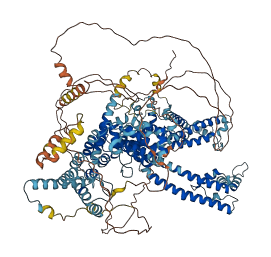
Descriptions
The autoinhibited protein was predicted that may have potential autoinhibitory elements via cis-regPred.
Autoinhibitory domains (AIDs)
Target domain |
|
Relief mechanism |
|
Assay |
cis-regPred |
Accessory elements
No accessory elements
Autoinhibited structure

Activated structure
1 structures for P48994
| Entry ID | Method | Resolution | Chain | Position | Source |
|---|---|---|---|---|---|
| AF-P48994-F1 | Predicted | AlphaFoldDB |
No variants for P48994
| Variant ID(s) | Position | Change | Description | Diseaes Association | Provenance |
|---|---|---|---|---|---|
| No variants for P48994 | |||||
No associated diseases with P48994
2 regional properties for P48994
| Type | Name | Position | InterPro Accession |
|---|---|---|---|
| domain | Pseudouridine synthase I, TruA, alpha/beta domain | 6 - 104 | IPR020097-1 |
| domain | Pseudouridine synthase I, TruA, alpha/beta domain | 148 - 246 | IPR020097-2 |
Functions
8 GO annotations of cellular component
| Name | Definition |
|---|---|
| cation channel complex | An ion channel complex through which cations pass. |
| dendrite | A neuron projection that has a short, tapering, morphology. Dendrites receive and integrate signals from other neurons or from sensory stimuli, and conduct nerve impulses towards the axon or the cell body. In most neurons, the impulse is conveyed from dendrites to axon via the cell body, but in some types of unipolar neuron, the impulse does not travel via the cell body. |
| inaD signaling complex | A complex of proteins that are involved in phototransduction and attached to the transient receptor potential (TRP) channel. The protein connections are mediated through inaD. |
| integral component of membrane | The component of a membrane consisting of the gene products and protein complexes having at least some part of their peptide sequence embedded in the hydrophobic region of the membrane. |
| integral component of plasma membrane | The component of the plasma membrane consisting of the gene products and protein complexes having at least some part of their peptide sequence embedded in the hydrophobic region of the membrane. |
| plasma membrane | The membrane surrounding a cell that separates the cell from its external environment. It consists of a phospholipid bilayer and associated proteins. |
| rhabdomere | The specialized microvilli-containing organelle on the apical surfaces of a photoreceptor cell containing the visual pigment rhodopsin and most of the proteins involved in phototransduction. |
| rhabdomere microvillus membrane | The portion of the plasma membrane surrounding a microvillus of a rhabdomere. |
9 GO annotations of molecular function
| Name | Definition |
|---|---|
| calcium channel activity | Enables the facilitated diffusion of a calcium ion (by an energy-independent process) involving passage through a transmembrane aqueous pore or channel without evidence for a carrier-mediated mechanism. |
| calmodulin binding | Binding to calmodulin, a calcium-binding protein with many roles, both in the calcium-bound and calcium-free states. |
| cation channel activity | Enables the energy-independent passage of cations across a lipid bilayer down a concentration gradient. |
| identical protein binding | Binding to an identical protein or proteins. |
| inositol 1,4,5 trisphosphate binding | Binding to inositol 1,4,5 trisphosphate. |
| ion transmembrane transporter activity | Enables the transfer of an ion from one side of a membrane to the other. |
| light-activated ion channel activity | Enables the transmembrane transfer of an ion by a channel that opens in response to a light stimulus. |
| protein heterodimerization activity | Binding to a nonidentical protein to form a heterodimer. |
| store-operated calcium channel activity | A ligand-gated ion channel activity which transports calcium in response to emptying of intracellular calcium stores. |
13 GO annotations of biological process
| Name | Definition |
|---|---|
| body fluid secretion | The controlled release of a fluid by a cell or tissue in an animal. |
| calcium ion transmembrane transport | A process in which a calcium ion is transported from one side of a membrane to the other by means of some agent such as a transporter or pore. |
| calcium ion transport | The directed movement of calcium (Ca) ions into, out of or within a cell, or between cells, by means of some agent such as a transporter or pore. |
| calcium-mediated signaling | Any intracellular signal transduction in which the signal is passed on within the cell via calcium ions. |
| cation transport | The directed movement of cations, atoms or small molecules with a net positive charge, into, out of or within a cell, or between cells, by means of some agent such as a transporter or pore. |
| cellular response to anoxia | Any process that results in a change in state or activity of a cell (in terms of movement, secretion, enzyme production, gene expression, etc.) as a result of a stimulus indicating a decline in oxygen levels to trace amounts, <0.1%. |
| detection of light stimulus involved in visual perception | The series of events involved in visual perception in which a light stimulus is received and converted into a molecular signal. |
| ion transport | The directed movement of charged atoms or small charged molecules into, out of or within a cell, or between cells, by means of some agent such as a transporter or pore. |
| manganese ion transport | The directed movement of manganese (Mn) ions into, out of or within a cell, or between cells, by means of some agent such as a transporter or pore. |
| phototransduction, visible light | The sequence of reactions within a cell required to convert absorbed photons from visible light into a molecular signal. A visible light stimulus is electromagnetic radiation that can be perceived visually by an organism; for organisms lacking a visual system, this can be defined as light with a wavelength within the range 380 to 780 nm. |
| regulation of cytosolic calcium ion concentration | Any process involved in the maintenance of an internal steady state of calcium ions within the cytosol of a cell or between the cytosol and its surroundings. |
| response to light stimulus | Any process that results in a change in state or activity of a cell or an organism (in terms of movement, secretion, enzyme production, gene expression, etc.) as a result of a light stimulus, electromagnetic radiation of wavelengths classified as infrared, visible or ultraviolet light. |
| sensory perception of sound | The series of events required for an organism to receive an auditory stimulus, convert it to a molecular signal, and recognize and characterize the signal. Sonic stimuli are detected in the form of vibrations and are processed to form a sound. |
20 homologous proteins in AiPD
| UniProt AC | Gene Name | Protein Name | Species | Evidence Code |
|---|---|---|---|---|
| P79100 | TRPC4 | Short transient receptor potential channel 4 | Bos taurus (Bovine) | PR |
| O18784 | TRPC1 | Short transient receptor potential channel 1 | Bos taurus (Bovine) | PR |
| P19334 | trp | Transient receptor potential protein | Drosophila melanogaster (Fruit fly) | PR |
| Q9UL62 | TRPC5 | Short transient receptor potential channel 5 | Homo sapiens (Human) | PR |
| Q9Y210 | TRPC6 | Short transient receptor potential channel 6 | Homo sapiens (Human) | PR |
| Q13507 | TRPC3 | Short transient receptor potential channel 3 | Homo sapiens (Human) | PR |
| Q9HCX4 | TRPC7 | Short transient receptor potential channel 7 | Homo sapiens (Human) | PR |
| P48995 | TRPC1 | Short transient receptor potential channel 1 | Homo sapiens (Human) | PR |
| Q9UBN4 | TRPC4 | Short transient receptor potential channel 4 | Homo sapiens (Human) | PR |
| Q61143 | Trpc6 | Short transient receptor potential channel 6 | Mus musculus (Mouse) | PR |
| Q9QX29 | Trpc5 | Short transient receptor potential channel 5 | Mus musculus (Mouse) | PR |
| Q9WVC5 | Trpc7 | Short transient receptor potential channel 7 | Mus musculus (Mouse) | PR |
| Q9R244 | Trpc2 | Short transient receptor potential channel 2 | Mus musculus (Mouse) | PR |
| Q61056 | Trpc1 | Short transient receptor potential channel 1 | Mus musculus (Mouse) | PR |
| Q9QUQ5 | Trpc4 | Short transient receptor potential channel 4 | Mus musculus (Mouse) | PR |
| Q9QZC1 | Trpc3 | Short transient receptor potential channel 3 | Mus musculus (Mouse) | PR |
| Q9QX01 | Trpc1 | Short transient receptor potential channel 1 | Rattus norvegicus (Rat) | PR |
| O35119 | Trpc4 | Short transient receptor potential channel 4 | Rattus norvegicus (Rat) | PR |
| Q9JMI9 | Trpc3 | Short transient receptor potential channel 3 | Rattus norvegicus (Rat) | PR |
| Q9R283 | Trpc2 | Short transient receptor potential channel 2 | Rattus norvegicus (Rat) | PR |
| 10 | 20 | 30 | 40 | 50 | 60 |
| MGRKKKLPTG | VSSGVSHASS | APKSVGGCCV | PLGLPQPLLL | EEKKFLLAVE | RGDMPNVRRI |
| 70 | 80 | 90 | 100 | 110 | 120 |
| LQKALRHQHI | NINCMDPLGR | RALTLAIDNE | NLEMVELLVV | MGVETKDALL | HAINAEFVEA |
| 130 | 140 | 150 | 160 | 170 | 180 |
| VELLLEHEEL | IYKEGEPYSW | QKVDINTAMF | APDITPLMLA | AHKNNFEILR | ILLDRGAAVP |
| 190 | 200 | 210 | 220 | 230 | 240 |
| VPHDIRCGCE | ECVRLTAEDS | LRHSLSRVNI | YRALCSPSLI | CLTSNDPIIT | AFQLSWELRN |
| 250 | 260 | 270 | 280 | 290 | 300 |
| LALTEQECKS | EYMDLRRQCQ | KFAVDLLDQT | RTSNELAIIL | NYDPQMSSYE | PGDRMSLTRL |
| 310 | 320 | 330 | 340 | 350 | 360 |
| VQAISYKQKK | FVAHSNIQQL | LSSIWYDGLP | GFRRKSIVDK | VICIAQVAVL | FPLYCLIYMC |
| 370 | 380 | 390 | 400 | 410 | 420 |
| APNCRTGQLM | RKPFMKFLIH | ASSYLFFLFI | LILVSQRADD | DFVRIFGTTR | MKKELAEQEL |
| 430 | 440 | 450 | 460 | 470 | 480 |
| RQRGQTPSKL | ELIVVMYVIG | FVWEEVQEIF | AVGMKSYLRN | MWNFIDFLRN | SLYVSVMCLR |
| 490 | 500 | 510 | 520 | 530 | 540 |
| AFAYIQQATE | IARDPQMAYI | PREKWHDFDP | QLIAEGLFAA | ANVFSALKLV | HLFSINPHLG |
| 550 | 560 | 570 | 580 | 590 | 600 |
| PLQISLGRMV | IDIVKFFFIY | TLVLFAFACG | LNQLLWYFAA | LEKSKCYVLP | GGEADWGSHG |
| 610 | 620 | 630 | 640 | 650 | 660 |
| DSCMKWRRFG | NLFESSQSLF | WASFGMVGLD | DFELSGIKSY | TRFWGLLMFG | SYSVINVIVL |
| 670 | 680 | 690 | 700 | 710 | 720 |
| LNLLIAMMSN | SYAMIDEHSD | TEWKFARTKL | WMSYFEDSAT | LPPPFNVLPS | VKWVIRIFRK |
| 730 | 740 | 750 | 760 | 770 | 780 |
| SSKTIDRQRS | KKRKEQEQFS | EYDNIMRSLV | WRYVAAMHRK | FENNPVSEDD | INEVKSEINT |
| 790 | 800 | 810 | 820 | 830 | 840 |
| MRYEMLEIFE | NSGMDVSSAN | KKERQPRPRR | IKVWERRLMK | GFQVAPVQNG | CELDAFGNVN |
| 850 | 860 | 870 | 880 | 890 | 900 |
| GQGEMQEIKV | ESIPSKPAKE | TAKERFQRVA | RTVLLQSTTH | KWNVVLRAAK | DSQIGRCTKN |
| 910 | 920 | 930 | 940 | 950 | 960 |
| ERKSLQNLGR | AIEEAKRLIM | LNPGCPSGRE | SPIRIEFEDE | KTSTLLELLN | QISAEISDSE |
| 970 | 980 | 990 | 1000 | 1010 | 1020 |
| KPKIRPIWRP | PLKTVPARAM | AANNTRSLTA | PELKISRKSS | PAPTPTPTPG | VSHTALSQFR |
| 1030 | 1040 | 1050 | 1060 | 1070 | 1080 |
| NRELPLCPSK | LIANSAPSAP | TAPPKKSAPT | APTPTYKPTT | HAPFSVEGGN | RENTRASDGV |
| 1090 | 1100 | 1110 | 1120 | ||
| RSDNSNFDIH | VVDLDEKGGH | LGRDNVSDIS | SIASTSPQRP | KHRN |