Q16623
Gene name |
STX1A (STX1) |
Protein name |
Syntaxin-1A |
Names |
Neuron-specific antigen HPC-1 |
Species |
Homo sapiens (Human) |
KEGG Pathway |
hsa:6804 |
EC number |
|
Protein Class |
|
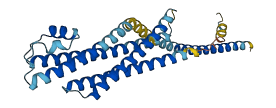
Descriptions
The autoinhibited protein was predicted that may have potential autoinhibitory elements via cis-regPred.
Autoinhibitory domains (AIDs)
Target domain |
|
Relief mechanism |
|
Assay |
cis-regPred |
Accessory elements
No accessory elements
Autoinhibited structure

Activated structure
1 structures for Q16623
| Entry ID | Method | Resolution | Chain | Position | Source |
|---|---|---|---|---|---|
| AF-Q16623-F1 | Predicted | AlphaFoldDB |
161 variants for Q16623
| Variant ID(s) | Position | Change | Description | Diseaes Association | Provenance |
|---|---|---|---|---|---|
|
RCV001264639 rs200456346 RCV002226530 |
145 | C>W | Intellectual disability [ClinVar] | Yes |
ClinVar dbSNP |
|
CA367838343 rs1305622716 |
2 | K>R | No |
ClinGen TOPMed |
|
|
CA367838323 rs1274838274 |
3 | D>H | No |
ClinGen TOPMed |
|
|
rs1343856512 CA367838287 |
5 | T>S | No |
ClinGen TOPMed |
|
|
CA367838271 rs1208045282 |
6 | Q>R | No |
ClinGen TOPMed |
|
|
rs547690713 CA367838246 |
7 | E>D | No |
ClinGen 1000Genomes ExAC TOPMed gnomAD |
|
|
CA367837199 rs1554617572 |
11 | A>V | No |
ClinGen gnomAD |
|
| TCGA novel | 13 | D>N | Variant assessed as Somatic; impact. [NCI-TCGA] | No | NCI-TCGA |
|
rs782202692 CA4290860 |
13 | D>V | No |
ClinGen ExAC TOPMed gnomAD |
|
|
rs782455881 CA4290858 |
15 | D>N | Variant assessed as Somatic; 0.0 impact. [NCI-TCGA] | No |
ClinGen ExAC NCI-TCGA TOPMed gnomAD |
|
CA4290857 rs781810772 |
16 | D>N | No |
ClinGen ExAC gnomAD |
|
| TCGA novel | 16 | D>Y | Variant assessed as Somatic; impact. [NCI-TCGA] | No | NCI-TCGA |
|
rs1289948694 CA367837130 |
17 | D>H | No |
ClinGen TOPMed |
|
|
rs782671628 CA4290856 |
18 | D>E | No |
ClinGen ExAC gnomAD |
|
|
CA4290853 rs782653375 |
21 | A>S | No |
ClinGen ExAC TOPMed gnomAD |
|
|
CA4290854 rs782653375 |
21 | A>T | No |
ClinGen ExAC TOPMed gnomAD |
|
|
rs567231961 CA4290852 |
21 | A>V | No |
ClinGen 1000Genomes ExAC gnomAD |
|
|
rs1271164067 CA367837046 |
23 | T>S | No |
ClinGen TOPMed gnomAD |
|
|
COSM3768472 rs369814636 CA4290850 |
24 | V>M | liver [Cosmic] | No |
ClinGen cosmic curated ESP ExAC TOPMed gnomAD |
|
rs267601564 CA160087749 |
26 | R>* | No |
ClinGen Ensembl |
|
|
rs1364135079 CA367837019 |
26 | R>Q | No |
ClinGen TOPMed gnomAD |
|
|
CA4290849 rs782703876 |
28 | R>C | Variant assessed as Somatic; 0.0 impact. [NCI-TCGA] | No |
ClinGen ExAC NCI-TCGA gnomAD |
|
CA160087748 rs375523583 |
28 | R>H | No |
ClinGen ESP TOPMed |
|
| TCGA novel | 33 | F>C | Variant assessed as Somatic; impact. [NCI-TCGA] | No | NCI-TCGA |
|
CA367836853 rs1178632016 |
37 | V>G | No |
ClinGen TOPMed |
|
|
CA367836829 rs1554617460 |
39 | E>D | No |
ClinGen gnomAD |
|
|
CA367836834 rs1584250219 |
39 | E>G | No |
ClinGen Ensembl |
|
|
rs1554617458 CA367836812 COSM3833184 |
41 | R>Q | Variant assessed as Somatic; impact. breast [NCI-TCGA, Cosmic] | No |
ClinGen cosmic curated NCI-TCGA gnomAD |
|
CA367836802 rs1554617455 |
42 | G>A | No |
ClinGen gnomAD |
|
|
rs1343838866 CA367836806 |
42 | G>S | No |
ClinGen TOPMed |
|
|
rs1584250193 CA367836786 |
44 | I>V | No |
ClinGen Ensembl |
|
|
rs144945504 CA367836740 |
48 | A>S | No |
ClinGen ESP ExAC TOPMed gnomAD |
|
|
rs144945504 CA4290832 |
48 | A>T | No |
ClinGen ESP ExAC TOPMed gnomAD |
|
|
rs1554617450 CA367836733 |
49 | E>Q | No |
ClinGen gnomAD |
|
|
rs2229854 CA4290831 |
50 | N>K | No |
ClinGen 1000Genomes ESP ExAC TOPMed gnomAD |
|
|
rs1554617448 CA367836707 |
51 | V>A | No |
ClinGen gnomAD |
|
|
rs782757103 CA4290829 |
51 | V>L | No |
ClinGen ExAC gnomAD |
|
|
CA160087498 rs782757103 |
51 | V>M | No |
ClinGen ExAC gnomAD |
|
|
rs1346014749 CA367836694 |
52 | E>D | No |
ClinGen TOPMed gnomAD |
|
|
CA4290828 rs782092932 |
56 | R>Q | No |
ClinGen ExAC TOPMed gnomAD |
|
|
CA367836623 rs1316169178 |
59 | S>G | No |
ClinGen TOPMed gnomAD |
|
|
CA4290825 rs782151306 |
61 | I>V | No |
ClinGen ExAC gnomAD |
|
|
CA367836576 rs1554617440 |
63 | A>V | No |
ClinGen gnomAD |
|
|
rs1554617438 CA367836566 |
64 | S>Y | No |
ClinGen gnomAD |
|
|
CA4290822 rs782259113 |
65 | P>T | No |
ClinGen ExAC gnomAD |
|
|
rs2228607 CA367836523 |
68 | D>E | No |
ClinGen 1000Genomes ESP ExAC TOPMed gnomAD |
|
|
CA4290820 rs782309912 |
68 | D>N | No |
ClinGen ExAC TOPMed gnomAD |
|
|
CA4290818 rs782665420 |
69 | E>K | No |
ClinGen ExAC gnomAD |
|
|
rs1554616681 CA367836338 |
70 | K>R | No |
ClinGen gnomAD |
|
| TCGA novel | 70 | K>T | Variant assessed as Somatic; impact. [NCI-TCGA] | No | NCI-TCGA |
|
COSM195749 rs781904935 CA4290787 |
71 | T>M | Variant assessed as Somatic; 0.0 impact. large_intestine [NCI-TCGA, Cosmic] | No |
ClinGen cosmic curated ExAC NCI-TCGA gnomAD |
|
rs781950897 CA4290784 |
76 | E>G | No |
ClinGen ExAC gnomAD |
|
| TCGA novel | 77 | E>* | Variant assessed as Somatic; impact. [NCI-TCGA] | No | NCI-TCGA |
|
CA367836293 rs1315627336 |
77 | E>K | No |
ClinGen TOPMed |
|
|
CA4290782 rs782043152 |
79 | M>T | No |
ClinGen ExAC TOPMed gnomAD |
|
|
CA4290781 rs781939626 |
80 | S>F | No |
ClinGen ExAC gnomAD |
|
|
rs147048336 CA4290779 |
81 | D>N | No |
ClinGen 1000Genomes ESP ExAC TOPMed gnomAD |
|
|
CA367836265 rs147048336 |
81 | D>Y | No |
ClinGen 1000Genomes ESP ExAC TOPMed gnomAD |
|
|
rs371575027 CA4290777 |
85 | T>A | No |
ClinGen ESP ExAC TOPMed gnomAD |
|
|
CA367836227 rs1469008260 |
86 | A>G | No |
ClinGen TOPMed |
|
|
CA367836201 rs1192968907 |
90 | R>C | No |
ClinGen TOPMed gnomAD |
|
|
rs944672566 CA160086042 |
90 | R>H | No |
ClinGen Ensembl |
|
| TCGA novel | 94 | K>A | Variant assessed as Somatic; impact. [NCI-TCGA] | No | NCI-TCGA |
|
CA367836167 rs782219643 |
94 | K>N | No |
ClinGen ExAC TOPMed gnomAD |
|
|
CA367836131 rs1554616488 |
97 | E>D | No |
ClinGen gnomAD |
|
|
CA367836119 rs1390792461 |
99 | S>A | No |
ClinGen TOPMed |
|
|
rs782236446 CA4290756 |
100 | I>F | No |
ClinGen ExAC |
|
| TCGA novel | 100 | I>V | Variant assessed as Somatic; impact. [NCI-TCGA] | No | NCI-TCGA |
|
CA4290755 rs782657148 |
101 | E>Q | No |
ClinGen ExAC gnomAD |
|
|
rs907617478 CA160085679 |
105 | G>A | No |
ClinGen Ensembl |
|
|
rs782226371 CA4290753 |
108 | R>C | No |
ClinGen ExAC gnomAD |
|
|
CA367836034 rs1584244001 |
112 | D>A | No |
ClinGen Ensembl |
|
|
rs1554616484 CA367836030 |
112 | D>E | No |
ClinGen gnomAD |
|
|
CA367836029 rs1554616482 |
113 | L>V | No |
ClinGen gnomAD |
|
|
CA4290748 rs782517349 |
116 | R>Q | No |
ClinGen ExAC gnomAD |
|
|
rs1554616478 CA367835997 |
118 | T>S | No |
ClinGen gnomAD |
|
|
CA4290727 rs376660582 |
129 | E>D | No |
ClinGen ESP ExAC TOPMed gnomAD |
|
|
rs1554616439 CA367835884 |
132 | S>L | No |
ClinGen gnomAD |
|
|
CA367835887 rs1361778002 |
132 | S>T | No |
ClinGen TOPMed |
|
|
CA367835877 rs1554616436 |
133 | E>D | No |
ClinGen gnomAD |
|
| TCGA novel | 133 | E>K | Variant assessed as Somatic; impact. [NCI-TCGA] | No | NCI-TCGA |
|
CA367835857 rs1159515604 |
136 | A>T | No |
ClinGen TOPMed gnomAD |
|
|
CA4290724 rs782758639 |
138 | Q>L | No |
ClinGen ExAC gnomAD |
|
|
CA367835835 rs1438131669 |
139 | S>F | No |
ClinGen TOPMed gnomAD |
|
|
rs782129449 CA367835834 |
140 | D>H | No |
ClinGen ExAC gnomAD |
|
|
rs782129449 CA4290723 |
140 | D>N | No |
ClinGen ExAC gnomAD |
|
|
CA367835818 rs1554616427 |
142 | R>S | No |
ClinGen gnomAD |
|
|
rs144263690 CA4290720 |
144 | R>C | No |
ClinGen ESP ExAC TOPMed gnomAD |
|
|
rs144263690 CA4290719 |
144 | R>G | No |
ClinGen ESP ExAC TOPMed gnomAD |
|
|
CA367835802 rs1554616422 |
144 | R>H | No |
ClinGen gnomAD |
|
|
CA4290717 rs782171983 |
145 | C>S | No |
ClinGen ExAC gnomAD |
|
|
CA367835777 rs1554616419 |
148 | R>H | No |
ClinGen gnomAD |
|
|
CA367835748 rs1554616416 |
152 | Q>R | No |
ClinGen gnomAD |
|
|
CA4290714 rs782217059 |
154 | E>A | No |
ClinGen ExAC gnomAD |
|
|
rs1554616412 CA367835725 |
155 | I>M | No |
ClinGen gnomAD |
|
| rs1025168062 | 156 | T>= | Variant assessed as Somatic; impact. [NCI-TCGA] | No | NCI-TCGA |
|
rs373330016 CA4290692 |
157 | G>C | No |
ClinGen ESP ExAC TOPMed gnomAD |
|
|
CA367835705 rs373330016 |
157 | G>S | No |
ClinGen ESP ExAC TOPMed gnomAD |
|
|
CA4290691 rs370111355 |
157 | G>V | No |
ClinGen ESP ExAC TOPMed gnomAD |
|
|
CA367835659 rs1554616291 |
164 | E>K | No |
ClinGen gnomAD |
|
|
CA4290689 rs782404923 |
165 | L>P | No |
ClinGen ExAC gnomAD |
|
|
CA367835603 rs782343806 CA4290686 |
171 | S>R | No |
ClinGen ExAC gnomAD |
|
|
CA367835582 rs1350740883 |
175 | A>T | No |
ClinGen TOPMed gnomAD |
|
|
CA367835560 rs1229777156 |
178 | A>T | No |
ClinGen TOPMed |
|
|
rs782316927 CA4290642 |
182 | I>M | No |
ClinGen ExAC TOPMed gnomAD |
|
|
rs1325188922 CA367835487 |
183 | M>L | No |
ClinGen TOPMed gnomAD |
|
|
CA4290641 rs567608089 |
187 | I>V | No |
ClinGen 1000Genomes ExAC TOPMed gnomAD |
|
|
rs1194587551 CA367835424 |
188 | S>L | No |
ClinGen TOPMed |
|
|
rs149588890 CA4290640 |
191 | A>D | No |
ClinGen ESP ExAC gnomAD |
|
|
CA367835338 rs1199098748 |
196 | E>A | No |
ClinGen TOPMed |
|
| TCGA novel | 196 | E>D | Variant assessed as Somatic; impact. [NCI-TCGA] | No | NCI-TCGA |
|
CA367835320 rs1430272820 |
197 | T>M | Variant assessed as Somatic; impact. [NCI-TCGA] | No |
ClinGen NCI-TCGA TOPMed gnomAD |
|
rs782589459 CA4290637 |
198 | R>L | No |
ClinGen ExAC gnomAD |
|
|
CA367835207 rs1554616127 |
207 | N>K | No |
ClinGen gnomAD |
|
|
CA367835179 rs1384422759 |
210 | R>C | Variant assessed as Somatic; impact. [NCI-TCGA] | No |
ClinGen NCI-TCGA TOPMed |
|
CA367835177 rs1401337421 COSM1240336 |
210 | R>H | oesophagus [Cosmic] | No |
ClinGen cosmic curated TOPMed gnomAD |
|
rs782529244 CA4290633 |
213 | H>Y | No |
ClinGen ExAC TOPMed gnomAD |
|
|
COSM1091595 CA367835136 rs1435523092 |
214 | D>N | Variant assessed as Somatic; 0.0 impact. endometrium [NCI-TCGA, Cosmic] | No |
ClinGen cosmic curated NCI-TCGA TOPMed gnomAD |
|
rs1435523092 CA367835139 |
214 | D>Y | No |
ClinGen TOPMed gnomAD |
|
|
rs139237669 CA4290631 |
217 | M>T | No |
ClinGen ESP ExAC TOPMed gnomAD |
|
|
rs1283617158 CA367835099 |
217 | M>V | No |
ClinGen TOPMed gnomAD |
|
|
rs782121987 CA4290630 |
219 | M>T | No |
ClinGen ExAC gnomAD |
|
|
rs370963256 CA4290628 |
221 | M>T | No |
ClinGen ESP ExAC gnomAD |
|
|
rs781827788 CA4290629 |
221 | M>V | No |
ClinGen ExAC TOPMed gnomAD |
|
|
CA367835033 rs782057252 |
222 | L>F | No |
ClinGen ExAC TOPMed gnomAD |
|
|
CA4290627 rs782057252 |
222 | L>I | No |
ClinGen ExAC TOPMed gnomAD |
|
|
rs782057252 CA367835035 |
222 | L>V | No |
ClinGen ExAC TOPMed gnomAD |
|
|
CA367835026 rs1554616102 |
223 | V>L | No |
ClinGen gnomAD |
|
| TCGA novel | 229 | M>I | Variant assessed as Somatic; impact. [NCI-TCGA] | No | NCI-TCGA |
|
rs1187928316 CA367833939 |
230 | I>T | No |
ClinGen TOPMed |
|
|
rs529603065 CA4290572 |
231 | D>N | No |
ClinGen 1000Genomes ExAC gnomAD |
|
|
rs782584153 CA4290571 |
233 | I>V | No |
ClinGen ExAC gnomAD |
|
|
rs782747612 CA4290568 |
237 | V>L | No |
ClinGen ExAC gnomAD |
|
|
CA367833868 rs1333991998 |
240 | A>S | No |
ClinGen TOPMed gnomAD |
|
|
CA367833869 rs1333991998 |
240 | A>T | No |
ClinGen TOPMed gnomAD |
|
|
CA4290565 rs782756808 |
241 | V>I | No |
ClinGen ExAC gnomAD |
|
|
CA367833855 rs1554615742 |
242 | D>H | No |
ClinGen gnomAD |
|
|
rs1554615733 CA367833811 |
247 | A>T | No |
ClinGen gnomAD |
|
|
CA367833803 rs782801540 |
248 | V>L | No |
ClinGen ExAC gnomAD |
|
|
CA4290562 rs782801540 |
248 | V>M | No |
ClinGen ExAC gnomAD |
|
|
rs782658280 CA4290560 |
255 | V>I | No |
ClinGen ExAC gnomAD |
|
|
CA367833732 rs1554615726 |
256 | K>T | No |
ClinGen gnomAD |
|
|
rs782212937 CA4290558 |
262 | R>C | No |
ClinGen ExAC TOPMed gnomAD |
|
|
rs202064998 CA4290557 |
262 | R>H | No |
ClinGen 1000Genomes ExAC gnomAD |
|
|
rs202064998 CA367833680 |
262 | R>P | No |
ClinGen 1000Genomes ExAC gnomAD |
|
|
CA160083585 rs782153036 |
263 | R>Q | No |
ClinGen TOPMed gnomAD |
|
|
rs782058423 CA4290540 |
267 | M>V | No |
ClinGen ExAC gnomAD |
|
|
rs991448424 CA160083462 |
269 | I>F | No |
ClinGen Ensembl |
|
|
rs1554615661 CA367833606 |
270 | I>T | No |
ClinGen gnomAD |
|
|
CA367833590 rs1554615659 |
272 | C>S | No |
ClinGen gnomAD |
|
|
rs782413114 CA4290537 |
274 | I>V | No |
ClinGen ExAC gnomAD |
|
|
rs1554615657 CA367833569 |
276 | G>S | No |
ClinGen gnomAD |
|
|
CA367833562 rs1554615654 |
277 | I>V | No |
ClinGen gnomAD |
|
|
CA4290534 rs782341932 |
278 | V>A | No |
ClinGen ExAC gnomAD |
|
|
CA4290535 rs201037992 |
278 | V>I | Variant assessed as Somatic; 0.0 impact. [NCI-TCGA] | No |
ClinGen 1000Genomes ExAC NCI-TCGA TOPMed gnomAD |
|
CA4290533 rs782224823 |
279 | I>V | No |
ClinGen ExAC gnomAD |
|
|
rs782328797 CA4290531 |
280 | A>T | Variant assessed as Somatic; 0.0 impact. [NCI-TCGA] | No |
ClinGen ExAC NCI-TCGA gnomAD |
|
CA4290530 rs782275853 |
284 | G>A | No |
ClinGen ExAC gnomAD |
|
|
CA4290528 rs782504771 |
286 | I>T | No |
ClinGen ExAC TOPMed gnomAD |
|
|
rs1311585207 CA367833504 |
287 | F>I | No |
ClinGen TOPMed |
|
|
CA4290526 rs782606855 |
288 | A>T | No |
ClinGen ExAC gnomAD |
1 associated diseases with Q16623
Without disease ID
Functions
22 GO annotations of cellular component
| Name | Definition |
|---|---|
| actomyosin | Any complex of actin, myosin, and accessory proteins. |
| anchoring junction | A cell junction that mechanically attaches a cell (and its cytoskeleton) to neighboring cells or to the extracellular matrix. |
| axon | The long process of a neuron that conducts nerve impulses, usually away from the cell body to the terminals and varicosities, which are sites of storage and release of neurotransmitter. |
| cytosol | The part of the cytoplasm that does not contain organelles but which does contain other particulate matter, such as protein complexes. |
| endomembrane system | A collection of membranous structures involved in transport within the cell. The main components of the endomembrane system are endoplasmic reticulum, Golgi bodies, vesicles, cell membrane and nuclear envelope. Members of the endomembrane system pass materials through each other or though the use of vesicles. |
| extracellular region | The space external to the outermost structure of a cell. For cells without external protective or external encapsulating structures this refers to space outside of the plasma membrane. This term covers the host cell environment outside an intracellular parasite. |
| glutamatergic synapse | A synapse that uses glutamate as a neurotransmitter. |
| integral component of membrane | The component of a membrane consisting of the gene products and protein complexes having at least some part of their peptide sequence embedded in the hydrophobic region of the membrane. |
| integral component of presynaptic membrane | The component of the presynaptic membrane consisting of the gene products and protein complexes having at least some part of their peptide sequence embedded in the hydrophobic region of the membrane. |
| integral component of synaptic vesicle membrane | The component of the synaptic vesicle membrane consisting of the gene products and protein complexes having at least some part of their peptide sequence embedded in the hydrophobic region of the membrane. |
| neuron projection | A prolongation or process extending from a nerve cell, e.g. an axon or dendrite. |
| nuclear membrane | Either of the lipid bilayers that surround the nucleus and form the nuclear envelope; excludes the intermembrane space. |
| plasma membrane | The membrane surrounding a cell that separates the cell from its external environment. It consists of a phospholipid bilayer and associated proteins. |
| postsynaptic density | An electron dense network of proteins within and adjacent to the postsynaptic membrane of an asymmetric, neuron-neuron synapse. Its major components include neurotransmitter receptors and the proteins that spatially and functionally organize them such as anchoring and scaffolding molecules, signaling enzymes and cytoskeletal components. |
| presynaptic active zone membrane | The membrane portion of the presynaptic active zone; it is the site where docking and fusion of synaptic vesicles occurs for the release of neurotransmitters. |
| secretory granule | A small subcellular vesicle, surrounded by a membrane, that is formed from the Golgi apparatus and contains a highly concentrated protein destined for secretion. Secretory granules move towards the periphery of the cell and upon stimulation, their membranes fuse with the cell membrane, and their protein load is exteriorized. Processing of the contained protein may take place in secretory granules. |
| SNARE complex | A protein complex involved in membrane fusion; a stable ternary complex consisting of a four-helix bundle, usually formed from one R-SNARE and three Q-SNAREs with an ionic layer sandwiched between hydrophobic layers. One well-characterized example is the neuronal SNARE complex formed of synaptobrevin 2, syntaxin 1a, and SNAP-25. |
| synaptic vesicle | A secretory organelle, typically 50 nm in diameter, of presynaptic nerve terminals; accumulates in high concentrations of neurotransmitters and secretes these into the synaptic cleft by fusion with the 'active zone' of the presynaptic plasma membrane. |
| synaptobrevin 2-SNAP-25-syntaxin-1a complex | A SNARE complex that contains synaptobrevin 2 (VAMP2), SNAP-25, and syntaxin 1a (or orthologs thereof). |
| synaptobrevin 2-SNAP-25-syntaxin-1a-complexin I complex | A SNARE complex that contains synaptobrevin 2 (VAMP2), SNAP-25, syntaxin 1a, and complexin I (or orthologs thereof). |
| synaptobrevin 2-SNAP-25-syntaxin-1a-complexin II complex | A SNARE complex that contains synaptobrevin 2 (VAMP2), SNAP-25, syntaxin 1a, and complexin II (or orthologs thereof). |
| voltage-gated potassium channel complex | A protein complex that forms a transmembrane channel through which potassium ions may cross a cell membrane in response to changes in membrane potential. |
13 GO annotations of molecular function
| Name | Definition |
|---|---|
| ATP-dependent protein binding | Binding to a protein or protein complex using energy from ATP hydrolysis. |
| calcium channel inhibitor activity | Binds to and stops, prevents, or reduces the activity of a calcium channel. |
| calcium-dependent protein binding | Binding to a protein or protein complex in the presence of calcium. |
| chloride channel inhibitor activity | Binds to and stops, prevents, or reduces the activity of a chloride channel. |
| identical protein binding | Binding to an identical protein or proteins. |
| kinase binding | Binding to a kinase, any enzyme that catalyzes the transfer of a phosphate group. |
| myosin head/neck binding | Binding to the head/neck region of a myosin heavy chain. |
| protein domain specific binding | Binding to a specific domain of a protein. |
| protein N-terminus binding | Binding to a protein N-terminus, the end of any peptide chain at which the 2-amino (or 2-imino) function of a constituent amino acid is not attached in peptide linkage to another amino-acid residue. |
| protein-containing complex binding | Binding to a macromolecular complex. |
| SNAP receptor activity | Acting as a marker to identify a membrane and interacting selectively with one or more SNAREs on another membrane to mediate membrane fusion. |
| SNARE binding | Binding to a SNARE (soluble N-ethylmaleimide-sensitive factor attached protein receptor) protein. |
| transmembrane transporter binding | Binding to a transmembrane transporter, a protein or protein complex that enables the transfer of a substance, usually a specific substance or a group of related substances, from one side of a membrane to the other. |
22 GO annotations of biological process
| Name | Definition |
|---|---|
| calcium-ion regulated exocytosis | The release of intracellular molecules (e.g. hormones, matrix proteins) contained within a membrane-bounded vesicle by fusion of the vesicle with the plasma membrane of a cell, induced by a rise in cytosolic calcium-ion levels. |
| exocytosis | A process of secretion by a cell that results in the release of intracellular molecules (e.g. hormones, matrix proteins) contained within a membrane-bounded vesicle. Exocytosis can occur either by full fusion, when the vesicle collapses into the plasma membrane, or by a kiss-and-run mechanism that involves the formation of a transient contact, a pore, between a granule (for exemple of chromaffin cells) and the plasma membrane. The latter process most of the time leads to only partial secretion of the granule content. Exocytosis begins with steps that prepare vesicles for fusion with the membrane (tethering and docking) and ends when molecules are secreted from the cell. |
| insulin secretion | The regulated release of proinsulin from secretory granules accompanied by cleavage of proinsulin to form mature insulin. In vertebrates, insulin is secreted from B granules in the B cells of the vertebrate pancreas and from insulin-producing cells in insects. |
| intracellular protein transport | The directed movement of proteins in a cell, including the movement of proteins between specific compartments or structures within a cell, such as organelles of a eukaryotic cell. |
| positive regulation of calcium ion-dependent exocytosis | Any process that activates or increases the frequency, rate or extent of calcium ion-dependent exocytosis. |
| positive regulation of catecholamine secretion | Any process that activates or increases the frequency, rate or extent of the regulated release of a catecholamine. |
| positive regulation of excitatory postsynaptic potential | Any process that enhances the establishment or increases the extent of the excitatory postsynaptic potential (EPSP) which is a temporary increase in postsynaptic potential due to the flow of positively charged ions into the postsynaptic cell. The flow of ions that causes an EPSP is an excitatory postsynaptic current (EPSC) and makes it easier for the neuron to fire an action potential. |
| positive regulation of neurotransmitter secretion | Any process that activates or increases the frequency, rate or extent of the regulated release of a neurotransmitter. |
| positive regulation of norepinephrine secretion | Any process that increases the frequency, rate or extent of the regulated release of norepinephrine. |
| protein localization to membrane | A process in which a protein is transported to, or maintained in, a specific location in a membrane. |
| protein sumoylation | The process in which a SUMO protein (small ubiquitin-related modifier) is conjugated to a target protein via an isopeptide bond between the carboxy-terminus of SUMO with an epsilon-amino group of a lysine residue of the target protein. |
| regulation of insulin secretion | Any process that modulates the frequency, rate or extent of the regulated release of insulin. |
| regulation of synaptic vesicle priming | Any process that modulates the frequency, rate or extent of synaptic vesicle priming. Synaptic vesicle priming is the formation of SNARE-containing complexes, bringing synaptic vesicle membrane and plasma membranes into close proximity and thereby facilitating membrane fusion. |
| response to gravity | Any process that results in a change in state or activity of a cell or an organism (in terms of movement, secretion, enzyme production, gene expression, etc.) as a result of a gravitational stimulus. |
| secretion by cell | The controlled release of a substance by a cell. |
| SNARE complex assembly | The aggregation, arrangement and bonding together of a set of components to form a SNARE complex, a protein complex involved in membrane fusion; a stable ternary complex consisting of a four-helix bundle, usually formed from one R-SNARE and three Q-SNAREs with an ionic layer sandwiched between hydrophobic layers. |
| synaptic vesicle docking | The initial (indirect) attachment of a synaptic vesicle membrane to the presynaptic active zone membrane, mediated by proteins protruding from the membrane and proteins of the presynaptic active zone cytoplasmic component. Synaptic vesicle tethering is the first step in this process. |
| synaptic vesicle endocytosis | A vesicle-mediated transport process, in which the synaptic vesicle membrane constituents are retrieved from the presynaptic membrane on the axon terminal after neurotransmitter secretion by exocytosis. Synaptic vesicle endocytosis can occur via clathrin-dependent and clathrin-independent mechanisms. |
| synaptic vesicle exocytosis | Fusion of intracellular membrane-bounded vesicles with the pre-synaptic membrane of the neuronal cell resulting in release of neurotransmitter into the synaptic cleft. |
| synaptic vesicle fusion to presynaptic active zone membrane | Fusion of the membrane of a synaptic vesicle with the presynaptic active zone membrane, thereby releasing its cargo neurotransmitters into the synaptic cleft. |
| vesicle docking | The initial attachment of a transport vesicle membrane to the target membrane, mediated by proteins protruding from the membrane of the vesicle and the target membrane. Docking requires only that the two membranes come close enough for these proteins to interact and adhere. |
| vesicle fusion | Fusion of the membrane of a transport vesicle with its target membrane. |
22 homologous proteins in AiPD
| UniProt AC | Gene Name | Protein Name | Species | Evidence Code |
|---|---|---|---|---|
| P32867 | SSO1 | Protein SSO1 | Saccharomyces cerevisiae (strain ATCC 204508 / S288c) (Baker's yeast) | PR |
| P39926 | SSO2 | Protein SSO2 | Saccharomyces cerevisiae (strain ATCC 204508 / S288c) (Baker's yeast) | PR |
| Q3SWZ3 | STX4 | Syntaxin-4 | Bos taurus (Bovine) | PR |
| P61267 | STX1B | Syntaxin-1B | Bos taurus (Bovine) | PR |
| P32850 | STX1A | Syntaxin-1A | Bos taurus (Bovine) | PR |
| Q7KVY7 | Syx4 | Syntaxin-4 | Drosophila melanogaster (Fruit fly) | PR |
| Q24547 | Syx1A | Syntaxin-1A | Drosophila melanogaster (Fruit fly) | PR |
| Q12846 | STX4 | Syntaxin-4 | Homo sapiens (Human) | PR |
| P61266 | STX1B | Syntaxin-1B | Homo sapiens (Human) | PR |
| O75558 | STX11 | Syntaxin-11 | Homo sapiens (Human) | PR |
| O15400 | STX7 | Syntaxin-7 | Homo sapiens (Human) | PR |
| Q00262 | Stx2 | Syntaxin-2 | Mus musculus (Mouse) | PR |
| P70452 | Stx4 | Syntaxin-4 | Mus musculus (Mouse) | PR |
| Q9D3G5 | Stx11 | Syntaxin-11 | Mus musculus (Mouse) | PR |
| P61264 | Stx1b | Syntaxin-1B | Mus musculus (Mouse) | PR |
| O35526 | Stx1a | Syntaxin-1A | Mus musculus (Mouse) | PR |
| P50279 | Stx2 | Syntaxin-2 | Rattus norvegicus (Rat) | PR |
| P61265 | Stx1b | Syntaxin-1B | Rattus norvegicus (Rat) | PR |
| Q08850 | Stx4 | Syntaxin-4 | Rattus norvegicus (Rat) | PR |
| P32851 | Stx1a | Syntaxin-1A | Rattus norvegicus (Rat) | PR |
| O16000 | unc-64 | Syntaxin-1A homolog | Caenorhabditis elegans | PR |
| Q9ZPV9 | SYP112 | Syntaxin-112 | Arabidopsis thaliana (Mouse-ear cress) | PR |
| 10 | 20 | 30 | 40 | 50 | 60 |
| MKDRTQELRT | AKDSDDDDDV | AVTVDRDRFM | DEFFEQVEEI | RGFIDKIAEN | VEEVKRKHSA |
| 70 | 80 | 90 | 100 | 110 | 120 |
| ILASPNPDEK | TKEELEELMS | DIKKTANKVR | SKLKSIEQSI | EQEEGLNRSS | ADLRIRKTQH |
| 130 | 140 | 150 | 160 | 170 | 180 |
| STLSRKFVEV | MSEYNATQSD | YRERCKGRIQ | RQLEITGRTT | TSEELEDMLE | SGNPAIFASG |
| 190 | 200 | 210 | 220 | 230 | 240 |
| IIMDSSISKQ | ALSEIETRHS | EIIKLENSIR | ELHDMFMDMA | MLVESQGEMI | DRIEYNVEHA |
| 250 | 260 | 270 | 280 | ||
| VDYVERAVSD | TKKAVKYQSK | ARRKKIMIII | CCVILGIVIA | STVGGIFA |