Q08850
Gene name |
Stx4 (Stx4a) |
Protein name |
Syntaxin-4 |
Names |
|
Species |
Rattus norvegicus (Rat) |
KEGG Pathway |
rno:81803 |
EC number |
|
Protein Class |
|
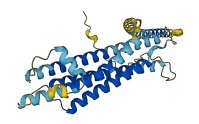
Descriptions
The autoinhibited protein was predicted that may have potential autoinhibitory elements via cis-regPred.
Autoinhibitory domains (AIDs)
Target domain |
|
Relief mechanism |
|
Assay |
cis-regPred |
Accessory elements
No accessory elements
Autoinhibited structure

Activated structure
1 structures for Q08850
| Entry ID | Method | Resolution | Chain | Position | Source |
|---|---|---|---|---|---|
| AF-Q08850-F1 | Predicted | AlphaFoldDB |
No variants for Q08850
| Variant ID(s) | Position | Change | Description | Diseaes Association | Provenance |
|---|---|---|---|---|---|
| No variants for Q08850 | |||||
No associated diseases with Q08850
Functions
28 GO annotations of cellular component
| Name | Definition |
|---|---|
| apical plasma membrane | The region of the plasma membrane located at the apical end of the cell. |
| basolateral plasma membrane | The region of the plasma membrane that includes the basal end and sides of the cell. Often used in reference to animal polarized epithelial membranes, where the basal membrane is the part attached to the extracellular matrix, or in plant cells, where the basal membrane is defined with respect to the zygotic axis. |
| cell surface | The external part of the cell wall and/or plasma membrane. |
| cytoplasm | The contents of a cell excluding the plasma membrane and nucleus, but including other subcellular structures. |
| dendritic spine | A small, membranous protrusion from a dendrite that forms a postsynaptic compartment, typically receiving input from a single presynapse. They function as partially isolated biochemical and an electrical compartments. Spine morphology is variable:they can be thin, stubby, mushroom, or branched, with a continuum of intermediate morphologies. They typically terminate in a bulb shape, linked to the dendritic shaft by a restriction. Spine remodeling is though to be involved in synaptic plasticity. |
| endomembrane system | A collection of membranous structures involved in transport within the cell. The main components of the endomembrane system are endoplasmic reticulum, Golgi bodies, vesicles, cell membrane and nuclear envelope. Members of the endomembrane system pass materials through each other or though the use of vesicles. |
| endosome | A vacuole to which materials ingested by endocytosis are delivered. |
| extracellular space | That part of a multicellular organism outside the cells proper, usually taken to be outside the plasma membranes, and occupied by fluid. |
| glutamatergic synapse | A synapse that uses glutamate as a neurotransmitter. |
| integral component of membrane | The component of a membrane consisting of the gene products and protein complexes having at least some part of their peptide sequence embedded in the hydrophobic region of the membrane. |
| lamellipodium | A thin sheetlike process extended by the leading edge of a migrating cell or extending cell process; contains a dense meshwork of actin filaments. |
| lateral loop | Non-compact myelin located adjacent to the nodes of Ranvier in a myelin segment. These non-compact regions include cytoplasm from the cell responsible for synthesizing the myelin. Lateral loops are found in the paranodal region adjacent to the nodes of Ranvier, while Schmidt-Lantermann clefts are analogous structures found within the compact myelin internode. |
| membrane | A lipid bilayer along with all the proteins and protein complexes embedded in it an attached to it. |
| myelin sheath adaxonal region | The region of the myelin sheath nearest to the axon. |
| neuron projection membrane | The portion of the plasma membrane surrounding a neuron projection. |
| perinuclear region of cytoplasm | Cytoplasm situated near, or occurring around, the nucleus. |
| phagocytic vesicle | A membrane-bounded intracellular vesicle that arises from the ingestion of particulate material by phagocytosis. |
| plasma membrane | The membrane surrounding a cell that separates the cell from its external environment. It consists of a phospholipid bilayer and associated proteins. |
| postsynapse | The part of a synapse that is part of the post-synaptic cell. |
| presynaptic active zone membrane | The membrane portion of the presynaptic active zone; it is the site where docking and fusion of synaptic vesicles occurs for the release of neurotransmitters. |
| sarcolemma | The outer membrane of a muscle cell, consisting of the plasma membrane, a covering basement membrane (about 100 nm thick and sometimes common to more than one fiber), and the associated loose network of collagen fibers. |
| SNARE complex | A protein complex involved in membrane fusion; a stable ternary complex consisting of a four-helix bundle, usually formed from one R-SNARE and three Q-SNAREs with an ionic layer sandwiched between hydrophobic layers. One well-characterized example is the neuronal SNARE complex formed of synaptobrevin 2, syntaxin 1a, and SNAP-25. |
| somatodendritic compartment | The region of a neuron that includes the cell body (cell soma) and dendrite(s), but excludes the axon. |
| specific granule | Granule with a membranous, tubular internal structure, found primarily in mature neutrophil cells. Most are released into the extracellular fluid. Specific granules contain lactoferrin, lysozyme, vitamin B12 binding protein and elastase. |
| storage vacuole | A vacuole that functions primarily in the storage of materials, including nutrients, pigments, waste products, and small molecules. |
| synapse | The junction between an axon of one neuron and a dendrite of another neuron, a muscle fiber or a glial cell. As the axon approaches the synapse it enlarges into a specialized structure, the presynaptic terminal bouton, which contains mitochondria and synaptic vesicles. At the tip of the terminal bouton is the presynaptic membrane; facing it, and separated from it by a minute cleft (the synaptic cleft) is a specialized area of membrane on the receiving cell, known as the postsynaptic membrane. In response to the arrival of nerve impulses, the presynaptic terminal bouton secretes molecules of neurotransmitters into the synaptic cleft. These diffuse across the cleft and transmit the signal to the postsynaptic membrane. |
| synaptic vesicle | A secretory organelle, typically 50 nm in diameter, of presynaptic nerve terminals; accumulates in high concentrations of neurotransmitters and secretes these into the synaptic cleft by fusion with the 'active zone' of the presynaptic plasma membrane. |
| trans-Golgi network | The network of interconnected tubular and cisternal structures located within the Golgi apparatus on the side distal to the endoplasmic reticulum, from which secretory vesicles emerge. The trans-Golgi network is important in the later stages of protein secretion where it is thought to play a key role in the sorting and targeting of secreted proteins to the correct destination. |
5 GO annotations of molecular function
| Name | Definition |
|---|---|
| small GTPase binding | Binding to a small monomeric GTPase. |
| SNAP receptor activity | Acting as a marker to identify a membrane and interacting selectively with one or more SNAREs on another membrane to mediate membrane fusion. |
| SNARE binding | Binding to a SNARE (soluble N-ethylmaleimide-sensitive factor attached protein receptor) protein. |
| spectrin binding | Binding to spectrin, a protein that is the major constituent of the erythrocyte cytoskeletal network. It associates with band 4.1 (see band protein) and actin to form the cytoskeletal superstructure of the erythrocyte plasma membrane. It is composed of nonhomologous chains, alpha and beta, which aggregate side-to-side in an antiparallel fashion to form dimers, tetramers, and higher polymers. |
| sphingomyelin phosphodiesterase activator activity | Increases the activity of the enzyme sphingomyelin phosphodiesterase. |
30 GO annotations of biological process
| Name | Definition |
|---|---|
| cellular response to interferon-gamma | Any process that results in a change in state or activity of a cell (in terms of movement, secretion, enzyme production, gene expression, etc.) as a result of an interferon-gamma stimulus. Interferon gamma is the only member of the type II interferon found so far. |
| cellular response to oxidative stress | Any process that results in a change in state or activity of a cell (in terms of movement, secretion, enzyme production, gene expression, etc.) as a result of oxidative stress, a state often resulting from exposure to high levels of reactive oxygen species, e.g. superoxide anions, hydrogen peroxide (H2O2), and hydroxyl radicals. |
| cornified envelope assembly | The aggregation, arrangement and bonding together of a set of components to form a cornified envelope. |
| exocytic insertion of neurotransmitter receptor to postsynaptic membrane | The exocytic fusion of neurotransmitter receptor containing vesicles with the postsynaptic membrane resulting in the integration of NT receptors, enabling them to participate in neurotransmitter reception. This process includes tethering and docking steps that prepare vesicles for fusion. |
| exocytosis | A process of secretion by a cell that results in the release of intracellular molecules (e.g. hormones, matrix proteins) contained within a membrane-bounded vesicle. Exocytosis can occur either by full fusion, when the vesicle collapses into the plasma membrane, or by a kiss-and-run mechanism that involves the formation of a transient contact, a pore, between a granule (for exemple of chromaffin cells) and the plasma membrane. The latter process most of the time leads to only partial secretion of the granule content. Exocytosis begins with steps that prepare vesicles for fusion with the membrane (tethering and docking) and ends when molecules are secreted from the cell. |
| intracellular protein transport | The directed movement of proteins in a cell, including the movement of proteins between specific compartments or structures within a cell, such as organelles of a eukaryotic cell. |
| intracellular transport | The directed movement of substances within a cell. |
| long-term synaptic potentiation | A process that modulates synaptic plasticity such that synapses are changed resulting in the increase in the rate, or frequency of synaptic transmission at the synapse. |
| membrane fusion | The membrane organization process that joins two lipid bilayers to form a single membrane. |
| organelle fusion | The creation of a single organelle from two or more organelles. |
| positive regulation of catalytic activity | Any process that activates or increases the activity of an enzyme. |
| positive regulation of cell adhesion | Any process that activates or increases the frequency, rate or extent of cell adhesion. |
| positive regulation of cell migration | Any process that activates or increases the frequency, rate or extent of cell migration. |
| positive regulation of cell population proliferation | Any process that activates or increases the rate or extent of cell proliferation. |
| positive regulation of chemotaxis | Any process that activates or increases the frequency, rate or extent of the directed movement of a motile cell or organism in response to a specific chemical concentration gradient. |
| positive regulation of eosinophil degranulation | Any process that activates or increases the frequency, rate or extent of eosinophil degranulation. |
| positive regulation of immunoglobulin production | Any process that activates or increases the frequency, rate, or extent of immunoglobulin production. |
| positive regulation of insulin secretion involved in cellular response to glucose stimulus | Any process that increases the frequency, rate or extent of the regulated release of insulin that contributes to the response of a cell to glucose. |
| positive regulation of protein localization to cell surface | Any process that activates or increases the frequency, rate or extent of protein localization to the cell surface. |
| positive regulation of protein localization to plasma membrane | Any process that activates or increases the frequency, rate or extent of protein localization to plasma membrane. |
| protein localization to cell surface | A process in which a protein is transported to, or maintained in, a location within the external part of the cell wall and/or plasma membrane. |
| protein-containing complex assembly | The aggregation, arrangement and bonding together of a set of macromolecules to form a protein-containing complex. |
| regulation of exocytosis | Any process that modulates the frequency, rate or extent of exocytosis. |
| regulation of extrinsic apoptotic signaling pathway via death domain receptors | Any process that modulates the frequency, rate or extent of extrinsic apoptotic signaling pathway via death domain receptors. |
| SNARE complex assembly | The aggregation, arrangement and bonding together of a set of components to form a SNARE complex, a protein complex involved in membrane fusion; a stable ternary complex consisting of a four-helix bundle, usually formed from one R-SNARE and three Q-SNAREs with an ionic layer sandwiched between hydrophobic layers. |
| synaptic vesicle docking | The initial (indirect) attachment of a synaptic vesicle membrane to the presynaptic active zone membrane, mediated by proteins protruding from the membrane and proteins of the presynaptic active zone cytoplasmic component. Synaptic vesicle tethering is the first step in this process. |
| synaptic vesicle fusion to presynaptic active zone membrane | Fusion of the membrane of a synaptic vesicle with the presynaptic active zone membrane, thereby releasing its cargo neurotransmitters into the synaptic cleft. |
| vesicle docking | The initial attachment of a transport vesicle membrane to the target membrane, mediated by proteins protruding from the membrane of the vesicle and the target membrane. Docking requires only that the two membranes come close enough for these proteins to interact and adhere. |
| vesicle fusion | Fusion of the membrane of a transport vesicle with its target membrane. |
| vesicle-mediated transport in synapse | Any vesicle-mediated transport that occurs in a synapse. |
21 homologous proteins in AiPD
| UniProt AC | Gene Name | Protein Name | Species | Evidence Code |
|---|---|---|---|---|
| P32867 | SSO1 | Protein SSO1 | Saccharomyces cerevisiae (strain ATCC 204508 / S288c) (Baker's yeast) | PR |
| P39926 | SSO2 | Protein SSO2 | Saccharomyces cerevisiae (strain ATCC 204508 / S288c) (Baker's yeast) | PR |
| P61267 | STX1B | Syntaxin-1B | Bos taurus (Bovine) | PR |
| Q3SWZ3 | STX4 | Syntaxin-4 | Bos taurus (Bovine) | PR |
| Q7KVY7 | Syx4 | Syntaxin-4 | Drosophila melanogaster (Fruit fly) | PR |
| Q24547 | Syx1A | Syntaxin-1A | Drosophila melanogaster (Fruit fly) | PR |
| P61266 | STX1B | Syntaxin-1B | Homo sapiens (Human) | PR |
| Q16623 | STX1A | Syntaxin-1A | Homo sapiens (Human) | PR |
| O75558 | STX11 | Syntaxin-11 | Homo sapiens (Human) | PR |
| Q12846 | STX4 | Syntaxin-4 | Homo sapiens (Human) | PR |
| O35526 | Stx1a | Syntaxin-1A | Mus musculus (Mouse) | PR |
| Q00262 | Stx2 | Syntaxin-2 | Mus musculus (Mouse) | PR |
| Q9D3G5 | Stx11 | Syntaxin-11 | Mus musculus (Mouse) | PR |
| P61264 | Stx1b | Syntaxin-1B | Mus musculus (Mouse) | PR |
| P70452 | Stx4 | Syntaxin-4 | Mus musculus (Mouse) | PR |
| P61265 | Stx1b | Syntaxin-1B | Rattus norvegicus (Rat) | PR |
| P32851 | Stx1a | Syntaxin-1A | Rattus norvegicus (Rat) | PR |
| O70257 | Stx7 | Syntaxin-7 | Rattus norvegicus (Rat) | PR |
| P50279 | Stx2 | Syntaxin-2 | Rattus norvegicus (Rat) | PR |
| O16000 | unc-64 | Syntaxin-1A homolog | Caenorhabditis elegans | PR |
| Q9ZPV9 | SYP112 | Syntaxin-112 | Arabidopsis thaliana (Mouse-ear cress) | PR |
| 10 | 20 | 30 | 40 | 50 | 60 |
| MRDRTHELRQ | GDNISDDEDE | VRVALVVHSG | AARLSSPDDE | FFQKVQTIRQ | TMAKLESKVR |
| 70 | 80 | 90 | 100 | 110 | 120 |
| ELEKQQVTIL | ATPLPEESMK | QGLQNLREEI | KQLGREVRAQ | LKAIEPQKEE | ADENYNSVNT |
| 130 | 140 | 150 | 160 | 170 | 180 |
| RMKKTQHGVL | SQQFVELINK | CNSMQSEYRE | KNVERIRRQL | KITNAGMVSD | EELEQMLDSG |
| 190 | 200 | 210 | 220 | 230 | 240 |
| QSEVFVSNIL | KDTQVTRQAL | NEISARHSEI | QQLERSIREL | HEIFTFLATE | VEMQGEMINR |
| 250 | 260 | 270 | 280 | 290 | |
| IEKNILSSAD | YVERGQEHVK | IALENQKKAR | KKKVMIAICV | SVTVLILAVI | IGITITVG |