P50279
Gene name |
Stx2 (Epim) |
Protein name |
Syntaxin-2 |
Names |
Epimorphin |
Species |
Rattus norvegicus (Rat) |
KEGG Pathway |
rno:25130 |
EC number |
|
Protein Class |
|
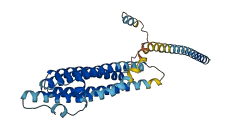
Descriptions
The autoinhibited protein was predicted that may have potential autoinhibitory elements via cis-regPred.
Autoinhibitory domains (AIDs)
Target domain |
|
Relief mechanism |
|
Assay |
cis-regPred |
Accessory elements
No accessory elements
Autoinhibited structure

Activated structure
1 structures for P50279
| Entry ID | Method | Resolution | Chain | Position | Source |
|---|---|---|---|---|---|
| AF-P50279-F1 | Predicted | AlphaFoldDB |
No variants for P50279
| Variant ID(s) | Position | Change | Description | Diseaes Association | Provenance |
|---|---|---|---|---|---|
| No variants for P50279 | |||||
No associated diseases with P50279
No regional properties for P50279
| Type | Name | Position | InterPro Accession |
|---|---|---|---|
| No domain, repeats, and functional sites for P50279 | |||
17 GO annotations of cellular component
| Name | Definition |
|---|---|
| basolateral plasma membrane | The region of the plasma membrane that includes the basal end and sides of the cell. Often used in reference to animal polarized epithelial membranes, where the basal membrane is the part attached to the extracellular matrix, or in plant cells, where the basal membrane is defined with respect to the zygotic axis. |
| cell surface | The external part of the cell wall and/or plasma membrane. |
| cell-cell junction | A cell junction that forms a connection between two or more cells of an organism; excludes direct cytoplasmic intercellular bridges, such as ring canals in insects. |
| cytoplasmic vesicle | A vesicle found in the cytoplasm of a cell. |
| endomembrane system | A collection of membranous structures involved in transport within the cell. The main components of the endomembrane system are endoplasmic reticulum, Golgi bodies, vesicles, cell membrane and nuclear envelope. Members of the endomembrane system pass materials through each other or though the use of vesicles. |
| extracellular space | That part of a multicellular organism outside the cells proper, usually taken to be outside the plasma membranes, and occupied by fluid. |
| integral component of membrane | The component of a membrane consisting of the gene products and protein complexes having at least some part of their peptide sequence embedded in the hydrophobic region of the membrane. |
| lamellipodium | A thin sheetlike process extended by the leading edge of a migrating cell or extending cell process; contains a dense meshwork of actin filaments. |
| membrane raft | Any of the small (10-200 nm), heterogeneous, highly dynamic, sterol- and sphingolipid-enriched membrane domains that compartmentalize cellular processes. Small rafts can sometimes be stabilized to form larger platforms through protein-protein and protein-lipid interactions. |
| midbody | A thin cytoplasmic bridge formed between daughter cells at the end of cytokinesis. The midbody forms where the contractile ring constricts, and may persist for some time before finally breaking to complete cytokinesis. |
| plasma membrane | The membrane surrounding a cell that separates the cell from its external environment. It consists of a phospholipid bilayer and associated proteins. |
| presynaptic active zone membrane | The membrane portion of the presynaptic active zone; it is the site where docking and fusion of synaptic vesicles occurs for the release of neurotransmitters. |
| protein-containing complex | A stable assembly of two or more macromolecules, i.e. proteins, nucleic acids, carbohydrates or lipids, in which at least one component is a protein and the constituent parts function together. |
| SNARE complex | A protein complex involved in membrane fusion; a stable ternary complex consisting of a four-helix bundle, usually formed from one R-SNARE and three Q-SNAREs with an ionic layer sandwiched between hydrophobic layers. One well-characterized example is the neuronal SNARE complex formed of synaptobrevin 2, syntaxin 1a, and SNAP-25. |
| synapse | The junction between an axon of one neuron and a dendrite of another neuron, a muscle fiber or a glial cell. As the axon approaches the synapse it enlarges into a specialized structure, the presynaptic terminal bouton, which contains mitochondria and synaptic vesicles. At the tip of the terminal bouton is the presynaptic membrane; facing it, and separated from it by a minute cleft (the synaptic cleft) is a specialized area of membrane on the receiving cell, known as the postsynaptic membrane. In response to the arrival of nerve impulses, the presynaptic terminal bouton secretes molecules of neurotransmitters into the synaptic cleft. These diffuse across the cleft and transmit the signal to the postsynaptic membrane. |
| synaptic vesicle | A secretory organelle, typically 50 nm in diameter, of presynaptic nerve terminals; accumulates in high concentrations of neurotransmitters and secretes these into the synaptic cleft by fusion with the 'active zone' of the presynaptic plasma membrane. |
| transport vesicle | Any of the vesicles of the constitutive secretory pathway, which carry cargo from the endoplasmic reticulum to the Golgi, between Golgi cisternae, from the Golgi to the ER (retrograde transport) or to destinations within or outside the cell. |
4 GO annotations of molecular function
| Name | Definition |
|---|---|
| calcium-dependent protein binding | Binding to a protein or protein complex in the presence of calcium. |
| SNAP receptor activity | Acting as a marker to identify a membrane and interacting selectively with one or more SNAREs on another membrane to mediate membrane fusion. |
| SNARE binding | Binding to a SNARE (soluble N-ethylmaleimide-sensitive factor attached protein receptor) protein. |
| structural molecule activity | The action of a molecule that contributes to the structural integrity of a complex or its assembly within or outside a cell. |
17 GO annotations of biological process
| Name | Definition |
|---|---|
| acrosome reaction | The discharge, by sperm, of a single, anterior secretory granule following the sperm's attachment to the zona pellucida of the oocyte. The process begins with the fusion of the outer acrosomal membrane with the sperm plasma membrane and ends with the exocytosis of the acrosomal contents into the zona pellucida. |
| cell differentiation | The process in which relatively unspecialized cells, e.g. embryonic or regenerative cells, acquire specialized structural and/or functional features that characterize the cells, tissues, or organs of the mature organism or some other relatively stable phase of the organism's life history. Differentiation includes the processes involved in commitment of a cell to a specific fate and its subsequent development to the mature state. |
| cellular response to oxidative stress | Any process that results in a change in state or activity of a cell (in terms of movement, secretion, enzyme production, gene expression, etc.) as a result of oxidative stress, a state often resulting from exposure to high levels of reactive oxygen species, e.g. superoxide anions, hydrogen peroxide (H2O2), and hydroxyl radicals. |
| cornified envelope assembly | The aggregation, arrangement and bonding together of a set of components to form a cornified envelope. |
| digestive tract morphogenesis | The process in which the anatomical structures of the digestive tract are generated and organized. The digestive tract is the anatomical structure through which food passes and is processed. |
| epithelial cell differentiation | The process in which a relatively unspecialized cell acquires specialized features of an epithelial cell, any of the cells making up an epithelium. |
| exocytosis | A process of secretion by a cell that results in the release of intracellular molecules (e.g. hormones, matrix proteins) contained within a membrane-bounded vesicle. Exocytosis can occur either by full fusion, when the vesicle collapses into the plasma membrane, or by a kiss-and-run mechanism that involves the formation of a transient contact, a pore, between a granule (for exemple of chromaffin cells) and the plasma membrane. The latter process most of the time leads to only partial secretion of the granule content. Exocytosis begins with steps that prepare vesicles for fusion with the membrane (tethering and docking) and ends when molecules are secreted from the cell. |
| intracellular protein transport | The directed movement of proteins in a cell, including the movement of proteins between specific compartments or structures within a cell, such as organelles of a eukaryotic cell. |
| intracellular transport | The directed movement of substances within a cell. |
| microvillus assembly | Formation of a microvillus, a thin cylindrical membrane-covered projection on the surface of a cell. |
| midbody abscission | The process by which the midbody, the cytoplasmic bridge that connects the two prospective daughter cells, is severed at the end of mitotic cytokinesis, resulting in two separate daughter cells. |
| mitotic cytokinesis | A cell cycle process that results in the division of the cytoplasm of a cell after mitosis, resulting in the separation of the original cell into two daughter cells. |
| synaptic vesicle fusion to presynaptic active zone membrane | Fusion of the membrane of a synaptic vesicle with the presynaptic active zone membrane, thereby releasing its cargo neurotransmitters into the synaptic cleft. |
| vesicle docking | The initial attachment of a transport vesicle membrane to the target membrane, mediated by proteins protruding from the membrane of the vesicle and the target membrane. Docking requires only that the two membranes come close enough for these proteins to interact and adhere. |
| vesicle fusion | Fusion of the membrane of a transport vesicle with its target membrane. |
| vesicle targeting | The process in which vesicles are directed to specific destination membranes. Targeting involves coordinated interactions among cytoskeletal elements (microtubules or actin filaments), motor proteins, molecules at the vesicle membrane and target membrane surfaces, and vesicle cargo. |
| vesicle-mediated transport | A cellular transport process in which transported substances are moved in membrane-bounded vesicles; transported substances are enclosed in the vesicle lumen or located in the vesicle membrane. The process begins with a step that directs a substance to the forming vesicle, and includes vesicle budding and coating. Vesicles are then targeted to, and fuse with, an acceptor membrane. |
21 homologous proteins in AiPD
| UniProt AC | Gene Name | Protein Name | Species | Evidence Code |
|---|---|---|---|---|
| P32867 | SSO1 | Protein SSO1 | Saccharomyces cerevisiae (strain ATCC 204508 / S288c) (Baker's yeast) | PR |
| P39926 | SSO2 | Protein SSO2 | Saccharomyces cerevisiae (strain ATCC 204508 / S288c) (Baker's yeast) | PR |
| Q3SWZ3 | STX4 | Syntaxin-4 | Bos taurus (Bovine) | PR |
| P61267 | STX1B | Syntaxin-1B | Bos taurus (Bovine) | PR |
| Q7KVY7 | Syx4 | Syntaxin-4 | Drosophila melanogaster (Fruit fly) | PR |
| Q24547 | Syx1A | Syntaxin-1A | Drosophila melanogaster (Fruit fly) | PR |
| P61266 | STX1B | Syntaxin-1B | Homo sapiens (Human) | PR |
| Q16623 | STX1A | Syntaxin-1A | Homo sapiens (Human) | PR |
| Q12846 | STX4 | Syntaxin-4 | Homo sapiens (Human) | PR |
| O75558 | STX11 | Syntaxin-11 | Homo sapiens (Human) | PR |
| O35526 | Stx1a | Syntaxin-1A | Mus musculus (Mouse) | PR |
| P70452 | Stx4 | Syntaxin-4 | Mus musculus (Mouse) | PR |
| Q9D3G5 | Stx11 | Syntaxin-11 | Mus musculus (Mouse) | PR |
| P61264 | Stx1b | Syntaxin-1B | Mus musculus (Mouse) | PR |
| Q00262 | Stx2 | Syntaxin-2 | Mus musculus (Mouse) | PR |
| P32851 | Stx1a | Syntaxin-1A | Rattus norvegicus (Rat) | PR |
| P61265 | Stx1b | Syntaxin-1B | Rattus norvegicus (Rat) | PR |
| Q08850 | Stx4 | Syntaxin-4 | Rattus norvegicus (Rat) | PR |
| O70257 | Stx7 | Syntaxin-7 | Rattus norvegicus (Rat) | PR |
| O16000 | unc-64 | Syntaxin-1A homolog | Caenorhabditis elegans | PR |
| Q9ZPV9 | SYP112 | Syntaxin-112 | Arabidopsis thaliana (Mouse-ear cress) | PR |
| 10 | 20 | 30 | 40 | 50 | 60 |
| MRDRLPDLTA | CRKSDDGDNA | VIITVEKDHF | MDAFFHQVEE | IRSSIARIAQ | HVEDVKKNHS |
| 70 | 80 | 90 | 100 | 110 | 120 |
| IILSAPNPEG | KIKEELEDLN | KEIKKTANRI | RGKLKAIEQS | CDQDENGNRT | SVDLRIRRTQ |
| 130 | 140 | 150 | 160 | 170 | 180 |
| HSVLSRKFVD | VMTEYNEAQI | LFRERSKGRI | QRQLEITGRT | TTDEELEEML | ESGKPSIFIS |
| 190 | 200 | 210 | 220 | 230 | 240 |
| DIISDSQITR | QALNEIESRH | KDIMKLETSI | RELHEMFMDM | AMFVETQGEM | VNNIERNVVN |
| 250 | 260 | 270 | 280 | ||
| SVDYVEHAKE | ETKKAIKYQS | KARRKKWIIA | AVVVAVIAVL | ALIIGLTVGK |