P61264
Gene name |
Stx1b (Stx1b1, Stx1b2) |
Protein name |
Syntaxin-1B |
Names |
|
Species |
Mus musculus (Mouse) |
KEGG Pathway |
mmu:56216 |
EC number |
|
Protein Class |
|
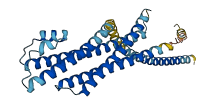
Descriptions
The autoinhibited protein was predicted that may have potential autoinhibitory elements via cis-regPred.
Autoinhibitory domains (AIDs)
Target domain |
|
Relief mechanism |
|
Assay |
cis-regPred |
Accessory elements
No accessory elements
Autoinhibited structure

Activated structure
1 structures for P61264
| Entry ID | Method | Resolution | Chain | Position | Source |
|---|---|---|---|---|---|
| AF-P61264-F1 | Predicted | AlphaFoldDB |
11 variants for P61264
| Variant ID(s) | Position | Change | Description | Diseaes Association | Provenance |
|---|---|---|---|---|---|
| rs3388956883 | 34 | E>* | No | EVA | |
| rs3388945219 | 36 | V>M | No | EVA | |
| rs3388954563 | 68 | E>G | No | EVA | |
| rs3388954483 | 69 | K>E | No | EVA | |
| rs3388945263 | 204 | L>M | No | EVA | |
| rs3388945604 | 211 | L>M | No | EVA | |
| rs3388923911 | 229 | I>T | No | EVA | |
| rs3388953437 | 237 | E>* | No | EVA | |
| rs3398130251 | 240 | V>E | No | EVA | |
| rs3398130248 | 270 | C>* | No | EVA | |
| rs3388949067 | 273 | V>S | No | EVA |
No associated diseases with P61264
17 GO annotations of cellular component
| Name | Definition |
|---|---|
| axon | The long process of a neuron that conducts nerve impulses, usually away from the cell body to the terminals and varicosities, which are sites of storage and release of neurotransmitter. |
| centrosome | A structure comprised of a core structure (in most organisms, a pair of centrioles) and peripheral material from which a microtubule-based structure, such as a spindle apparatus, is organized. Centrosomes occur close to the nucleus during interphase in many eukaryotic cells, though in animal cells it changes continually during the cell-division cycle. |
| cytoplasm | The contents of a cell excluding the plasma membrane and nucleus, but including other subcellular structures. |
| endomembrane system | A collection of membranous structures involved in transport within the cell. The main components of the endomembrane system are endoplasmic reticulum, Golgi bodies, vesicles, cell membrane and nuclear envelope. Members of the endomembrane system pass materials through each other or though the use of vesicles. |
| integral component of membrane | The component of a membrane consisting of the gene products and protein complexes having at least some part of their peptide sequence embedded in the hydrophobic region of the membrane. |
| integral component of presynaptic membrane | The component of the presynaptic membrane consisting of the gene products and protein complexes having at least some part of their peptide sequence embedded in the hydrophobic region of the membrane. |
| membrane | A lipid bilayer along with all the proteins and protein complexes embedded in it an attached to it. |
| neuromuscular junction | The junction between the axon of a motor neuron and a muscle fiber. In response to the arrival of action potentials, the presynaptic button releases molecules of neurotransmitters into the synaptic cleft. These diffuse across the cleft and transmit the signal to the postsynaptic membrane of the muscle fiber, leading to a change in post-synaptic potential. |
| nuclear lamina | The fibrous, electron-dense layer lying on the nucleoplasmic side of the inner membrane of a cell nucleus, composed of lamin filaments. The polypeptides of the lamina are thought to be concerned in the dissolution of the nuclear envelope and its re-formation during mitosis. The lamina is composed of lamin A and lamin C filaments cross-linked into an orthogonal lattice, which is attached via lamin B to the inner nuclear membrane through interactions with a lamin B receptor, an IFAP, in the membrane. |
| nucleoplasm | That part of the nuclear content other than the chromosomes or the nucleolus. |
| nucleus | A membrane-bounded organelle of eukaryotic cells in which chromosomes are housed and replicated. In most cells, the nucleus contains all of the cell's chromosomes except the organellar chromosomes, and is the site of RNA synthesis and processing. In some species, or in specialized cell types, RNA metabolism or DNA replication may be absent. |
| plasma membrane | The membrane surrounding a cell that separates the cell from its external environment. It consists of a phospholipid bilayer and associated proteins. |
| presynapse | The part of a synapse that is part of the presynaptic cell. |
| presynaptic active zone membrane | The membrane portion of the presynaptic active zone; it is the site where docking and fusion of synaptic vesicles occurs for the release of neurotransmitters. |
| presynaptic membrane | A specialized area of membrane of the axon terminal that faces the plasma membrane of the neuron or muscle fiber with which the axon terminal establishes a synaptic junction; many synaptic junctions exhibit structural presynaptic characteristics, such as conical, electron-dense internal protrusions, that distinguish it from the remainder of the axon plasma membrane. |
| SNARE complex | A protein complex involved in membrane fusion; a stable ternary complex consisting of a four-helix bundle, usually formed from one R-SNARE and three Q-SNAREs with an ionic layer sandwiched between hydrophobic layers. One well-characterized example is the neuronal SNARE complex formed of synaptobrevin 2, syntaxin 1a, and SNAP-25. |
| synaptic vesicle | A secretory organelle, typically 50 nm in diameter, of presynaptic nerve terminals; accumulates in high concentrations of neurotransmitters and secretes these into the synaptic cleft by fusion with the 'active zone' of the presynaptic plasma membrane. |
5 GO annotations of molecular function
| Name | Definition |
|---|---|
| protein domain specific binding | Binding to a specific domain of a protein. |
| protein kinase binding | Binding to a protein kinase, any enzyme that catalyzes the transfer of a phosphate group, usually from ATP, to a protein substrate. |
| signaling receptor binding | Binding to one or more specific sites on a receptor molecule, a macromolecule that undergoes combination with a hormone, neurotransmitter, drug or intracellular messenger to initiate a change in cell function. |
| SNAP receptor activity | Acting as a marker to identify a membrane and interacting selectively with one or more SNAREs on another membrane to mediate membrane fusion. |
| SNARE binding | Binding to a SNARE (soluble N-ethylmaleimide-sensitive factor attached protein receptor) protein. |
24 GO annotations of biological process
| Name | Definition |
|---|---|
| calcium ion-regulated exocytosis of neurotransmitter | The release of a neurotransmitter into the synaptic cleft by exocytosis of synaptic vesicles, where the release step is dependent on a rise in cytosolic calcium ion levels. |
| exocytic insertion of neurotransmitter receptor to postsynaptic membrane | The exocytic fusion of neurotransmitter receptor containing vesicles with the postsynaptic membrane resulting in the integration of NT receptors, enabling them to participate in neurotransmitter reception. This process includes tethering and docking steps that prepare vesicles for fusion. |
| exocytosis | A process of secretion by a cell that results in the release of intracellular molecules (e.g. hormones, matrix proteins) contained within a membrane-bounded vesicle. Exocytosis can occur either by full fusion, when the vesicle collapses into the plasma membrane, or by a kiss-and-run mechanism that involves the formation of a transient contact, a pore, between a granule (for exemple of chromaffin cells) and the plasma membrane. The latter process most of the time leads to only partial secretion of the granule content. Exocytosis begins with steps that prepare vesicles for fusion with the membrane (tethering and docking) and ends when molecules are secreted from the cell. |
| intracellular protein transport | The directed movement of proteins in a cell, including the movement of proteins between specific compartments or structures within a cell, such as organelles of a eukaryotic cell. |
| negative regulation of macropinocytosis | Any process that stops, prevents or reduces the frequency, rate or extent of macropinocytosis. |
| negative regulation of neuron projection development | Any process that decreases the rate, frequency or extent of neuron projection development. Neuron projection development is the process whose specific outcome is the progression of a neuron projection over time, from its formation to the mature structure. A neuron projection is any process extending from a neural cell, such as axons or dendrites (collectively called neurites). |
| negative regulation of synaptic vesicle recycling | Any process that stops, prevents or reduces the frequency, rate or extent of synaptic vesicle recycling. |
| positive regulation of excitatory postsynaptic potential | Any process that enhances the establishment or increases the extent of the excitatory postsynaptic potential (EPSP) which is a temporary increase in postsynaptic potential due to the flow of positively charged ions into the postsynaptic cell. The flow of ions that causes an EPSP is an excitatory postsynaptic current (EPSC) and makes it easier for the neuron to fire an action potential. |
| positive regulation of neurotransmitter secretion | Any process that activates or increases the frequency, rate or extent of the regulated release of a neurotransmitter. |
| positive regulation of spontaneous neurotransmitter secretion | Any process that activates or increases the frequency, rate or extent of spontaneous neurotransmitter secretion. |
| protein localization to membrane | A process in which a protein is transported to, or maintained in, a specific location in a membrane. |
| protein transport | The directed movement of proteins into, out of or within a cell, or between cells, by means of some agent such as a transporter or pore. |
| regulation of exocytosis | Any process that modulates the frequency, rate or extent of exocytosis. |
| regulation of gene expression | Any process that modulates the frequency, rate or extent of gene expression. Gene expression is the process in which a gene's coding sequence is converted into a mature gene product (protein or RNA). |
| regulation of synaptic activity | Any process that modulates the frequency, rate or extent of synaptic activity, the controlled release of neurotransmitters into the synaptic cleft and their subsequent detection by a postsynaptic cell. |
| regulation of synaptic vesicle priming | Any process that modulates the frequency, rate or extent of synaptic vesicle priming. Synaptic vesicle priming is the formation of SNARE-containing complexes, bringing synaptic vesicle membrane and plasma membranes into close proximity and thereby facilitating membrane fusion. |
| spontaneous neurotransmitter secretion | Neurotransmitter secretion that occurs in the absence of the action of a secretagogue or a presynaptic action potential. |
| synaptic vesicle docking | The initial (indirect) attachment of a synaptic vesicle membrane to the presynaptic active zone membrane, mediated by proteins protruding from the membrane and proteins of the presynaptic active zone cytoplasmic component. Synaptic vesicle tethering is the first step in this process. |
| synaptic vesicle exocytosis | Fusion of intracellular membrane-bounded vesicles with the pre-synaptic membrane of the neuronal cell resulting in release of neurotransmitter into the synaptic cleft. |
| synaptic vesicle fusion to presynaptic active zone membrane | Fusion of the membrane of a synaptic vesicle with the presynaptic active zone membrane, thereby releasing its cargo neurotransmitters into the synaptic cleft. |
| vesicle docking | The initial attachment of a transport vesicle membrane to the target membrane, mediated by proteins protruding from the membrane of the vesicle and the target membrane. Docking requires only that the two membranes come close enough for these proteins to interact and adhere. |
| vesicle docking involved in exocytosis | The initial attachment of a vesicle membrane to a target membrane, mediated by proteins protruding from the membrane of the vesicle and the target membrane, that contributes to exocytosis. |
| vesicle fusion | Fusion of the membrane of a transport vesicle with its target membrane. |
| vesicle-mediated transport | A cellular transport process in which transported substances are moved in membrane-bounded vesicles; transported substances are enclosed in the vesicle lumen or located in the vesicle membrane. The process begins with a step that directs a substance to the forming vesicle, and includes vesicle budding and coating. Vesicles are then targeted to, and fuse with, an acceptor membrane. |
21 homologous proteins in AiPD
| UniProt AC | Gene Name | Protein Name | Species | Evidence Code |
|---|---|---|---|---|
| P32867 | SSO1 | Protein SSO1 | Saccharomyces cerevisiae (strain ATCC 204508 / S288c) (Baker's yeast) | PR |
| P39926 | SSO2 | Protein SSO2 | Saccharomyces cerevisiae (strain ATCC 204508 / S288c) (Baker's yeast) | PR |
| Q3SWZ3 | STX4 | Syntaxin-4 | Bos taurus (Bovine) | PR |
| P61267 | STX1B | Syntaxin-1B | Bos taurus (Bovine) | PR |
| Q7KVY7 | Syx4 | Syntaxin-4 | Drosophila melanogaster (Fruit fly) | PR |
| Q24547 | Syx1A | Syntaxin-1A | Drosophila melanogaster (Fruit fly) | PR |
| Q16623 | STX1A | Syntaxin-1A | Homo sapiens (Human) | PR |
| Q12846 | STX4 | Syntaxin-4 | Homo sapiens (Human) | PR |
| O75558 | STX11 | Syntaxin-11 | Homo sapiens (Human) | PR |
| P61266 | STX1B | Syntaxin-1B | Homo sapiens (Human) | PR |
| O35526 | Stx1a | Syntaxin-1A | Mus musculus (Mouse) | PR |
| P70452 | Stx4 | Syntaxin-4 | Mus musculus (Mouse) | PR |
| Q9D3G5 | Stx11 | Syntaxin-11 | Mus musculus (Mouse) | PR |
| Q00262 | Stx2 | Syntaxin-2 | Mus musculus (Mouse) | PR |
| O70439 | Stx7 | Syntaxin-7 | Mus musculus (Mouse) | PR |
| P50279 | Stx2 | Syntaxin-2 | Rattus norvegicus (Rat) | PR |
| Q08850 | Stx4 | Syntaxin-4 | Rattus norvegicus (Rat) | PR |
| P32851 | Stx1a | Syntaxin-1A | Rattus norvegicus (Rat) | PR |
| P61265 | Stx1b | Syntaxin-1B | Rattus norvegicus (Rat) | PR |
| O16000 | unc-64 | Syntaxin-1A homolog | Caenorhabditis elegans | PR |
| Q9ZPV9 | SYP112 | Syntaxin-112 | Arabidopsis thaliana (Mouse-ear cress) | PR |
| 10 | 20 | 30 | 40 | 50 | 60 |
| MKDRTQELRS | AKDSDDEEEV | VHVDRDHFMD | EFFEQVEEIR | GCIEKLSEDV | EQVKKQHSAI |
| 70 | 80 | 90 | 100 | 110 | 120 |
| LAAPNPDEKT | KQELEDLTAD | IKKTANKVRS | KLKAIEQSIE | QEEGLNRSSA | DLRIRKTQHS |
| 130 | 140 | 150 | 160 | 170 | 180 |
| TLSRKFVEVM | TEYNATQSKY | RDRCKDRIQR | QLEITGRTTT | NEELEDMLES | GKLAIFTDDI |
| 190 | 200 | 210 | 220 | 230 | 240 |
| KMDSQMTKQA | LNEIETRHNE | IIKLETSIRE | LHDMFVDMAM | LVESQGEMID | RIEYNVEHSV |
| 250 | 260 | 270 | 280 | ||
| DYVERAVSDT | KKAVKYQSKA | RRKKIMIIIC | CVVLGVVLAS | SIGGTLGL |