Q24547
Gene name |
Syx1A (syx-1A, CG31136) |
Protein name |
Syntaxin-1A |
Names |
dSynt1 |
Species |
Drosophila melanogaster (Fruit fly) |
KEGG Pathway |
dme:Dmel_CG31136 |
EC number |
|
Protein Class |
|
Descriptions
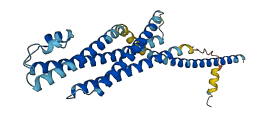
The autoinhibited protein was predicted that may have potential autoinhibitory elements via cis-regPred.
Autoinhibitory domains (AIDs)
Target domain |
|
Relief mechanism |
|
Assay |
cis-regPred |
Accessory elements
No accessory elements
Autoinhibited structure

Activated structure
1 structures for Q24547
| Entry ID | Method | Resolution | Chain | Position | Source |
|---|---|---|---|---|---|
| AF-Q24547-F1 | Predicted | AlphaFoldDB |
No variants for Q24547
| Variant ID(s) | Position | Change | Description | Diseaes Association | Provenance |
|---|---|---|---|---|---|
| No variants for Q24547 | |||||
No associated diseases with Q24547
Functions
10 GO annotations of cellular component
| Name | Definition |
|---|---|
| anchoring junction | A cell junction that mechanically attaches a cell (and its cytoskeleton) to neighboring cells or to the extracellular matrix. |
| endomembrane system | A collection of membranous structures involved in transport within the cell. The main components of the endomembrane system are endoplasmic reticulum, Golgi bodies, vesicles, cell membrane and nuclear envelope. Members of the endomembrane system pass materials through each other or though the use of vesicles. |
| integral component of membrane | The component of a membrane consisting of the gene products and protein complexes having at least some part of their peptide sequence embedded in the hydrophobic region of the membrane. |
| lysosomal membrane | The lipid bilayer surrounding the lysosome and separating its contents from the cell cytoplasm. |
| plasma membrane | The membrane surrounding a cell that separates the cell from its external environment. It consists of a phospholipid bilayer and associated proteins. |
| presynaptic active zone membrane | The membrane portion of the presynaptic active zone; it is the site where docking and fusion of synaptic vesicles occurs for the release of neurotransmitters. |
| SNARE complex | A protein complex involved in membrane fusion; a stable ternary complex consisting of a four-helix bundle, usually formed from one R-SNARE and three Q-SNAREs with an ionic layer sandwiched between hydrophobic layers. One well-characterized example is the neuronal SNARE complex formed of synaptobrevin 2, syntaxin 1a, and SNAP-25. |
| synaptic vesicle | A secretory organelle, typically 50 nm in diameter, of presynaptic nerve terminals; accumulates in high concentrations of neurotransmitters and secretes these into the synaptic cleft by fusion with the 'active zone' of the presynaptic plasma membrane. |
| synaptic vesicle membrane | The lipid bilayer surrounding a synaptic vesicle. |
| terminal bouton | Terminal inflated portion of the axon, containing the specialized apparatus necessary to release neurotransmitters. The axon terminus is considered to be the whole region of thickening and the terminal bouton is a specialized region of it. |
2 GO annotations of molecular function
| Name | Definition |
|---|---|
| SNAP receptor activity | Acting as a marker to identify a membrane and interacting selectively with one or more SNAREs on another membrane to mediate membrane fusion. |
| SNARE binding | Binding to a SNARE (soluble N-ethylmaleimide-sensitive factor attached protein receptor) protein. |
14 GO annotations of biological process
| Name | Definition |
|---|---|
| cellularization | The separation of a multi-nucleate cell or syncytium into individual cells. An example of this is found in Drosophila melanogaster embryo development. |
| exocytosis | A process of secretion by a cell that results in the release of intracellular molecules (e.g. hormones, matrix proteins) contained within a membrane-bounded vesicle. Exocytosis can occur either by full fusion, when the vesicle collapses into the plasma membrane, or by a kiss-and-run mechanism that involves the formation of a transient contact, a pore, between a granule (for exemple of chromaffin cells) and the plasma membrane. The latter process most of the time leads to only partial secretion of the granule content. Exocytosis begins with steps that prepare vesicles for fusion with the membrane (tethering and docking) and ends when molecules are secreted from the cell. |
| haltere development | The process whose specific outcome is the progression of the haltere over time, from its formation to the mature structure. The haltere is the club-shaped 'balancers' found on each side of the metathorax among the true flies (Diptera). They are the much-modified hind wings. |
| intracellular protein transport | The directed movement of proteins in a cell, including the movement of proteins between specific compartments or structures within a cell, such as organelles of a eukaryotic cell. |
| mitotic cytokinesis | A cell cycle process that results in the division of the cytoplasm of a cell after mitosis, resulting in the separation of the original cell into two daughter cells. |
| neuromuscular synaptic transmission | The process of synaptic transmission from a neuron to a muscle, across a synapse. |
| neurotransmitter secretion | The regulated release of neurotransmitter from the presynapse into the synaptic cleft via calcium-regulated exocytosis during synaptic transmission. |
| regulation of exocytosis | Any process that modulates the frequency, rate or extent of exocytosis. |
| regulation of pole plasm oskar mRNA localization | Any process that modulates the frequency, rate or extent of the process in which oskar mRNA is transported to, or maintained in, the oocyte pole plasm. |
| synaptic vesicle docking | The initial (indirect) attachment of a synaptic vesicle membrane to the presynaptic active zone membrane, mediated by proteins protruding from the membrane and proteins of the presynaptic active zone cytoplasmic component. Synaptic vesicle tethering is the first step in this process. |
| synaptic vesicle fusion to presynaptic active zone membrane | Fusion of the membrane of a synaptic vesicle with the presynaptic active zone membrane, thereby releasing its cargo neurotransmitters into the synaptic cleft. |
| vesicle docking | The initial attachment of a transport vesicle membrane to the target membrane, mediated by proteins protruding from the membrane of the vesicle and the target membrane. Docking requires only that the two membranes come close enough for these proteins to interact and adhere. |
| vesicle fusion | Fusion of the membrane of a transport vesicle with its target membrane. |
| vesicle-mediated transport | A cellular transport process in which transported substances are moved in membrane-bounded vesicles; transported substances are enclosed in the vesicle lumen or located in the vesicle membrane. The process begins with a step that directs a substance to the forming vesicle, and includes vesicle budding and coating. Vesicles are then targeted to, and fuse with, an acceptor membrane. |
21 homologous proteins in AiPD
| UniProt AC | Gene Name | Protein Name | Species | Evidence Code |
|---|---|---|---|---|
| P32867 | SSO1 | Protein SSO1 | Saccharomyces cerevisiae (strain ATCC 204508 / S288c) (Baker's yeast) | PR |
| P39926 | SSO2 | Protein SSO2 | Saccharomyces cerevisiae (strain ATCC 204508 / S288c) (Baker's yeast) | PR |
| Q3SWZ3 | STX4 | Syntaxin-4 | Bos taurus (Bovine) | PR |
| P61267 | STX1B | Syntaxin-1B | Bos taurus (Bovine) | PR |
| P32850 | STX1A | Syntaxin-1A | Bos taurus (Bovine) | PR |
| Q7KVY7 | Syx4 | Syntaxin-4 | Drosophila melanogaster (Fruit fly) | PR |
| Q12846 | STX4 | Syntaxin-4 | Homo sapiens (Human) | PR |
| O75558 | STX11 | Syntaxin-11 | Homo sapiens (Human) | PR |
| P61266 | STX1B | Syntaxin-1B | Homo sapiens (Human) | PR |
| Q16623 | STX1A | Syntaxin-1A | Homo sapiens (Human) | PR |
| P70452 | Stx4 | Syntaxin-4 | Mus musculus (Mouse) | PR |
| Q9D3G5 | Stx11 | Syntaxin-11 | Mus musculus (Mouse) | PR |
| O35526 | Stx1a | Syntaxin-1A | Mus musculus (Mouse) | PR |
| P61264 | Stx1b | Syntaxin-1B | Mus musculus (Mouse) | PR |
| Q00262 | Stx2 | Syntaxin-2 | Mus musculus (Mouse) | PR |
| Q08850 | Stx4 | Syntaxin-4 | Rattus norvegicus (Rat) | PR |
| P32851 | Stx1a | Syntaxin-1A | Rattus norvegicus (Rat) | PR |
| P61265 | Stx1b | Syntaxin-1B | Rattus norvegicus (Rat) | PR |
| P50279 | Stx2 | Syntaxin-2 | Rattus norvegicus (Rat) | PR |
| O16000 | unc-64 | Syntaxin-1A homolog | Caenorhabditis elegans | PR |
| Q9ZPV9 | SYP112 | Syntaxin-112 | Arabidopsis thaliana (Mouse-ear cress) | PR |
| 10 | 20 | 30 | 40 | 50 | 60 |
| MTKDRLAALH | AAQSDDEEET | EVAVNVDGHD | SYMDDFFAQV | EEIRGMIDKV | QDNVEEVKKK |
| 70 | 80 | 90 | 100 | 110 | 120 |
| HSAILSAPQT | DEKTKQELED | LMADIKKNAN | RVRGKLKGIE | QNIEQEEQQN | KSSADLRIRK |
| 130 | 140 | 150 | 160 | 170 | 180 |
| TQHSTLSRKF | VEVMTEYNRT | QTDYRERCKG | RIQRQLEITG | RPTNDDELEK | MLEEGNSSVF |
| 190 | 200 | 210 | 220 | 230 | 240 |
| TQGIIMETQQ | AKQTLADIEA | RHQDIMKLET | SIKELHDMFM | DMAMLVESQG | EMIDRIEYHV |
| 250 | 260 | 270 | 280 | 290 | |
| EHAMDYVQTA | TQDTKKALKY | QSKARRKKIM | ILICLTVLGI | LAASYVSSYF | M |