P32867
Gene name |
SSO1 (YPL232W, P1405) |
Protein name |
Protein SSO1 |
Names |
|
Species |
Saccharomyces cerevisiae (strain ATCC 204508 / S288c) (Baker's yeast) |
KEGG Pathway |
sce:YPL232W |
EC number |
|
Protein Class |
|
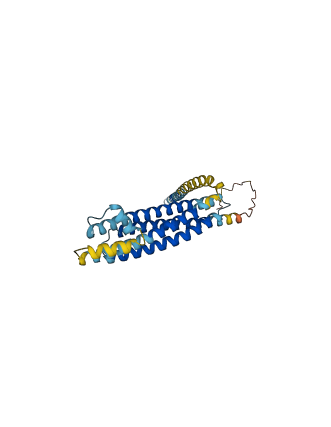
Descriptions
The autoinhibited protein was predicted that may have potential autoinhibitory elements via cis-regPred.
Autoinhibitory domains (AIDs)
Target domain |
|
Relief mechanism |
|
Assay |
cis-regPred |
Accessory elements
No accessory elements
Autoinhibited structure

Activated structure
3 structures for P32867
| Entry ID | Method | Resolution | Chain | Position | Source |
|---|---|---|---|---|---|
| 1FIO | X-ray | 210 A | A | 31-225 | PDB |
| 3B5N | X-ray | 160 A | B/F/J | 189-257 | PDB |
| AF-P32867-F1 | Predicted | AlphaFoldDB |
3 variants for P32867
| Variant ID(s) | Position | Change | Description | Diseaes Association | Provenance |
|---|---|---|---|---|---|
| s16-107437 | 55 | N>D | No | SGRP | |
| s16-108019 | 249 | T>S | No | SGRP | |
| s16-108103 | 277 | V>I | No | SGRP |
No associated diseases with P32867
9 GO annotations of cellular component
| Name | Definition |
|---|---|
| cell periphery | The part of a cell encompassing the cell cortex, the plasma membrane, and any external encapsulating structures. |
| endomembrane system | A collection of membranous structures involved in transport within the cell. The main components of the endomembrane system are endoplasmic reticulum, Golgi bodies, vesicles, cell membrane and nuclear envelope. Members of the endomembrane system pass materials through each other or though the use of vesicles. |
| fungal-type vacuole membrane | The lipid bilayer surrounding a vacuole, the shape of which correlates with cell cycle phase. The membrane separates its contents from the cytoplasm of the cell. An example of this structure is found in Saccharomyces cerevisiae. |
| Golgi membrane | The lipid bilayer surrounding any of the compartments of the Golgi apparatus. |
| integral component of membrane | The component of a membrane consisting of the gene products and protein complexes having at least some part of their peptide sequence embedded in the hydrophobic region of the membrane. |
| membrane | A lipid bilayer along with all the proteins and protein complexes embedded in it an attached to it. |
| plasma membrane | The membrane surrounding a cell that separates the cell from its external environment. It consists of a phospholipid bilayer and associated proteins. |
| prospore membrane | The prospore membrane is a double-membraned structure that extends from the cytoplasmic face of the spindle pole bodies to encompass the spindle pole bodies and the four nuclear lobes that are formed during meiosis. It helps isolate the meiotic nuclei from the cytoplasm during spore formation and serves as a foundation for the formation of the spore walls. An example of this component is found in Schizosaccharomyces pombe. |
| SNARE complex | A protein complex involved in membrane fusion; a stable ternary complex consisting of a four-helix bundle, usually formed from one R-SNARE and three Q-SNAREs with an ionic layer sandwiched between hydrophobic layers. One well-characterized example is the neuronal SNARE complex formed of synaptobrevin 2, syntaxin 1a, and SNAP-25. |
6 GO annotations of molecular function
| Name | Definition |
|---|---|
| phosphatidic acid binding | Binding to phosphatidic acid, any of a class of glycerol phosphate in which both the remaining hydroxyl groups of the glycerol moiety are esterified with fatty acids. |
| phosphatidylinositol-3,4-bisphosphate binding | Binding to phosphatidylinositol-3,4-bisphosphate, a derivative of phosphatidylinositol in which the inositol ring is phosphorylated at the 3' and 4' positions. |
| phosphatidylinositol-3,5-bisphosphate binding | Binding to phosphatidylinositol-3,5-bisphosphate, a derivative of phosphatidylinositol in which the inositol ring is phosphorylated at the 3' and 5' positions. |
| phosphatidylinositol-4,5-bisphosphate binding | Binding to phosphatidylinositol-4,5-bisphosphate, a derivative of phosphatidylinositol in which the inositol ring is phosphorylated at the 4' and 5' positions. |
| SNAP receptor activity | Acting as a marker to identify a membrane and interacting selectively with one or more SNAREs on another membrane to mediate membrane fusion. |
| SNARE binding | Binding to a SNARE (soluble N-ethylmaleimide-sensitive factor attached protein receptor) protein. |
11 GO annotations of biological process
| Name | Definition |
|---|---|
| ascospore formation | The process in which cells that are products of meiosis acquire the specialized features of ascospores. Ascospores are generally found in clusters of four or eight spores within a single mother cell, the ascus, and are characteristic of the ascomycete fungi (phylum Ascomycota). |
| ascospore-type prospore assembly | During ascospore formation, the process in which each haploid nucleus becomes encapsulated by a double membrane. |
| exocytosis | A process of secretion by a cell that results in the release of intracellular molecules (e.g. hormones, matrix proteins) contained within a membrane-bounded vesicle. Exocytosis can occur either by full fusion, when the vesicle collapses into the plasma membrane, or by a kiss-and-run mechanism that involves the formation of a transient contact, a pore, between a granule (for exemple of chromaffin cells) and the plasma membrane. The latter process most of the time leads to only partial secretion of the granule content. Exocytosis begins with steps that prepare vesicles for fusion with the membrane (tethering and docking) and ends when molecules are secreted from the cell. |
| Golgi to plasma membrane transport | The directed movement of substances from the Golgi to the plasma membrane in transport vesicles that move from the trans-Golgi network to the plasma membrane, where they fuse and release their contents by exocytosis. |
| Golgi vesicle fusion to target membrane | The joining of the lipid bilayer membrane around a Golgi transport vesicle to the target lipid bilayer membrane. |
| intracellular protein transport | The directed movement of proteins in a cell, including the movement of proteins between specific compartments or structures within a cell, such as organelles of a eukaryotic cell. |
| SNARE complex assembly | The aggregation, arrangement and bonding together of a set of components to form a SNARE complex, a protein complex involved in membrane fusion; a stable ternary complex consisting of a four-helix bundle, usually formed from one R-SNARE and three Q-SNAREs with an ionic layer sandwiched between hydrophobic layers. |
| sporulation | The process whose specific outcome is the progression of a spore over time, from its initiation to the mature structure. A spore is a structure that can be used for dissemination, for survival of adverse conditions because of its heat and dessication resistance, and/or for reproduction. |
| vesicle docking | The initial attachment of a transport vesicle membrane to the target membrane, mediated by proteins protruding from the membrane of the vesicle and the target membrane. Docking requires only that the two membranes come close enough for these proteins to interact and adhere. |
| vesicle fusion | Fusion of the membrane of a transport vesicle with its target membrane. |
| vesicle fusion to plasma membrane | Fusion of the membrane of a vesicle with the plasma membrane, thereby releasing its contents into the extracellular space. |
21 homologous proteins in AiPD
| UniProt AC | Gene Name | Protein Name | Species | Evidence Code |
|---|---|---|---|---|
| P39926 | SSO2 | Protein SSO2 | Saccharomyces cerevisiae (strain ATCC 204508 / S288c) (Baker's yeast) | PR |
| P32854 | PEP12 | Syntaxin PEP12 | Saccharomyces cerevisiae (strain ATCC 204508 / S288c) (Baker's yeast) | PR |
| Q3SWZ3 | STX4 | Syntaxin-4 | Bos taurus (Bovine) | PR |
| P61267 | STX1B | Syntaxin-1B | Bos taurus (Bovine) | PR |
| P32850 | STX1A | Syntaxin-1A | Bos taurus (Bovine) | PR |
| Q24547 | Syx1A | Syntaxin-1A | Drosophila melanogaster (Fruit fly) | PR |
| Q12846 | STX4 | Syntaxin-4 | Homo sapiens (Human) | PR |
| O75558 | STX11 | Syntaxin-11 | Homo sapiens (Human) | PR |
| P61266 | STX1B | Syntaxin-1B | Homo sapiens (Human) | PR |
| Q16623 | STX1A | Syntaxin-1A | Homo sapiens (Human) | PR |
| P70452 | Stx4 | Syntaxin-4 | Mus musculus (Mouse) | PR |
| Q9D3G5 | Stx11 | Syntaxin-11 | Mus musculus (Mouse) | PR |
| P61264 | Stx1b | Syntaxin-1B | Mus musculus (Mouse) | PR |
| O35526 | Stx1a | Syntaxin-1A | Mus musculus (Mouse) | PR |
| Q00262 | Stx2 | Syntaxin-2 | Mus musculus (Mouse) | PR |
| Q08850 | Stx4 | Syntaxin-4 | Rattus norvegicus (Rat) | PR |
| P61265 | Stx1b | Syntaxin-1B | Rattus norvegicus (Rat) | PR |
| P32851 | Stx1a | Syntaxin-1A | Rattus norvegicus (Rat) | PR |
| P50279 | Stx2 | Syntaxin-2 | Rattus norvegicus (Rat) | PR |
| O16000 | unc-64 | Syntaxin-1A homolog | Caenorhabditis elegans | PR |
| Q9ZPV9 | SYP112 | Syntaxin-112 | Arabidopsis thaliana (Mouse-ear cress) | PR |
| 10 | 20 | 30 | 40 | 50 | 60 |
| MSYNNPYQLE | TPFEESYELD | EGSSAIGAEG | HDFVGFMNKI | SQINRDLDKY | DHTINQVDSL |
| 70 | 80 | 90 | 100 | 110 | 120 |
| HKRLLTEVNE | EQASHLRHSL | DNFVAQATDL | QFKLKNEIKS | AQRDGIHDTN | KQAQAENSRQ |
| 130 | 140 | 150 | 160 | 170 | 180 |
| RFLKLIQDYR | IVDSNYKEEN | KEQAKRQYMI | IQPEATEDEV | EAAISDVGGQ | QIFSQALLNA |
| 190 | 200 | 210 | 220 | 230 | 240 |
| NRRGEAKTAL | AEVQARHQEL | LKLEKSMAEL | TQLFNDMEEL | VIEQQENVDV | IDKNVEDAQL |
| 250 | 260 | 270 | 280 | ||
| DVEQGVGHTD | KAVKSARKAR | KNKIRCWLIV | FAIIVVVVVV | VVVPAVVKTR |