P32854
Gene name |
PEP12 (VPS6, VPT13, YOR036W, OR26.29) |
Protein name |
Syntaxin PEP12 |
Names |
Carboxypeptidase Y-deficient protein 12, Vacuolar protein sorting-associated protein 6, Vacuolar protein-targeting protein 13 |
Species |
Saccharomyces cerevisiae (strain ATCC 204508 / S288c) (Baker's yeast) |
KEGG Pathway |
sce:YOR036W |
EC number |
|
Protein Class |
|
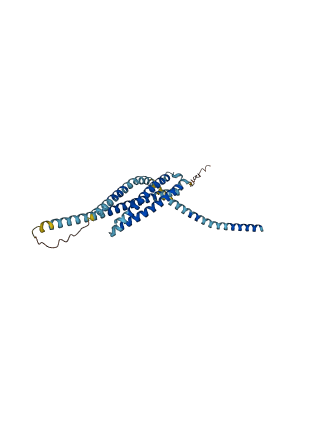
Descriptions
The autoinhibited protein was predicted that may have potential autoinhibitory elements via cis-regPred.
Autoinhibitory domains (AIDs)
Target domain |
|
Relief mechanism |
|
Assay |
cis-regPred |
Accessory elements
No accessory elements
Autoinhibited structure

Activated structure
1 structures for P32854
| Entry ID | Method | Resolution | Chain | Position | Source |
|---|---|---|---|---|---|
| AF-P32854-F1 | Predicted | AlphaFoldDB |
10 variants for P32854
| Variant ID(s) | Position | Change | Description | Diseaes Association | Provenance |
|---|---|---|---|---|---|
| s15-400388 | 14 | V>A | No | SGRP | |
| s15-400444 | 33 | V>I | No | SGRP | |
| s15-400447 | 34 | A>S | No | SGRP | |
| s15-400496 | 50 | F>S | No | SGRP | |
| s15-400705 | 120 | S>G | No | SGRP | |
| s15-400849 | 168 | S>G | No | SGRP | |
| s15-400862 | 172 | T>S | No | SGRP | |
| s15-400942 | 199 | E>K | No | SGRP | |
| s15-401023 | 226 | V>I | No | SGRP | |
| s15-401080 | 245 | D>N | No | SGRP |
No associated diseases with P32854
9 GO annotations of cellular component
| Name | Definition |
|---|---|
| cytosol | The part of the cytoplasm that does not contain organelles but which does contain other particulate matter, such as protein complexes. |
| endomembrane system | A collection of membranous structures involved in transport within the cell. The main components of the endomembrane system are endoplasmic reticulum, Golgi bodies, vesicles, cell membrane and nuclear envelope. Members of the endomembrane system pass materials through each other or though the use of vesicles. |
| endosome | A vacuole to which materials ingested by endocytosis are delivered. |
| endosome membrane | The lipid bilayer surrounding an endosome. |
| fungal-type vacuole membrane | The lipid bilayer surrounding a vacuole, the shape of which correlates with cell cycle phase. The membrane separates its contents from the cytoplasm of the cell. An example of this structure is found in Saccharomyces cerevisiae. |
| Golgi apparatus | A membrane-bound cytoplasmic organelle of the endomembrane system that further processes the core oligosaccharides (e.g. N-glycans) added to proteins in the endoplasmic reticulum and packages them into membrane-bound vesicles. The Golgi apparatus operates at the intersection of the secretory, lysosomal, and endocytic pathways. |
| Golgi membrane | The lipid bilayer surrounding any of the compartments of the Golgi apparatus. |
| integral component of membrane | The component of a membrane consisting of the gene products and protein complexes having at least some part of their peptide sequence embedded in the hydrophobic region of the membrane. |
| SNARE complex | A protein complex involved in membrane fusion; a stable ternary complex consisting of a four-helix bundle, usually formed from one R-SNARE and three Q-SNAREs with an ionic layer sandwiched between hydrophobic layers. One well-characterized example is the neuronal SNARE complex formed of synaptobrevin 2, syntaxin 1a, and SNAP-25. |
2 GO annotations of molecular function
| Name | Definition |
|---|---|
| SNAP receptor activity | Acting as a marker to identify a membrane and interacting selectively with one or more SNAREs on another membrane to mediate membrane fusion. |
| SNARE binding | Binding to a SNARE (soluble N-ethylmaleimide-sensitive factor attached protein receptor) protein. |
9 GO annotations of biological process
| Name | Definition |
|---|---|
| cytoplasm to vacuole transport by the Cvt pathway | A cytoplasm to vacuole targeting pathway that uses machinery common with autophagy. The Cvt vesicle is formed when the receptor protein, Atg19, binds to the complexes of the target protein (aminopeptidase or alpha-mannosidase homododecamers), forming the Cvt complex. Atg11 binds to Atg9 and transports the Cvt complex to the pre-autophagosome (PAS). The phagophore membrane expands around the Cvt complex (excluding bulk cytoplasm) forming the Cvt vesicle. This pathway is mostly observed in yeast. |
| Golgi to endosome transport | The directed movement of substances from the Golgi to early sorting endosomes. Clathrin vesicles transport substances from the trans-Golgi to endosomes. |
| Golgi to vacuole transport | The directed movement of substances from the Golgi to the vacuole. |
| Golgi vesicle fusion to target membrane | The joining of the lipid bilayer membrane around a Golgi transport vesicle to the target lipid bilayer membrane. |
| intracellular protein transport | The directed movement of proteins in a cell, including the movement of proteins between specific compartments or structures within a cell, such as organelles of a eukaryotic cell. |
| macroautophagy | The major inducible pathway for the general turnover of cytoplasmic constituents in eukaryotic cells, it is also responsible for the degradation of active cytoplasmic enzymes and organelles during nutrient starvation. Macroautophagy involves the formation of double-membrane-bounded autophagosomes which enclose the cytoplasmic constituent targeted for degradation in a membrane-bounded structure. Autophagosomes then fuse with a lysosome (or vacuole) releasing single-membrane-bounded autophagic bodies that are then degraded within the lysosome (or vacuole). Some types of macroautophagy, e.g. pexophagy, mitophagy, involve selective targeting of the targets to be degraded. |
| vacuole inheritance | The distribution of vacuoles into daughter cells after mitosis or meiosis, mediated by interactions between vacuoles and the cytoskeleton. |
| vesicle docking | The initial attachment of a transport vesicle membrane to the target membrane, mediated by proteins protruding from the membrane of the vesicle and the target membrane. Docking requires only that the two membranes come close enough for these proteins to interact and adhere. |
| vesicle fusion | Fusion of the membrane of a transport vesicle with its target membrane. |
7 homologous proteins in AiPD
| UniProt AC | Gene Name | Protein Name | Species | Evidence Code |
|---|---|---|---|---|
| P32867 | SSO1 | Protein SSO1 | Saccharomyces cerevisiae (strain ATCC 204508 / S288c) (Baker's yeast) | PR |
| P39926 | SSO2 | Protein SSO2 | Saccharomyces cerevisiae (strain ATCC 204508 / S288c) (Baker's yeast) | PR |
| Q3ZBT5 | STX7 | Syntaxin-7 | Bos taurus (Bovine) | PR |
| Q7KVY7 | Syx4 | Syntaxin-4 | Drosophila melanogaster (Fruit fly) | PR |
| O15400 | STX7 | Syntaxin-7 | Homo sapiens (Human) | PR |
| O70439 | Stx7 | Syntaxin-7 | Mus musculus (Mouse) | PR |
| O70257 | Stx7 | Syntaxin-7 | Rattus norvegicus (Rat) | PR |
| 10 | 20 | 30 | 40 | 50 | 60 |
| MSEDEFFGGD | NEAVWNGSRF | SDSPEFQTLK | EEVAAELFEI | NGQISTLQQF | TATLKSFIDR |
| 70 | 80 | 90 | 100 | 110 | 120 |
| GDVSAKVVER | INKRSVAKIE | EIGGLIKKVN | TSVKKMDAIE | EASLDKTQII | AREKLVRDVS |
| 130 | 140 | 150 | 160 | 170 | 180 |
| YSFQEFQGIQ | RQFTQVMKQV | NERAKESLEA | SEMANDAALL | DEEQRQNSSK | STRIPGSQIV |
| 190 | 200 | 210 | 220 | 230 | 240 |
| IERDPINNEE | FAYQQNLIEQ | RDQEISNIER | GITELNEVFK | DLGSVVQQQG | VLVDNIEANI |
| 250 | 260 | 270 | 280 | ||
| YTTSDNTQLA | SDELRKAMRY | QKRTSRWRVY | LLIVLLVMLL | FIFLIMKL |