P02518
Gene name |
Hsp27 (CG4466) |
Protein name |
Heat shock protein 27 |
Names |
|
Species |
Drosophila melanogaster (Fruit fly) |
KEGG Pathway |
dme:Dmel_CG4466 |
EC number |
|
Protein Class |
|
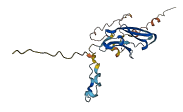
Descriptions
The autoinhibited protein was predicted that may have potential autoinhibitory elements via cis-regPred.
Autoinhibitory domains (AIDs)
Target domain |
|
Relief mechanism |
|
Assay |
cis-regPred |
Accessory elements
No accessory elements
Autoinhibited structure

Activated structure
1 structures for P02518
| Entry ID | Method | Resolution | Chain | Position | Source |
|---|---|---|---|---|---|
| AF-P02518-F1 | Predicted | AlphaFoldDB |
No variants for P02518
| Variant ID(s) | Position | Change | Description | Diseaes Association | Provenance |
|---|---|---|---|---|---|
| No variants for P02518 | |||||
No associated diseases with P02518
1 regional properties for P02518
| Type | Name | Position | InterPro Accession |
|---|---|---|---|
| domain | Alpha crystallin/Hsp20 domain | 71 - 182 | IPR002068 |
3 GO annotations of cellular component
| Name | Definition |
|---|---|
| cytoplasm | The contents of a cell excluding the plasma membrane and nucleus, but including other subcellular structures. |
| endoplasmic reticulum chaperone complex | A protein complex that is located in the endoplasmic reticulum and is composed of chaperone proteins, including BiP, GRP94; CaBP1, protein disulfide isomerase (PDI), ERdj3, cyclophilin B, ERp72, GRP170, UDP-glucosyltransferase, and SDF2-L1. |
| nucleus | A membrane-bounded organelle of eukaryotic cells in which chromosomes are housed and replicated. In most cells, the nucleus contains all of the cell's chromosomes except the organellar chromosomes, and is the site of RNA synthesis and processing. In some species, or in specialized cell types, RNA metabolism or DNA replication may be absent. |
1 GO annotations of molecular function
| Name | Definition |
|---|---|
| unfolded protein binding | Binding to an unfolded protein. |
7 GO annotations of biological process
| Name | Definition |
|---|---|
| behavioral response to starvation | Any process that results in a change in the behavior of an organism as a result of deprivation of nourishment. |
| chaperone-mediated protein folding | The process of inhibiting aggregation and assisting in the covalent and noncovalent assembly of single chain polypeptides or multisubunit complexes into the correct tertiary structure that is dependent on interaction with a chaperone. |
| defense response to bacterium | Reactions triggered in response to the presence of a bacterium that act to protect the cell or organism. |
| defense response to fungus | Reactions triggered in response to the presence of a fungus that act to protect the cell or organism. |
| determination of adult lifespan | The pathways that regulate the duration of the adult phase of the life-cycle of an animal. |
| protein refolding | The process carried out by a cell that restores the biological activity of an unfolded or misfolded protein, using helper proteins such as chaperones. |
| response to heat | Any process that results in a change in state or activity of a cell or an organism (in terms of movement, secretion, enzyme production, gene expression, etc.) as a result of a heat stimulus, a temperature stimulus above the optimal temperature for that organism. |
19 homologous proteins in AiPD
| UniProt AC | Gene Name | Protein Name | Species | Evidence Code |
|---|---|---|---|---|
| Q9UJY1 | HSPB8 | Heat shock protein beta-8 | Homo sapiens (Human) | PR |
| P02511 | CRYAB | Alpha-crystallin B chain | Homo sapiens (Human) | PR |
| Q9JK92 | Hspb8 | Heat shock protein beta-8 | Mus musculus (Mouse) | PR |
| Q9EPX0 | Hspb8 | Heat shock protein beta-8 | Rattus norvegicus (Rat) | PR |
| Q84Q77 | HSP17.9A | 17.9 kDa class I heat shock protein | Oryza sativa subsp japonica (Rice) | PR |
| Q84Q72 | HSP18.1 | 18.1 kDa class I heat shock protein | Oryza sativa subsp japonica (Rice) | PR |
| Q84J50 | HSP17.7 | 17.7 kDa class I heat shock protein | Oryza sativa subsp japonica (Rice) | PR |
| P31673 | HSP17.4 | 17.4 kDa class I heat shock protein | Oryza sativa subsp japonica (Rice) | PR |
| Q943E6 | HSP16.9B | 16.9 kDa class I heat shock protein 2 | Oryza sativa subsp japonica (Rice) | PR |
| P27777 | HSP16.9A | 16.9 kDa class I heat shock protein 1 | Oryza sativa subsp japonica (Rice) | PR |
| Q943E7 | HSP16.9C | 16.9 kDa class I heat shock protein 3 | Oryza sativa subsp japonica (Rice) | PR |
| Q6K7E9 | HSP18.6 | 18.6 kDa class III heat shock protein | Oryza sativa subsp japonica (Rice) | PR |
| Q20363 | sip-1 | Stress-induced protein 1 | Caenorhabditis elegans | PR |
| P30236 | HSP22.0 | 22.0 kDa class IV heat shock protein | Glycine max (Soybean) (Glycine hispida) | PR |
| Q9XIE3 | HSP17.6A | 17.6 kDa class I heat shock protein 1 | Arabidopsis thaliana (Mouse-ear cress) | PR |
| P19037 | HSP18.1 | 18.1 kDa class I heat shock protein | Arabidopsis thaliana (Mouse-ear cress) | PR |
| Q38806 | HSP22.0 | 22.0 kDa heat shock protein | Arabidopsis thaliana (Mouse-ear cress) | PR |
| O49710 | HSP15.4 | 15.4 kDa class V heat shock protein | Arabidopsis thaliana (Mouse-ear cress) | PR |
| A5JV83 | hspb11 | Heat shock protein beta-11 | Danio rerio (Zebrafish) (Brachydanio rerio) | PR |
| 10 | 20 | 30 | 40 | 50 | 60 |
| MSIIPLLHLA | RELDHDYRTD | WGHLLEDDFG | FGVHAHDLFH | PRRLLLPNTL | GLGRRRYSPY |
| 70 | 80 | 90 | 100 | 110 | 120 |
| ERSHGHHNQM | SRRASGGPNA | LLPAVGKDGF | QVCMDVSQFK | PNELTVKVVD | NTVVVEGKHE |
| 130 | 140 | 150 | 160 | 170 | 180 |
| EREDGHGMIQ | RHFVRKYTLP | KGFDPNEVVS | TVSSDGVLTL | KAPPPPSKEQ | AKSERIVQIQ |
| 190 | 200 | 210 | |||
| QTGPAHLSVK | APAPEAGDGK | AENGSGEKME | TSK |