Q38806
Gene name |
HSP22.0 (At4g10250, F24G24.50, T9A4.7) |
Protein name |
22.0 kDa heat shock protein |
Names |
AtHsp22.0 |
Species |
Arabidopsis thaliana (Mouse-ear cress) |
KEGG Pathway |
ath:AT4G10250 |
EC number |
|
Protein Class |
|
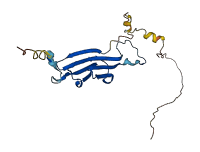
Descriptions
The autoinhibited protein was predicted that may have potential autoinhibitory elements via cis-regPred.
Autoinhibitory domains (AIDs)
Target domain |
|
Relief mechanism |
|
Assay |
cis-regPred |
Accessory elements
No accessory elements
Autoinhibited structure

Activated structure
1 structures for Q38806
| Entry ID | Method | Resolution | Chain | Position | Source |
|---|---|---|---|---|---|
| AF-Q38806-F1 | Predicted | AlphaFoldDB |
34 variants for Q38806
| Variant ID(s) | Position | Change | Description | Diseaes Association | Provenance |
|---|---|---|---|---|---|
| tmp_4_6370551_G_T | 5 | L>F | No | 1000Genomes | |
| ENSVATH00485578 | 6 | L>V | No | 1000Genomes | |
| ENSVATH02772562 | 18 | N>H | No | 1000Genomes | |
| ENSVATH00485580 | 30 | L>F | No | 1000Genomes | |
| tmp_4_6370627_G_C | 31 | E>Q | No | 1000Genomes | |
| tmp_4_6370639_G_A | 35 | G>S | No | 1000Genomes | |
| tmp_4_6370670_G_A | 45 | R>Q | No | 1000Genomes | |
| ENSVATH06601941 | 49 | P>L | No | 1000Genomes | |
| tmp_4_6370693_T_G,C | 53 | L>V | No | 1000Genomes | |
| ENSVATH02772563 | 60 | L>I | No | 1000Genomes | |
| ENSVATH00485584 | 79 | A>V | No | 1000Genomes | |
| ENSVATH00485585 | 80 | E>D | No | 1000Genomes | |
| ENSVATH06601944 | 86 | L>V | No | 1000Genomes | |
| ENSVATH00485586 | 88 | I>V | No | 1000Genomes | |
| ENSVATH11430095 | 93 | K>N | No | 1000Genomes | |
| ENSVATH06601946 | 95 | E>K | No | 1000Genomes | |
| ENSVATH06601947 | 96 | V>I | No | 1000Genomes | |
| tmp_4_6370832_A_C | 99 | E>A | No | 1000Genomes | |
| ENSVATH11430096 | 113 | K>E | No | 1000Genomes | |
| tmp_4_6370897_G_A | 121 | D>N | No | 1000Genomes | |
| tmp_4_6370913_T_G | 126 | V>G | No | 1000Genomes | |
| tmp_4_6370966_G_A | 144 | D>N | No | 1000Genomes | |
| tmp_4_6370972_G_T | 146 | E>* | No | 1000Genomes | |
| ENSVATH00485589 | 147 | S>L | No | 1000Genomes | |
| ENSVATH02772567 | 152 | L>I | No | 1000Genomes | |
| ENSVATH00485590 | 162 | T>M | No | 1000Genomes | |
| ENSVATH02772568 | 166 | P>S | No | 1000Genomes | |
| ENSVATH11430098 | 169 | V>F | No | 1000Genomes | |
| ENSVATH11430098 | 169 | V>I | No | 1000Genomes | |
| tmp_4_6371050_C_T | 172 | P>S | No | 1000Genomes | |
| ENSVATH00485593 | 181 | E>K | No | 1000Genomes | |
| ENSVATH00485594 | 188 | S>R | No | 1000Genomes | |
| ENSVATH02772570 | 189 | S>T | No | 1000Genomes | |
| ENSVATH02772571 | 191 | E>G | No | 1000Genomes |
No associated diseases with Q38806
1 regional properties for Q38806
| Type | Name | Position | InterPro Accession |
|---|---|---|---|
| domain | Histone H2A/H2B/H3 | 1 - 132 | IPR007125 |
1 GO annotations of cellular component
| Name | Definition |
|---|---|
| endoplasmic reticulum | The irregular network of unit membranes, visible only by electron microscopy, that occurs in the cytoplasm of many eukaryotic cells. The membranes form a complex meshwork of tubular channels, which are often expanded into slitlike cavities called cisternae. The ER takes two forms, rough (or granular), with ribosomes adhering to the outer surface, and smooth (with no ribosomes attached). |
2 GO annotations of molecular function
| Name | Definition |
|---|---|
| protein self-association | Binding to a domain within the same polypeptide. |
| unfolded protein binding | Binding to an unfolded protein. |
6 GO annotations of biological process
| Name | Definition |
|---|---|
| cellular response to hypoxia | Any process that results in a change in state or activity of a cell (in terms of movement, secretion, enzyme production, gene expression, etc.) as a result of a stimulus indicating lowered oxygen tension. Hypoxia, defined as a decline in O2 levels below normoxic levels of 20.8 - 20.95%, results in metabolic adaptation at both the cellular and organismal level. |
| protein complex oligomerization | The process of creating protein oligomers, compounds composed of a small number, usually between three and ten, of component monomers; protein oligomers may be composed of different or identical monomers. Oligomers may be formed by the polymerization of a number of monomers or the depolymerization of a large protein polymer. |
| protein folding | The process of assisting in the covalent and noncovalent assembly of single chain polypeptides or multisubunit complexes into the correct tertiary structure. |
| response to heat | Any process that results in a change in state or activity of a cell or an organism (in terms of movement, secretion, enzyme production, gene expression, etc.) as a result of a heat stimulus, a temperature stimulus above the optimal temperature for that organism. |
| response to hydrogen peroxide | Any process that results in a change in state or activity of a cell or an organism (in terms of movement, secretion, enzyme production, gene expression, etc.) as a result of a hydrogen peroxide (H2O2) stimulus. |
| response to salt stress | Any process that results in a change in state or activity of a cell or an organism (in terms of movement, secretion, enzyme production, gene expression, etc.) as a result of a stimulus indicating an increase or decrease in the concentration of salt (particularly but not exclusively sodium and chloride ions) in the environment. |
17 homologous proteins in AiPD
| UniProt AC | Gene Name | Protein Name | Species | Evidence Code |
|---|---|---|---|---|
| P02518 | Hsp27 | Heat shock protein 27 | Drosophila melanogaster (Fruit fly) | PR |
| P02511 | CRYAB | Alpha-crystallin B chain | Homo sapiens (Human) | PR |
| Q9UJY1 | HSPB8 | Heat shock protein beta-8 | Homo sapiens (Human) | PR |
| Q943E7 | HSP16.9C | 16.9 kDa class I heat shock protein 3 | Oryza sativa subsp japonica (Rice) | PR |
| P27777 | HSP16.9A | 16.9 kDa class I heat shock protein 1 | Oryza sativa subsp japonica (Rice) | PR |
| Q943E6 | HSP16.9B | 16.9 kDa class I heat shock protein 2 | Oryza sativa subsp japonica (Rice) | PR |
| Q6K7E9 | HSP18.6 | 18.6 kDa class III heat shock protein | Oryza sativa subsp japonica (Rice) | PR |
| Q84Q77 | HSP17.9A | 17.9 kDa class I heat shock protein | Oryza sativa subsp japonica (Rice) | PR |
| P31673 | HSP17.4 | 17.4 kDa class I heat shock protein | Oryza sativa subsp japonica (Rice) | PR |
| Q84Q72 | HSP18.1 | 18.1 kDa class I heat shock protein | Oryza sativa subsp japonica (Rice) | PR |
| Q84J50 | HSP17.7 | 17.7 kDa class I heat shock protein | Oryza sativa subsp japonica (Rice) | PR |
| P30236 | HSP22.0 | 22.0 kDa class IV heat shock protein | Glycine max (Soybean) (Glycine hispida) | PR |
| O49710 | HSP15.4 | 15.4 kDa class V heat shock protein | Arabidopsis thaliana (Mouse-ear cress) | PR |
| O64564 | HSP18.5 | 18.5 kDa class IV heat shock protein | Arabidopsis thaliana (Mouse-ear cress) | PR |
| P19037 | HSP18.1 | 18.1 kDa class I heat shock protein | Arabidopsis thaliana (Mouse-ear cress) | PR |
| Q9XIE3 | HSP17.6A | 17.6 kDa class I heat shock protein 1 | Arabidopsis thaliana (Mouse-ear cress) | PR |
| P30221 | 17.8 kDa class I heat shock protein | Solanum lycopersicum (Tomato) (Lycopersicon esculentum) | PR |
| 10 | 20 | 30 | 40 | 50 | 60 |
| MMKHLLSIFF | IGALLLGNIK | TSEGSLSSAL | ETTPGSLLSD | LWLDRFPDPF | KILERIPLGL |
| 70 | 80 | 90 | 100 | 110 | 120 |
| ERDTSVALSP | ARVDWKETAE | GHEIMLDIPG | LKKDEVKIEV | EENGVLRVSG | ERKREEEKKG |
| 130 | 140 | 150 | 160 | 170 | 180 |
| DQWHRVERSY | GKFWRQFKLP | DNVDMESVKA | KLENGVLTIN | LTKLSPEKVK | GPRVVNIAAE |
| 190 | |||||
| EDQTAKISSS | ESKEL |