P31673
Gene name |
HSP17.4 (Os03g0266900, LOC_Os03g16020, OJ1364E02.10, OsJ_10261) |
Protein name |
17.4 kDa class I heat shock protein |
Names |
17.4 kDa heat shock protein, OsHsp17.4 |
Species |
Oryza sativa subsp japonica (Rice) |
KEGG Pathway |
osa:4332360 |
EC number |
|
Protein Class |
|
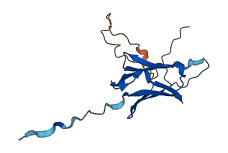
Descriptions
The autoinhibited protein was predicted that may have potential autoinhibitory elements via cis-regPred.
Autoinhibitory domains (AIDs)
Target domain |
|
Relief mechanism |
|
Assay |
cis-regPred |
Accessory elements
No accessory elements
Autoinhibited structure

Activated structure
1 structures for P31673
| Entry ID | Method | Resolution | Chain | Position | Source |
|---|---|---|---|---|---|
| AF-P31673-F1 | Predicted | AlphaFoldDB |
No variants for P31673
| Variant ID(s) | Position | Change | Description | Diseaes Association | Provenance |
|---|---|---|---|---|---|
| No variants for P31673 | |||||
No associated diseases with P31673
1 GO annotations of cellular component
| Name | Definition |
|---|---|
| cytoplasm | The contents of a cell excluding the plasma membrane and nucleus, but including other subcellular structures. |
2 GO annotations of molecular function
| Name | Definition |
|---|---|
| protein self-association | Binding to a domain within the same polypeptide. |
| unfolded protein binding | Binding to an unfolded protein. |
9 GO annotations of biological process
| Name | Definition |
|---|---|
| protein complex oligomerization | The process of creating protein oligomers, compounds composed of a small number, usually between three and ten, of component monomers; protein oligomers may be composed of different or identical monomers. Oligomers may be formed by the polymerization of a number of monomers or the depolymerization of a large protein polymer. |
| protein folding | The process of assisting in the covalent and noncovalent assembly of single chain polypeptides or multisubunit complexes into the correct tertiary structure. |
| response to arsenic-containing substance | Any process that results in a change in state or activity of a cell or an organism (in terms of movement, secretion, enzyme production, gene expression, etc.) as a result of an arsenic stimulus from compounds containing arsenic, including arsenates, arsenites, and arsenides. |
| response to cadmium ion | Any process that results in a change in state or activity of a cell or an organism (in terms of movement, secretion, enzyme production, gene expression, etc.) as a result of a cadmium (Cd) ion stimulus. |
| response to copper ion | Any process that results in a change in state or activity of a cell or an organism (in terms of movement, secretion, enzyme production, gene expression, etc.) as a result of a copper ion stimulus. |
| response to ethanol | Any process that results in a change in state or activity of a cell or an organism (in terms of movement, secretion, enzyme production, gene expression, etc.) as a result of an ethanol stimulus. |
| response to heat | Any process that results in a change in state or activity of a cell or an organism (in terms of movement, secretion, enzyme production, gene expression, etc.) as a result of a heat stimulus, a temperature stimulus above the optimal temperature for that organism. |
| response to hydrogen peroxide | Any process that results in a change in state or activity of a cell or an organism (in terms of movement, secretion, enzyme production, gene expression, etc.) as a result of a hydrogen peroxide (H2O2) stimulus. |
| response to salt stress | Any process that results in a change in state or activity of a cell or an organism (in terms of movement, secretion, enzyme production, gene expression, etc.) as a result of a stimulus indicating an increase or decrease in the concentration of salt (particularly but not exclusively sodium and chloride ions) in the environment. |
17 homologous proteins in AiPD
| UniProt AC | Gene Name | Protein Name | Species | Evidence Code |
|---|---|---|---|---|
| Q8MJ36 | HSPB8 | Heat shock protein beta-8 | Canis lupus familiaris (Dog) (Canis familiaris) | PR |
| P02518 | Hsp27 | Heat shock protein 27 | Drosophila melanogaster (Fruit fly) | PR |
| Q9EPX0 | Hspb8 | Heat shock protein beta-8 | Rattus norvegicus (Rat) | PR |
| P27777 | HSP16.9A | 16.9 kDa class I heat shock protein 1 | Oryza sativa subsp japonica (Rice) | PR |
| Q6K7E9 | HSP18.6 | 18.6 kDa class III heat shock protein | Oryza sativa subsp japonica (Rice) | PR |
| Q84J50 | HSP17.7 | 17.7 kDa class I heat shock protein | Oryza sativa subsp japonica (Rice) | PR |
| Q84Q72 | HSP18.1 | 18.1 kDa class I heat shock protein | Oryza sativa subsp japonica (Rice) | PR |
| Q84Q77 | HSP17.9A | 17.9 kDa class I heat shock protein | Oryza sativa subsp japonica (Rice) | PR |
| Q943E6 | HSP16.9B | 16.9 kDa class I heat shock protein 2 | Oryza sativa subsp japonica (Rice) | PR |
| Q943E7 | HSP16.9C | 16.9 kDa class I heat shock protein 3 | Oryza sativa subsp japonica (Rice) | PR |
| P30236 | HSP22.0 | 22.0 kDa class IV heat shock protein | Glycine max (Soybean) (Glycine hispida) | PR |
| Q9XIE3 | HSP17.6A | 17.6 kDa class I heat shock protein 1 | Arabidopsis thaliana (Mouse-ear cress) | PR |
| O64564 | HSP18.5 | 18.5 kDa class IV heat shock protein | Arabidopsis thaliana (Mouse-ear cress) | PR |
| Q38806 | HSP22.0 | 22.0 kDa heat shock protein | Arabidopsis thaliana (Mouse-ear cress) | PR |
| O49710 | HSP15.4 | 15.4 kDa class V heat shock protein | Arabidopsis thaliana (Mouse-ear cress) | PR |
| P19037 | HSP18.1 | 18.1 kDa class I heat shock protein | Arabidopsis thaliana (Mouse-ear cress) | PR |
| P30221 | 17.8 kDa class I heat shock protein | Solanum lycopersicum (Tomato) (Lycopersicon esculentum) | PR |
| 10 | 20 | 30 | 40 | 50 | 60 |
| MSMIRRSNVF | DPFSLDLWDP | FDGFPFGSGS | GSLFPRANSD | AAAFAGARID | WKETPEAHVF |
| 70 | 80 | 90 | 100 | 110 | 120 |
| KADVPGLKKE | EVKVEVEDGN | VLQISGERIK | EQEEKTDKWH | RVERSSGKFL | RRFRLPENTK |
| 130 | 140 | 150 | |||
| PEQIKASMEN | GVLTVTVPKE | EPKKPDVKSI | QITG |