O08529
Gene name |
Capn2 |
Protein name |
Calpain-2 catalytic subunit |
Names |
80 kDa M-calpain subunit, CALP80, Calcium-activated neutral proteinase 2, CANP 2, Calpain M-type, Calpain-2 large subunit, Millimolar-calpain, M-calpain |
Species |
Mus musculus (Mouse) |
KEGG Pathway |
mmu:12334 |
EC number |
3.4.22.53: Cysteine endopeptidases |
Protein Class |
|
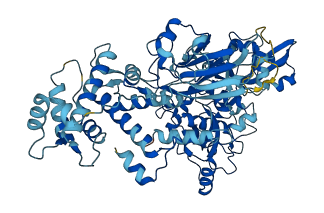
Descriptions
The autoinhibited protein was predicted that may have potential autoinhibitory elements via cis-regPred.
Autoinhibitory domains (AIDs)
Target domain |
|
Relief mechanism |
|
Assay |
cis-regPred |
Accessory elements
No accessory elements
Autoinhibited structure

Activated structure
1 structures for O08529
| Entry ID | Method | Resolution | Chain | Position | Source |
|---|---|---|---|---|---|
| AF-O08529-F1 | Predicted | AlphaFoldDB |
25 variants for O08529
| Variant ID(s) | Position | Change | Description | Diseaes Association | Provenance |
|---|---|---|---|---|---|
| rs213824039 | 6 | I>M | No | EVA | |
| rs3388520236 | 102 | L>R | No | EVA | |
| rs3388523078 | 139 | F>I | No | EVA | |
| rs3388519727 | 194 | A>T | No | EVA | |
| rs3388522503 | 233 | E>K | No | EVA | |
| rs3388524345 | 249 | D>E | No | EVA | |
| rs3388517663 | 251 | E>A | No | EVA | |
| rs3388523030 | 280 | K>I | No | EVA | |
| rs3388522852 | 285 | R>S | No | EVA | |
| rs3388520240 | 286 | N>S | No | EVA | |
| rs3388519794 | 287 | P>L | No | EVA | |
| rs3388519759 | 350 | C>S | No | EVA | |
| rs3391087559 | 380 | T>L | No | EVA | |
| rs3388517591 | 389 | I>F | No | EVA | |
| rs262722660 | 398 | E>D | No | EVA | |
| rs3388520251 | 411 | L>P | No | EVA | |
| rs3388522091 | 418 | R>Q | No | EVA | |
| rs3388522872 | 435 | E>D | No | EVA | |
| rs3388523050 | 455 | T>I | No | EVA | |
| rs3412829890 | 479 | P>S | No | EVA | |
| rs31473206 | 525 | A>T | No | EVA | |
| rs3388521597 | 532 | D>E | No | EVA | |
| rs3388522463 | 671 | T>M | No | EVA | |
| rs3388521593 | 674 | K>T | No | EVA | |
| rs3388522016 | 693 | S>* | No | EVA |
No associated diseases with O08529
2 regional properties for O08529
| Type | Name | Position | InterPro Accession |
|---|---|---|---|
| conserved_site | UbiE/COQ5 methyltransferase, conserved site | 33 - 48 | IPR023576-1 |
| conserved_site | UbiE/COQ5 methyltransferase, conserved site | 159 - 173 | IPR023576-2 |
Functions
| Description | ||
|---|---|---|
| EC Number | 3.4.22.53 | Cysteine endopeptidases |
| Subcellular Localization |
|
|
| PANTHER Family | ||
| PANTHER Subfamily | ||
| PANTHER Protein Class | ||
| PANTHER Pathway Category | No pathway information available | |
19 GO annotations of cellular component
| Name | Definition |
|---|---|
| calpain complex | A calcium-dependent protease complex that processes its substrate by limited proteolysis rather than degrading it. In some cases limited proteolysis is required for the activation of its substrate. |
| cell projection | A prolongation or process extending from a cell, e.g. a flagellum or axon. |
| chromatin | The ordered and organized complex of DNA, protein, and sometimes RNA, that forms the chromosome. |
| cytoplasm | The contents of a cell excluding the plasma membrane and nucleus, but including other subcellular structures. |
| cytosol | The part of the cytoplasm that does not contain organelles but which does contain other particulate matter, such as protein complexes. |
| dendrite | A neuron projection that has a short, tapering, morphology. Dendrites receive and integrate signals from other neurons or from sensory stimuli, and conduct nerve impulses towards the axon or the cell body. In most neurons, the impulse is conveyed from dendrites to axon via the cell body, but in some types of unipolar neuron, the impulse does not travel via the cell body. |
| endoplasmic reticulum | The irregular network of unit membranes, visible only by electron microscopy, that occurs in the cytoplasm of many eukaryotic cells. The membranes form a complex meshwork of tubular channels, which are often expanded into slitlike cavities called cisternae. The ER takes two forms, rough (or granular), with ribosomes adhering to the outer surface, and smooth (with no ribosomes attached). |
| external side of plasma membrane | The leaflet of the plasma membrane that faces away from the cytoplasm and any proteins embedded or anchored in it or attached to its surface. |
| focal adhesion | A cell-substrate junction that anchors the cell to the extracellular matrix and that forms a point of termination of actin filaments. In insects focal adhesion has also been referred to as hemi-adherens junction (HAJ). |
| Golgi apparatus | A membrane-bound cytoplasmic organelle of the endomembrane system that further processes the core oligosaccharides (e.g. N-glycans) added to proteins in the endoplasmic reticulum and packages them into membrane-bound vesicles. The Golgi apparatus operates at the intersection of the secretory, lysosomal, and endocytic pathways. |
| lysosome | A small lytic vacuole that has cell cycle-independent morphology found in most animal cells and that contains a variety of hydrolases, most of which have their maximal activities in the pH range 5-6. The contained enzymes display latency if properly isolated. About 40 different lysosomal hydrolases are known and lysosomes have a great variety of morphologies and functions. |
| membrane | A lipid bilayer along with all the proteins and protein complexes embedded in it an attached to it. |
| membrane raft | Any of the small (10-200 nm), heterogeneous, highly dynamic, sterol- and sphingolipid-enriched membrane domains that compartmentalize cellular processes. Small rafts can sometimes be stabilized to form larger platforms through protein-protein and protein-lipid interactions. |
| mitochondrial intermembrane space | The region between the inner and outer lipid bilayers of the mitochondrial envelope. |
| neuronal cell body | The portion of a neuron that includes the nucleus, but excludes cell projections such as axons and dendrites. |
| nucleus | A membrane-bounded organelle of eukaryotic cells in which chromosomes are housed and replicated. In most cells, the nucleus contains all of the cell's chromosomes except the organellar chromosomes, and is the site of RNA synthesis and processing. In some species, or in specialized cell types, RNA metabolism or DNA replication may be absent. |
| perinuclear endoplasmic reticulum | The portion of endoplasmic reticulum, the intracellular network of tubules and cisternae, that occurs near the nucleus. The lumen of the perinuclear endoplasmic reticulum is contiguous with the nuclear envelope lumen (also called perinuclear space), the region between the inner and outer nuclear membranes. |
| plasma membrane | The membrane surrounding a cell that separates the cell from its external environment. It consists of a phospholipid bilayer and associated proteins. |
| pseudopodium | A temporary protrusion or retractile process of a cell, associated with flowing movements of the protoplasm, and serving for locomotion and feeding. |
6 GO annotations of molecular function
| Name | Definition |
|---|---|
| calcium ion binding | Binding to a calcium ion (Ca2+). |
| calcium-dependent cysteine-type endopeptidase activity | Catalysis of the hydrolysis of nonterminal peptide bonds in a polypeptide chain by a mechanism using a cysteine residue at the enzyme active center, and requiring the presence of calcium. |
| cytoskeletal protein binding | Binding to a protein component of a cytoskeleton (actin, microtubule, or intermediate filament cytoskeleton). |
| enzyme binding | Binding to an enzyme, a protein with catalytic activity. |
| peptidase activity | Catalysis of the hydrolysis of a peptide bond. A peptide bond is a covalent bond formed when the carbon atom from the carboxyl group of one amino acid shares electrons with the nitrogen atom from the amino group of a second amino acid. |
| protein-containing complex binding | Binding to a macromolecular complex. |
20 GO annotations of biological process
| Name | Definition |
|---|---|
| behavioral response to pain | Any process that results in a change in the behavior of an organism as a result of a pain stimulus. Pain stimuli cause activation of nociceptors, peripheral receptors for pain, include receptors which are sensitive to painful mechanical stimuli, extreme heat or cold, and chemical stimuli. |
| blastocyst development | The process whose specific outcome is the progression of the blastocyst over time, from its formation to the mature structure. The mammalian blastocyst is a hollow ball of cells containing two cell types, the inner cell mass and the trophectoderm. |
| cellular response to amino acid stimulus | Any process that results in a change in state or activity of a cell (in terms of movement, secretion, enzyme production, gene expression, etc.) as a result of an amino acid stimulus. An amino acid is a carboxylic acids containing one or more amino groups. |
| cellular response to interferon-beta | Any process that results in a change in state or activity of a cell (in terms of movement, secretion, enzyme production, gene expression, etc.) as a result of an interferon-beta stimulus. Interferon-beta is a type I interferon. |
| cellular response to lipopolysaccharide | Any process that results in a change in state or activity of a cell (in terms of movement, secretion, enzyme production, gene expression, etc.) as a result of a lipopolysaccharide stimulus; lipopolysaccharide is a major component of the cell wall of gram-negative bacteria. |
| female pregnancy | The set of physiological processes that allow an embryo or foetus to develop within the body of a female animal. It covers the time from fertilization of a female ovum by a male spermatozoon until birth. |
| myoblast fusion | A process in which non-proliferating myoblasts fuse to existing fibers or to myotubes to form new fibers. A myoblast is a mononucleate cell type that, by fusion with other myoblasts, gives rise to the myotubes that eventually develop into skeletal muscle fibers. |
| positive regulation of cardiac muscle cell apoptotic process | Any process that increases the rate or extent of cardiac cell apoptotic process, a form of programmed cell death induced by external or internal signals that trigger the activity of proteolytic caspases whose actions dismantle a cardiac muscle cell and result in its death. |
| positive regulation of myoblast fusion | Any process that activates or increases the frequency, rate or extent of myoblast fusion. |
| positive regulation of neuron death | Any process that activates or increases the frequency, rate or extent of neuron death. |
| positive regulation of phosphatidylcholine biosynthetic process | Any process that activates or increases the frequency, rate or extent of phosphatidylcholine biosynthetic process. |
| protein autoprocessing | Processing which a protein carries out itself. This involves actions such as the autolytic removal of residues to generate the mature form of the protein. |
| protein catabolic process | The chemical reactions and pathways resulting in the breakdown of a protein by the destruction of the native, active configuration, with or without the hydrolysis of peptide bonds. |
| proteolysis | The hydrolysis of proteins into smaller polypeptides and/or amino acids by cleavage of their peptide bonds. |
| proteolysis involved in protein catabolic process | The hydrolysis of a peptide bond or bonds within a protein as part of the chemical reactions and pathways resulting in the breakdown of a protein by individual cells. |
| regulation of cytoskeleton organization | Any process that modulates the frequency, rate or extent of the formation, arrangement of constituent parts, or disassembly of cytoskeletal structures. |
| regulation of interleukin-6 production | Any process that modulates the frequency, rate, or extent of interleukin-6 production. |
| response to hydrogen peroxide | Any process that results in a change in state or activity of a cell or an organism (in terms of movement, secretion, enzyme production, gene expression, etc.) as a result of a hydrogen peroxide (H2O2) stimulus. |
| response to hypoxia | Any process that results in a change in state or activity of a cell or an organism (in terms of movement, secretion, enzyme production, gene expression, etc.) as a result of a stimulus indicating lowered oxygen tension. Hypoxia, defined as a decline in O2 levels below normoxic levels of 20.8 - 20.95%, results in metabolic adaptation at both the cellular and organismal level. |
| response to mechanical stimulus | Any process that results in a change in state or activity of a cell or an organism (in terms of movement, secretion, enzyme production, gene expression, etc.) as a result of a mechanical stimulus. |
19 homologous proteins in AiPD
| UniProt AC | Gene Name | Protein Name | Species | Evidence Code |
|---|---|---|---|---|
| Q27970 | CAPN1 | Calpain-1 catalytic subunit | Bos taurus (Bovine) | PR |
| Q27971 | CAPN2 | Calpain-2 catalytic subunit | Bos taurus (Bovine) | PR |
| P00789 | Calpain-1 catalytic subunit | Gallus gallus (Chicken) | PR | |
| Q9VXH6 | CalpC | Calpain-C | Drosophila melanogaster (Fruit fly) | PR |
| O14815 | CAPN9 | Calpain-9 | Homo sapiens (Human) | PR |
| Q6MZZ7 | CAPN13 | Calpain-13 | Homo sapiens (Human) | PR |
| Q9HC96 | CAPN10 | Calpain-10 | Homo sapiens (Human) | PR |
| P07384 | CAPN1 | Calpain-1 catalytic subunit | Homo sapiens (Human) | PR |
| G3UZ78 | Adgb | Androglobin | Mus musculus (Mouse) | PR |
| O35350 | Capn1 | Calpain-1 catalytic subunit | Mus musculus (Mouse) | PR |
| Q3UW68 | Capn13 | Calpain-13 | Mus musculus (Mouse) | PR |
| Q9D805 | Capn9 | Calpain-9 | Mus musculus (Mouse) | PR |
| Q9ESK3 | Capn10 | Calpain-10 | Mus musculus (Mouse) | PR |
| P35750 | CAPN1 | Calpain-1 catalytic subunit | Sus scrofa (Pig) | PR |
| P43367 | CAPN2 | Calpain-2 catalytic subunit | Sus scrofa (Pig) | PR |
| O35920 | Capn9 | Calpain-9 | Rattus norvegicus (Rat) | PR |
| P97571 | Capn1 | Calpain-1 catalytic subunit | Rattus norvegicus (Rat) | PR |
| Q5BK10 | Capn13 | Calpain-13 | Rattus norvegicus (Rat) | PR |
| Q07009 | Capn2 | Calpain-2 catalytic subunit | Rattus norvegicus (Rat) | PR |
| 10 | 20 | 30 | 40 | 50 | 60 |
| MAGIAIKLAK | DREAAEGLGS | HERAIKYLNQ | DYETLRNECL | EAGALFQDPS | FPALPSSLGY |
| 70 | 80 | 90 | 100 | 110 | 120 |
| KELGPYSSKT | RGIEWKRPTE | ICADPQFIIG | GATRTDICQG | ALGDCWLLAA | IASLTLNEEI |
| 130 | 140 | 150 | 160 | 170 | 180 |
| LARVVPPDQS | FQENYAGIFH | FQFWQYGEWV | EVVVDDRLPT | KDGELLFVHS | AEGSEFWSAL |
| 190 | 200 | 210 | 220 | 230 | 240 |
| LEKAYAKING | CYEALSGGAT | TEGFEDFTGG | IAEWYELRKP | PPNLFKIIQK | ALEKGSLLGC |
| 250 | 260 | 270 | 280 | 290 | 300 |
| SIDITSAADS | EAVTYQKLVK | GHAYSVTGAE | EVESSGSLQK | LIRIRNPWGQ | VEWTGKWNDN |
| 310 | 320 | 330 | 340 | 350 | 360 |
| CPSWNTVDPE | VRANLTERQE | DGEFWMSFSD | FLRHYSRLEI | CNLTPDTLTC | DSYKKWKLTK |
| 370 | 380 | 390 | 400 | 410 | 420 |
| MDGNWRRGST | AGGCRNYPNT | FWMNPQYLIK | LEEEDEDEED | GERGCTFLVG | LIQKHRRRQR |
| 430 | 440 | 450 | 460 | 470 | 480 |
| KMGEDMHTIG | FGIYEVPEEL | TGQTNIHLGK | NFFLTTRARE | RSDTFINLRE | VLNRFKLPPG |
| 490 | 500 | 510 | 520 | 530 | 540 |
| EYVLVPSTFE | PHKDGDFCIR | VFSEKKADYQ | AVDDEIEANI | EEIDANEEDI | DDGFRRLFVQ |
| 550 | 560 | 570 | 580 | 590 | 600 |
| LAGEDAEISA | FELQTILRRV | LAKRQDIKSD | GFSIETCKIM | VDMLDEDGSG | KLGLKEFYIL |
| 610 | 620 | 630 | 640 | 650 | 660 |
| WTKIQKYQKI | YREIDVDRSG | TMNSYEMRKA | LEEAGFKLPC | QLHQVIVARF | ADDELIIDFD |
| 670 | 680 | 690 | |||
| NFVRCLVRLE | TLFKIFKQLD | PENTGTIQLN | LASWLSFSVL |