Q924C9
Gene name |
Slc26a3 (Dra) |
Protein name |
Chloride anion exchanger |
Names |
Down-regulated in adenoma, Protein DRA, Solute carrier family 26 member 3 |
Species |
Rattus norvegicus (Rat) |
KEGG Pathway |
rno:114629 |
EC number |
|
Protein Class |
|
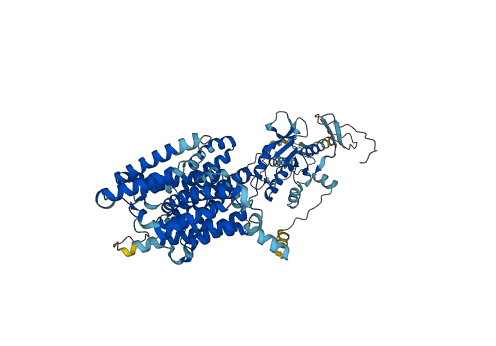
Descriptions
The autoinhibited protein was predicted that may have potential autoinhibitory elements via cis-regPred.
Autoinhibitory domains (AIDs)
Target domain |
|
Relief mechanism |
|
Assay |
cis-regPred |
Accessory elements
No accessory elements
Autoinhibited structure

Activated structure
1 structures for Q924C9
| Entry ID | Method | Resolution | Chain | Position | Source |
|---|---|---|---|---|---|
| AF-Q924C9-F1 | Predicted | AlphaFoldDB |
2 variants for Q924C9
| Variant ID(s) | Position | Change | Description | Diseaes Association | Provenance |
|---|---|---|---|---|---|
| rs3320789801 | 146 | S>L | No | EVA | |
| rs107495477 | 616 | T>M | No | EVA |
No associated diseases with Q924C9
Functions
5 GO annotations of cellular component
| Name | Definition |
|---|---|
| apical plasma membrane | The region of the plasma membrane located at the apical end of the cell. |
| brush border membrane | The portion of the plasma membrane surrounding the brush border. |
| integral component of plasma membrane | The component of the plasma membrane consisting of the gene products and protein complexes having at least some part of their peptide sequence embedded in the hydrophobic region of the membrane. |
| membrane | A lipid bilayer along with all the proteins and protein complexes embedded in it an attached to it. |
| sperm midpiece | The highly organized segment of the sperm flagellum which begins at the connecting piece and is characterized by the presence of 9 outer dense fibers (ODFs) that lie outside each of the 9 outer axonemal microtubule doublets and by a sheath of mitochondria that encloses the ODFs and the axoneme; the midpiece terminates about one-fourth of the way down the sperm flagellum at the annulus, which marks the beginning of the principal piece. |
6 GO annotations of molecular function
| Name | Definition |
|---|---|
| antiporter activity | Enables the active transport of a solute across a membrane by a mechanism whereby two or more species are transported in opposite directions in a tightly coupled process not directly linked to a form of energy other than chemiosmotic energy. The reaction is: solute A(out) + solute B(in) = solute A(in) + solute B(out). |
| bicarbonate transmembrane transporter activity | Enables the transfer of bicarbonate from one side of a membrane to the other. Bicarbonate is the hydrogencarbonate ion, HCO3-. |
| chloride transmembrane transporter activity | Enables the transfer of chloride ions from one side of a membrane to the other. |
| oxalate transmembrane transporter activity | Enables the transfer of oxalate from one side of a membrane to the other. Oxalate, or ethanedioic acid, occurs in many plants and is highly toxic to animals. |
| secondary active sulfate transmembrane transporter activity | Enables the secondary active transfer of sulfate from one side of a membrane to the other. Secondary active transport is the transfer of a solute across a membrane, up its concentration gradient. The transporter binds the solute and undergoes a series of conformational changes. Transport works equally well in either direction and is driven by a chemiosmotic source of energy. Secondary active transporters include symporters and antiporters. |
| sulfate transmembrane transporter activity | Enables the transfer of sulfate ions, SO4(2-), from one side of a membrane to the other. |
5 GO annotations of biological process
| Name | Definition |
|---|---|
| anion transmembrane transport | The process in which an anion is transported across a membrane. |
| cellular response to cAMP | Any process that results in a change in state or activity of a cell (in terms of movement, secretion, enzyme production, gene expression, etc.) as a result of a cAMP (cyclic AMP, adenosine 3',5'-cyclophosphate) stimulus. |
| intracellular pH elevation | Any process that increases the internal pH of a cell, measured by the concentration of the hydrogen ion. |
| membrane hyperpolarization | The process in which membrane potential increases with respect to its steady-state potential, usually from negative potential to a more negative potential. For example, during the repolarization phase of an action potential the membrane potential often becomes more negative or hyperpolarized before returning to the steady-state resting potential. |
| sperm capacitation | A process required for sperm to reach fertilization competence. Sperm undergo an incompletely understood series of morphological and molecular maturational processes, termed capacitation, involving, among other processes, protein tyrosine phosphorylation and increased intracellular calcium. |
15 homologous proteins in AiPD
| UniProt AC | Gene Name | Protein Name | Species | Evidence Code |
|---|---|---|---|---|
| A6QNW6 | SLC26A8 | Testis anion transporter 1 | Bos taurus (Bovine) | PR |
| P50443 | SLC26A2 | Sulfate transporter | Homo sapiens (Human) | PR |
| P58743 | SLC26A5 | Prestin | Homo sapiens (Human) | PR |
| Q8TE54 | SLC26A7 | Anion exchange transporter | Homo sapiens (Human) | PR |
| Q86WA9 | SLC26A11 | Sodium-independent sulfate anion transporter | Homo sapiens (Human) | PR |
| Q96RN1 | SLC26A8 | Testis anion transporter 1 | Homo sapiens (Human) | PR |
| Q9R155 | Slc26a4 | Pendrin | Mus musculus (Mouse) | PR |
| Q99NH7 | Slc26a5 | Prestin | Mus musculus (Mouse) | PR |
| Q8R0C3 | Slc26a8 | Testis anion transporter 1 | Mus musculus (Mouse) | PR |
| Q9WVC8 | Slc26a3 | Chloride anion exchanger | Mus musculus (Mouse) | PR |
| Q9EPH0 | Slc26a5 | Prestin | Rattus norvegicus (Rat) | PR |
| Q02920 | Early nodulin-70 | Glycine max (Soybean) (Glycine hispida) | PR | |
| Q9FY46 | SULTR4;1 | Sulfate transporter 4.1, chloroplastic | Arabidopsis thaliana (Mouse-ear cress) | PR |
| Q9SV13 | SULTR3;1 | Sulfate transporter 3.1 | Arabidopsis thaliana (Mouse-ear cress) | PR |
| Q8GYH8 | SULTR4;2 | Probable sulfate transporter 4.2 | Arabidopsis thaliana (Mouse-ear cress) | PR |
| 10 | 20 | 30 | 40 | 50 | 60 |
| MIEAIGNQYV | VARPVYSTKA | FGEEFKKTYG | HHKTFLDHLK | GCCSCSSQKA | KKIALSLFPI |
| 70 | 80 | 90 | 100 | 110 | 120 |
| ASWLPAYKIK | EWLLSDIVSG | ISTGLVAVLQ | GLAFALLVNI | PPAYGLYAAF | FPVITYFFLG |
| 130 | 140 | 150 | 160 | 170 | 180 |
| TSRHISVGPF | PVLSMMVGVV | VTRVASGSDT | SPALSSSSAE | NDSMIEEKVM | VAASVTVLSG |
| 190 | 200 | 210 | 220 | 230 | 240 |
| IIQLLLGVLQ | IGFVVIYLSE | SLISGFTTAA | AIHVLVSQLK | FMLQLTVPAH | SDPFSIFKVL |
| 250 | 260 | 270 | 280 | 290 | 300 |
| ESVFSQIQKT | NIADLVTSVI | ILVVVFVVKE | INQRYRSKLP | VPIPIELIMT | VIATGISYGC |
| 310 | 320 | 330 | 340 | 350 | 360 |
| NFEQRFGVAV | VGNMSLGFQP | PITPSVEVFQ | DTIGDCFGIA | IVGFAVAFSV | ASVYSLKYDY |
| 370 | 380 | 390 | 400 | 410 | 420 |
| PIDGNQELIA | LGVSNIFTGA | FKGFAGSTAL | SRSGVQESTG | GKTQVAGLLS | AVIVLIVIVA |
| 430 | 440 | 450 | 460 | 470 | 480 |
| IGFLLQPLQK | SVLAALALGN | LKGMLMQFAE | IGRLWKKDKY | DCLIWIMTFI | FAIVLGLGLG |
| 490 | 500 | 510 | 520 | 530 | 540 |
| LAASVAFQLL | TIVFRTQFPK | CSTLANVGRS | NIYKNKKNYA | DVYEPEGVKI | FRCPSPIYFA |
| 550 | 560 | 570 | 580 | 590 | 600 |
| NIGFFKQKLI | DAVGFNPLRI | LRKRNKALKK | IRKLQKQGLI | QVTPKGFICT | SDGFKDSDEE |
| 610 | 620 | 630 | 640 | 650 | 660 |
| LDNNQIEELD | QPINTTDLPF | EIDWNADLPL | NITIPKISLH | SLILDFSAVS | FLDISSMRGL |
| 670 | 680 | 690 | 700 | 710 | 720 |
| RTILQEFIRI | KVDVYIVGTD | DDFIDKLARC | EFFDDEVTDS | IFFLTIHDAI | LHIWMKKDYS |
| 730 | 740 | 750 | |||
| TSKFNSSQEK | ERKFDFTINT | NGGLRNRECQ | VPVETKF |